Are three in ten UK businesses now using AI?
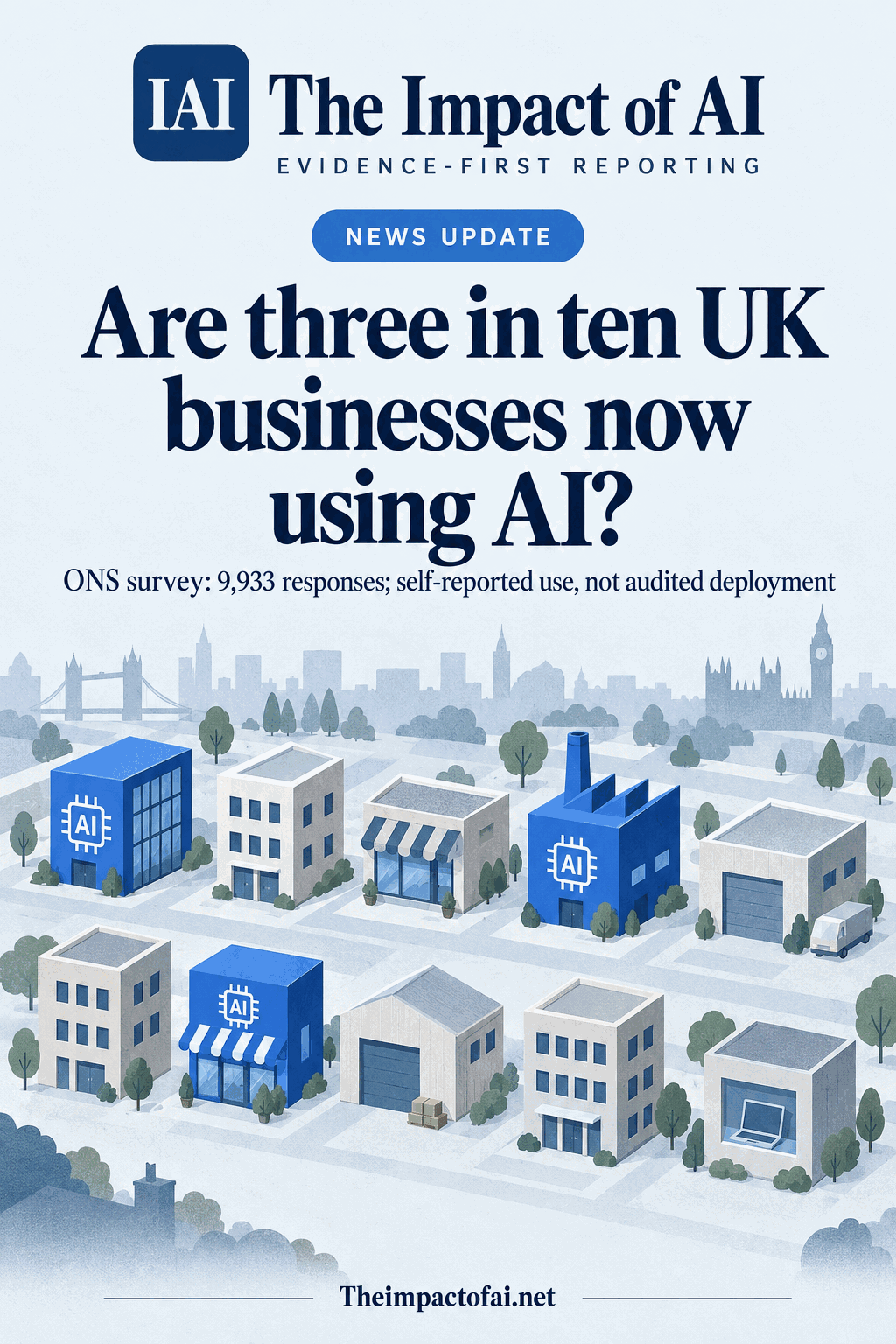
An ONS survey estimates that 30% of UK businesses used at least one AI technology in September 2026. The finding comes from 9,933 voluntary responses—a 25.7% response rate—and measures reported use, not audited deployment, productivity or job losses.
Editorial responsibility: The Impact of AI Editorial Desk · Report a factual concern
At a glance
- 1The ONS estimates that 30% of UK businesses used at least one AI technology in September 2026, up from 9% in September 2023 but broadly stable compared with June 2026.
- 2Wave 165 sampled 38,592 businesses and received 9,933 responses, a voluntary response rate of 25.7%; the published figures are weighted estimates, not a census or audit.
- 3Among businesses with 10 or more employees that reported using AI, 6% said AI had reduced headcount and fewer than 1% reported an increase. Those answers do not establish how many jobs changed or prove AI caused the change.
The direct answer: about 30%, on a self-reported survey measure
The Office for National Statistics estimates that 30% of UK businesses were using at least one artificial-intelligence technology in September 2026. That is roughly three in ten, up from 9% when the same question was asked in September 2023. The latest overall estimate was broadly stable compared with June 2026, however, so the release describes a longer-term rise rather than evidence of a sudden quarterly surge.
The figure answers a narrower question than the headline number can appear to. A business selected its own response to the survey; the ONS did not inspect software, expenditure, frequency of use or whether an AI system was embedded in a critical workflow. A firm whose staff occasionally use a text generator and a firm running AI throughout operations can both count as users. Thirty per cent is therefore an estimate of reported adoption across business units, not the share of workers using AI, the share of tasks automated or the value produced by the technology.[1]
How the ONS reached the estimate
The result comes from Wave 165 of the Business Insights and Conditions Survey. The questionnaire was live from 21 September to 4 October 2026. The ONS sampled 38,592 businesses and received 9,933 responses, producing a 25.7% voluntary response rate. It weights responses so that the estimates better represent the business population within scope, and it labels the release official statistics in development rather than fully accredited official statistics.
That denominator is central to interpretation. Nearly three quarters of sampled businesses did not respond. Weighting can correct for known differences such as size and industry, but it cannot guarantee that responding and non-responding firms have the same appetite for AI or interpret the question identically. The ONS also warns about sampling variability and non-sampling error. The bulletin provides confidence intervals in its datasets, while rounded headline percentages can conceal small changes that are not statistically meaningful.
Coverage is also narrower than the entire economy. The business survey excludes several activities, including agriculture, finance and insurance, public administration and defence, public health and education, and electricity and gas supply. It is not a household or worker survey. Comparing its 30% estimate directly with a measure from employees, public services or a differently defined business sample would mix populations and questions.[1]
Adoption differs by business size, technology and industry
Businesses with fewer than 10 employees dominate the UK business population, and the ONS estimates that 29% of them used at least one AI technology. Among businesses with 10 or more employees, the estimate was 38%, three percentage points higher than in June 2026 and 26 points higher than in September 2023. The size gap matters: a single percentage for all businesses should not be read as a description of the average workplace or the experience of the average employee.
Among businesses with 10 or more employees, text generation using large language models was the most commonly reported technology at 21%, followed by visual-content creation at 19%. These categories can overlap because a business may use more than one technology. They also describe types of use, not a hierarchy of business value. The release does not measure accuracy, time saved, return on investment, security controls or whether employees were authorised to use the tools they reported.
Information and communication businesses had the highest reported AI adoption, at 60%. That concentration is plausible because software, data and digital-service firms often have both relevant skills and accessible use cases. It also cautions against treating a national average as a benchmark for every sector. A manufacturer, retailer, accommodation provider and professional-services firm face different data, regulation, capital and workflow constraints.[1]
What the workforce answers show—and what they do not
The ONS asked AI-using businesses with 10 or more employees which occupational groups were most affected. Thirty-eight per cent selected administrative and clerical roles, while 24% selected creative or design roles. The answers indicate where respondents perceive effects; they do not say whether the effect was positive, negative or large, and a business could identify a role because its tasks changed without any job disappearing.
On headcount, 6% of AI-using businesses with 10 or more employees said AI adoption had reduced their number of employees, while fewer than 1% reported an increase. Most did not report a headcount effect. These are percentages of responding business units in the relevant subgroup, not percentages of jobs or people. The bulletin does not provide a count of posts lost, the timing of changes, a non-AI comparison group or a causal design that separates AI from demand, restructuring, wages and other business conditions.
For workers and managers, the practical implication is to investigate tasks before predicting occupations will vanish. Administrative work may be exposed because text drafting, summarising and information retrieval are easy to trial, yet adoption can also shift work toward checking, escalation, client contact and process redesign. Employers need workload and quality measures, incident reporting and worker consultation if they want to know whether a tool removes drudgery, moves risk or simply adds review work.[1]
What business leaders and policymakers can use now
The survey is useful as a repeated national signal. It shows that reported AI use has spread well beyond a small group of technology companies since 2023, while the latest overall result offers no evidence of an accelerating quarter-on-quarter rush. That combination argues for practical adoption support—skills, procurement, data governance and evaluation—rather than assuming access to a chatbot automatically produces productivity.
For small firms, the relevant policy problem may be less whether a tool is available than whether the business can test it safely and decide if it is worth the time. Guidance should distinguish low-risk drafting from decisions about customers, employees or credit. Training should cover verification, confidential data, intellectual property and fallback routes. Vendors and advisers should be asked for task-level evidence and total operating costs, not only demonstration performance.
For government, the result is a baseline to connect with stronger evidence. Business surveys can track reported use quickly; administrative data, longitudinal panels and controlled workplace studies are better suited to measuring investment, output, wages, employment and distributional effects. Publishing breakdowns and uncertainty consistently will matter as adoption becomes more heterogeneous and the boundary of what respondents call AI keeps moving.[1]
The evidence limits
This is a large and timely official survey, but participation was voluntary and the response rate was 25.7%. Non-response bias can remain after weighting. Self-report can also produce both over-counting and under-counting: respondents may label ordinary automation as AI, may not know which services contain AI, or may omit unofficial employee use. Changes in awareness can move the reported figure even if underlying deployment changes less.
The estimates describe businesses, not establishments, workers or economic output. They do not measure intensity, model quality, spending, productivity, revenue, working time, safety incidents or distribution of gains. The reported headcount answers are especially easy to overstate because the unit is a business response rather than a person and because no counterfactual identifies what would have happened without AI.
Finally, the exclusions limit generalisation. Finance, public administration, defence, public health, public education, agriculture and energy supply are not represented in this business estimate. These sectors include some of the most consequential and regulated AI uses. Separate evidence is needed before the national business percentage is applied to them.[1]
What would change the assessment
Confidence that business AI adoption is still accelerating would rise if subsequent waves show a sustained increase outside sampling uncertainty, especially across small firms and sectors currently below the information-and-communication industry. A stable questionnaire and published confidence intervals are essential; otherwise a wording or category change can be mistaken for economic change.
The stronger claim—that AI is improving business performance or causing net job change—requires different evidence. Linked longitudinal data should compare adopting and non-adopting firms before and after deployment, record the technology and task, and measure output, hours, pay, hiring, displacement and quality. Independent workplace studies should also test whether gains persist after implementation costs and human review are counted. Until those results exist, the ONS release supports a conclusion about reported reach, not effectiveness or causation.[1]
What this means for people
- Workers should read the occupational figures as reports of affected roles, not a forecast that 38% of administrative jobs will disappear.
- Small-business owners need low-cost ways to test whether an AI tool improves a specific task after checking errors, data risks and review time.
- Managers need measures of quality and workload alongside adoption counts so that apparent time savings do not conceal extra checking or risk transfer.
- Policymakers need separate evidence for excluded public and regulated sectors before applying the business estimate to them.
Global context
The ONS series offers a repeated national measure with unusually current fieldwork, but its 30% estimate should not be ranked directly against adoption figures from other countries unless the business population, sector exclusions, question wording, technology list and unit of analysis match. International comparisons are also shaped by business size, digital infrastructure, language, regulation and whether surveys count embedded AI or only tools respondents recognise. Comparable longitudinal surveys would help distinguish a genuine national adoption gap from a measurement gap.
What the evidence does not yet show
- The 9,933 responses were voluntary and represented 25.7% of the 38,592 sampled businesses, leaving possible non-response bias after weighting.
- AI use was self-reported and not independently audited; the survey does not measure frequency, intensity, authorisation or business value.
- The unit is a business response, not a worker, job, task, establishment or pound of output.
- Reported headcount effects are descriptive and cannot establish how many posts changed or whether AI caused the change.
- Several sectors are outside the survey coverage, including finance and insurance, public administration and defence, public health and education, agriculture and energy supply.
- Rounded estimates and sampling uncertainty mean small movements should not automatically be read as real changes.
What to watch next
- Whether later BICS waves show a sustained increase in reported AI use beyond sampling uncertainty.
- Task-level evidence linking particular deployments to output, quality, wages, hiring and working time.
- Adoption gaps by business size and industry, especially where governance or skills constraints are material.
- Longitudinal evidence that separates AI-related headcount change from wider demand and restructuring.
Living evidence record
Impact record IAI-1W7R0CP
Evidence stage
Announced
Confidence
Developing
Reporting basis
Source analysis
Independent or research support
Not yet
Record status
Monitoring
Last checked
8 October 2026
Source trail
1 direct source across 1 source type.
People impact
Documented in this record.
Uncertainty
Limits and next checks are explicit.
Stages describe the evidence available—not whether a technology is good or bad. See the public method.
Single-source reporting disclosure
This record analyses one direct source. It can establish what Office for National Statistics published or reported, but it is not independent corroboration of every performance claim or predicted outcome. The confidence label will change only when broader evidence is added.
Evidence trail
Sources used for this report
Links checked 8 October 2026
This report is labelled source analysis. We summarise and analyse source material in our own words; company statements remain attributed claims until independently supported. Translated summaries preserve the meaning of the original source and link back to it. Read our editorial standards.
Continue the story
Related reporting
Finance & Business
Can a UK AI start-up qualify for the new £3.1 million Frontier AI fund?
Innovate UK has opened a tightly scoped feasibility competition for UK SMEs. Projects must cost £150,000 to £250,000, last no more than three months and resolve a defined technical uncertainty; the published guidance warns that similar calls can have a 2% success rate.
7 min · 2 sources
Finance & Business
Could AI-linked debt become a financial-stability risk? The Bank of England widens its warning
The Financial Policy Committee says AI investment is exposing more investors and funding markets to a repricing. Its official record quantifies the build-out, but the underlying analyst estimates are not a stress test or forecast of losses.
5 min · 2 sources
Finance & Business
Bank of England puts AI into mainstream financial-stability monitoring
The Bank's July Financial Stability Report assesses AI through core decision-making, markets, service-provider concentration and the changing cyber threat environment.
2 min · 1 source
The Impact Brief
Keep the evidence trail, not the noise.
Get the most consequential AI developments with direct sources and clear limits.
Reader commentary
Add evidence, experience or a question
No account is required. Reader notes are published after a brief civility, relevance and safety check; disagreement is welcome.
Explore commentary across the portal →Published reader notes
0No published reader notes yet. You can start the evidence-led discussion above.
Prefer a private correction or response? Contact the newsroom.