Can a failing AI policy reveal what a tumour model is missing?
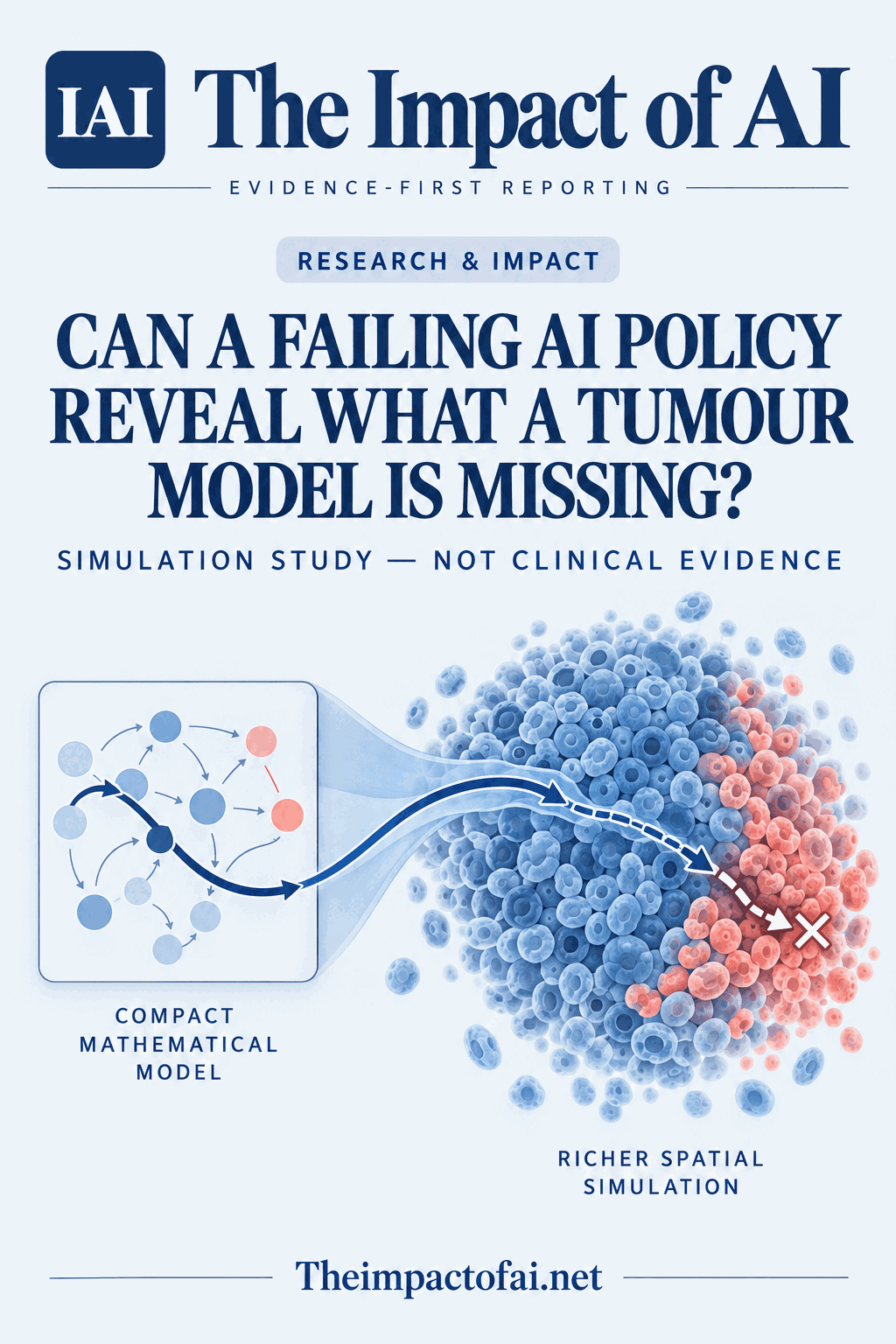
A peer-reviewed simulation study used the different ways ten reinforcement-learning policies failed when moved into a richer tumour model to identify missing spatial dynamics. It is a method for interrogating models—not clinical evidence for an AI-designed cancer treatment.
Editorial responsibility: The Impact of AI Editorial Desk · Report a factual concern
At a glance
- 1The researchers compared ten independently trained treatment policies in a compact mathematical training environment and a richer agent-based reference simulation, using transfer failures as clues to missing mechanisms.
- 2The reference simulation began with 3,584 cells and five resistant cells; each policy result was averaged over 50 runs, but every experiment remained in silico.
- 3The analysis identified a coupling between mechanically driven cell motion and position-dependent proliferation, then used it to improve transfer into the reference environment. That does not establish biological truth or patient benefit.
Research topic
AI-guided scientific discovery and adaptive therapy simulation
The direct answer: yes, inside this simulated test case
A policy that performs well in a simplified model but poorly in a richer simulation can reveal more than a disappointing score. In this study, researchers treated the pattern of failure as a diagnostic signal. By comparing ten independently trained reinforcement-learning policies across two simulated versions of tumour dynamics, they were guided toward spatial processes omitted from the compact training model: outward cell motion caused by mechanical interactions and faster proliferation nearer the tumour edge.
Adding those linked processes to the training environment improved how the next generation of policies transferred to the high-fidelity reference simulation. The result supports a specific methodological claim: diverse AI policies can help scientists find consequential gaps between a tractable model and a more detailed one. It does not show that the policies are safe treatment schedules, that the inferred mechanism operates with the same importance in a human tumour, or that any patient's cancer would be controlled for longer.[1]
Two models, deliberately unequal
The high-fidelity reference environment used PhysiCell and BioFVM to simulate individual cells, mechanical interactions, oxygen and drug diffusion inside a two-dimensional area measuring 2 by 2 millimetres. A tumour was grown from one cell for 15 simulated generations, producing 3,584 cells, after which five drug-resistant cells were placed part-way between the centre and surface. Treatment was an on-or-off exposure. Because oxygen and drug were concentrated toward the edge, location affected both growth and cell killing.
The efficient training environment was much simpler: two ordinary differential equations represented sensitive and resistant populations without explicitly representing every cell's position. Researchers calibrated four parameters using Bayesian inference, with eight parallel Markov-chain Monte Carlo chains, 2,000 tuning steps and 1,000 posterior draws in the final stage. The simplification is the point of the experiment—reinforcement learning needs many interactions—but it creates a realistic scientific problem: effective fitted parameters can reproduce broad trajectories while hiding the mechanism that makes a policy transferable.[1]
How policy failure became an instrument
Ten agents were trained independently in the compact model using proximal policy optimisation. Each received a history of total tumour burden and prior treatment decisions, not the hidden counts of sensitive and resistant cells. Agents chose full treatment or no treatment every 1.5 simulated generations. Training ran for five million environmental steps per agent, or roughly 100,000 episodes, encouraging policies to keep average tumour burden below its initial level for as long as possible.
The researchers then evaluated every policy in both environments and mapped the cross-environment performance difference. A policy's behaviour was compared through the divergence between its action probabilities and those of other policies. This group-relative analysis—called GRAPE—did not simply select the highest-scoring agent. It highlighted policies that looked similar in the training model yet separated sharply in the spatial reference model, giving researchers trajectories to inspect for missing causes.[1]
The measured result, with its denominator
As a basic check, fixed adaptive therapy that paused treatment below 50% of baseline tumour burden roughly doubled mean time to therapy failure compared with continuous treatment in both simulated environments. In the compact model, mean time to failure was 33.8 plus or minus 0.8 generations for adaptive therapy versus 15.3 plus or minus 0.2 for continuous therapy; in the reference simulation it was 30.2 plus or minus 2.9 versus 14.9 plus or minus 0.5. These are model generations, not days or survival estimates.
The ten trained agents averaged 149 plus or minus 19 generations before failure in the environment on which they trained—almost five times the fixed adaptive rule there—but their results varied after transfer. For policy evaluation, each value was averaged over 50 stochastic runs, and policy-level correlations used ten paired observations with bootstrap intervals based on 10,000 resamples. The small number of policies and dependence on one constructed reference model make this a proof of method, not a broad estimate of reliability.[1]
What the researchers added—and why it matters
Inspection of the failures pointed to two coupled spatial effects. Resistant clones nearer the tumour edge had better access to oxygen and therefore a different growth opportunity, while mechanical interactions could move cells outward. The augmented mathematical environment represented resistant-cell growth as a function of distance from the tumour front and added a position-dependent outward velocity. Parameters were fitted to measurements made in the reference simulation rather than asserted from the policy scores alone.
That distinction is important. The AI narrowed attention to behaviours worth explaining; a human researcher supplied the mechanistic interpretation and modified the equations. A laboratory could use the same logic to test whether a compact simulator is missing a critical interaction before trusting policies trained within it. The approach may also apply outside oncology wherever a fast model and a costly, more detailed model coexist. Its value is model criticism, not automated discovery without expert judgement.[1]
What this changes for people now
For patients and clinicians, there is no treatment recommendation here. The agents used simulated tumour burden and binary dosing, while the outcome—resistant cells reaching the starting tumour size—can be observed exactly only in a model. Real adaptive therapy involves toxicity, imperfect measurements, changing biology, multiple drugs, clinical decision intervals and outcomes that matter to patients. None of those complexities is validated by this experiment.
The nearer-term audience is scientists and developers building AI around mechanistic simulators. Rather than reporting only the best in-model performance, teams can preserve varied policies, test them against independent higher-fidelity environments and investigate structured failures. That practice could expose brittle assumptions earlier. It also creates work: reference models need independent justification, failure analysis must be reproducible, and a mechanism discovered in one simulator still requires experimental confirmation.[1]
Evidence limits and what would change the assessment
Both the training and reference environments were designed by researchers, so agreement with the richer simulation cannot establish that either captures a human tumour. The reference model is two-dimensional, begins from a highly specified population, uses five resistant cells, and represents treatment as binary exposure. Patient prostate-specific-antigen trajectories appear as context, but the new reinforcement-learning policies were not fitted to or prospectively tested in patients. The authors explicitly say reinforcement learning does not establish model completeness, causal truth or clinical efficacy.
Confidence would rise if the framework repeatedly identifies mechanisms that are then confirmed in independent simulators, three-dimensional cultures, animal models and prospectively specified experiments. For therapeutic relevance, policies would need validation across tumour types, resistance patterns, measurement error and toxicity constraints before any carefully governed clinical study. The work was supported by the German Research Foundation. One author later joined NEURA Robotics after the research was completed; the paper says the company had no role. Other authors declared no competing interests.[1]
What this means for people
- Patients should not interpret the simulated treatment schedules as medical advice or evidence of improved survival.
- Researchers gain a structured way to inspect why an apparently strong policy fails after model transfer.
- Clinical AI teams should require independent biological validation before turning a simulator result into a protocol.
Global context
Adaptive therapy is being explored internationally, but this paper's contribution is a general method for interrogating simplified training environments. Its claims travel more readily to other simulation-heavy fields than to routine oncology. Whether the framework works across laboratories, diseases and modelling traditions will matter more than the country in which this demonstration was produced.
What the evidence does not yet show
- All new results are from mathematical and agent-based simulations; there were no patients, animals or wet-lab experiments.
- The high-fidelity reference is still a researcher-designed two-dimensional model, not ground truth.
- Only ten independent reinforcement-learning policies formed the group-relative policy analysis.
- The simulated tumour began with 3,584 cells and five resistant cells under fixed modelling assumptions.
- The outcome called time to therapy failure is available directly in simulation and is not a clinical survival endpoint.
- Human interpretation supplied the mechanism; the AI did not autonomously establish causality.
What to watch next
- Replication across independently developed simulators and biological systems.
- Prospective tests in organoids or other experimental models before therapeutic claims.
- Whether policy-diversity methods find useful omissions beyond this one tumour example.
- Robustness to noisy observations, toxicity constraints and clinically realistic decision intervals.
Living evidence record
Impact record IAI-1H0TGLF
Evidence stage
Studied
Confidence
Supported
Reporting basis
Source analysis
Independent or research support
Present
Record status
Monitoring
Last checked
8 October 2026
Source trail
1 direct source across 1 source type.
People impact
Documented in this record.
Uncertainty
Limits and next checks are explicit.
Stages describe the evidence available—not whether a technology is good or bad. See the public method.
Single-source reporting disclosure
This record analyses one direct source. It can establish what npj Artificial Intelligence published or reported, but it is not independent corroboration of every performance claim or predicted outcome. The confidence label will change only when broader evidence is added.
Evidence trail
Sources used for this report
Links checked 8 October 2026
This report is labelled source analysis. We summarise and analyse source material in our own words; company statements remain attributed claims until independently supported. Translated summaries preserve the meaning of the original source and link back to it. Read our editorial standards.
Continue the story
Related reporting
Science & Research
Microrobot navigation can be trained in minutes in new study; patient use remains untested
A peer-reviewed Hong Kong-led paper reports under-ten-minute policy training across thousands of simulated vessel environments and controlled robot tests. It does not show a clinical procedure or patient benefit.
4 min · 2 sources
Science & Research
Can self-supervised AI help neutrino detectors learn from fewer labelled events?
A Nature Machine Intelligence paper reports strong low-label performance across simulated detector tasks. The million-event dataset is substantial, but it models a proposed detector and cannot substitute for validation on real collisions.
5 min · 2 sources
Science & Research
What did first-day verification find in OpenAI’s mass maths release?
OpenAI’s repository now lists 719 AI-produced manuscripts, down from 722 after a sign error invalidated three linked papers. Fourteen more received proof repairs, and 300 of 719 top-line results have formalizations—evidence that publication volume and verified mathematical knowledge are not the same thing.
7 min · 3 sources
The Impact Brief
Keep the evidence trail, not the noise.
Get the most consequential AI developments with direct sources and clear limits.
Reader commentary
Add evidence, experience or a question
No account is required. Reader notes are published after a brief civility, relevance and safety check; disagreement is welcome.
Explore commentary across the portal →Published reader notes
0No published reader notes yet. You can start the evidence-led discussion above.
Prefer a private correction or response? Contact the newsroom.