Can AI flag sepsis risk early in trauma intensive care?
Models using the first 24 hours of records moderately separated trauma patients who developed sepsis over the next 48 hours in one US intensive-care database. The best AUROC was 0.734, with sensitivity below 69%; this supports further surveillance research, not autonomous alerts or treatment.
Editorial responsibility: The Impact of AI Editorial Desk · Report a factual concern
At a glance
- 1The retrospective cohort contained 4,043 adult trauma ICU patients in MIMIC-IV; 450, or 11.13%, developed incident Sepsis-3 between hours 24 and 72.
- 2The strongest discrimination came from polynomial and linear support-vector machines, with AUROCs of 0.734 and 0.733; sensitivity across models was 0.589 to 0.689 and specificity 0.650 to 0.707.
- 3The study used a held-out internal evaluation set and bootstrap confidence intervals, but no external hospital or prospective workflow. The authors position the models for surveillance support, not autonomous clinical decisions.
Research topic
Machine-learning prediction at ICU hour 24 of incident Sepsis-3 during hours 24 to 72 among adult trauma patients
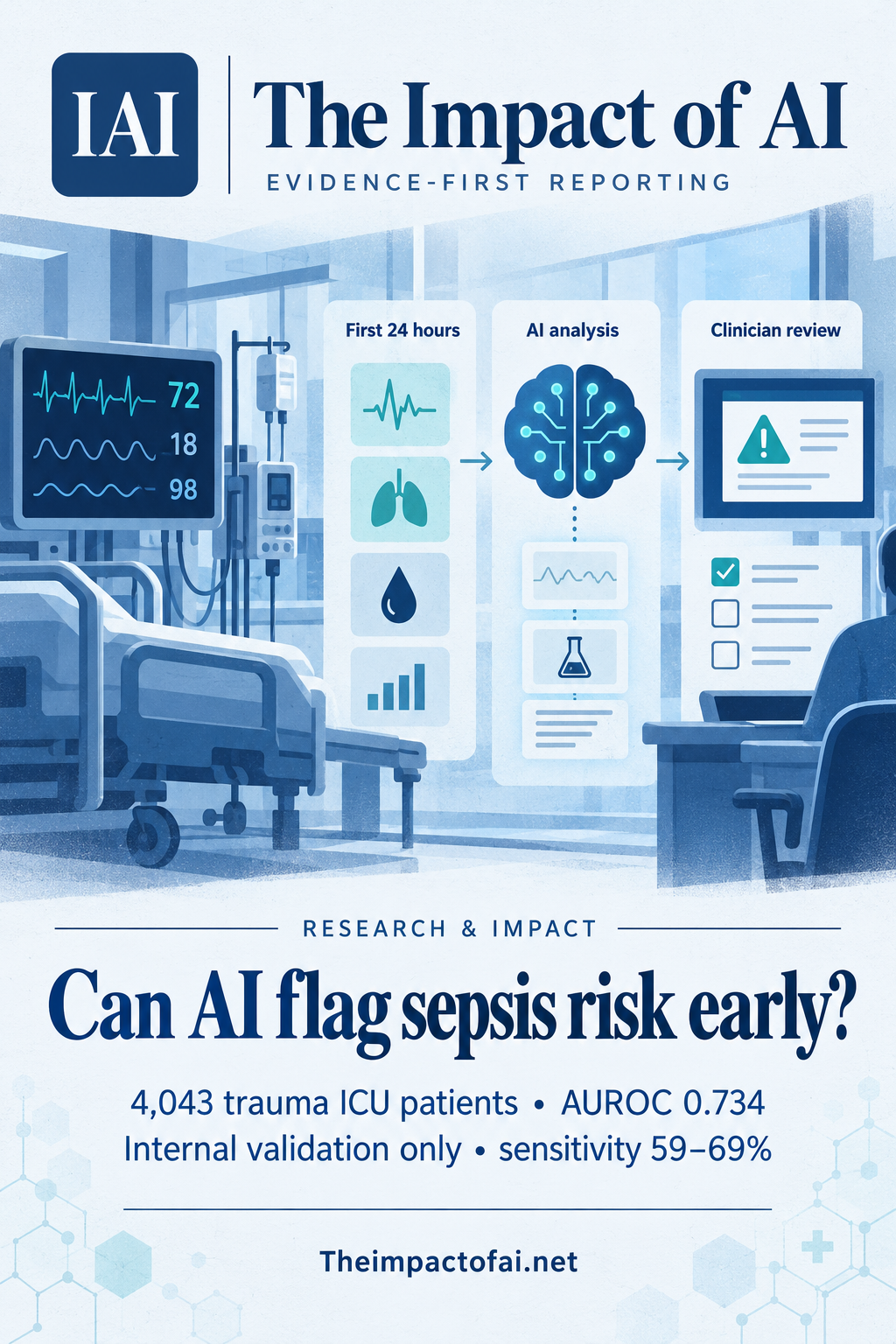
The direct answer: a moderate risk signal, with too many misses for autonomous use
A machine-learning model could identify a higher-risk group of trauma patients after their first day in intensive care, but the evidence does not support handing sepsis decisions to software. GuanDong Huang and colleagues studied 4,043 adult trauma admissions in the MIMIC-IV database. Four hundred and fifty patients, 11.13%, developed incident Sepsis-3 between 24 and 72 hours after ICU admission. The best-performing polynomial support-vector machine produced an area under the receiver operating characteristic curve, or AUROC, of 0.734 with a 95% confidence interval from 0.680 to 0.788. A linear support-vector machine was almost identical at 0.733, with a 95% interval from 0.678 to 0.785.
That is moderate discrimination, not a dependable bedside alarm. Across the evaluated models, sensitivity ranged from 0.589 to 0.689 and specificity from 0.650 to 0.707. In plain terms, a chosen operating point could miss a meaningful share of patients who later meet the sepsis definition while also flagging people who will not. The system might help a clinical team decide where to intensify surveillance, but it cannot diagnose infection, determine treatment or safely replace repeated human assessment.[1]
How the study kept the prediction window separate from the outcome
The design used information recorded during the first 24 hours of intensive care to make a prediction at hour 24. The target was new Sepsis-3 during the following 48 hours, from hour 24 through hour 72. Adults who already had sepsis or suspected infection during the first day were excluded, as were ICU stays shorter than 24 hours. This temporal separation is important: a model that learns from actions taken after clinicians suspect sepsis can appear accurate while merely detecting the care response.
The researchers also excluded treatment variables and Sequential Organ Failure Assessment, or SOFA, scores from the model inputs to reduce target leakage. Feature selection occurred inside each training fold and retained 19 predictors. Nine configurations spanning seven algorithm families were trained without synthetic oversampling, then assessed on a held-out internal evaluation set. The paper reports 1,000-bootstrap confidence intervals and uses SHAP values to describe which measurements most influenced predictions. This is a more defensible pipeline than selecting features once on the full dataset, although every stage still draws from one underlying source database.[1]
The model beat general severity scores, but that is not the same as clinical benefit
The polynomial and linear support-vector machines outperformed two broad ICU severity comparators: SOFA produced an AUROC of 0.655 and the Simplified Acute Physiology Score II, or SAPS II, 0.668. The reported DeLong comparisons were statistically significant at p below 0.01. That supports the narrower claim that a trauma-specific pattern learned from early physiology and laboratory data discriminated the study outcome better than these general scores in the internal evaluation.
It does not show that an alert improves care. SOFA and SAPS II were not designed solely as early sepsis-prediction tools, and the study did not randomise clinicians to receive or withhold model outputs. There is no measurement of antibiotic timing, diagnostic testing, length of stay, organ failure, mortality, unnecessary treatment or alert fatigue. A statistically better AUROC can still translate into an unusable workflow if alerts arrive too often, cluster after clinicians have already noticed deterioration or encourage treatment of people without infection.[1]
Calibration and net benefit are useful, but local prevalence matters
Gradient boosting had the strongest reported calibration, with a calibration slope of 0.946, an intercept of minus 0.073 and a Brier score of 0.092. Calibration asks whether predicted probabilities correspond to observed frequencies, not only whether higher-risk patients rank above lower-risk patients. Decision-curve analysis indicated positive net benefit across threshold probabilities from 2% to 35%. These are welcome checks because a model used to trigger closer observation needs probabilities that a hospital can connect to an explicit action threshold.
Both results can change when the patient mix, coding practice, laboratory equipment or sepsis prevalence changes. MIMIC-IV contains de-identified records from Beth Israel Deaconess Medical Center in Boston, whereas the research team is based at Shanghai Sixth People's Hospital. A hospital with different trauma pathways may observe different baseline risk and different measurement patterns. Recalibration may be required even if ranking performance transfers, and a threshold that is sensible for an inexpensive chart review may be unsafe for an intervention carrying antibiotic, imaging or staffing costs.[1]
What the influential variables mean—and do not prove
The most influential predictors in the SHAP analysis included maximum glucose, mean oxygen saturation, maximum temperature, mean respiratory rate, minimum haemoglobin and minimum platelet count. These are clinically plausible signals of physiological stress, respiratory compromise, inflammation or injury severity. Their importance can help reviewers test whether the model is using available bedside information rather than an obvious proxy for the future outcome.
SHAP does not establish that changing any one variable will prevent sepsis, nor does it turn a complex model into a causal explanation. Trauma, transfusion, surgery and pre-existing illness can affect the same measurements. A useful external study should report performance by injury type, age, sex, race and ethnicity where responsibly available, alongside missingness, transfer status and care setting. It should also examine whether repeated predictions add value over ordinary trends already visible to clinicians.[1]
The evidence needed before a bedside rollout
The next step is a locked-model external validation across hospitals, including sites outside the United States, with prespecified thresholds and clear accounting of missing data. A prospective silent deployment could then measure alert volume, lead time beyond clinician recognition, subgroup errors and changes in calibration without affecting care. Only after that should an interventional trial test whether a human-reviewed alert improves patient outcomes without increasing unnecessary antibiotics or diagnostic burden.
The authors describe the system as support for risk-based infection surveillance rather than autonomous decision-making and explicitly call for external validation. The work was funded by a hospital-level research project of Shanghai Sixth People's Hospital, and the authors declare no competing interests. For patients and families, the near-term value is therefore a more focused question for clinical research: can a moderate statistical signal create useful extra observation time? The paper does not yet answer whether that time exists in practice or improves recovery.[1]
What this means for people
- A reliable signal could focus observation on trauma patients at higher risk during a time-critical window.
- False negatives could create false reassurance, while false positives could add tests, antibiotics and alarm burden.
- Clinicians must retain authority over diagnosis and treatment until prospective evidence shows benefit.
Global context
The records came from one Boston academic hospital, while the authors are based in Shanghai. That cross-border analysis does not itself establish transportability to Chinese hospitals or other health systems. Trauma epidemiology, laboratory practice, staffing and sepsis coding vary widely. A reusable model would need independent validation and locally appropriate thresholds in every intended setting.
What the evidence does not yet show
- The retrospective cohort came from one US critical-care database and was evaluated only internally.
- The strongest AUROC was 0.734, and model sensitivity ranged from 58.9% to 68.9%, leaving substantial potential for missed cases.
- The outcome was an electronic Sepsis-3 definition, not independent adjudication of every infection or treatment decision.
- The comparison with SOFA and SAPS II does not substitute for comparison with an existing clinical sepsis workflow.
- No prospective alerting, clinician response, patient outcome, workload or cost was tested.
What to watch next
- External validation across hospitals, countries, injury types and care pathways using a frozen model.
- Prospective measurement of useful lead time beyond clinicians' existing recognition.
- Alert volume, subgroup performance, recalibration needs and missing-data failures.
- Randomised evidence on patient outcomes, unnecessary treatment and staff workload.
Living evidence record
Impact record IAI-09XF8BV
Evidence stage
Studied
Confidence
Supported
Reporting basis
Source analysis
Independent or research support
Present
Record status
Monitoring
Last checked
8 October 2026
Source trail
1 direct source across 1 source type.
People impact
Documented in this record.
Uncertainty
Limits and next checks are explicit.
Stages describe the evidence available—not whether a technology is good or bad. See the public method.
Single-source reporting disclosure
This record analyses one direct source. It can establish what Scientific Reports published or reported, but it is not independent corroboration of every performance claim or predicted outcome. The confidence label will change only when broader evidence is added.
Evidence trail
Sources used for this report
Links checked 8 October 2026
This report is labelled source analysis. We summarise and analyse source material in our own words; company statements remain attributed claims until independently supported. Translated summaries preserve the meaning of the original source and link back to it. Read our editorial standards.
Continue the story
Related reporting
Health & Life Sciences
Can clinical AI recognise when the patient record does not support an answer?
A new clinical-agent benchmark raises a practical question for health systems: can an assistant explain what the record cannot establish? Our analysis examines evidence, local testing and the burden on staff.
6 min · 2 sources
Health & Life Sciences
Is operating-room AI ready for clinical use?
Not on the published evidence yet. A peer-reviewed scoping review screened 3,020 records but found only one completed feasibility study with five analysed patients; four larger prospective studies had no results posted.
8 min · 1 source
Health & Life Sciences
Can AI estimate survival after a Parkinson’s diagnosis?
A peer-reviewed Chinese registry study compared four survival models in 3,148 people with Parkinson’s disease. A transparent Cox model matched the machine-learning alternatives, but validation stayed within the same registry and no clinical-impact study was performed.
9 min · 2 sources
The Impact Brief
Keep the evidence trail, not the noise.
Get the most consequential AI developments with direct sources and clear limits.
Reader commentary
Add evidence, experience or a question
No account is required. Reader notes are published after a brief civility, relevance and safety check; disagreement is welcome.
Explore commentary across the portal →Published reader notes
0No published reader notes yet. You can start the evidence-led discussion above.
Prefer a private correction or response? Contact the newsroom.