Can AI identify a validated blood-pressure monitor?
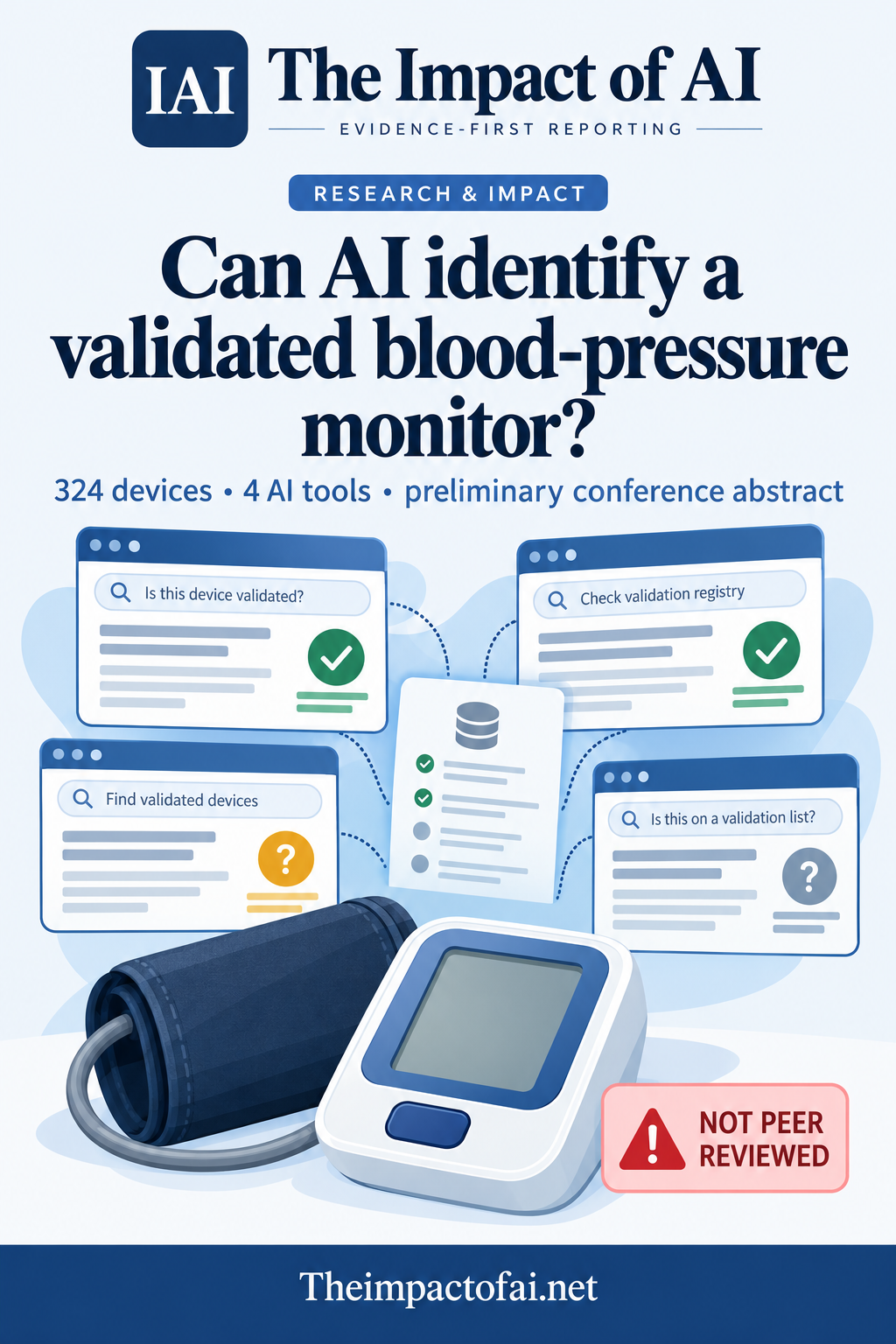
A preliminary study tested 324 devices with four AI search tools and found materially different answers across tools, prompts and repeat checks. The results point people back to independent registries, but the conference abstract has not been peer reviewed and the full analysis is not yet public.
Editorial responsibility: The Impact of AI Editorial Desk · Report a factual concern
At a glance
- 1Researchers tested 324 home blood-pressure monitors—145 validated and 179 not validated—with four AI search tools and three prompt styles during April and May 2026.
- 2Reported correct-answer ranges were 86%–91% for the best-performing tool and about 63%–83% for the other three; all four were less reliable at recognising validated devices than unvalidated ones.
- 3This is a conference abstract, not a peer-reviewed paper. The public release does not provide confusion matrices, confidence intervals, full repeat-test denominators, model versions or all funding and conflict disclosures.
Research topic
Whether consumer-facing AI search tools can correctly identify home blood-pressure monitors listed in independent validation registries
The direct answer: use the registry, not the chatbot
No consumer should rely on a general AI answer to decide whether a home blood-pressure monitor has passed recognised validation testing. In a preliminary study released by the American Heart Association on 8 October, four popular AI search tools gave materially different answers when asked about 324 devices. The best reported range was 86% to 91% correct depending on the wording, while the other three tools ranged from roughly 63% to 83%. Even the strongest result leaves avoidable errors in a task for which public specialist registries already exist.
The practical route is simpler: check the device model directly in an independent validation registry, such as ValidateBP, STRIDE BP or the Hypertension Canada list, and discuss the choice and cuff fit with a clinician when appropriate. A chatbot may help locate a registry, but it should not replace the registry entry. The new results are also preliminary. They come from moderated-poster abstract TH125 at Hypertension Scientific Sessions 2026, not from a peer-reviewed full paper.[1][2]
What the researchers tested
The team assembled 324 monitors in Canada during April and May 2026. Of these, 145 were classed as validated and 179 as not validated. The set drew from three validation registries, a list of known non-validated products and leading cuff monitors sold through Amazon in Canada, Australia and the United States. Each model was checked with Google Gemini, Microsoft Copilot, OpenAI ChatGPT and Perplexity.
The researchers used three question styles for each device: an ordinary consumer-style question about validation status; a more directed request to consult a named registry; and a detailed version demanding a one-word answer. That design tests a real usability problem. People do not all ask the same question, and an answer that changes materially after a small wording adjustment is not dependable for health-product verification. A subset of mixed results was also repeated on another day or computer, where the release says answers often changed again.[1]
Accuracy alone hides the clinically important error
The study found that every tool was less accurate at recognising validated monitors than at rejecting unvalidated ones. That asymmetry matters. A false claim that an unvalidated device is validated could steer a person toward unreliable readings. But a false claim that a properly validated device is not validated can also waste money, undermine trust and push people away from a sound product. The useful evaluation is therefore not only total accuracy: it is the separate count of false reassurance and false rejection.
The public release does not provide the complete confusion matrix, uncertainty intervals or model-by-model denominator for every prompt. Nor does it report whether errors clustered around spelling variants, regional model names, discontinued products or inaccessible registry pages. Those missing details prevent a precise estimate of how many mistakes a person should expect from a particular tool today. They also make the quoted percentage ranges unsuitable for ranking products as if this were a permanent league table.[1]
Why a correct cuff matters to people
Home blood-pressure readings influence whether people seek care, how clinicians interpret treatment and whether medicine appears to be working. A monitor can look professional and still lack adequate independent validation. Technique also matters: cuff size, positioning, rest, repeated readings and an appropriate schedule all affect the result. Device validation is therefore necessary but not sufficient for trustworthy home monitoring.
The American Heart Association says more than 125 million US adults have high blood pressure and only about one in four has it controlled to its stated target. At that scale, even a small verification error can reach many people. The safest role for consumer AI is to guide someone toward authoritative records and clear measurement instructions while preserving the original source—not to issue an unsupported yes-or-no verdict that obscures uncertainty.[1]
What remains unproven
The abstract has not been peer reviewed, and the presentation was scheduled for later on 8 October. The public release identifies the device denominator and broad test procedure, but the full protocol, prompts, response-scoring rules, adjudication process and analysis are not yet available. Model versions and retrieval settings are particularly important because consumer AI services change frequently, sometimes without a stable public version identifier.
The study also did not test whether people followed the answers, bought a device, measured blood pressure more accurately or received better care. Private browsing was used to reduce carry-over, but the researchers acknowledge it could not fully prevent systems from learning or changing. A snapshot of four services in spring 2026 should therefore be treated as a warning about verification reliability, not as a durable estimate of any provider's current performance.[1][2]
The evidence that would change the assessment
Confidence would rise with a peer-reviewed manuscript containing prespecified prompts, a dated list of exact model versions, blinded scoring, confusion matrices, uncertainty intervals and publicly reproducible device labels. Researchers should repeat the test in several countries and languages, distinguish exact product variants and report how often each tool cites the correct registry. A longitudinal audit would show whether updates improve reliability or merely change which devices are misclassified.
A subsequent user study should ask whether people can reach the correct registry faster with or without AI, whether citations survive the handoff and whether incorrect answers alter purchasing or care decisions. Until then, the result supports a narrow action: verify the model number at the original registry, keep human clinical judgement in the loop and treat conversational confidence as presentation—not evidence.[1]
What this means for people
- A confident but wrong answer could encourage use of an unvalidated monitor or rejection of a sound one.
- Independent registries give patients and clinicians a direct check that does not depend on a chatbot's interpretation.
- People still need the correct cuff size, measurement technique and clinical interpretation even when a device is validated.
Global context
Validation lists and product names differ across markets, while the tested services and study assembly centred on Canada with products sold in Canada, Australia and the United States. The reliability question is global, but performance cannot be assumed to transfer across languages, regional catalogues or AI versions. Any replication should preserve exact model numbers and local registry standards.
What the evidence does not yet show
- The work is a conference research abstract and has not been peer reviewed or published as a full manuscript.
- The public release omits full confusion matrices, uncertainty intervals, prompts, model versions, adjudication details and repeat-test denominators.
- Four services were tested during April–May 2026; rapidly changing systems may perform differently later.
- The study assessed answers about device validation, not measurement accuracy, user behaviour, diagnosis, treatment or patient outcomes.
- The product sample and registry access were assembled in Canada and may not represent every market or language.
What to watch next
- Publication of the full abstract, disclosures and a peer-reviewed manuscript.
- Independent replication with fixed model versions and publicly reproducible prompts and labels.
- Separate false-positive and false-negative rates for validated and unvalidated devices.
- User studies measuring whether citations lead people to the correct registry and safer monitoring choices.
Living evidence record
Impact record IAI-0E3HQEW
Evidence stage
Observed
Confidence
Supported
Reporting basis
Source analysis
Independent or research support
Not yet
Record status
Monitoring
Last checked
8 October 2026
Source trail
2 direct sources across 1 source type.
People impact
Documented in this record.
Uncertainty
Limits and next checks are explicit.
Stages describe the evidence available—not whether a technology is good or bad. See the public method.
Related-source reporting disclosure
This record analyses 2 linked source records around the same underlying development. The extra records add method, date or context, but they do not by themselves constitute independent replication of every performance claim or predicted outcome.
Evidence trail
Sources used for this report
Links checked 8 October 2026
This report is labelled source analysis. We summarise and analyse source material in our own words; company statements remain attributed claims until independently supported. Translated summaries preserve the meaning of the original source and link back to it. Read our editorial standards.
Continue the story
Related reporting
Health & Life Sciences
Can clinical AI recognise when the patient record does not support an answer?
A new clinical-agent benchmark raises a practical question for health systems: can an assistant explain what the record cannot establish? Our analysis examines evidence, local testing and the burden on staff.
6 min · 2 sources
Health & Life Sciences
On-premise medical agents trade cloud scale for clinical control
A Nature Medicine analysis examines running medical AI agents inside a health organisation's own infrastructure to improve data control, reliability and integration with clinical systems.
2 min · 1 source
Health & Life Sciences
US, Canadian and UK regulators align around lifecycle practice for medical AI
Updated good-machine-learning-practice principles from the FDA, Health Canada and the MHRA emphasise representative data, human-AI team performance and monitoring across the full device lifecycle.
2 min · 1 source
The Impact Brief
Keep the evidence trail, not the noise.
Get the most consequential AI developments with direct sources and clear limits.
Reader commentary
Add evidence, experience or a question
No account is required. Reader notes are published after a brief civility, relevance and safety check; disagreement is welcome.
Explore commentary across the portal →Published reader notes
0No published reader notes yet. You can start the evidence-led discussion above.
Prefer a private correction or response? Contact the newsroom.