Can a polymer AI predict beyond its simulations?
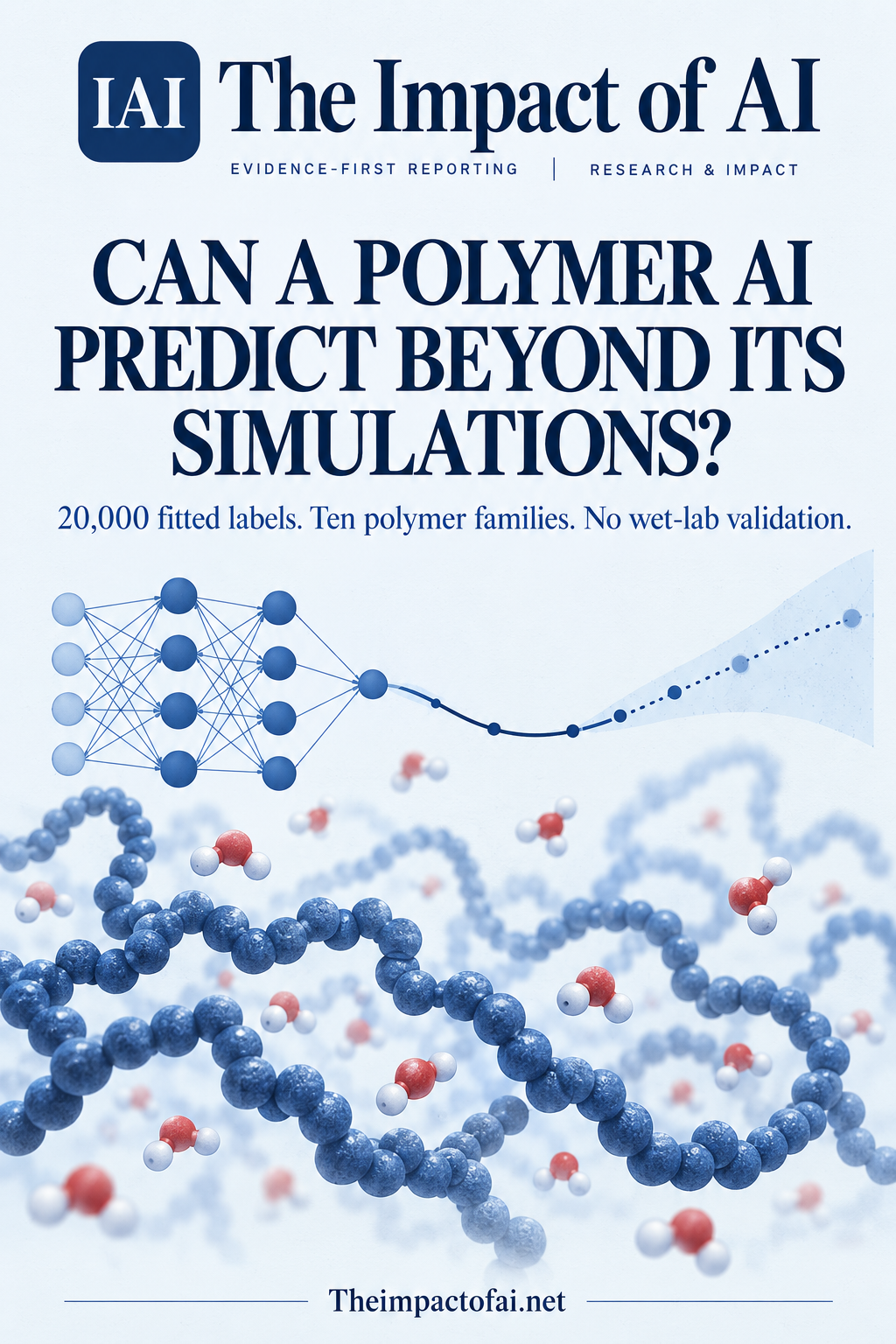
AdaptDelivery predicts polymer size and solvent-accessible surface area through neural networks trained on 20,000 values generated from fitted molecular-dynamics curves. The low errors show the networks learnt those curves; they do not validate new polymer chemistry, wet-lab delivery or clinical performance.
Editorial responsibility: The Impact of AI Editorial Desk · Report a factual concern
Research topic
Whether neural networks trained on fitted molecular-dynamics outputs can provide fast estimates of radius of gyration and solvent-accessible surface area for ten polymer families
At a glance
- 1The underlying molecular-dynamics work covered ten polymers in explicit water, using 3 nanoseconds of equilibration followed by 200 nanoseconds of production simulation for selected chain lengths up to 200 monomers.
- 2Power-law functions fitted to those simulation outputs were evaluated up to 1,000 monomers to create 20,000 labelled pairs, then randomly split 80:10:10 for neural-network training, validation and testing.
- 3Very low held-out error mainly demonstrates that the networks reproduced the fitted curves. The study did not validate unseen polymer chemistries, other solvents, synthesis, toxicity, cargo release or delivery outcomes.
The Impact Brief
Keep the evidence trail, not the noise.
Get the most consequential AI developments with direct sources and clear limits.
Living evidence record
Impact record IAI-0Q5OUGL
Evidence stage
Studied
Confidence
Supported
Reporting basis
Source analysis
Independent support
Present
Record status
Monitoring
Last checked
4 October 2026
Source trail
1 direct source across 1 source type.
People impact
Documented in this record.
Uncertainty
Limits and next checks are explicit.
Stages describe the evidence available—not whether a technology is good or bad. See the public method.
Single-source reporting disclosure
This record analyses one direct source. It can establish what Scientific Reports published or reported, but it is not independent corroboration of every performance claim or predicted outcome. The confidence label will change only when broader evidence is added.
AdaptDelivery turns a simulation workflow into a public tool
Polymer researchers often care about radius of gyration, which describes the spatial spread of a chain, and solvent-accessible surface area, which describes how much of the structure is exposed to surrounding solvent. Molecular-dynamics simulation can estimate both, but long chains and many candidate materials make repeated calculations expensive. The Romanian team built AdaptDelivery to return estimates quickly through an online interface for a defined group of synthetic and natural polymers.
The system combines molecular dynamics, curve fitting and artificial neural networks. Users choose one of the supported polymers and enter chain length; the current model uses that length as its only numerical input. It predicts radius of gyration and surface area for the selected family. The platform may be convenient for exploration, but its evidential chain matters: most machine-learning labels were not independent simulations or experiments. They were values calculated from smooth mathematical functions fitted to the initial simulation results.[1]
Ten polymer families anchor the model
The study covers ten named polymer families, including polyethylene, polyethyleneimine, polyethylene oxide, polyacrylamide, related acrylamide and vinyl systems, PNIPAAm-related structures and three natural-polymer families labelled GUAI, SYR and PHP in the paper. Simulated chain lengths included 5, 8, 10, 12, 16, 25, 50, 100, 150 and 200 monomers where applicable. The molecular-dynamics setup used the CHARMM force field and explicit water.
Each system underwent 3 nanoseconds of equilibration followed by a 200-nanosecond production run. That is a substantial computational foundation for a platform prototype, yet it remains a particular force field, solvent, temperature and simulation protocol. Conformations can depend on initial conditions, protonation, tacticity, branching, salt concentration and other chemistry not represented by chain length alone. The study does not show that its selected trajectories exhaust those possibilities.
The team fitted power-law relations to the tabulated simulation-derived property values up to 200 monomers. It then evaluated each fitted function at chain lengths extending to 1,000 monomers, producing 20,000 input-label pairs. Those pairs were randomly divided into 80% training, 10% validation and 10% testing. Consequently, many long-chain targets are extrapolations of the fitted equation rather than fresh molecular-dynamics calculations.[1]
The neural networks learnt a deliberately smooth target
The radius-of-gyration network used one hidden layer with 16 neurons. The surface-area network used three hidden layers with 64, 32 and 16 neurons. Both used rectified-linear activations, the Adam optimiser, batches of 128 and mean absolute error as the training objective. Reported test errors were very small relative to average target values; the largest relative error highlighted by the paper was about 0.14% for the polyethylene-oxide surface-area model.
That accuracy is real for the labelled dataset but easier to interpret once the label-generation step is visible. A neural network trained and tested on random points from one smooth fitted power law is being assessed mainly on its ability to approximate that function. Because nearby chain lengths follow the same curve and all splits share the same construction, a tiny random-test error does not demonstrate discovery of new polymer behaviour. In some cases, the fitted equation itself may be the more transparent predictor.
The paper overlays some molecular-dynamics points and compares polyethyleneimine radius predictions with previously published simulation values. For example, earlier work reported approximately 1.23 ± 0.12 nanometres for a 50-mer and 0.97 ± 0.16 nanometres for a 20-mer; AdaptDelivery returned 12.83 and 8.659 ångströms respectively. That gives a useful consistency check, though it is still comparison with related simulation—not blinded wet-lab measurement or broad external validation.[1]
Prediction beyond 200 monomers is mathematical extrapolation
The interface supports chain lengths beyond the directly tabulated simulation range, up to 1,000 monomers. Those predictions can be useful as hypotheses, but they inherit the assumption that the fitted scaling relation continues. Real long chains may change conformation, aggregate, entangle or interact with solvent in ways a short-range fit does not capture. Randomly holding out fitted points cannot test those failure modes because every held-out label follows the same assumed continuation.
A more demanding evaluation would withhold entire chain-length ranges, then compare extrapolations with newly run molecular-dynamics trajectories. Better still, independent teams could simulate the same polymers with alternative force fields and starting conformations. Uncertainty should widen outside the observed range rather than remain visually equivalent to interpolation. If the platform is used to prioritise experiments, it should also say when a query falls far from the evidence supporting that polymer family.[1]
Drug delivery is a motivation, not a tested outcome
The publication discusses applications in drug and gene delivery because polymer size and exposed surface can affect interactions with cargo, cells and biological fluids. But the experiments did not measure encapsulation, release, targeting, uptake, immune response, toxicity, manufacturing quality or therapeutic benefit. No patients, animals or wet-lab delivery studies were included. The online name should therefore not be mistaken for evidence that a predicted polymer will deliver a treatment successfully.
For materials scientists, a rapid property estimate may help narrow an early search or teach scaling relationships. For experimental teams, it is a starting point for simulation and laboratory planning rather than a selection authority. A one-input model cannot distinguish different stereochemistry, branching, end groups or environmental conditions unless those distinctions are encoded through the selected polymer category and training data. Users should confirm whether their material and solvent really match the supported case.
The current calibration is for water. The authors note that other solvents would require solvent-specific training. That is an important boundary because polymer conformation can change substantially across environments. Biological delivery adds further complexity through salts, proteins, membranes and pH. A platform intended for those settings would need new simulation and experimental evidence rather than extending the water-trained curves by analogy.[1]
What would show genuine generalisation
Confidence would rise if the developers locked the models and predicted new molecular-dynamics runs that were never used to fit the power laws, especially for long chains and difficult intermediate ranges. An evaluation on completely unseen polymer chemistries would test whether the approach learns transferable molecular structure rather than maintaining separate curve approximators. Richer inputs—such as graph representations, solvent conditions and temperature—could support that broader question, but would require much more diverse training data.
The decisive evidence for practical materials work is prospective experiment: synthesised polymers with independently measured structural properties and preregistered comparison rules. Delivery claims would require separate assays for cargo loading, release, toxicity and relevant biological outcomes. The paper acknowledges Romanian and European public funding, including project 61TE and the Romanian Hub for Artificial Intelligence, and the authors declare no competing interests. For now, AdaptDelivery is best read as an accessible surrogate for fitted simulation trends, not a validated discovery engine or clinical-delivery predictor.[1]
What this means for people
- Researchers may gain a quick exploratory estimate, but the tool should not replace simulation or laboratory validation for consequential material choices.
- Patients and clinicians should not interpret the platform name as evidence of safe or effective drug or gene delivery.
- Clear warnings about extrapolation and supported solvents can help users avoid treating a smooth prediction as measured chemistry.
Global context
The platform was developed by Romanian universities and research institutes with Romanian and European public funding and is accessible online. Polymer simulation and delivery research are international, but force fields, experimental protocols and available materials vary. General use requires independent evidence across laboratories and conditions, especially before predictions influence biomedical research or regulated products.
What the evidence does not yet show
- The 20,000 machine-learning labels were generated from fitted power-law functions; they were not 20,000 independent simulations or experiments.
- Random train, validation and test splits all draw from the same smooth fitted functions, making the reported test task close to interpolation.
- Predictions up to 1,000 monomers extend beyond the directly tabulated molecular-dynamics chain lengths up to 200 monomers.
- The current model uses chain length as its only numerical input and is calibrated to explicit-water simulations for ten supported polymer families.
- No wet-lab structure, synthesis, toxicity, drug release, delivery efficiency, animal or clinical outcome was tested.
What to watch next
- Locked predictions compared with newly run molecular-dynamics trajectories outside the fitted range.
- External validation across force fields, starting conformations, solvents and independent research groups.
- Models tested on unseen polymer chemistries using structural descriptors rather than family-specific curves alone.
- Prospective laboratory measurements before the tool informs delivery-material selection.
Evidence trail
Sources used for this report
Links checked 4 October 2026
This report is labelled source analysis. We summarise and analyse source material in our own words; company statements remain attributed claims until independently supported. Translated summaries preserve the meaning of the original source and link back to it. Read our editorial standards.
Continue the story
Related reporting
Science & Research
Microrobot navigation can be trained in minutes in new study; patient use remains untested
A peer-reviewed Hong Kong-led paper reports under-ten-minute policy training across thousands of simulated vessel environments and controlled robot tests. It does not show a clinical procedure or patient benefit.
4 min · 2 sources
Science & Research
Can a crash model help dispatchers if it already knows the outcome?
A Chicago-record model reported a 99.85% AUC, but its main 37-feature pipeline included seven injury-outcome fields. The paper describes post-crash classification—not prospective dispatch prediction—and does not report results for its reduced feature check.
7 min · 1 source
Science & Research
Why did AI vision miss a human illusion?
New analysis today of a peer-reviewed 2 October Current Biology experiment. Motion adaptation shifted human judgements and position codes decoded from macaque inferior-temporal cortex, while nine tested artificial-vision networks did not reproduce the effect on their own; this is a targeted benchmark, not proof that the models cannot localise objects.
8 min · 3 sources
Reader commentary
Add evidence, experience or a question
No account is required. Reader notes are published after a brief civility, relevance and safety check; disagreement is welcome.
Explore commentary across the portal →Published reader notes
0No published reader notes yet. You can start the evidence-led discussion above.
Prefer a private correction or response? Contact the newsroom.