Can AI sort four stages of cognitive decline?
In one Egyptian dataset of 140 people, LightGBM produced the strongest average four-class result. The study used internal cross-validation, not an independent cohort or a prospective clinical test.
Editorial responsibility: The Impact of AI Editorial Desk · Report a factual concern
At a glance
- 1The study used 140 assessments with 28 clinical and demographic features to distinguish cognitively normal, subjective cognitive decline, mild cognitive impairment and dementia categories.
- 2Across stratified five-fold cross-validation, LightGBM reported a mean macro F1 of 0.723 ± 0.114 and balanced accuracy of 0.716 ± 0.121; a voting classifier had the same mean balanced accuracy with lower fold-to-fold variation.
- 3LightGBM's macro-F1 advantage survived multiplicity correction only against logistic regression, not against the other ten comparators. No independent cohort, prospective workflow or patient-outcome test was reported.
Research topic
Four-class machine-learning stratification of cognitive status from Egyptian Arabic ACE-III clinical and demographic assessment data
The direct answer: promising internal separation, not a clinical diagnostic claim
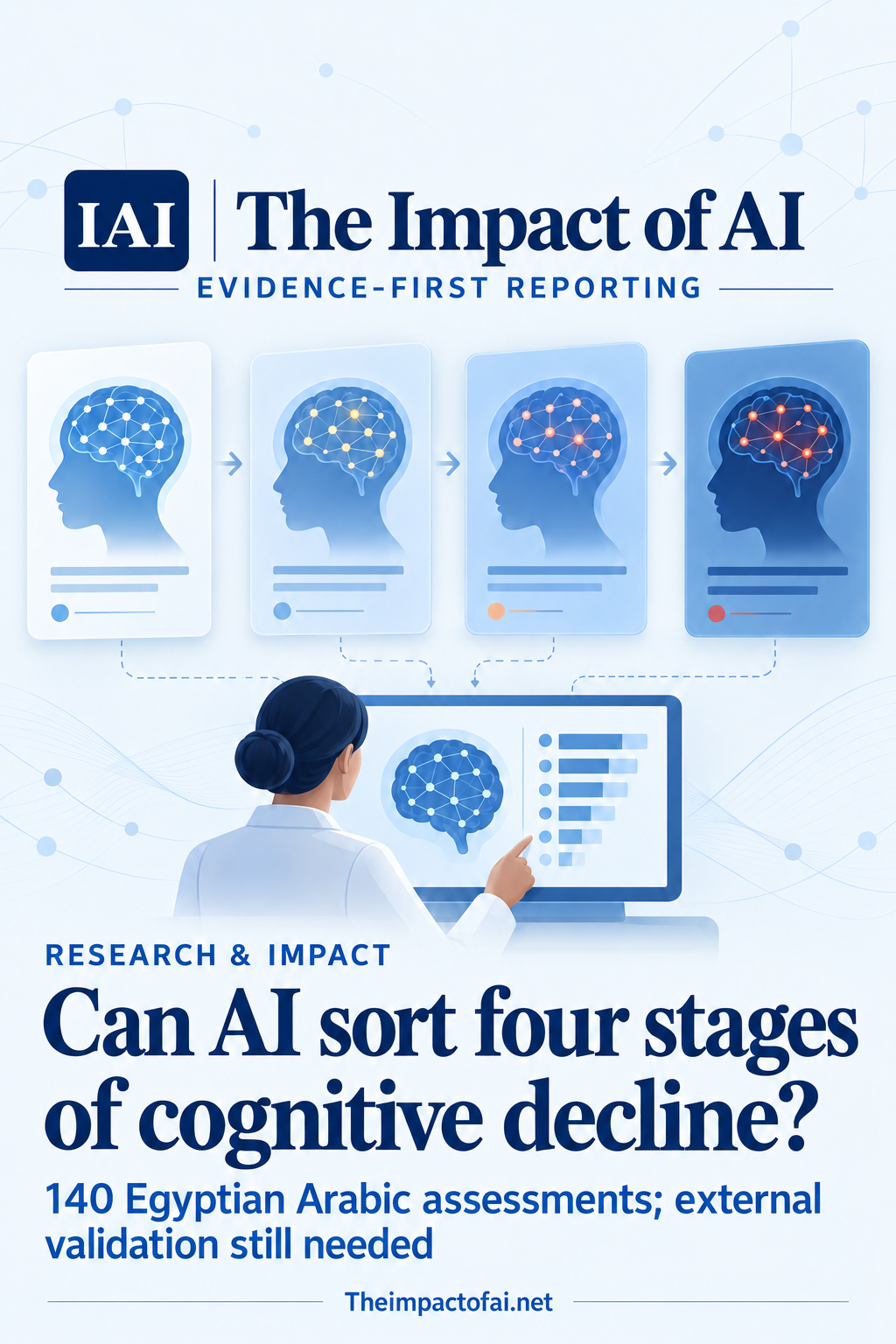
A machine-learning model separated four labelled cognitive states in a small Egyptian dataset better than several conventional alternatives on average, but the evidence is not yet enough to show that it can diagnose new patients. Mohamed Sherif N. Abd Rabou and colleagues analysed 140 Egyptian Arabic ACE-III assessments containing 28 clinical and demographic features. The target classes were cognitively normal, subjective cognitive decline, mild cognitive impairment and dementia. LightGBM achieved the highest reported mean macro F1 score, 0.723 with a standard deviation of 0.114 across five folds, and a mean balanced accuracy of 0.716 ± 0.121.
Those values describe resampling within one dataset. They are not results from an independent hospital, a later patient cohort or a live primary-care workflow. A voting classifier produced the same mean balanced accuracy, 0.716, with a smaller standard deviation of 0.068 and a macro F1 of 0.714 ± 0.058. After the authors corrected multiple pairwise comparisons, LightGBM's macro-F1 advantage was statistically significant only against logistic regression. It was not significant against its ten other comparators, including the voting classifier, k-nearest neighbours and Extra Trees. The result therefore identifies a competitive approach for further testing rather than a clear clinical winner.[1]
What was compared and how imbalance was handled
The researchers benchmarked twelve algorithms spanning linear, kernel, tree, boosting, probabilistic, distance-based and ensemble methods. Evaluation used stratified five-fold cross-validation so that each fold retained representation from the four classes. The processing pipeline applied Synthetic Minority Over-sampling Technique, or SMOTE, to reduce class imbalance. Integrating oversampling inside the pipeline is important because creating synthetic minority examples before splitting can leak information between training and validation data. Even with that safeguard, five folds drawn from the same 140-person source population share recruitment, assessment and labelling conditions.
The paper reports accuracy, macro F1, one-versus-rest ROC-AUC, balanced accuracy, Cohen's kappa and Matthews correlation coefficient as fold means with standard deviations. LightGBM led on macro F1, ROC-AUC at 0.944 ± 0.030, and kappa at 0.729 ± 0.138. The voting classifier recorded the highest mean MCC, 0.734 ± 0.091, narrowly above LightGBM's 0.733 ± 0.139. K-nearest neighbours and support-vector machines followed on macro F1 at 0.640 ± 0.136 and 0.631 ± 0.095; Gaussian Naive Bayes was lowest at 0.480 ± 0.143. Reporting spread across folds is useful: it shows that rankings based on a single headline score would conceal substantial uncertainty.[1]
Explainability shows associations, not causes
The team applied SHAP to estimate how each input contributed to model predictions globally and for individual records. Age, reported health-condition status, educational attainment, depression, blood pressure and a family history of mild cognitive impairment or Alzheimer's disease were among the features that repeatedly influenced predictions. That can help investigators check whether a model is relying on clinically plausible or concerning patterns. It does not establish that any feature caused cognitive decline, nor does it guarantee that the explanation remains stable when the model encounters a different clinic or population.
This distinction matters because several influential variables are socially and clinically patterned. Educational attainment can affect performance on cognitive tests, while access to diagnosis and the recording of depression, blood pressure or family history can vary by health system. A model may reproduce those patterns without learning a portable biological signal. SHAP also explains the fitted model, not whether the underlying labels are correct or whether acting on a prediction benefits a person. Before deployment, investigators would need to examine calibration and errors within age, sex, education and other relevant subgroups and test whether explanations remain consistent outside the development cohort.[1]
What the study could change—and what it should not
If externally validated, a low-cost model built around data already gathered during an Arabic-language ACE-III assessment could help clinicians prioritise fuller evaluation or research follow-up. That is especially relevant where specialist imaging or memory-clinic capacity is limited. The four-class design is also closer to the ambiguity encountered in practice than a binary dementia-versus-no-dementia benchmark. Yet the model should not replace clinical assessment: subjective decline, mild impairment and dementia are consequential labels, and an incorrect classification can create anxiety, delay appropriate investigation or direct scarce services away from someone who needs them.
The article does not report a prospective comparison with clinicians, a randomised triage study, downstream health outcomes or independent external validation. The sample of 140 is modest for fitting and comparing twelve models across four classes, and SMOTE generates synthetic training examples rather than new observed patients. The study's strongest responsible use is as a reproducible hypothesis for validation. Evidence that would change the assessment includes a locked model tested in separately recruited Arabic-speaking cohorts, prospective workflow studies, class-specific sensitivity and calibration, subgroup performance, decision-curve analysis and measurement of whether triage changes waiting time or patient outcomes without widening inequity.[1]
Funding, ethics and the limits of transfer
The authors report ethics approval from the Faculty of Electronic Engineering Research Ethics Committee at Menoufia University, informed consent from participants, compliance with the Declaration of Helsinki and no clinical trial registration because the work was not a trial. They declare no external funds or grants and no competing interests. The affiliations include Zewail City of Science and Technology, Ain Shams University's Cognitive Training Lab, Menoufia University and the Pyramids High Institute for Engineering and Technology.
Geographic relevance is a strength and a boundary. Arabic-language cognitive-assessment research is underrepresented in many international benchmarks, so an Egyptian dataset can address a real evidence gap. It cannot automatically stand in for other Arabic-speaking countries, dialects, education systems or clinical pathways, still less for populations using another language version of ACE-III. External validation should preserve the paper's four-class problem, document how reference diagnoses were assigned, and report failures as carefully as aggregate performance. Until that work exists, the study supports further evaluation of an inexpensive pre-screening aid—not routine automated diagnosis.[1]
What this means for people
- A validated tool could help prioritise scarce cognitive-assessment services using data already collected in routine encounters.
- False classification between normal cognition, subjective decline, mild impairment and dementia could materially affect reassurance, referrals and treatment pathways.
- People should not be told that an internally cross-validated research model has diagnosed them; clinician review and confirmatory assessment remain essential.
Global context
The study centres Egyptian Arabic assessment data, an important contribution in a literature often dominated by English-language or high-income-country cohorts. Language, schooling, test adaptation, disease prevalence and health-system practice can all change model behaviour. Validation across Arabic-speaking regions should therefore be treated as a series of empirical tests rather than assumed from a shared language label, and transfer outside Arabic-language ACE-III settings would require separate evidence.
What the evidence does not yet show
- The dataset contained 140 people and 28 features, a modest sample for comparing twelve algorithms across four outcome classes.
- Performance came from stratified five-fold cross-validation within one Egyptian dataset; no independent external or prospective validation cohort was reported.
- SMOTE addresses class imbalance in training but synthetic examples do not replace observations from additional patients or clinical settings.
- LightGBM's corrected macro-F1 advantage was significant only against logistic regression, not against the ten other model comparators.
- SHAP describes model-feature associations, not causal risk factors, label validity, calibration or clinical benefit.
- The authors reported no external funding and no competing interests.
What to watch next
- A locked model evaluated on independently recruited Arabic-speaking cohorts from different clinics and countries.
- Prospective comparisons with clinician assessment, including class-specific sensitivity, calibration and referral consequences.
- Subgroup performance by age, sex, education and other relevant characteristics, with analysis of unequal error costs.
- Transparent reporting of reference diagnoses, missing data, class counts and the exact preprocessing pipeline.
- Evidence that use in triage shortens delays or improves outcomes without increasing false reassurance, anxiety or inequity.
Living evidence record
Impact record IAI-0QRY9B1
Evidence stage
Studied
Confidence
Supported
Reporting basis
Source analysis
Independent or research support
Present
Record status
Monitoring
Last checked
8 October 2026
Source trail
1 direct source across 1 source type.
People impact
Documented in this record.
Uncertainty
Limits and next checks are explicit.
Stages describe the evidence available—not whether a technology is good or bad. See the public method.
Single-source reporting disclosure
This record analyses one direct source. It can establish what Scientific Reports published or reported, but it is not independent corroboration of every performance claim or predicted outcome. The confidence label will change only when broader evidence is added.
Evidence trail
Sources used for this report
Links checked 8 October 2026
This report is labelled source analysis. We summarise and analyse source material in our own words; company statements remain attributed claims until independently supported. Translated summaries preserve the meaning of the original source and link back to it. Read our editorial standards.
Continue the story
Related reporting
Health & Life Sciences
Can AI estimate survival after a Parkinson’s diagnosis?
A peer-reviewed Chinese registry study compared four survival models in 3,148 people with Parkinson’s disease. A transparent Cox model matched the machine-learning alternatives, but validation stayed within the same registry and no clinical-impact study was performed.
9 min · 2 sources
Health & Life Sciences
Does 99% MRI accuracy mean an Alzheimer’s diagnostic is ready?
No. A peer-reviewed model classified images from one 6,400-image Kaggle collection with reported 99% test accuracy, but it has no external clinical validation and the published test counts do not reconcile cleanly.
8 min · 2 sources
Health & Life Sciences
Can endoscopy AI travel beyond still images?
A new classifier reached about 94% accuracy in cross-validation and 96% on an aligned external image subset, then narrowly outscored five gastroenterologists on 200 still images. Both datasets came from Norway, and the work did not test live video, workflow or patient outcomes.
8 min · 1 source
The Impact Brief
Keep the evidence trail, not the noise.
Get the most consequential AI developments with direct sources and clear limits.
Reader commentary
Add evidence, experience or a question
No account is required. Reader notes are published after a brief civility, relevance and safety check; disagreement is welcome.
Explore commentary across the portal →Published reader notes
0No published reader notes yet. You can start the evidence-led discussion above.
Prefer a private correction or response? Contact the newsroom.