Can an automated map keep pace with AI-oncology research?
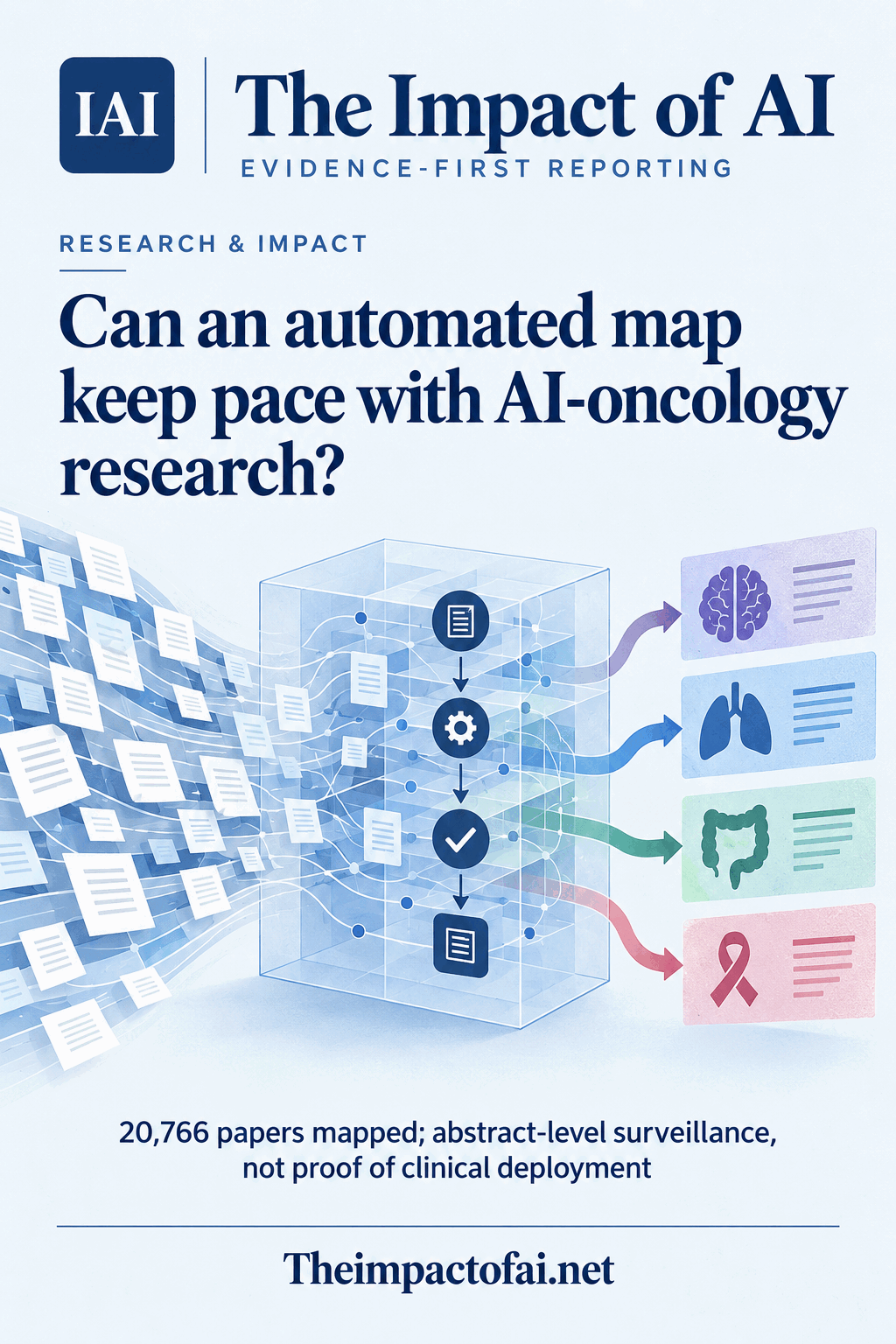
A peer-reviewed study used transparent rules to classify 20,766 open-access cancer-AI papers from 2019 to 2025. Audits show useful article-level accuracy, but the map is not a clinical-readiness score, a complete field census or a comparison of which algorithms work best.
Editorial responsibility: The Impact of AI Editorial Desk · Report a factual concern
Research topic
Whether a transparent rules-based classifier can map the volume, applications, metrics and geography of AI-oncology literature
At a glance
- 1The authors reduced 59,994 Web of Science records to 20,766 English-language open-access AI-oncology articles published from 2019 to 2025, then classified titles, abstracts, keywords and metadata with transparent rules.
- 2In manual audits, corpus-weighted metric-detection accuracy was 92.3%, while exact agreement for application categories was 73.6% and primary-task agreement was 68.0%; these results show utility but also meaningful classification error.
- 3The study maps published articles, not patients or deployments. It cannot establish clinical benefit, compare model performance fairly, measure research quality or provide a complete census of global cancer-AI work.
The Impact Brief
Keep the evidence trail, not the noise.
Get the most consequential AI developments with direct sources and clear limits.
Living evidence record
Impact record IAI-14FMHZ9
Evidence stage
Studied
Confidence
Supported
Reporting basis
Source analysis
Independent support
Present
Record status
Monitoring
Last checked
3 October 2026
Source trail
2 direct sources across 1 source type.
People impact
Documented in this record.
Uncertainty
Limits and next checks are explicit.
Stages describe the evidence available—not whether a technology is good or bad. See the public method.
Related-source reporting disclosure
This record analyses 2 linked source records around the same underlying development. The extra records add method, date or context, but they do not by themselves constitute independent replication of every performance claim or predicted outcome.
The study tried to make a fast-moving literature inspectable
Cancer-AI research now spans imaging, pathology, prognosis, drug discovery, treatment planning and administrative tasks. Conventional reviews can examine one question deeply, but they age quickly and are difficult to repeat across tens of thousands of papers. OncoTagger asks a narrower engineering question: can transparent, reproducible rules turn article metadata into a regularly updated map without pretending to read the clinical truth of every paper?
The authors built a deterministic pipeline rather than a black-box language model. It searches titles, abstracts, author keywords and indexed metadata for curated terms, then assigns tumour type, application, modality, algorithm family, performance-metric signals, geography and a small set of translational signals. Rules, dictionaries and ordering are visible in code, so disagreements can be traced to a term or decision rather than an opaque model weight.
That transparency is the paper’s main contribution. It also defines the ceiling of the claim. A rules-based map can help researchers find clusters and gaps; it cannot determine whether a model is clinically useful, whether a trial is well designed or whether an accuracy number is comparable with another paper’s result. The authors explicitly describe OncoTagger as an article-level classifier and discovery aid, not a validated clinical-readiness instrument.[1][2]
Nearly sixty thousand records became a 20,766-paper corpus
The source was Web of Science Core Collection. The search targeted English-language open-access journal articles published from 2019 through 2025 and retrieved 59,994 records before screening. The pipeline removed duplicates, enforced the year and publication criteria, applied automated inclusion and exclusion rules and sent a small ambiguous set for manual adjudication. The final corpus contained 20,766 articles.
The article reports that 39,057 records were automatically excluded and 48 were flagged for manual review. That workflow is useful because it preserves the denominator: readers can see that the final map represents about a third of the starting records, not the entire universe of oncology or AI publishing. The paper also states that licensed raw Web of Science exports cannot be redistributed, although code and derived outputs are available in the linked repository.
The restrictions create selection effects. Closed-access papers, conference proceedings, non-English research and work missing the expected indexed terms may be absent. Web of Science coverage varies across journals, countries and disciplines. A trend in this corpus is therefore a trend in one defined slice of the literature, not an estimate of every AI-oncology study produced worldwide or of where patients received AI-supported cancer care.[1]
Manual review measured where the rules work—and where they do not
Two medically trained reviewers annotated a proportional, year-stratified sample of 400 articles. Of those, 379 could be compared on the ordinal application framework. Exact agreement between OncoTagger and the manual labels was 73.6% for the weighted application category and 76.8% for the composite classification, with weighted kappa values of 0.588 and 0.615 respectively. Primary-task exact agreement was lower at 68.0%, with kappa 0.508.
A separate 200-article audit tested whether the pipeline correctly detected numeric performance metrics. The sample was deliberately balanced between 100 metric-positive and 100 metric-negative records, so the authors also calculated corpus-weighted performance. Weighted accuracy was 92.3%, with a 95% confidence interval from 88.9% to 95.2%; sensitivity was 89.3% and specificity 98.2%.
Those figures are encouraging for screening, but they are not near-perfect. Roughly one paper in four could receive a different exact application label from a human reviewer, and primary-task disagreement was still larger. The validation was internal because the rules and dictionaries were iteratively refined during development. An independent team applying the frozen system to new journals, languages or future years would provide stronger evidence of generalisability.[1]
The map finds reporting signals, not comparable clinical performance
OncoTagger detected at least one numeric performance metric in 12,538 of 20,766 articles, or 60.4%. That means the abstract or metadata contained a recognised metric expression; it does not mean 60.4% reported a clinically adequate result. Metrics can refer to internal validation, a secondary task, a small test set or an outcome unrelated to patient benefit.
The pipeline also identified 225 records in a deliberately narrow translational-signal subset. A manual audit estimated 92.0% precision for those signals. Yet the authors caution that this subset should not be read as a count of mature or deployed systems. Words associated with prospective testing, trials or workflow evaluation can signal movement toward translation without proving regulatory clearance, safe adoption or improved outcomes.
This distinction protects readers from a familiar bibliometric mistake: counting performance language as evidence of progress. To compare algorithms, reviewers would need harmonised tasks, patient cohorts, comparators, thresholds and confidence intervals, along with external validation and impact studies. OncoTagger can locate candidate papers for that deeper appraisal; it cannot replace it.[1]
Geography describes institutions, not patients or access
The corpus assigned geography from reprint-address metadata, which usually points to the corresponding author’s institution. China led with 7,655 records. That is a measure of publication affiliation under the paper’s rules. It is not the location of every co-author, the origin of every dataset, the countries represented by patients or the places where a system was deployed.
The difference matters because multinational papers may use public datasets collected elsewhere, and a corresponding author can work in a country different from the study population. English-only and Web of Science filters may also undercount regional journals. Readers should therefore resist turning the map into a league table of national clinical capability.
A stronger global view would link institutional geography with dataset provenance, patient demographics, care setting and deployment location, while respecting privacy and licensing. It would also include multilingual sources and regional indexes. The present paper provides a reproducible starting layer, not that full research-and-care map.[1]
No funding was declared and the authors report no competing interests
The author group is affiliated with SciForce and Ukrainian universities. The paper states that no funding was received and declares no competing interests. It also says a GPT-based language model was used for language refinement and structural editing, not for data extraction, adjudication or label creation. No human participants or patient data were involved because the unit of analysis was publication metadata.
The repository improves auditability, but reproducibility is still bounded by database licensing and indexing changes. The paper anchors its analysis to repository commit bef89e5e40317c805ead68f7716e39bed19c3879. Future runs should version search dates, term dictionaries and derived datasets so that a changed result can be separated from a changed literature base.
The journal page labels the article an accepted peer-reviewed version published on 3 October 2026 and warns that further copy-editing and typesetting may change details before the final version of record. That status does not negate peer review, but corrections or clarified denominators should be checked when the final version appears.[1][2]
The practical value is triage, followed by human appraisal
For researchers, funders and evidence teams, an automated map can identify rapidly growing topics, underrepresented tumour types and papers that mention external validation or prospective work. That can make systematic-review surveillance more efficient. It may also expose how often abstracts omit essential sample, comparator or uncertainty information.
For patients and clinicians, the immediate effect is indirect. A better discovery layer can speed evidence synthesis, but it should never be used to rank a hospital, select a treatment or infer that a model is ready for use. Any candidate technology still needs study-level review of population, dataset, comparator, bias, calibration, clinical workflow and patient-relevant outcomes.
Confidence would rise if independent groups validated the frozen pipeline on later years, non-English corpora and databases beyond Web of Science; reported error by tumour type and application; and compared its surveillance yield with expert systematic-review searches. The most valuable next step is not a more impressive map. It is evidence that the map consistently leads experts to consequential studies without systematically hiding regions, topics or negative results.[1][2]
What this means for people
- Evidence teams may find relevant AI-oncology papers faster, but every shortlisted study still requires human appraisal before influencing care or policy.
- Patients should not interpret publication counts, metric mentions or translational signals as proof that an AI system improves cancer outcomes.
- Multilingual and regional coverage will matter if automated evidence maps are to avoid reinforcing existing visibility gaps in global cancer research.
Global context
The mapped literature is global, but the inclusion of English-language open-access Web of Science articles and the use of corresponding-author address shape what becomes visible. China contributed the largest number of institutional reprint addresses, but this does not measure patient representation or clinical deployment. The Ukraine-linked team’s open code supports reuse; broader validation must include multilingual indexes and research communities in Asia, the Middle East, Africa and Latin America.
What the evidence does not yet show
- The corpus is limited to English-language open-access journal articles indexed in Web of Science from 2019 to 2025 and is not a complete field census.
- Validation was internal after iterative rule development; independent external validation on frozen rules, later years and other databases remains necessary.
- Exact agreement was 73.6% for application category and 68.0% for primary task, leaving meaningful classification error.
- Metric and translational-signal detection identify reporting language, not research quality, clinical maturity, comparative performance or patient benefit.
- Institutional reprint-address geography does not establish dataset provenance, patient geography, deployment or access to care.
What to watch next
- Independent validation on 2026 publications, non-English literature and databases beyond Web of Science.
- Error analyses by tumour type, modality, application and region, including whether minority categories are systematically missed.
- Linkage of publication metadata to dataset provenance, prospective validation, regulatory status and patient-relevant outcomes.
- A final version of record and any corrections to the accepted article’s methods, counts or repository reference.
Evidence trail
Sources used for this report
Links checked 3 October 2026
This report is labelled source analysis. We summarise and analyse source material in our own words; company statements remain attributed claims until independently supported. Translated summaries preserve the meaning of the original source and link back to it. Read our editorial standards.
Continue the story
Related reporting
Science & Research
Can AI design better optimisation rules?
A Nature Machine Intelligence paper reports that a structured LLM framework outperformed prior LLM approaches across 36 combinatorial-optimisation benchmarks and produced feasible algorithms for four new port-logistics problems. It remains an offline benchmark, not a live operations result.
8 min · 2 sources
Science & Research
Can AI make a chemical prediction useful in a different laboratory?
A new Nature Methods publication addresses transfer between chromatography systems. We examine the accessible research record, software and data infrastructure, and propose a practical laboratory test.
6 min · 5 sources
Science & Research
Robin links literature agents and laboratory data in a closed discovery loop
Researchers describe Robin, a multi-agent system that generates hypotheses, proposes experiments, analyses results and revises its ideas, including work on candidate therapies for dry age-related macular degeneration.
4 min · 1 source
Reader discussion
Add evidence, experience or a question
No account is required. Reader notes are published after a brief civility, relevance and safety check; disagreement is welcome.
Published reader notes
0No published reader notes yet. You can start the evidence-led discussion above.
Prefer a private correction or response? Contact the newsroom.