Can federated health AI resist poisoned model updates?
In a peer-reviewed single-server simulation using three public health datasets and 5, 10 or 20 clients, PoSFed kept an F1 score of 88.6% ± 1.2% when half the simulated participants were malicious. It was not tested on a live hospital network or an actual permissioned blockchain.
Editorial responsibility: The Impact of AI Editorial Desk · Report a factual concern
At a glance
- 1PoSFed combines stake-inspired validator selection, validator-side F1-score filtering and contribution-aware rewards rather than accepting every client update into the global model.
- 2The authors tested 5, 10 and 20 simulated clients on the Pima Indian Diabetes, Wisconsin Breast Cancer and COVIDx CXR-4 datasets under IID, non-IID and adversarial conditions.
- 3At 50% malicious simulated participants, reported accuracy was 86.7% ± 1.4% and F1 was 88.6% ± 1.2%; no real blockchain, distributed hospital network, patient workflow or adaptive attacker was tested.
Research topic
Stake-aware validator selection and F1-score filtering against malicious model updates in simulated healthcare federated learning
The direct answer: promising simulated resilience, not hospital-grade security
PoSFed resisted a severe poisoning scenario in the authors’ controlled experiments. When half of the simulated participants submitted malicious updates, the framework reported accuracy of 86.7% ± 1.4% and an F1 score of 88.6% ± 1.2%. It did so by selecting validators with a stake-inspired rule, testing incoming updates against validator data and rewarding contributions judged useful. The result suggests that model-update governance can improve robustness when healthcare data remain distributed.
It does not show that the system can secure a hospital network. All experiments ran on a single server. The study did not deploy a permissioned blockchain, connect independent clinical organisations, measure communications over a real network or test patient care. The malicious clients were simulated within a defined experimental threat model. Hospitals should therefore read the result as a candidate defence mechanism to investigate, not as evidence that blockchain makes federated learning safe.[1]
What the framework changes in federated learning
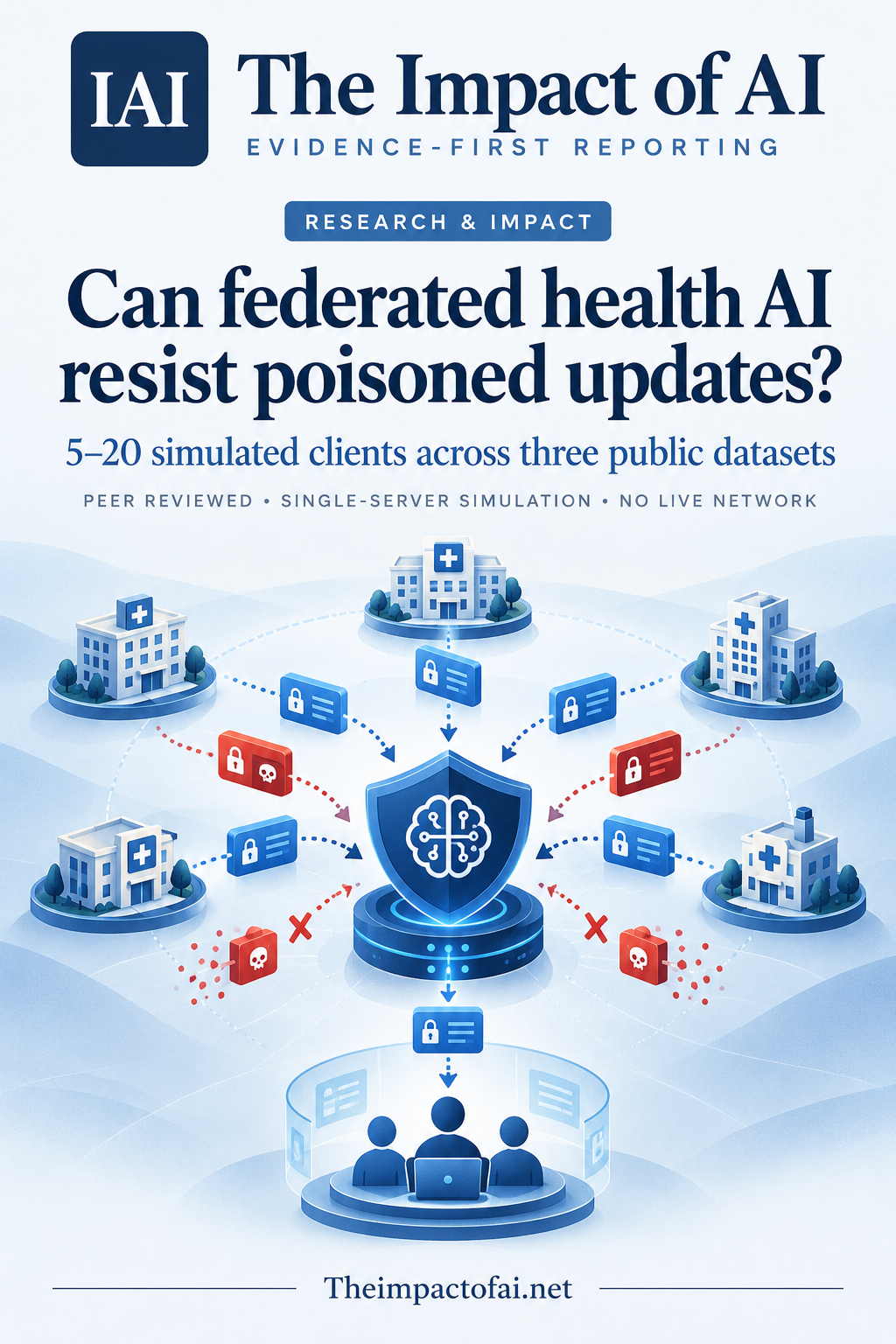
Conventional federated learning sends a shared model to participating clients, lets each train locally and aggregates their updates without collecting the raw records centrally. The privacy advantage is limited: an untrusted or compromised participant can still submit a poisoned update, and an aggregator can give that update influence. PoSFed places a validator layer between local training and global aggregation, borrowing the idea of stake to favour participants with a stronger history of trustworthy contribution.
Validators evaluate candidate updates using F1 score and filter those that fail the acceptance rule. A contribution-aware reward mechanism is intended to align participation with model quality. That combination addresses two related problems—who gets to validate and which updates enter the model—but creates new governance questions. Stake can entrench incumbents, validator data can be biased or unrepresentative, and an attacker may learn to optimise an update so it passes a fixed performance gate while preserving a targeted backdoor.[1]
The experiment used three public datasets and three client populations
The authors evaluated the framework on the Pima Indian Diabetes dataset, the Wisconsin Breast Cancer dataset and COVIDx CXR-4 chest-radiograph data. These cover tabular and imaging tasks, which is more informative than a single benchmark. The simulated federation contained 5, 10 or 20 clients. Experiments included identically distributed data, non-identically distributed data and adversarial conditions, because real institutions rarely have equal patient mixes or identical equipment.
Those denominators remain small beside a national health federation, and public benchmark records do not reproduce the operational complexity of live hospitals. The paper’s unit of attack is a simulated client update, not a verified compromised organisation. A single-server test also removes latency, intermittent connectivity, software-version drift, identity management and institutional approval. Performance across the three datasets shows breadth within the experiment; it is not external validation across three health systems.[1]
What the 50% malicious result does—and does not—measure
An attack fraction of 50% is a demanding stress test because half the participating clients are adversarial. The reported mean and variability indicate that the framework retained classification utility across repeated experimental runs under the specified setup. Accuracy alone could conceal class imbalance, so the accompanying F1 score is useful. Neither metric reveals whether a small patient subgroup absorbed most errors, whether confidence remained calibrated or whether an attacker could force a particular target prediction.
The comparison is also bounded by the attacks and conventional federated-optimisation baselines selected by the authors. Security claims need adaptive evaluation: attackers should know the validator rule, collude, behave honestly long enough to accumulate stake and then change strategy. Researchers should report false rejection of benign updates, false acceptance of malicious ones, time to detect an attack and recovery after a poisoned round. Patient-facing risk depends on those failure modes, not only average test-set classification.[1]
Why blockchain coordination is still an untested deployment claim
The architecture is described as blockchain-coordinated, but the authors explicitly identify the absence of an actual permissioned-blockchain deployment as a limitation. A real implementation would have to define organisational identities, consensus rules, audit visibility, revocation, key management, data-retention obligations and responsibility when an update causes harm. Recording a decision immutably does not prove that the decision or the validator’s data were correct.
Healthcare federations also operate under legal and ethical constraints that benchmarks cannot simulate. Even when raw records stay local, model updates can leak information. Validator evaluation may require access to representative labelled data, creating another sensitive asset. Hospitals would need privacy testing, secure aggregation, incident response and clear authority to pause or roll back a model. Blockchain may provide provenance, but it does not replace access control, clinical safety management or an accountable human operator.[1]
What evidence would justify a real-world pilot
The next evidence step is a reproducible multi-node test using separately administered systems, network delays and heterogeneous local data. It should include adaptive and colluding attackers, validator compromise, stake gaming and privacy leakage. Results need subgroup performance, calibration, attack-detection errors, communication and compute costs, convergence time and the effect of honest but unusual hospitals whose updates may look suspicious because their patients differ.
Only then would a tightly governed clinical shadow pilot be reasonable, with no model output affecting care. The researchers are based in Taiwan, and the work received public and industry-linked funding; the authors declared no competing interests. Independent replication outside the originating team would materially strengthen confidence. For patients, the potential benefit is collaboration without centralising records. The corresponding risk is false security: a robust simulation can become a fragile deployment if identity, incentives, privacy and clinical oversight are treated as solved by the word blockchain.[1]
What this means for people
- Federated learning could let hospitals collaborate without pooling raw records in one database.
- Biased validators could exclude useful updates from institutions serving underrepresented populations.
- Patients could be harmed if simulated robustness is mistaken for assurance of a live clinical system.
Global context
The study comes from Taiwan and uses public datasets with different task types, while the deployment problem is global. Health systems differ in data protection law, cyber maturity, network reliability, patient mix and the authority granted to algorithmic systems. Any cross-border federation would need jurisdiction-specific governance and independent security validation; a common protocol cannot make those differences disappear.
What the evidence does not yet show
- The experiments were controlled single-server simulations with 5, 10 or 20 clients.
- No permissioned blockchain or geographically distributed healthcare network was deployed.
- The attack results apply to the authors’ simulated threat models, not every poisoning or backdoor strategy.
- Public benchmark performance does not measure patient outcomes, workflow safety or institutional governance.
- F1-based filtering may reject legitimate updates from hospitals serving different patient populations.
What to watch next
- Independent replication with adaptive, colluding and validator-level attackers.
- A genuine multi-node permissioned-network test with measured latency, cost and failure recovery.
- Subgroup, calibration and privacy-leakage results alongside average accuracy and F1.
- Clinical shadow-mode evaluation with formal rollback and human accountability.
Living evidence record
Impact record IAI-0MQ1LMR
Evidence stage
Studied
Confidence
Supported
Reporting basis
Source analysis
Independent or research support
Present
Record status
Monitoring
Last checked
8 October 2026
Source trail
1 direct source across 1 source type.
People impact
Documented in this record.
Uncertainty
Limits and next checks are explicit.
Stages describe the evidence available—not whether a technology is good or bad. See the public method.
Single-source reporting disclosure
This record analyses one direct source. It can establish what Scientific Reports published or reported, but it is not independent corroboration of every performance claim or predicted outcome. The confidence label will change only when broader evidence is added.
Evidence trail
Sources used for this report
Links checked 8 October 2026
This report is labelled source analysis. We summarise and analyse source material in our own words; company statements remain attributed claims until independently supported. Translated summaries preserve the meaning of the original source and link back to it. Read our editorial standards.
Continue the story
Related reporting
Security & Defence
Can clouds share phishing signals without sharing raw data?
A three-model ensemble reached 95.21% accuracy on 2,211 test examples while exchanging probability scores. But the clouds, network and feature split were simulated, and the framework has no formal privacy or adversarial-robustness guarantee.
8 min · 1 source
Security & Defence
Can phishing models learn without pooling URLs?
A peer-reviewed benchmark tests seven classifiers on 11,430 labelled URLs and simulates federated learning across 20 clients. XGBoost leads centrally, while a feature-weighted neural model stays competitive without moving raw examples—but no real organisations or live traffic were tested.
9 min · 2 sources
Security & Defence
Do low error rates prove biometric templates are secure?
No. A peer-reviewed iris-and-fingerprint system reported equal-error rates from 0.0201% to 0.496% on three benchmark cohorts, but matching accuracy is not the same as independent proof against attacks or safe deployment.
9 min · 1 source
The Impact Brief
Keep the evidence trail, not the noise.
Get the most consequential AI developments with direct sources and clear limits.
Reader commentary
Add evidence, experience or a question
No account is required. Reader notes are published after a brief civility, relevance and safety check; disagreement is welcome.
Explore commentary across the portal →Published reader notes
0No published reader notes yet. You can start the evidence-led discussion above.
Prefer a private correction or response? Contact the newsroom.