Can fine-tuning hide large changes in medical AI answers?
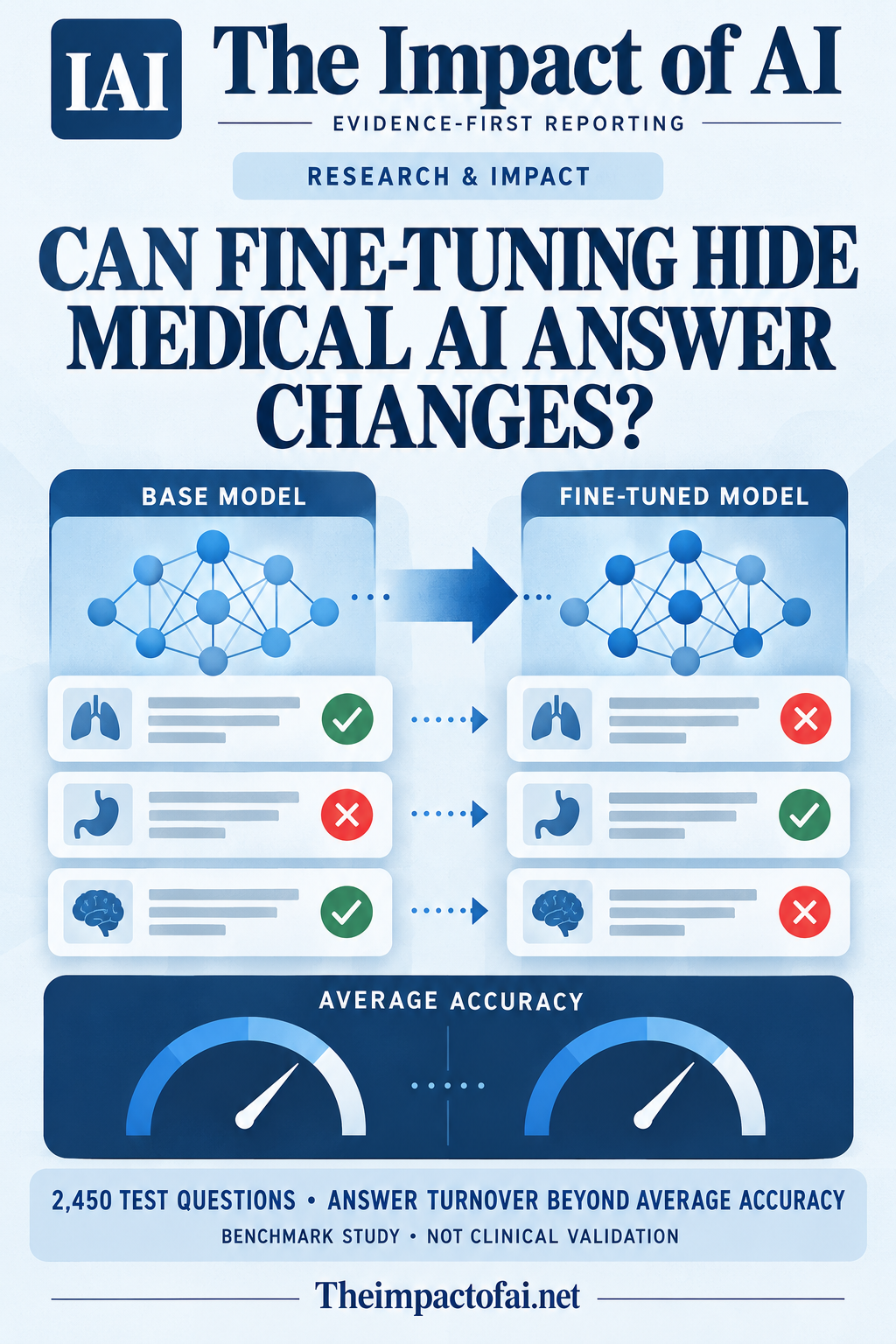
Yes. In a peer-reviewed accepted study, medical-model checkpoints with similar overall accuracy still changed which questions they answered correctly on 15.1%–18.2% of a 2,450-item test. The result exposes a model-upgrade risk, but it is a benchmark study—not clinical validation or evidence of patient harm.
Editorial responsibility: The Impact of AI Editorial Desk · Report a factual concern
At a glance
- 1One 27B parent model and five fine-tuned derivatives were tested deterministically on the same 2,450 MedXpertQA-Text questions with identical scoring.
- 2Four derivatives within 2.41 percentage points of the parent still differed from it on 15.1%–18.2% of items; the range remained 12.8%–14.5% after excluding questions where either model hit the generation cap.
- 3No derivative exceeded the parent’s 43.76% accuracy, and the single-run benchmark design cannot show clinical usefulness, patient effects or which training choice caused the turnover.
Research topic
Whether aggregate accuracy conceals item-level gains and losses after fine-tuning a medical question-answering model
The direct answer: similar averages can conceal different failures
Yes. The study’s central result is that a small change in overall accuracy does not mean a fine-tuned medical model behaves like its parent. Four derivative checkpoints finished within 2.41 percentage points of the parent’s aggregate score, yet 15.1%–18.2% of the 2,450 test questions changed correctness status between the paired models. Some previously correct answers became wrong while other previously wrong answers became correct, leaving the headline average comparatively stable.
That distinction matters whenever a model update is judged by one summary number. A team could see almost unchanged accuracy and conclude that a new checkpoint preserves existing capability. At item level, however, the users, conditions or question types helped by the old model may not be the ones helped by the new one. The paper therefore argues for reporting retention, acquisition and turnover alongside aggregate accuracy. It does not claim that the tested system is fit for care, and the authors’ model card explicitly says the checkpoints are research artefacts rather than clinical tools.[1][2]
What the researchers compared
Researchers at United Arab Emirates University compared one 27-billion-parameter parent checkpoint, Qwen3.6-27B, with five derivatives produced through different fine-tuning configurations. They held the model scale, underlying architecture, 2,450-item MedXpertQA-Text test set, deterministic decoding and exact-match scoring constant. The design therefore supports paired, question-by-question comparison rather than a loose comparison of scores taken from different leaderboards or test sets.
The six reported accuracies ranged from 43.76% for the parent to 26.90% for the weakest derivative, a 16.86 percentage-point span. Among the five derivatives, the span was 15.30 points. None beat the parent. Four clustered closer to it, with accuracies of 41.35%, 41.67%, 41.67% and 42.20%; the fifth scored 26.90%. The authors used exact McNemar tests for paired comparisons, which test whether the directions of discordant outcomes are balanced rather than treating every answer as an unrelated observation.[1][2]
Retention makes the hidden change visible
A derivative’s retention rate asks how often it remains correct on questions the parent answered correctly. Across the configurations, retention ranged from 47.2% to 80.3%. That means even a model with a broadly similar overall score could lose a meaningful share of the parent’s correct answers and compensate by gaining correctness elsewhere. For a safety-sensitive application, the identity of those lost answers can matter more than whether gains and losses cancel in the mean.
Generation limits were a possible source of apparent failure, so the researchers repeated the turnover calculation after removing items where either model hit the generation cap. For the four near-parent derivatives, turnover still ranged from 12.8% to 14.5%. That sensitivity check reduces—but does not eliminate—concern that the result is merely an artefact of truncated responses. The study also found no consistent relationship between rationale length and accuracy, and no category-level retention difference survived correction for multiple testing.[1]
Why this changes model-update testing
The practical lesson is not that fine-tuning is unsafe by definition. It is that update evaluation should preserve a regression set of consequential cases and compare individual outcomes, not only average performance. Developers can record which parent-correct items remain correct, which are lost and which are newly acquired. In a clinical domain, that analysis should then be stratified by specialty, task difficulty, patient subgroup and harm severity using datasets designed for those questions, rather than assuming a multiple-choice benchmark represents practice.
The authors released prediction-level evaluation artefacts and identify a reproducibility dataset with DOI 10.57967/hf/9501; the model collection has DOI 10.57967/hf/9500. The model card also records that an earlier causal interpretation of one training configuration was withdrawn because the available comparisons did not support it. That correction is important: the five derivatives differ in more than one training dimension, so their outcomes cannot isolate a single recipe choice.[1][2]
What the evidence does not establish
This was not a clinical trial, silent deployment or reader study. It did not test diagnosis, treatment selection, clinician workflow, patient outcomes or the consequences of a wrong answer. MedXpertQA-Text is a fixed medical question-answering benchmark scored by exact match. Its item mix and scoring rules cannot reproduce the ambiguity, incomplete information, dialogue and accountability of real care. A change in benchmark correctness is therefore a signal for investigation, not direct evidence that an update would harm a patient.
Each configuration came from a single training run. Random-seed variation could account for some observed turnover, while the configurations’ multiple simultaneous differences prevent causal attribution. The study covers one parent family and a limited set of related checkpoints at one scale. Similar analyses on MedQA and MedMCQA in the authors’ artefacts are useful corroboration, but independent groups have not yet shown how common the pattern is across vendors, languages, specialties and deployment settings.[1][2]
What would change the assessment
Confidence would rise with repeated fine-tuning runs under controlled one-factor changes, followed by independent replication across model families and clinically curated tasks. Researchers should report confidence intervals for retention and acquisition, inspect high-harm errors with qualified clinicians and test whether item-level turnover predicts instability in realistic longitudinal cases. Prospective evaluation could then determine whether stronger regression gates actually reduce harmful changes during model updates.
For procurement and governance, the immediate standard should be modest: ask suppliers to disclose what changed, provide paired regression results on relevant cases and show that update approval is not based on a single aggregate metric. This paper makes that demand more evidence-based. It does not identify an acceptable medical threshold, prove that one derivative is safer, or establish that benchmark turnover translates directly into patient risk.[1][2]
What this means for people
- Patients and clinicians need model updates to preserve dependable behaviour on consequential cases, not merely maintain an average benchmark score.
- Developers can use paired regression testing to detect lost capabilities before an update reaches users.
- The result should not be read as proof that any tested checkpoint is suitable for patient care; the authors explicitly say it is not.
Global context
Medical AI models are updated across jurisdictions that differ in clinical practice, language and regulation. This UAE-led benchmark study identifies a general evaluation risk, but its questions and English-language research setting cannot establish stability for local patient populations. Regulators and health systems would need domain-specific, subgroup-aware evidence before applying the finding to deployment decisions.
What the evidence does not yet show
- The evaluation used one parent model family, five related derivatives and one principal 2,450-item benchmark; it does not establish prevalence across medical AI systems.
- One training run was available for each configuration, so random-seed variability was not estimated.
- Configurations differed on multiple training dimensions, preventing causal attribution to a single technique or dataset choice.
- Exact-match medical question answering is not a clinical workflow and provides no direct evidence about patient benefit or harm.
- The peer-reviewed accepted manuscript was available on 7 October, but Frontiers had not yet published the final formatted Version of Record.
What to watch next
- Independent paired-turnover studies across medical specialties, languages and model families.
- Repeated-run estimates that separate fine-tuning effects from random-seed instability.
- Clinician-reviewed regression suites weighted by the likely severity of a lost answer.
- Prospective evidence connecting item-level stability metrics with safer real-world updates.
Living evidence record
Impact record IAI-1K5ZK0E
Evidence stage
Studied
Confidence
Supported
Reporting basis
Source analysis
Independent or research support
Present
Record status
Monitoring
Last checked
7 October 2026
Source trail
2 direct sources across 2 source types.
People impact
Documented in this record.
Uncertainty
Limits and next checks are explicit.
Stages describe the evidence available—not whether a technology is good or bad. See the public method.
Related-source reporting disclosure
This record analyses 2 linked source records around the same underlying development. The extra records add method, date or context, but they do not by themselves constitute independent replication of every performance claim or predicted outcome.
Evidence trail
Sources used for this report
Links checked 7 October 2026
This report is labelled source analysis. We summarise and analyse source material in our own words; company statements remain attributed claims until independently supported. Translated summaries preserve the meaning of the original source and link back to it. Read our editorial standards.
Continue the story
Related reporting
AI Risks & Safety
Can a few poisoned documents reframe medical AI answers?
Yes, in a peer-reviewed laboratory study across three biomedical corpora and five open-weight language models. Injecting five crafted documents per question often put at least three in the top five retrieved results, and one or two retrieved poisons could be enough in successful attacks.
6 min · 1 source
AI Risks & Safety
Can clinicians see the evidence behind approved diagnostic AI?
A peer-reviewed audit found public, device-specific performance evidence for 30 of 77 approved pathology and haematology AI products. The result is a transparency finding—not proof that the other 47 lack regulatory evidence or that the documented products are clinically equivalent.
9 min · 3 sources
AI Risks & Safety
Do AI explanations prevent over-reliance?
Not in this unreviewed experiment. Explanations reduced raw acceptance but did not improve reliance calibration among novices doing a clinical-text annotation task; over-reliance tended to increase across the session.
7 min · 1 source
The Impact Brief
Keep the evidence trail, not the noise.
Get the most consequential AI developments with direct sources and clear limits.
Reader commentary
Add evidence, experience or a question
No account is required. Reader notes are published after a brief civility, relevance and safety check; disagreement is welcome.
Explore commentary across the portal →Published reader notes
0No published reader notes yet. You can start the evidence-led discussion above.
Prefer a private correction or response? Contact the newsroom.