Can a smaller AI model separate voices from noise in real time?
A 3.9-million-parameter model separated overlapping speech and suppressed noise with competitive open-benchmark scores at lower computational cost. It ran faster than real time on one CPU core, but reverberation reduced performance and no live hearing, conferencing or call-centre deployment was tested.
Editorial responsibility: The Impact of AI Editorial Desk · Report a factual concern
At a glance
- 1The 3.9-million-parameter model reached 15.60 ± 0.10 dB SI-SNR improvement, PESQ 3.02 and STOI 0.917 at 0 dB in the reported benchmark setting.
- 2Two larger alternatives scored 0.50–0.80 dB higher but required seven to eleven times the arithmetic cost; the new model’s claim is efficiency, not absolute state-of-the-art accuracy.
- 3Cross-corpus and unseen-language transfer reduced performance by 0.70–2.20 dB, and improvement fell to 7.80 dB in reverberation longer than 0.90 seconds.
Research topic
Joint end-to-end separation of overlapping speakers and non-stationary noise with a compact time-frequency neural network
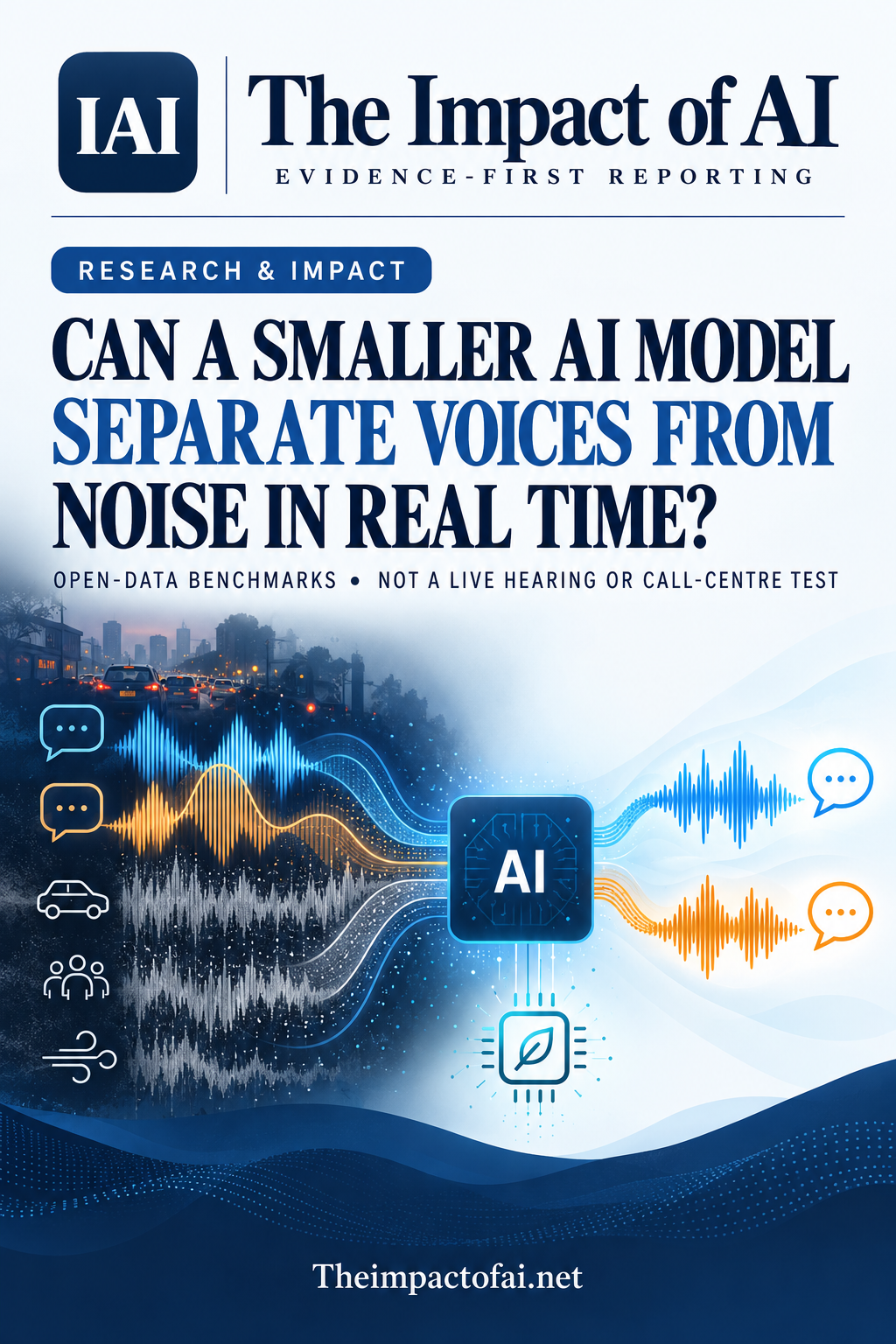
The direct answer: faster-than-real-time benchmark processing, not proven live performance
The model processed benchmark audio faster than real time on a single CPU core while approaching the quality of much larger systems. Rong Xie and colleagues report a real-time factor of 0.51, meaning the measured processing time was about half the audio duration under their test setup. The network used 3.9 million parameters and 6.8 billion multiply-accumulate operations per second of audio, with reported energy use of 0.41 joules per processed second.
Those measurements support the possibility of efficient edge or desktop processing. They do not prove acceptable latency on a phone, hearing device, videoconference platform or call-centre stack. Hardware, buffering, microphone characteristics and streaming constraints can change the experience substantially. The authors also report that their causal streaming variant lost 1.70 dB of separation improvement, illustrating the familiar trade-off between using future context for quality and producing output immediately.[1]
Why separation and denoising were trained together
Conventional systems may first separate overlapping talkers and then send each output through a denoiser. Errors created by the separation stage can pass into the second stage, which was not trained to correct them. The proposed network instead shares a learnable time-frequency encoding across a multi-scale dilated separator and a noise-suppression module conditioned on that representation, then reconstructs the streams jointly.
Training combined three objectives: scale-invariant signal-to-noise ratio, spectral magnitude and perceptual weighting. Input conditions extended to minus 5 dB signal-to-noise ratio, where noise energy exceeds the target signal. That joint objective is a plausible reason for the model’s balance of separation and intelligibility measures. It does not ensure that the same balance will satisfy every application: a transcription service, a conversation aid and a music remix tool value different artefacts and delays.[1]
The comparison was broad and controlled
Evaluation used LibriMix, WHAM! and WHAMR! for speech separation, VoiceBank-DEMAND and MUSAN for noise, and MUSDB18-HQ for a full-band test beyond speech. Seven baseline systems were retrained under an identical recipe. The authors tested every difference on 3,000 mixtures across three random seeds, a more informative design than comparing a new run with published headline numbers produced under incompatible training conditions.
At 0 dB, the proposed system reached a scale-invariant signal-to-noise-ratio improvement of 15.60 ± 0.10 dB, a perceptual evaluation of speech quality score of 3.02 and short-time objective intelligibility of 0.917. It outperformed Conv-TasNet, DPRNN, SepFormer, a diffusion cascade and a serial separation-then-denoising pipeline under the stated recipe. Those are objective metrics; the report does not substitute them for blinded human listening in the intended deployment contexts.[1]
Efficiency, rather than absolute accuracy, is the central contribution
TF-GridNet and MossFormer2 achieved 0.50 to 0.80 dB more signal-to-noise improvement, but the authors estimate that they required seven to eleven times the arithmetic cost. The new network therefore does not set the best raw score. Its value proposition is to retain much of the performance with a smaller computational and energy budget that may be easier to deploy.
That distinction matters for reporting. A compact model can be more useful than a marginally stronger one when battery, latency, heat or hardware cost is constrained. Conversely, a lower arithmetic count does not automatically deliver lower end-to-end cost: memory access, implementation quality, accelerator support and input-output overhead also matter. Independent profiling on representative devices is needed before calling the system energy-efficient in practice.[1]
Reverberation and domain transfer reveal where performance weakens
The study included cross-corpus, unseen-language and reverberant tests. Moving away from the training conditions cost between 0.70 and 2.20 dB. When reverberation time exceeded 0.90 seconds, improvement fell to 7.80 dB. Rooms with long reflections are common in stations, halls, classrooms and open-plan spaces, so this decline is not an edge case for many potential users.
Unseen-language testing is welcome because acoustic and phonetic patterns vary, but publicly distributed recordings still cannot represent accents, age, speech impairment, microphone distance or simultaneous environmental events encountered worldwide. A system can score well on aggregate while suppressing quiet voices or distorting speakers who differ from the dominant training data. Future work should report subgroup and condition-specific listening results, not only overall objective averages.[1]
What would establish real benefit for listeners
The code, configurations and per-utterance records accompanying the article should help independent teams reproduce the benchmark. The authors report no external funding and no competing interests. Replication should include device-level latency and energy, packet or microphone failure, double-talk, room changes and speakers entering or leaving. A frozen model should be compared with both larger systems and practical non-AI baselines.
Human studies would then need tasks matched to the use case: speech comprehension and fatigue for conversation support, word error rates plus agent workload for call centres, and preference or artefact ratings for conferencing. Accessibility claims require participation from the people intended to benefit, including users with hearing loss, rather than inference from STOI alone. Such studies should also report when users disable processing because its artefacts are more disruptive than the original noise. Until those tests exist, the defensible result is narrower: a compact joint architecture achieved a strong compute-quality trade-off on several open audio benchmarks, with clear losses under difficult reverberation.[1]
What this means for people
- Efficient separation could improve conversations, recordings and transcription on modest hardware.
- Distortion or suppression of quieter and under-represented voices could create new accessibility failures.
- Users need visible control and an easy return to unprocessed audio when enhancement performs poorly.
Global context
The authors are based in Hunan, China, and evaluated public datasets containing varied speech and noise sources, including an unseen-language test. Open benchmarks support international comparison, but real acoustic environments and speech populations remain broader than the test suite. Deployers would need local listening studies and transparent monitoring for language, accent, disability and room-specific failures.
What the evidence does not yet show
- The evidence comes from open benchmark recordings, not a live product or field deployment.
- Objective quality and intelligibility metrics do not replace blinded human listening.
- Two larger models achieved higher raw separation scores, albeit at substantially greater arithmetic cost.
- The causal streaming variant lost 1.70 dB, and long reverberation sharply reduced improvement.
- No hearing-accessibility, conferencing, call-centre or device-level outcome was tested.
What to watch next
- Independent reproduction using the released code and per-utterance records.
- Latency, memory and energy measurements on phones, laptops and specialist edge devices.
- Blinded listening tests across languages, accents, speech characteristics and reverberant spaces.
- Prospective comparisons of user comprehension, fatigue, transcription error and workflow burden.
Living evidence record
Impact record IAI-1S034TE
Evidence stage
Studied
Confidence
Supported
Reporting basis
Source analysis
Independent or research support
Present
Record status
Monitoring
Last checked
8 October 2026
Source trail
1 direct source across 1 source type.
People impact
Documented in this record.
Uncertainty
Limits and next checks are explicit.
Stages describe the evidence available—not whether a technology is good or bad. See the public method.
Single-source reporting disclosure
This record analyses one direct source. It can establish what Scientific Reports published or reported, but it is not independent corroboration of every performance claim or predicted outcome. The confidence label will change only when broader evidence is added.
Evidence trail
Sources used for this report
Links checked 8 October 2026
This report is labelled source analysis. We summarise and analyse source material in our own words; company statements remain attributed claims until independently supported. Translated summaries preserve the meaning of the original source and link back to it. Read our editorial standards.
Continue the story
Related reporting
Technology
Cloud offloading could change the performance and battery trade-off for robots
Microsoft Research reports that moving some physical-AI inference from a robot's onboard processor to edge or cloud GPUs can improve task success, efficiency and the complexity of workloads the machine can handle.
2 min · 1 source
Technology
Why do multi-agent AI systems keep failing?
An unreviewed analysis of 22,848 closed issues across 21 prominent open-source projects identified 944 genuine multi-agent problems. Handoffs, execution control and memory dominated—but repository reports cannot establish failure rates in production systems.
7 min · 3 sources
Technology
What does beating a Stratego champion prove about AI under hidden information?
Ataraxos won 15 of 20 games against one of Stratego's most decorated players and transferred its methods to three other games. The peer-reviewed Nature paper shows a real advance in efficient game strategy—not that the system can already run negotiations, markets or military decisions.
7 min · 3 sources
The Impact Brief
Keep the evidence trail, not the noise.
Get the most consequential AI developments with direct sources and clear limits.
Reader commentary
Add evidence, experience or a question
No account is required. Reader notes are published after a brief civility, relevance and safety check; disagreement is welcome.
Explore commentary across the portal →Published reader notes
0No published reader notes yet. You can start the evidence-led discussion above.
Prefer a private correction or response? Contact the newsroom.