Can wearable AI make school training safer?
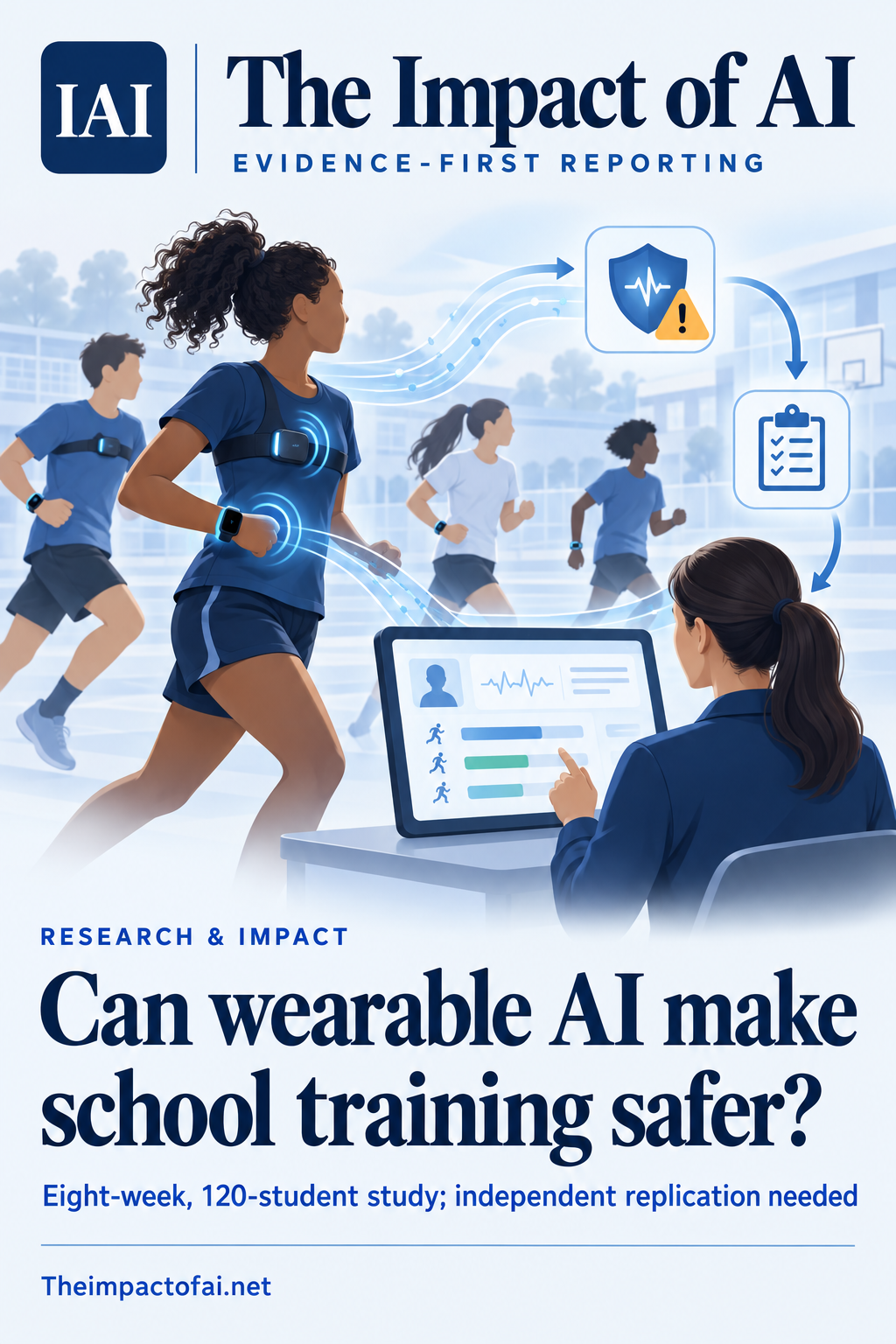
A single-campus, eight-week study of 120 students reported stronger fitness gains and fewer injuries with AI-guided plans. Teachers knew the allocation, and independent replication is still required.
Editorial responsibility: The Impact of AI Editorial Desk · Report a factual concern
At a glance
- 1The system combined wearable streams sampled at 1, 50 and 100 Hz with edge preprocessing, spatiotemporal feature fusion, multi-task assessment and multi-objective Actor-Critic plan support.
- 2On the authors' campus dataset it reported ability-assessment MAE of 2.18, risk-warning recall of 95.8%, plan adaptability of 94.7% and a mean 185 ms response time with 200 concurrent users.
- 3In an eight-week controlled teaching study of 120 students, the intervention arm had 32.4% higher reported overall improvement efficiency and injury incidence of 1.7% versus 13.3%; teacher awareness of allocation and the single institution limit causal and general claims.
Research topic
An integrated wearable-sensing and Actor-Critic decision-support framework for personalised university physical-education training
The direct answer: encouraging in one campus study, not proven across schools
A wearable-data system linked to AI-generated training guidance was associated with stronger fitness gains and fewer recorded injuries during an eight-week physical-education study, but the experiment was conducted at one institution and teachers knew which students received the intervention. Zhengxiong Dai reports a total of 120 participants. The intervention group improved more than the control group across the reported fitness outcomes, with an overall improvement-efficiency measure 32.4% higher. Injury incidence was 1.7% in the intervention group and 13.3% in the control group.
That difference is potentially important for students and teachers, yet it is not a general proof that wearable AI makes exercise safer. The total denominator is clear, but the result still depends on how students were allocated, how an injury was defined and recorded, whether the groups started with comparable risk, and what teachers changed after seeing system recommendations. Teacher awareness can affect instruction, encouragement and reporting. The authors explicitly identify that awareness and the single-institution design as limits on causal interpretation and generalisability.[1]
The system joins sensing, assessment and plan support
The technical contribution is an end-to-end design for physical education rather than a new learning algorithm. Wearable inputs arrived at heterogeneous rates, including 1, 50 and 100 Hz. Edge processing cleaned and aligned those streams before a spatiotemporal fusion component combined them. Multi-task models estimated student ability and risk, while a multi-objective Actor-Critic component proposed adjustments intended to balance training effectiveness, injury-risk control and plan adaptability. Individual baseline calibration was used to avoid treating the same physiological value as equivalent for every student.
A teacher-facing decision-support framing is preferable to unattended control, but the paper's technical scores need the same scrutiny as the teaching result. On the self-built campus dataset, the authors report a mean absolute error of 2.18 for ability assessment with R² of 0.962, risk-warning recall of 95.8%, and plan adaptability of 94.7%. A load test supported 200 concurrent users with mean response time of 185 milliseconds. These metrics answer different questions: prediction error, sensitivity to labelled risk, agreement with a plan criterion and computing latency. None alone establishes injury prevention, long-term learning or safe performance with new devices and campuses.[1]
The controlled study adds outcomes but leaves causal uncertainty
The eight-week comparison is stronger evidence than a model benchmark because it measured students during actual teaching. The reported advantage covered fitness outcomes and injury incidence rather than only technical accuracy. It also evaluated the integrated workflow: wearable collection, model inference, plan adjustment and teacher delivery. That makes the result relevant to education leaders considering whether a technically capable system can function at classroom scale.
However, the article's own qualification is decisive. When teachers know allocation, the intervention includes more than software. They may supervise one group more closely, alter training intensity, reinforce adherence or classify minor events differently. A single university also concentrates instructor practice, facilities, climate, student age, baseline fitness and device maintenance. The study does not establish which part of the package produced the difference, whether benefits persist after eight weeks, or whether the same risk thresholds are appropriate for another sport, school or population. Replication should separate the effect of monitoring, personalised feedback and algorithmic optimisation.[1]
Practical value depends on teacher authority and data governance
Used carefully, continuous sensing could alert a teacher when a student's workload or recovery pattern differs from their baseline, helping staff vary intensity instead of applying one plan to an entire class. It may also give students more specific feedback about pacing and progress. But a high recall figure can coexist with many false alerts, and the public headline results do not supply enough information to judge alert burden in a new setting. Excessive warnings could distract teachers, stigmatise students or encourage unnecessary withdrawal from activity.
The system also collects physiological and movement data in an educational context. Schools need clear rules on consent, access, retention, deletion, security and whether data may affect grading or participation. Students should be able to challenge an inaccurate profile, and non-participation should not become a penalty. Teacher review must be substantive: staff need the authority and information to override a recommendation, plus training to recognise sensor failure or a plan that conflicts with a student's health needs. A rapid response time is operationally useful only when the surrounding governance is equally ready.[1]
What would change the assessment
The next persuasive test would be a pre-registered, adequately powered, multi-campus randomised study with concealed allocation where feasible and outcome assessors who do not know group assignment. It should publish group denominators, attrition, adherence, the definition and severity of each injury, class-specific warning precision and recall, and confidence intervals for both fitness and safety outcomes. A comparison that gives the control group equivalent wearable attention without adaptive AI would help isolate the contribution of the decision system.
Evidence should also cover different sports, devices, ages, baseline fitness levels and students with disabilities or health conditions. Independent teams should test whether the self-built dataset, feature pipeline and risk labels can be reproduced. The article reports support from a 2025 Hunan Provincial Sports Bureau project on college basketball teaching, ethics approval from Hunan University of Arts and Science, written consent from participants or guardians, and no competing interests. That disclosure does not invalidate the findings; it clarifies the institutional context in which independent replication is most valuable. For now, the work supports a monitored pilot with teacher control—not automatic adoption as a proven injury-prevention system.[1]
What this means for people
- Students could receive training plans better matched to their baseline and recovery, but false warnings or inaccurate profiles could restrict participation unfairly.
- Teachers may gain faster feedback, while remaining responsible for interpreting recommendations and recognising sensor or model failures.
- Families and institutions need assurance that physiological and movement data will not be repurposed for grading, discipline or unrelated surveillance.
Global context
The study was conducted at Hunan University of Arts and Science in China and was funded through a provincial sports project focused on college basketball teaching. Physical-education curricula, class sizes, climate, facilities, device access and data-protection rules vary widely across countries. The integrated design may be portable in principle, but its thresholds and teaching workflow require local validation; a result from one Chinese university should not be treated as evidence for children, schools or sports systems everywhere.
What the evidence does not yet show
- The controlled teaching study involved 120 participants over eight weeks at a single institution.
- Teachers were aware of allocation, which can change supervision, encouragement, plan delivery and injury reporting.
- The integrated intervention does not isolate the effects of wearable monitoring, personalised feedback, teacher behaviour and Actor-Critic optimisation.
- Technical performance was measured on a self-built campus dataset; independent external replication was not reported.
- Risk-warning recall does not by itself report false-alert burden, calibration or performance across student subgroups.
- The study was funded by a Hunan Provincial Sports Bureau project; the author declared no competing interests.
What to watch next
- Pre-registered randomised multi-campus trials with blinded outcome assessment and published group denominators.
- Injury severity, adjudication, confidence intervals and alert precision as well as recall.
- Comparisons that isolate adaptive AI from the effects of devices, extra attention and teacher coaching.
- Independent reproduction of the campus dataset pipeline across sports, devices and student populations.
- Governance for consent, retention, access, grading, opt-out and correction of inaccurate student profiles.
Living evidence record
Impact record IAI-132IBQE
Evidence stage
Studied
Confidence
Supported
Reporting basis
Source analysis
Independent or research support
Present
Record status
Monitoring
Last checked
8 October 2026
Source trail
1 direct source across 1 source type.
People impact
Documented in this record.
Uncertainty
Limits and next checks are explicit.
Stages describe the evidence available—not whether a technology is good or bad. See the public method.
Single-source reporting disclosure
This record analyses one direct source. It can establish what Scientific Reports published or reported, but it is not independent corroboration of every performance claim or predicted outcome. The confidence label will change only when broader evidence is added.
Evidence trail
Sources used for this report
Links checked 8 October 2026
This report is labelled source analysis. We summarise and analyse source material in our own words; company statements remain attributed claims until independently supported. Translated summaries preserve the meaning of the original source and link back to it. Read our editorial standards.
Continue the story
Related reporting
Education
Did ChatGPT improve writing scores in a 16-week Taiwan course?
Twelve university students used ChatGPT throughout a five-stage inquiry-writing course. Their closed-book writing scores rose by 2.79 points, but the change was not statistically significant and the study had no comparison group.
8 min · 1 source
Education
Can AI avoid overreacting to one wrong answer?
A diffusion-based knowledge-tracing model led four educational benchmarks, including difficult response reversals. The evaluation reuses folds for early stopping and scoring and does not test classroom decisions.
8 min · 2 sources
Education
Does bilingual AI dialogue improve learning?
In a Karnataka field study, AI dialogue increased interest and self-efficacy but did not produce reliably larger knowledge gains than written responses. Bilingual voice reduced some participation barriers, while dialogue had lower completion. The work is an unreviewed preprint.
8 min · 1 source
The Impact Brief
Keep the evidence trail, not the noise.
Get the most consequential AI developments with direct sources and clear limits.
Reader commentary
Add evidence, experience or a question
No account is required. Reader notes are published after a brief civility, relevance and safety check; disagreement is welcome.
Explore commentary across the portal →Published reader notes
0No published reader notes yet. You can start the evidence-led discussion above.
Prefer a private correction or response? Contact the newsroom.