Does algorithmic scheduling drive hotel-worker burnout?
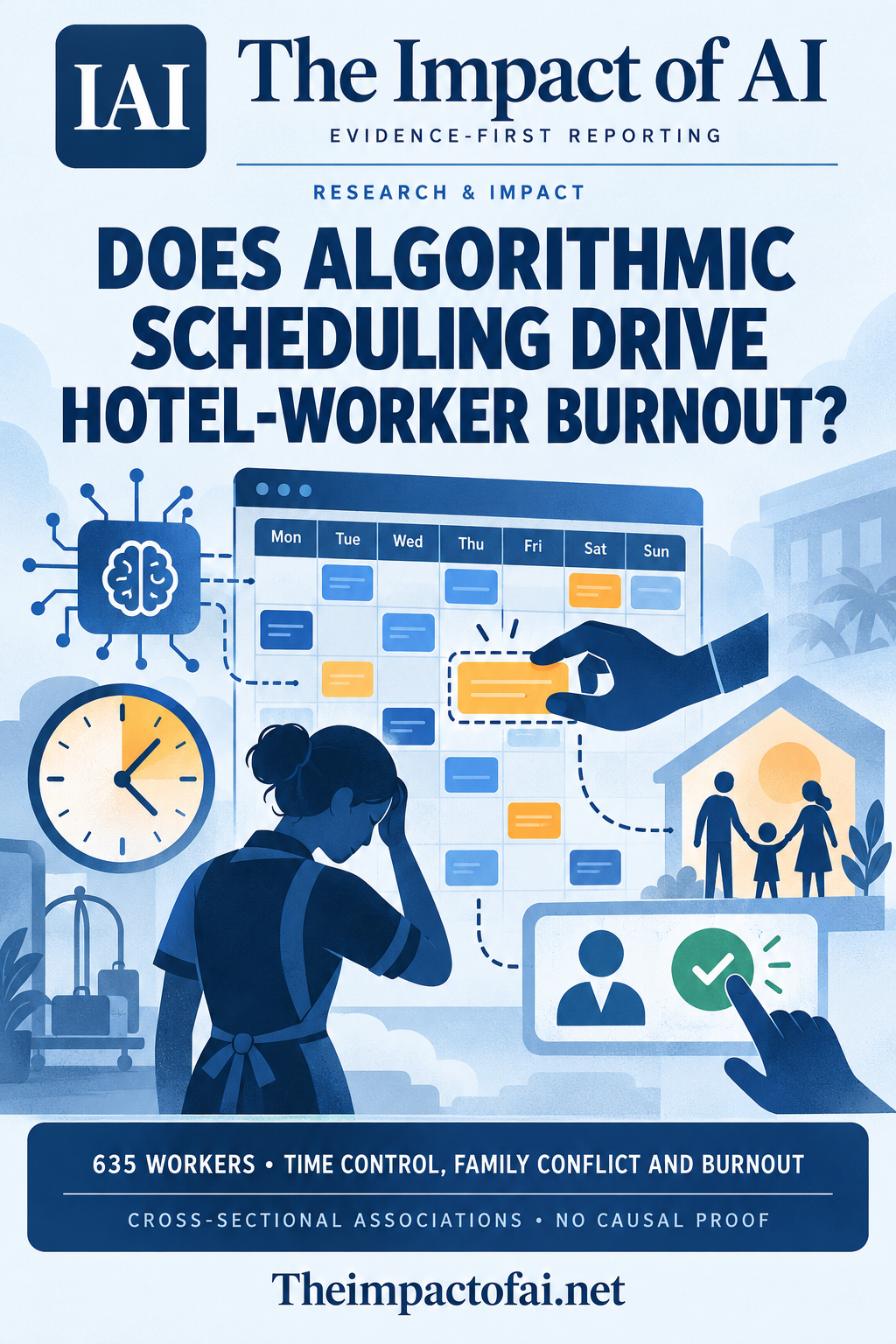
A peer-reviewed survey of 635 hotel workers in Shandong links greater exposure to algorithm-influenced schedules with less control over time, more work–family conflict and higher burnout. The pathway remained after adjustment but weakened substantially, and the one-time self-report design cannot prove that scheduling software caused the outcomes.
Editorial responsibility: The Impact of AI Editorial Desk · Report a factual concern
At a glance
- 1The one-time survey retained 635 frontline employees from 3–5-star hotels in Shandong who said an automated or electronic system had influenced their schedule within the previous three months.
- 2The proposed serial pathway—scheduling exposure to low time control to work–family conflict to burnout—was statistically positive, but its indirect coefficient fell from 0.053 to 0.023 after adjustment for working hours, night work and family circumstances.
- 3Supportive supervisors weakened the link between scheduling exposure and low time control, but did not remove it; the study did not audit schedules, software or management decisions and cannot establish causality.
Research topic
Associations between algorithm-influenced scheduling, employee time control, work-family conflict, supervisor support and burnout in hotels
The direct answer: the study finds a warning signal, not causal proof
The study does not prove that an algorithm caused hotel workers to burn out. It finds a coherent association: employees reporting more exposure to algorithm-influenced scheduling also reported less control over their time; lower control was associated with more work–family conflict; and conflict was associated with higher burnout. The estimated serial indirect pathway was positive in both the main and adjusted analyses, but it became less than half as large after the researchers accounted for several work and family factors.
That attenuation is central to an evidence-first reading. In the unadjusted structural model, the serial indirect coefficient was 0.053 with a bootstrapped 95% confidence interval of 0.037–0.072. After adjustment for weekly hours, night work, relationship status, children and caregiving, it was 0.023 with an interval of 0.013–0.037. The remaining association warrants attention, but the change shows that working conditions and family circumstances explain a meaningful part of the pattern.[1]
Who was studied and how
The researchers approached 12 candidate 3–5-star hotels in Shandong through university–industry links and used purposive convenience access rather than probability sampling. Between May and June 2026, they collected 710 anonymous questionnaires and retained 635, an 89% usable response share. Eligibility required participants to be at least 18, work in a frontline or operational role, have at least three months’ tenure and report that an automated or electronic system had generated, revised or influenced their schedule during the preceding three months.
The retained group included 141 front-office workers, 149 in housekeeping, 160 in food and beverage, 79 in kitchens, 61 in banquets or events and 45 in other functions. Because the paper does not identify participating hotels or report a probability frame, those 635 responses should not be treated as a representative estimate for all hotel workers in Shandong, China or the wider hospitality industry.[1]
What the survey measured
Algorithmic-scheduling exposure was measured with four self-report items on a seven-point scale. Low time control used three five-point items covering unpredictable hours, short notice and difficulty obtaining requested time off. Work–family conflict used five seven-point items, burnout used a 0–100 measure, and family-supportive supervisor behaviour used four five-point items. These are perceptions and reported experiences, not extracts from a roster system or health records.
The researchers used partial least-squares structural equation modelling and 10,000 bootstrap samples. In the principal model, scheduling exposure was associated with low time control at β=0.338 and directly with work–family conflict at β=0.276. Low time control was associated with conflict at β=0.318, while conflict was associated with burnout at β=0.493. These standardized coefficients describe relationships within the fitted survey model; they are not percentage increases in risk and should not be translated into a worker-level prediction.[1]
Supportive managers helped, but did not erase the pattern
Family-supportive supervisor behaviour moderated the scheduling-to-control relationship: the interaction coefficient was −0.116. In practical terms, employees who experienced more understanding and practical support from supervisors reported a weaker connection between algorithmic scheduling and loss of time control. Even at high support, however, the relationship remained positive. A helpful manager may buffer an inflexible system, but the study does not show that manager behaviour can fully compensate for short notice or limited worker input.
This supports a combined organisational response. Hotels can train supervisors to discuss constraints and accommodate family needs, while also changing the scheduling process itself: publish shifts earlier, allow swaps, preserve human override, document reasons for revisions and offer a usable appeal route. The paper did not test any of those interventions, so they remain plausible responses to the measured mechanisms rather than proven burnout treatments.[1]
Why the algorithm label needs care
The eligibility definition combined schedules generated, revised or influenced by automated or electronic systems. The researchers did not inspect vendor software, optimisation objectives, staffing data, manager overrides or actual notice periods. A basic electronic roster, a forecasting tool and a highly automated optimisation system could therefore fall under the same exposure category. Management policy may be as important as the software: the same tool can be configured to prioritise stable shifts or rapid labour-cost adjustments.
The survey also did not measure several properties that would help explain worker experience, including system transparency, perceived fairness, negotiability and the accuracy of workload forecasts. Calling the result an effect of ‘AI’ would go beyond the evidence. The defensible finding concerns perceived exposure to algorithm-influenced scheduling and reported control, conflict and burnout within this sample.[1]
What the design cannot resolve
All central variables were self-reported at one time point. Burned-out employees may view scheduling as less controllable, low-control workplaces may adopt more automation, or an unmeasured management culture may drive both. Temporal order—the minimum requirement for a causal chain—was assumed by the model rather than observed over time. Common-method bias can also strengthen associations when exposure, mediators and outcome come from the same questionnaire.
Workers were nested within hotels, yet hotel identifiers were not collected, so the analysis could not use multilevel or cluster-robust methods. If people in the same property share managers and scheduling practices, conventional confidence intervals may be too narrow. The sensitivity model’s attenuation reinforces the possibility of residual confounding. These limits do not make the associations meaningless; they prevent the study from estimating how much changing software or policy would reduce burnout.[1]
What would change the assessment
Stronger evidence would combine administrative schedule logs with repeated worker surveys before and after a clearly defined system or policy change. Researchers could measure notice time, shift volatility, employee requests, overrides and actual hours, then analyse workers within hotels using cluster-aware models. A stepped rollout or randomized organisational intervention could test whether stable scheduling, worker input and appeal rights improve control and reduce burnout.
Replication should include different countries, hotel tiers and jobs with different bargaining power. Independent audits should distinguish the scheduling algorithm from the management rules around it. The paper reports funding from the Shandong Social Science Planning Fund, no commercial conflict and no generative-AI use in manuscript preparation. For now, the study justifies closer monitoring and worker-centred safeguards—not a claim that one technology has been shown to cause burnout.[1]
What this means for people
- Unpredictable shifts can make childcare, eldercare, transport, rest and family time harder to plan even when total weekly hours do not change.
- Supportive supervisors may reduce the loss of time control, but workers also need scheduling rules that preserve notice, input and a route to challenge unsuitable shifts.
- Employers should not use this one survey to diagnose individual burnout or assume software alone is responsible; it is a prompt for better measurement and policy trials.
Global context
Algorithmic management is spreading across hospitality, retail, logistics and platform work, but labour law, staffing norms and worker voice differ sharply by country. This Shandong study offers a detailed mechanism to test elsewhere rather than a universal effect estimate. The strongest global lesson is to evaluate both the software and the organisational rules that determine how much control workers retain.
What the evidence does not yet show
- The cross-sectional design cannot establish whether scheduling exposure preceded or caused work–family conflict or burnout.
- Exposure, mediators and outcomes were self-reported in the same questionnaire, creating possible common-method and perception bias.
- Convenience recruitment through 12 candidate hotels does not provide a representative sample of Shandong or global hospitality workers.
- Hotel identifiers were not retained, preventing cluster-adjusted or multilevel analysis of workers sharing the same workplace.
- The study did not audit software, schedules, algorithms, vendor systems or manager overrides, so it cannot identify which technical or policy features matter.
What to watch next
- Longitudinal and intervention studies using actual schedule logs and repeated wellbeing measures.
- Cluster-aware results that separate hotel-level management practices from worker-level perceptions.
- Tests of advance notice, shift-swap rights, employee input, human override and appeal mechanisms.
- Replication across countries, employment arrangements and service sectors beyond hotels.
Living evidence record
Impact record IAI-1CGKO97
Evidence stage
Studied
Confidence
Supported
Reporting basis
Source analysis
Independent or research support
Present
Record status
Monitoring
Last checked
7 October 2026
Source trail
1 direct source across 1 source type.
People impact
Documented in this record.
Uncertainty
Limits and next checks are explicit.
Stages describe the evidence available—not whether a technology is good or bad. See the public method.
Single-source reporting disclosure
This record analyses one direct source. It can establish what Frontiers in Psychology published or reported, but it is not independent corroboration of every performance claim or predicted outcome. The confidence label will change only when broader evidence is added.
Evidence trail
Sources used for this report
Links checked 7 October 2026
This report is labelled source analysis. We summarise and analyse source material in our own words; company statements remain attributed claims until independently supported. Translated summaries preserve the meaning of the original source and link back to it. Read our editorial standards.
Continue the story
Related reporting
Work & Skills
Can AI agents configure complex contract workflows?
OpenAI reports that GPT-6 Astra scored 55.0% across 11 Ironclad tasks versus 41.6% for GPT-5.6 Sol, while simulated time fell from 37.0 to 19.2 minutes. The company-run benchmark shows progress—not autonomous legal work or measured customer productivity.
7 min · 1 source
Work & Skills
Who is gaining from AI at work?
A Gallup survey of 15,482 US employees finds that regular AI users report more speed, creativity and work quality, but frequent use is concentrated among graduates, managers and workers who already have better jobs. The results are self-reported associations, not a productivity trial.
8 min · 2 sources
Work & Skills
Should AI wait until people think first?
In an unreviewed study of 398 adults across five countries, a writing assistant withheld direct generation until users stated a position and supporting argument. The design shifted effort earlier and improved one conditional error-classification measure, but did not significantly improve overall judgment accuracy.
8 min · 2 sources
The Impact Brief
Keep the evidence trail, not the noise.
Get the most consequential AI developments with direct sources and clear limits.
Reader commentary
Add evidence, experience or a question
No account is required. Reader notes are published after a brief civility, relevance and safety check; disagreement is welcome.
Explore commentary across the portal →Published reader notes
0No published reader notes yet. You can start the evidence-led discussion above.
Prefer a private correction or response? Contact the newsroom.