Does a strong physics benchmark make a reliable AI tutor?
Not by itself. A peer-reviewed German study found a locally hosted Gemma 3 27B answered a 731-item physics benchmark well, yet in a 32-student classroom exercise only 17 surveys were returned, 14 reported prompt reformulation and no learning gains were measured.
Editorial responsibility: The Impact of AI Editorial Desk · Report a factual concern
At a glance
- 1The researchers built a 731-question German Physics 101 benchmark and ran 16 complete exams for each of three quantized Gemma 3 27B configurations on local hardware.
- 2A classroom exercise involved 32 first-semester engineering students, but only 17 submitted surveys; 14 of those 17 said they reformulated at least one request.
- 3Student work was not collected or graded, there was no control group and no learning gain was measured. The study supports field testing, not a verdict on tutoring effectiveness.
Research topic
Whether strong single-turn physics benchmark performance transfers to useful multi-turn tutoring in an undergraduate classroom
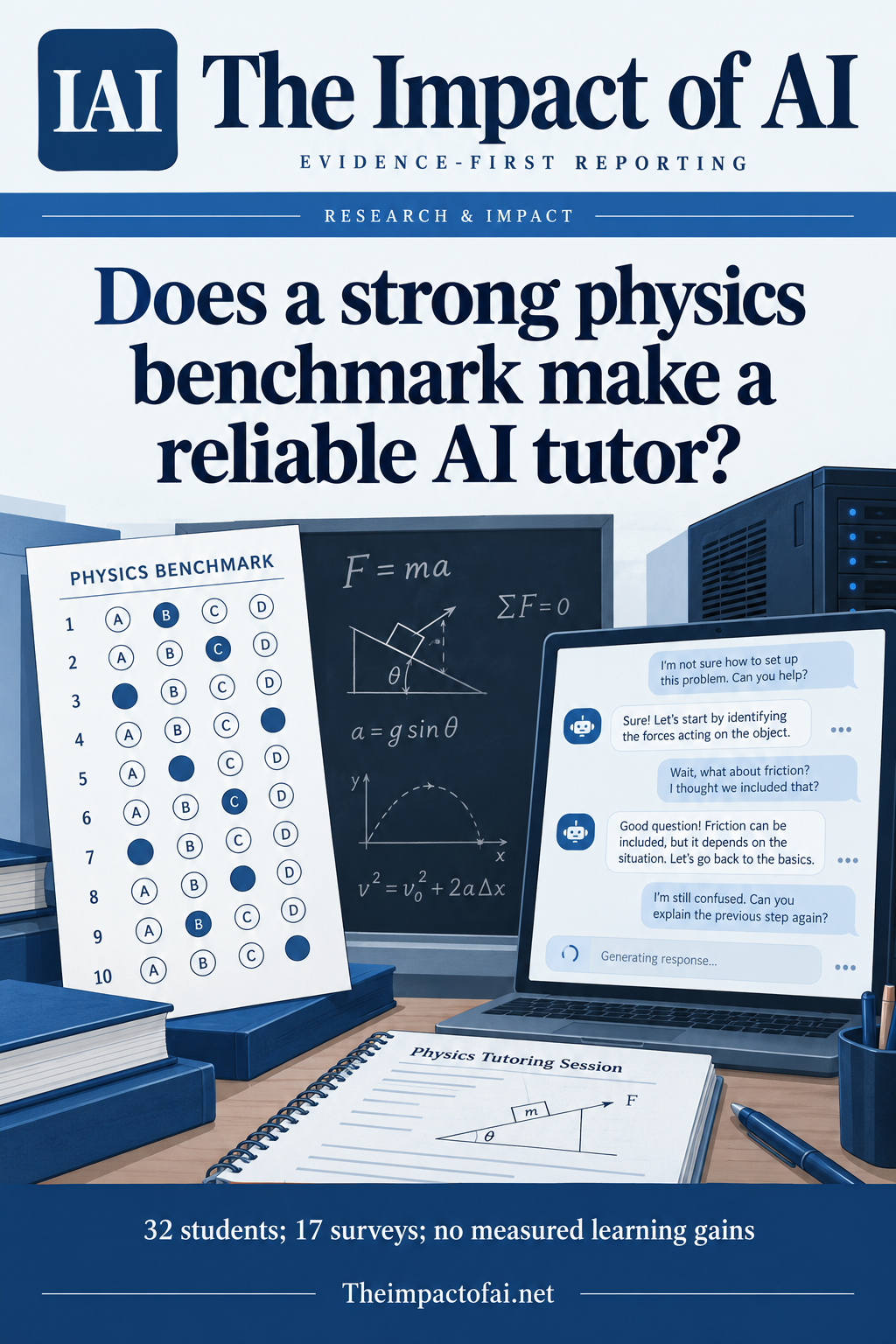
The direct answer: benchmark competence did not guarantee tutoring reliability
The locally hosted model knew a great deal of introductory physics under controlled conditions, but the classroom experience exposed a different problem. Gemma 3 27B scored highly across a 731-question German multiple-choice benchmark, although it remained below a commercial cloud baseline and was more variable on conceptual and multi-step tasks. When students used the same local model as a conversational tutor, explanations were often understandable but context handling, correctness, speed and the need to rephrase questions limited its usefulness.
This is not evidence that the tutor reduced learning or that local models are unsuitable for education. It is evidence that answer accuracy and tutoring quality are different constructs. A benchmark asks a self-contained question with five choices. Tutoring requires the system to interpret an incomplete request, remember quantities and earlier turns, diagnose a misconception, choose how much help to give and respond quickly enough to support concentration.[1]
The benchmark covered 731 questions, not open-ended teaching
The authors adapted a public Physics 101 question bank, removing image-dependent and duplicate items to leave 731 tasks. These included 136 definition questions, 125 factual questions, 203 conceptual questions, 204 single-step calculations and 63 multi-step calculations. Questions were translated into German with a model and reviewed by a trained physicist who was a native German speaker. The source material had been available online, so contamination of model training data could not be excluded.
Three quantized versions of Gemma 3 27B were served through llama.cpp on institutional hardware with a 48 GB GPU memory limit. Each configuration took 16 complete exams using different random seeds. Across 34,357 generated responses, the parser extracted an answer in all but one case. This repeated design examined variability, but scoring focused on the final option letter. The paper explicitly says the explanations were not checked systematically for coherent or correct reasoning.[1]
The classroom exercise was small and exploratory
Thirty-two first-semester electrical and information engineering students attending a Physics 1 lecture worked on a mock exam with three multi-part problems. They could use a calculator and the local chatbot. The exam structured their interaction; solutions were not collected and graded as study outcomes. There was no comparison group using another tutor, no pre-test or post-test and no attempt to estimate a learning effect.
Seventeen students submitted the follow-up questionnaire. Overall helpfulness averaged 2.7 out of 5, while explanation comprehensibility averaged 3.4 and support for fundamental concepts 3.5. Confidence in the obtained solution averaged 2.9 among 16 respondents. These descriptive responses are informative about usability, but the denominator is small and self-selected: fifteen attending students did not submit the survey.[1]
Reformulation and lost context were the clearest warning
Fourteen of the 17 survey submissions reported reformulating a request at least once to obtain a satisfactory answer; nine said they did so more than once. Only seven respondents said unambiguously that the chatbot understood their questions, eight said it did not and two gave qualified answers. Free-text comments described incorrect numerical values, formulas that were not always right and failures to retain quantities or other information supplied earlier.
Response speed ranked last for 14 of 17 respondents. The local deployment gave the institution control over model hosting and conversational data, but parallel use on one server created latency. This trade-off matters: privacy and operational control can favour a local model, while slower responses and weaker multi-turn performance can undermine the activity it is meant to support.[1]
Privacy was designed into the prototype, with caveats
The tutoring interface did not persist ordinary chat history beyond a browser refresh. Students could deliberately save a response by marking it with a thumbs-up or thumbs-down, after which it was stored in a protected folder. That design reduces routine data retention and illustrates one reason a university may consider local hosting. It does not establish the security, accessibility or compliance of a production service.
The paper reports that students participated voluntarily and were briefed, but no formal ethics approval or waiver was obtained before the field experiment. Institutional permission came from the university chancellor and the responsible lecturer. That disclosure does not invalidate the observations, but it is relevant when institutions use student interactions to assess emerging educational systems and should encourage clearer prospective governance for future trials.[1]
What universities can use now
The practical lesson is to evaluate the whole tutoring service, not buy or reject a model from a leaderboard. Procurement and teaching teams should test multi-turn memory, explanation quality, misconception handling, accessibility, response time under concurrent load and escalation when the system is unsure. They should specify which interactions are retained, who can inspect flagged conversations and how students can challenge incorrect guidance.
A benchmark can still be useful as a minimum knowledge check. The new multilingual question set may help institutions compare local configurations under reproducible conditions. But a high option-selection score cannot show that a student learns, becomes more confident or receives an explanation matched to their needs. The paper’s classroom component usefully demonstrates the gap while remaining too small to quantify it.[1]
What would change the assessment
A stronger study would randomly assign students to the local tutor, an alternative tutoring system and ordinary teaching support; collect baseline knowledge; grade blinded pre- and post-tests; and track delayed retention. Independent experts should rate a sampled set of conversations for physical correctness, pedagogical quality, harmful misconceptions and whether hints reveal answers prematurely. System logs could measure latency and context failures without retaining unnecessary personal data.
Larger, multi-course and multilingual trials would show whether these results generalise beyond one German engineering cohort and one model version. The authors declare no competing interests, and the article acknowledges NASA-funded use of the Astrophysics Data System but does not report a study funding grant. Until controlled learning evidence exists, the fairest conclusion is modest: local models can know the subject while still needing substantial product and pedagogical testing before they can be trusted as tutors.[1]
What this means for people
- Students can benefit from on-demand explanations, but repeated reformulation shifts work onto learners who may already be struggling.
- Local hosting can improve institutional control over data while creating capability and infrastructure trade-offs.
- Teachers need evidence about learning and errors, not just benchmark accuracy, before integrating a tutor into assessed work.
Global context
Universities worldwide are weighing local open models against more capable cloud services. Data protection, language coverage, cost and infrastructure vary, so no deployment choice transfers automatically. The study’s most general contribution is methodological: combine a knowledge benchmark with realistic multi-turn use and keep the two results separate.
What the evidence does not yet show
- The classroom exercise involved 32 attending students and only 17 submitted surveys.
- There was no control group, pre-test, post-test, graded outcome or measured learning gain.
- The benchmark questions were public and may have appeared in training data; multiple-choice scoring did not validate explanation quality.
- One German first-year engineering cohort and one model deployment cannot establish broad educational effectiveness.
- No formal ethics approval or waiver was obtained before the field exercise, although institutional permission and voluntary participation were reported.
What to watch next
- Randomised studies comparing local and cloud tutors against ordinary teaching support.
- Blinded expert review of explanation correctness and misconception handling.
- Learning retention, accessibility and equity outcomes rather than satisfaction alone.
- Latency and context reliability when many students use a local service simultaneously.
Living evidence record
Impact record IAI-0NS5JID
Evidence stage
Studied
Confidence
Supported
Reporting basis
Source analysis
Independent or research support
Present
Record status
Monitoring
Last checked
7 October 2026
Source trail
1 direct source across 1 source type.
People impact
Documented in this record.
Uncertainty
Limits and next checks are explicit.
Stages describe the evidence available—not whether a technology is good or bad. See the public method.
Single-source reporting disclosure
This record analyses one direct source. It can establish what Discover Artificial Intelligence published or reported, but it is not independent corroboration of every performance claim or predicted outcome. The confidence label will change only when broader evidence is added.
Evidence trail
Sources used for this report
Links checked 7 October 2026
This report is labelled source analysis. We summarise and analyse source material in our own words; company statements remain attributed claims until independently supported. Translated summaries preserve the meaning of the original source and link back to it. Read our editorial standards.
Continue the story
Related reporting
Education
Vietnamese AI tutoring preprint puts local curriculum and data control at the centre
DeepEdu-v1 reports faster serving and stronger results on its selected agent tasks. Its local-design argument is significant, but no study of classroom learning or student safety is reported in the abstract.
4 min · 1 source
Education
Are Kurdistan universities ready to govern generative AI?
Not visibly, according to a peer-reviewed audit of 30 university websites. Twenty-one institutions were in the study's lowest readiness stage and only two showed direct public GenAI guidance—but the audit measured published evidence in June 2026, not confidential policy or actual classroom practice.
9 min · 2 sources
Education
Can AI make clinical skills exams fairer?
An Oxford study found that an examiner-aware AI second marker improved agreement with a panel-derived reference across 442 ratings from 120 students, especially for borderline fails. That is an audit result in virtual-reality exams—not proof of fairer real-world assessment or a licence for automated grading.
9 min · 1 source
The Impact Brief
Keep the evidence trail, not the noise.
Get the most consequential AI developments with direct sources and clear limits.
Reader commentary
Add evidence, experience or a question
No account is required. Reader notes are published after a brief civility, relevance and safety check; disagreement is welcome.
Explore commentary across the portal →Published reader notes
0No published reader notes yet. You can start the evidence-led discussion above.
Prefer a private correction or response? Contact the newsroom.