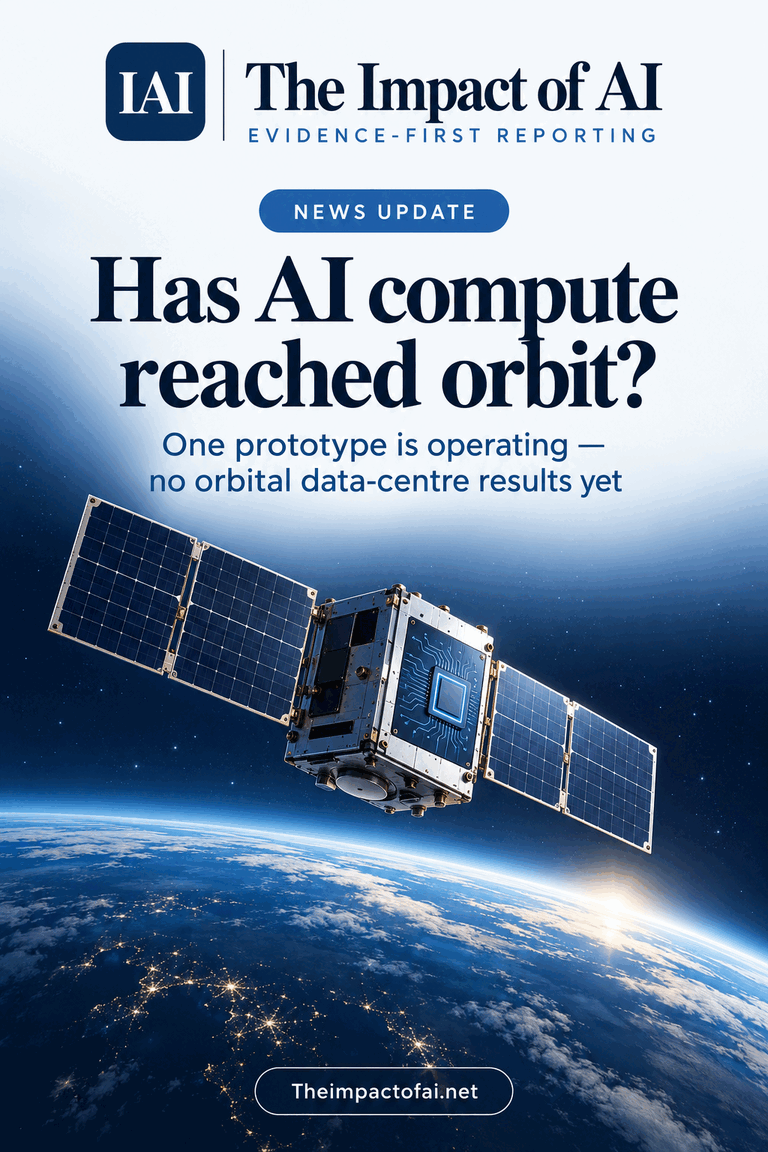
Has AI compute reached orbit?
Google says a Project Suncatcher prototype satellite launched on 1 October, made contact and is operating as expected. A peer-reviewed systems paper explains the larger ambition—but one test satellite is not an orbital AI data centre, and no in-orbit compute result has been reported.
Editorial responsibility: The Impact of AI Editorial Desk · Report a factual concern
Research topic
Whether today's prototype and ground evidence support Google's proposed solar-powered orbital AI infrastructure design
At a glance
- 1Google says one Project Suncatcher prototype satellite launched on 1 October 2026, made contact and is operating as expected. The company has not reported an AI workload completed in orbit.
- 2A peer-reviewed Google-authored systems paper models an 81-satellite cluster within a one-kilometre radius, estimates roughly 10 terabits per second of aggregate inter-satellite traffic and reports ground—not orbital—tests of optical links and TPU radiation exposure.
- 3The economic case depends heavily on launch prices falling to around $200 per kilogram. Thermal management, maintenance, ground communications, collision safety and system reliability remain unresolved.
The Impact Brief
Keep the evidence trail, not the noise.
Get the most consequential AI developments with direct sources and clear limits.
Living evidence record
Impact record IAI-0RGOLEF
Evidence stage
Announced
Confidence
Corroborated
Reporting basis
Source analysis
Independent support
Present
Record status
Monitoring
Last checked
3 October 2026
Source trail
4 direct sources across 3 source types.
People impact
Documented in this record.
Uncertainty
Limits and next checks are explicit.
Stages describe the evidence available—not whether a technology is good or bad. See the public method.
Related-source reporting disclosure
This record analyses 4 linked source records around the same underlying development. The extra records add method, date or context, but they do not by themselves constitute independent replication of every performance claim or predicted outcome.
One test satellite is operating; the larger claim remains a research programme
Google confirmed on 1 October that a Project Suncatcher prototype built with Planet had launched aboard SpaceX's Transporter-18 mission. The company says it established contact and that the spacecraft is operating as expected. That is the new event: hardware associated with the programme is now in orbit rather than only on a test bench.
The satellite's immediate purpose is narrower than the project's name may suggest. Google says it will collect data on how a Tensor Processing Unit and supporting hardware respond to physical stress, radiation and thermal extremes. The announcement does not say the spacecraft has trained a model, served an inference, exchanged high-speed data with another satellite or sustained the heat load of data-centre-class computing.
That distinction matters because ‘AI compute has reached orbit’ can mean several different things. A compute component can be switched on and monitored; a useful workload can run; a cluster can communicate; or a commercial service can deliver dependable capacity. Google's update establishes contact with one prototype. It does not establish the other steps.
Google describes Project Suncatcher as long-term research into solar-powered AI infrastructure in space. The prototype is therefore a sensor-rich engineering experiment, not proof that a fleet of orbital data centres is technically, economically or environmentally viable.[1][2]
The peer-reviewed paper models an 81-satellite cluster
Alongside the launch, a Google-authored systems paper became available in the peer-reviewed journal Joule. It develops an illustrative low-Earth-orbit architecture rather than reporting a clinical-style trial or a deployed service. All nine listed authors are affiliated with Google, which has an obvious commercial interest in the concept.
The worked example places 81 satellites inside a formation with a one-kilometre radius at a mean altitude of about 650 kilometres. In the model, next-nearest-neighbour distances oscillate between roughly 100 and 200 metres. The authors explore how such a tightly packed formation might keep relative positions while maintaining solar orientation and avoiding unacceptable collision risk.
Those simulations are useful because they expose the engineering problem: data-centre accelerators need not only power, but also frequent, low-latency communication. The paper estimates that a data-centre-scale system could require roughly 10 terabits per second of aggregate inter-satellite capacity. That is a system requirement, not a measured performance result from space.
A formation of dozens of high-value satellites would also have to tolerate failed thrusters, degraded sensors, space weather and conjunctions with other objects. The paper treats formation dynamics, but it does not demonstrate years of safe autonomous operation. A successful single launch cannot supply that evidence.[3][4]
The fastest link and radiation results were obtained on the ground
For communications, the paper reports a bench demonstration of 800 gigabits per second in one direction and 1.6 terabits per second bidirectionally over a short free-space optical path. The authors discuss combining wavelengths and spatial channels to move toward the much larger aggregate requirement. But the experiment was not a link between satellites passing through orbital vibration, pointing error and thermal cycles.
Google's public roadmap calls for a separate two-satellite optical-link experiment in 2027. That planned test is the more relevant milestone for whether very high bandwidth survives real formation flight. Until results are published, the ground link should be read as a component demonstration, not evidence that a distributed orbital accelerator cluster can communicate at data-centre scale.
The radiation evidence is also a ground test. A Trillium v6e TPU was exposed to a 67 megaelectronvolt proton beam. The paper estimates a shielded five-year mission would accumulate about 750 rad(Si) of total ionising dose. One chip showed no hard failure attributed to total ionising dose through 15 kilorad(Si), although its high-bandwidth memory was the most sensitive component and irregularities began after a cumulative two kilorad(Si).
The researchers estimate approximately one uncorrectable memory error per 50 rad under the tested conditions—translated, with their workload assumptions, to roughly one event per ten million inferences. They caution that training could behave differently and that more data are needed. Beam exposure cannot reproduce every particle, manufacturing variation, thermal interaction or single-event effect encountered over years in orbit.[2][3]
Solar abundance does not remove the heat problem
The attraction is straightforward. In a suitable sun-synchronous orbit, solar panels can receive near-continuous sunlight, while land use and local water consumption associated with terrestrial facilities could in principle be reduced. Google says a panel in that setting could receive up to eight times the solar energy of a panel at a mid-latitude ground site.
More available sunlight is not the same as eight times more usable computing. Conversion losses, battery or ride-through needs, radiation degradation, orientation constraints and the mass of power electronics still matter. Above all, high-performance accelerators convert most electrical input into heat, and space has no air or water to carry that heat away.
Radiators must reject heat by infrared emission. They add area and mass, affect attitude control and can face unwanted sunlight or Earth radiation. The prototype can inform component temperatures, but the launch post does not report a sustained, data-centre-level thermal load. Cooling therefore remains one of the project's central unanswered questions rather than an advantage already demonstrated.[2][3]
The cost comparison depends on a steep fall in launch prices
The paper's economic discussion asks when the annualised cost of launching power-generating hardware might approach terrestrial data-centre energy costs. For one illustrative satellite, it estimates about $14,700 per kilowatt per year at a launch price of $3,600 per kilogram, falling to roughly $810 per kilowatt per year at $200 per kilogram. The terrestrial comparison range cited is approximately $570 to $3,000 per kilowatt per year.
The lower result is conditional on launch prices falling below about $200 per kilogram in the mid-2030s. A more optimistic scenario in the paper reaches $60 per kilogram under specific assumptions about future Starship-derived capacity and learning curves. These are projections, not quoted launch prices available today.
Nor is launched power the full cost of compute. Accelerators, radiation shielding, radiators, optical terminals, propulsion, replacement spacecraft, insurance, ground networks, operations, failed launches and de-orbit capability would all affect a commercial comparison. Launch emissions and upper-atmosphere effects also need lifecycle assessment; moving electricity demand off Earth does not make the system impact-free.
A fair comparison would specify equal compute delivered, reliability, latency, lifespan and environmental boundaries. The current paper is most useful as a sensitivity analysis showing where launch cost becomes decisive. It is not a business case proving orbital computing is cheaper.[3]
What the prototype could change for people—and what it cannot yet promise
If the engineering eventually works, space-based capacity could add another location for highly parallel workloads and reduce some pressure on land, electricity grids and cooling water near terrestrial data centres. It might also concentrate supply in the hands of organisations able to finance launch fleets, spectrum, ground stations and specialised hardware.
For communities near proposed data centres, the prototype does not yet justify claims that future AI demand will leave the ground. Terrestrial facilities are being planned now, while a scalable orbital alternative would require many successful technology and regulatory milestones. Grid planners, water authorities and residents should evaluate current projects on current evidence.
There are space-side externalities too. Dense formations would add objects, manoeuvres and failure modes to an already shared orbital environment. Operators would need transparent conjunction procedures, reliable disposal, coordination with regulators and evidence that a failed spacecraft could not endanger neighbours. The public sources do not provide an end-to-end debris and collision-risk assessment for a commercial-scale fleet.
The prototype is nonetheless a meaningful experiment. In-orbit telemetry can replace some assumptions about component temperature, radiation effects and mechanical survival with observations. The responsible conclusion is therefore neither dismissal nor a declaration of success: a company has placed one relevant test article in orbit, while the proposed infrastructure remains unproven.[1][2][3]
What evidence would change the assessment
First, Google should publish the prototype's prespecified tests and denominators: operating hours, TPU workload type, power draw, throughput, temperature range, corrected and uncorrected memory errors, resets and any component degradation. Results should include failures and missing telemetry, not only selected successes.
Second, the planned two-satellite experiment should report link distance, duration, availability, bidirectional throughput, latency, pointing loss and performance through thermal cycles. Independent reproduction or third-party review would strengthen a result produced by the system's developer.
Third, a multi-satellite demonstration must show safe formation control and useful distributed computing, including recovery from a failed node. A credible economic and environmental assessment should count the complete system, launch and replacement cadence, ground infrastructure, atmospheric effects and end-of-life disposal against an equivalent terrestrial service.
Until those milestones arrive, the wording should remain precise. A prototype satellite has reached orbit and established contact. An orbital AI data centre has not.[1][2][3]
What this means for people
- Communities facing data-centre expansion should not assume one orbital prototype will reduce near-term land, grid or water demand.
- A workable orbital system could diversify compute locations, but it may also reinforce concentration among companies able to finance launch and space operations.
- Satellite operators and the public would bear collision, debris and atmospheric externalities unless fleet-scale safeguards are demonstrated and enforced.
Global context
The project joins growing interest in space-based computing, but its consequences would be global: launch and ground infrastructure may sit in a few countries while orbital congestion, atmospheric effects, spectrum use and access to AI capacity cross borders. The United States-based corporate programme will require international coordination as well as technical progress. Comparisons with terrestrial data centres also vary by region because grid carbon, water stress, land constraints, latency needs and launch access differ sharply.
What the evidence does not yet show
- The new evidence is Google's own launch announcement; no independent telemetry, in-orbit workload result or raw prototype dataset is public.
- The Joule paper is peer-reviewed but entirely Google-authored, and its 81-satellite system is a model rather than a flown constellation.
- The 1.6-terabit-per-second optical result and TPU radiation exposure were ground tests, not orbital demonstrations.
- Cost competitiveness depends on speculative future launch prices and does not include every capital, operations, reliability or environmental cost.
- Thermal management, ground communication, maintenance, dense-formation safety, debris mitigation and reliable multi-node computing remain unproven.
What to watch next
- Publication of complete in-orbit TPU, thermal and radiation telemetry from the prototype, including failure and reset counts.
- The planned 2027 two-satellite optical-link experiment and whether sustained throughput approaches system requirements in realistic conditions.
- A formation-flight and distributed-workload demonstration with transparent collision, fault-recovery and disposal evidence.
- Independent lifecycle, launch-economics and environmental comparisons with an equivalent terrestrial AI service.
Evidence trail
Sources used for this report
Links checked 3 October 2026
This report is labelled source analysis. We summarise and analyse source material in our own words; company statements remain attributed claims until independently supported. Translated summaries preserve the meaning of the original source and link back to it. Read our editorial standards.
Continue the story
Related reporting
Technology
NVIDIA designs its Vera CPU around agent workloads
NVIDIA presented Vera as a CPU optimised for AI-agent tool use, sandbox execution and other tasks that surround model inference inside large AI systems.
4 min · 1 source
Technology
Google adds a live visual avatar to its real-time Gemini model
Google introduced Gemini 3.8 Live with Live Avatar, combining spoken conversation with a real-time visual presence and pointing to a more embodied form of consumer and workplace AI interaction.
4 min · 1 source
Technology
Cloud offloading could change the performance and battery trade-off for robots
Microsoft Research reports that moving some physical-AI inference from a robot's onboard processor to edge or cloud GPUs can improve task success, efficiency and the complexity of workloads the machine can handle.
4 min · 1 source
Reader discussion
Add evidence, experience or a question
No account is required. Reader notes are published after a brief civility, relevance and safety check; disagreement is welcome.
Published reader notes
0No published reader notes yet. You can start the evidence-led discussion above.
Prefer a private correction or response? Contact the newsroom.