What does China’s new AI plan change?
China’s central authorities have put sector-wide AI deployment, research use, smart terminals and a monitoring–warning–response system inside a broader national industrial policy. The direction is consequential, but the document does not set a new technical standard, enforcement timetable or budget for the AI measures.
Editorial responsibility: The Impact of AI Editorial Desk · Report a factual concern
At a glance
- 1The policy directs broad AI deployment across traditional industries and names intelligent vehicles, AI phones and computers, humanoid robots, sector pilot bases and high-value use cases.
- 2It calls for technology monitoring, risk warning and emergency response so AI remains safe, reliable and controllable, while also strengthening compute, algorithms and data supply.
- 3The text is a high-level national direction: it does not identify AI-specific budgets, deadlines, measurable safety thresholds or the agencies responsible for each operational rule.
Research topic
How China's new national productive-forces policy links AI deployment and industrial investment to research reform, safety monitoring, data infrastructure and workforce development
The direct answer: deployment and safety are now written into one national programme
The new document places AI inside a much wider plan for what China's leaders call new quality productive forces. Its AI provisions are not a stand-alone model law. They connect research, industrial modernisation, data and compute infrastructure, smart products, sector application bases, market governance, workforce training and risk response. That makes the policy consequential: it tells central and local institutions to treat AI adoption as part of economic restructuring rather than as a narrow technology programme.
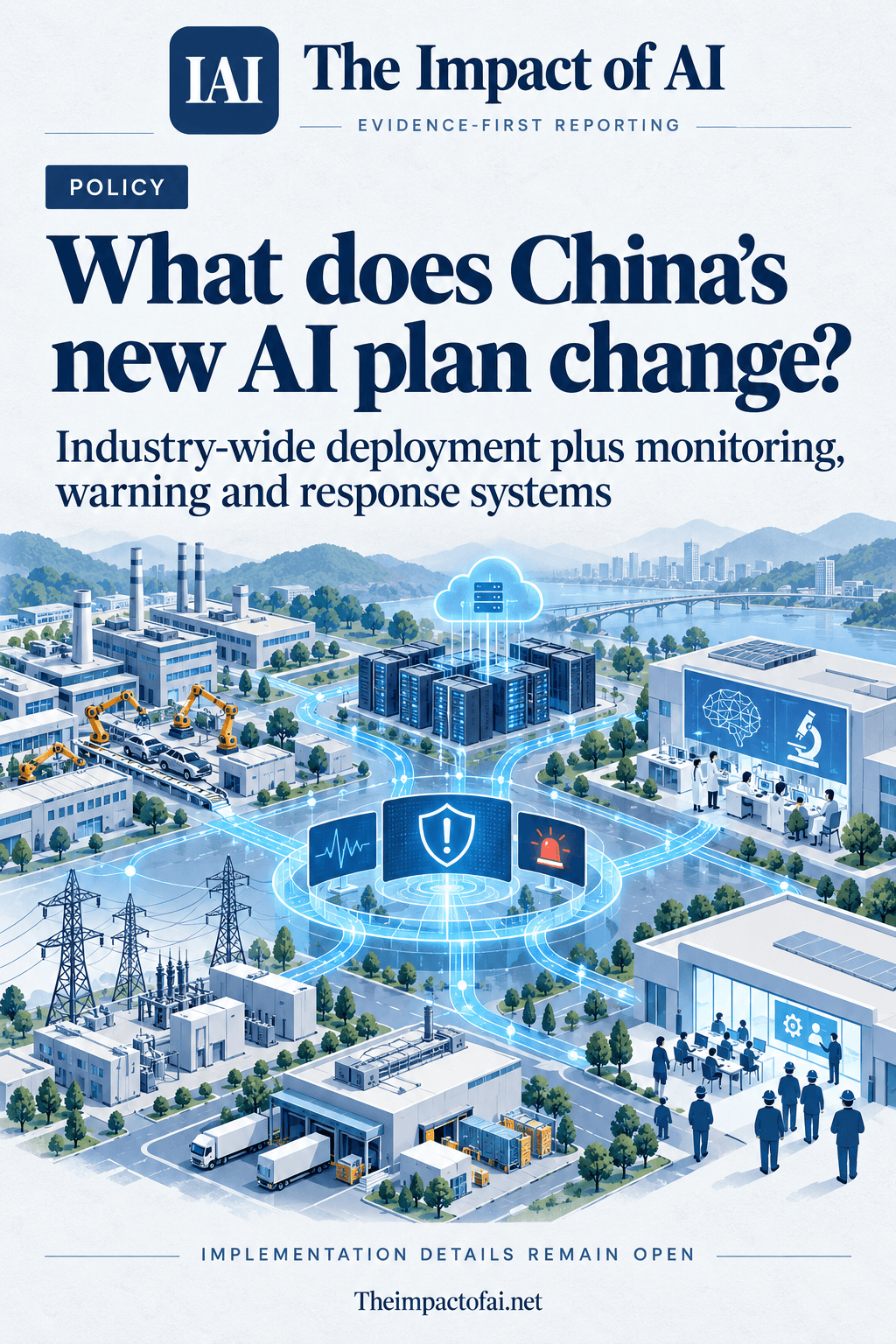
The most specific AI paragraph calls for the full implementation of the country's AI Plus initiative. It directs AI-enabled transformation of traditional industries; faster application of intelligent connected vehicles, AI phones and computers, humanoid robots and other smart terminals; stronger supply of computing power, algorithms and data; industry-specific pilot bases and high-value use cases; and technology monitoring, risk warning and emergency response. The same document says AI governance should be strengthened and warns against speculative, duplicative or loss-making investment.[1][2][3]
The Impact Brief · Free
Follow the evidence in government & policy.
Get a five-minute weekday briefing on what changed, why it matters and where the evidence comes from. Choose the topics you care about.
What the policy changes at the level of national direction
The document gives AI a role in at least four parts of the national programme. First, it says AI should lead changes in the research paradigm and improve research efficiency. Second, it embeds AI and other digital technologies in the upgrading of established sectors, including manufacturing and agriculture. Third, it promotes smart terminals and broad sector deployment through national application test bases. Fourth, it couples that expansion with monitoring and emergency-response infrastructure rather than describing deployment as an innovation-only objective.
It also situates AI within the country's data and compute architecture. The text calls for a national integrated computing network, continued work on the East Data, West Computing programme, industrial internet development and clearer data-property, trading, distribution and protection rules. These supporting measures matter because deployment depends on infrastructure and access to data, not only model capability. They also create governance questions about who can use data, how value is distributed and what oversight applies across regions and industries.[1][2]
The safety language is operational in shape but not yet an operating standard
The policy calls for a system of technology monitoring, risk warning and emergency response to keep AI safe, reliable and controllable. That sequence is more concrete than a general statement of responsible innovation. It implies observation before an incident, thresholds or signals that trigger warnings, and a capacity to respond when risk materialises. It also places safety within the same deployment paragraph as compute, algorithms, data and application bases, suggesting that governance is meant to scale with adoption.
The published text does not say what will be monitored, which harms qualify for a warning, how an emergency will be declared, what evidence providers must submit or which authority can suspend a system. It gives no technical evaluation thresholds, incident-reporting deadline, public disclosure rule or appeal mechanism. Those omissions do not make the direction meaningless; they mean the practical effect will depend on later standards, sector rules, agency assignments and enforcement practice.[1][3]
Industry policy reaches beyond model developers
The programme is aimed at the wider economy. It names the digital transformation of traditional industry, smart manufacturing, industrial internet, vehicles, consumer devices, robotics, biomedicine, advanced equipment and future industries such as embodied intelligence and brain–computer interfaces. Local and sector authorities are told to adapt measures to their circumstances rather than follow one identical template. For companies, that can mean new pilot sites, procurement opportunities, infrastructure support and expectations to integrate AI into products and operations.
The document also tries to limit familiar industrial-policy failure modes. It warns against internal price wars, blindly chasing novelty, bubble-like expansion, redundant investment and projects that hollow out existing industries. Officials may be held seriously accountable for major losses caused by herd behaviour or blind investment. The accountability language is broad and does not define a test for loss or responsibility, but it signals that adoption figures alone are not supposed to count as success.[1][2]
Research and skills are part of the same plan
The policy says AI should help transform scientific research and improve research efficiency. It also calls for stronger basic and interdisciplinary research, national laboratories and research infrastructure, and closer links among research, industry, finance and talent. That direction could support AI-assisted discovery and shared tools, but the document does not specify how research quality, reproducibility, attribution, confidential data or the role of human expertise will be protected. Efficiency is an objective, not a measured result.
On people and skills, the text links higher education, modern vocational education, employer–university training and lifelong skills development to industrial change. It calls for subject and programme adjustment, work-integrated training and routes for skilled workers to advance. Workers may gain access to training and new roles, but the document does not quantify displacement, wage effects, regional access or who pays for transition. Implementation will determine whether training reaches people before jobs change or after losses have already occurred.[1]
Climate and energy sit alongside AI, not underneath it
The same national programme calls for a green, low-carbon and circular economy, zero-carbon factories and parks, a higher share of renewable electricity, carbon accounting and product-footprint systems. Those provisions can shape the infrastructure in which AI expands, especially data centres, manufacturing and electricity demand. But the text does not set an AI-specific energy or carbon budget, efficiency requirement or reporting obligation.
It would therefore be an overreading to say the policy resolves AI's environmental cost. The document promotes both digital infrastructure and energy transition. Whether those goals reinforce or compete with each other will depend on power-system planning, hardware efficiency, siting, water use, supply-chain emissions and disclosure. Future implementation rules would need to connect the two agendas explicitly if officials want to measure net environmental impact rather than parallel activity.[1]
What it means for companies, workers and citizens
For companies, the immediate signal is strategic rather than transactional. AI deployment, compute, data infrastructure and smart products have strong central support, but projects are also expected to avoid waste and operate within stronger monitoring and market governance. Firms should not assume that a policy endorsement guarantees funding, regulatory approval or commercial success. Sector regulators and local authorities will translate the programme into requirements that may differ by use case and region.
For workers and citizens, the promised benefits include more capable products, industrial upgrading, research efficiency and training. The risks include automation pressure, surveillance or data misuse, product failures, unequal regional access and public money spent on weak projects. The document acknowledges safety and investment discipline but does not define individual rights, remedy or consultation for these consequences. Existing Chinese laws and sector rules still matter, and later measures will determine how the high-level objectives affect people in practice.[1][2][3]
Global context and the limits of comparison
China's approach combines industrial scale, infrastructure, research policy and risk control under central direction. Other jurisdictions often split those functions among competition authorities, sector regulators, research funders, standards bodies and private infrastructure providers. The difference is important when comparing announcements: a broad national instruction may mobilise institutions quickly, while transparency, contestability and local variation depend on the implementing system.
The policy also matters outside China because smart devices, industrial components, models and standards move through global supply chains. Expanded deployment can influence product design and competition abroad, while data and cross-border rules affect international research and business. None of that is measurable from the document alone. A responsible assessment should separate the ambition of the policy, the implementing rules that follow and the observed effects on investment, safety, productivity, workers and the environment.[1][3]
What would change the assessment
The assessment will change when agencies publish responsibilities, budgets, deadlines and measurable outcomes for the AI provisions. The most informative next documents would define the national application test bases, evaluation and procurement rules, data-access conditions, safety-monitoring indicators, warning thresholds, incident-response powers and public reporting. Evidence of how officials distinguish productive investment from duplication would also clarify the accountability language.
Observed results matter more than the breadth of the plan. Useful evidence would include audited adoption and productivity measures, business formation and failure, changes in wages and job transitions, safety incidents and responses, regional distribution of infrastructure, energy and water use, and independent evaluation of public spending. Until then, the warranted conclusion is that China has linked AI expansion and risk control in a consequential national programme, while leaving the operational tests of success largely open.[1][2]
What this means for people
- Workers may see new training and technology-enabled roles, but the document does not quantify displacement or guarantee access to transition support.
- Consumers may encounter more AI-enabled vehicles, devices and services before the monitoring system's practical protections are fully specified.
- Taxpayers and local communities need evidence that subsidised projects produce durable value rather than duplication, debt or environmental pressure.
Global context
The programme is Chinese national policy, but its effects may travel through supply chains, technical standards, research partnerships and competition in smart devices, robotics, vehicles and industrial systems. Comparisons with other regions should separate policy ambition from implementation capacity and observed outcomes; different legal and institutional systems divide responsibility in different ways.
What the evidence does not yet show
- The policy is a high-level national direction, not a technical standard, implementation budget or sector-specific rule.
- The full text does not assign every AI measure to a named agency or set deadlines and quantitative targets for the monitoring system.
- The authorised source is in Chinese; this article paraphrases the relevant provisions and the original text remains authoritative.
- No observed adoption, productivity, safety or environmental outcome can be attributed to a policy released on the same day.
- Later national, sector and local measures may materially change how the programme works in practice.
What to watch next
- Agency rules defining AI monitoring, risk-warning thresholds and emergency-response powers.
- Budgets, deadlines and locations for industry application test bases and compute infrastructure.
- Sector-specific standards for vehicles, devices, robotics, health, manufacturing and research use.
- Audited evidence on productivity, job transitions, safety incidents and regional distribution of benefits.
- AI-specific energy, water and carbon reporting tied to the programme's green-development goals.
Living evidence record
Impact record IAI-01D9452
Evidence stage
Announced
Confidence
Corroborated
Reporting basis
Multi-source analysis
Independent or research support
Present
Record status
Monitoring
Last checked
9 October 2026
Source trail
3 direct sources across 3 source types.
People impact
Documented in this record.
Uncertainty
Limits and next checks are explicit.
Stages describe the evidence available—not whether a technology is good or bad. See the public method.
Evidence trail
Sources used for this report
Links checked 9 October 2026
This report is labelled multi-source analysis. We summarise and analyse source material in our own words; company statements remain attributed claims until independently supported. Translated summaries preserve the meaning of the original source and link back to it. Read our editorial standards.
Continue the story
Related reporting
Government & Policy
What did 17 countries promise on AI for science?
Ministers meeting in Kyoto endorsed a shared vision for AI-enabled discovery, new research funding models and wider access to compute. The one-page declaration has no budget, deadline, enforcement mechanism or country-by-country delivery plan.
7 min · 2 sources
Government & Policy
US and China plan AI-safety talks; an incident line is still a proposal
Officials are due to meet again in Shenzhen to discuss AI dangers and crisis communication. The scope, triggers and authority of an incident line have yet to be agreed.
3 min · 2 sources
Government & Policy
What is Australia investigating about smart glasses?
Australia's privacy regulator has opened a formal investigation into the Chinese company behind the HeyCyan app used by several low-cost smart glasses. The inquiry follows an unanswered information request; it is not a finding that a breach or Privacy Act violation occurred.
8 min · 2 sources
Reader commentary
Add evidence, experience or a question
No account is required. Reader notes are published after a brief civility, relevance and safety check; disagreement is welcome.
Explore commentary across the portal →Published reader notes
0No published reader notes yet. You can start the evidence-led discussion above.
Prefer a private correction or response? Contact the newsroom.