What does frontier AI change for banks?
Canada's federal prudential regulator says frontier AI is compressing cyber-defence time and increasing dependence on a small number of model and cloud providers. The 8 October update is a supervisory risk assessment, not evidence of a new bank failure, breach or enforcement action.
Editorial responsibility: The Impact of AI Editorial Desk · Report a factual concern
At a glance
- 1OSFI says frontier AI can shorten the interval between vulnerability discovery and exploitation while also supporting faster detection and patching.
- 2The regulator identifies concentration among model and cloud providers, cross-border technology dependence and opaque controls at critical suppliers as linked resilience risks.
- 3The update does not document a new incident or quantify probability, exposure or loss; it signals where Canadian supervisors intend to focus attention.
Research topic
Do regulated financial institutions that adopt frontier AI experience more correlated outages or cyber losses, and which governance, resilience and exit measures reduce that risk in comparable prospective data?
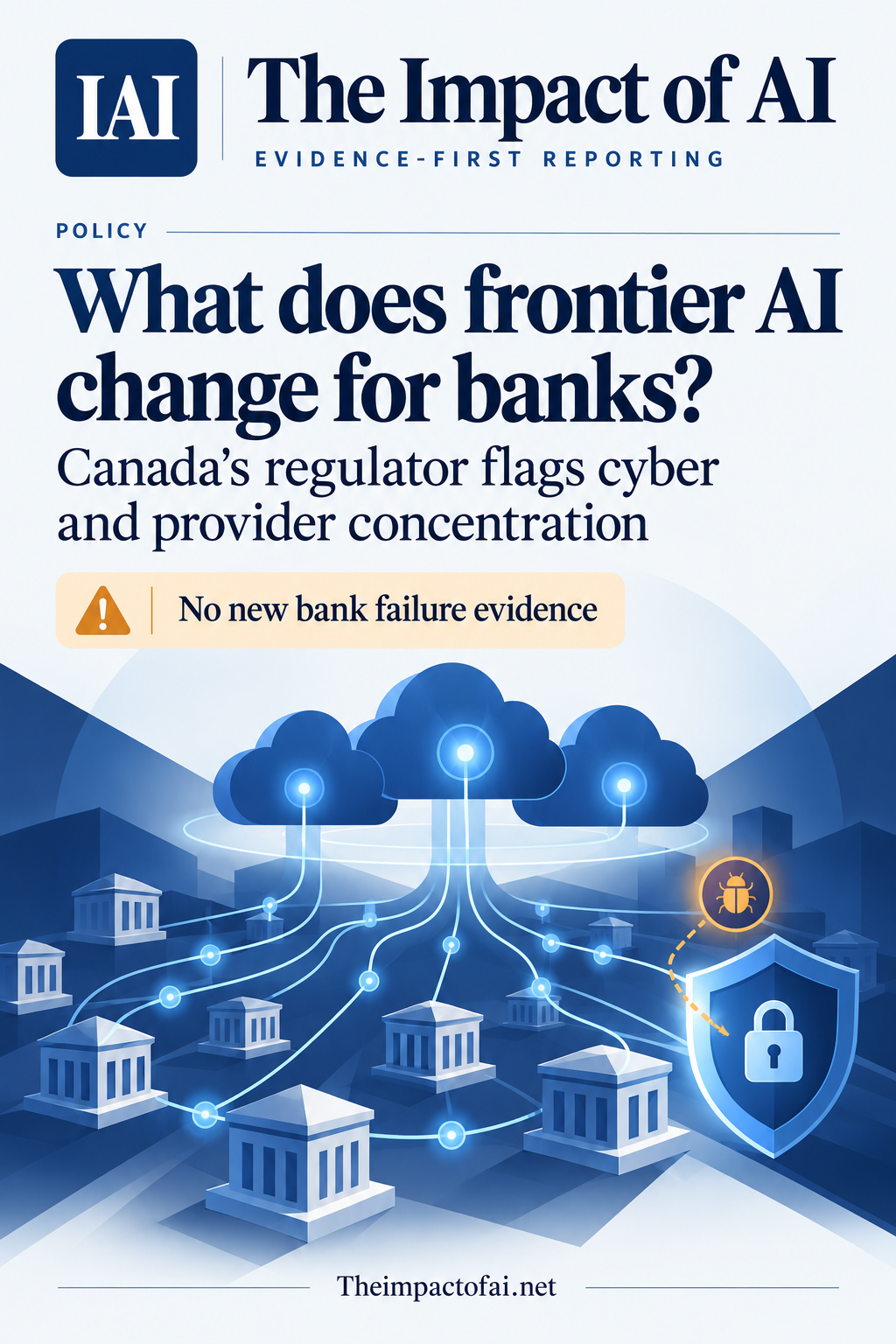
The direct answer: faster cyber pressure and more concentrated dependencies
Frontier AI changes the banking risk picture in two connected ways, according to Canada's Office of the Superintendent of Financial Institutions. It can make cyber activity faster and more capable, reducing the time available to detect and contain a weakness. At the same time, adopting advanced models can deepen dependence on a small group of model developers, cloud platforms and cross-border technology services, creating the possibility that one disruption affects many institutions together.
The 8 October semi-annual risk update is consequential because OSFI supervises federally regulated banks, insurers and pension plans and is telling boards where scrutiny is moving. It is not an incident report. OSFI did not identify a named provider failure, quantify AI-related losses, announce enforcement or say a bank is unsafe. Its accompanying release says Canada's financial system remains resilient and that strong capital, liquidity, governance and risk management help institutions adapt.
That distinction matters for customers and investors. The document justifies stronger preparation and oversight, but it is not evidence that deposits, payments or insurance services are currently failing because of frontier AI. Treating a forward-looking supervisory assessment as a verified breach would exaggerate the source and obscure the practical questions institutions now need to answer.[1][2]
How the regulator connects AI to cyber risk
OSFI says increasingly autonomous capabilities can raise the speed, sophistication and accessibility of malicious cyber activity. Tasks that once required substantial technical expertise may become available to a wider range of attackers. Its update highlights the ability to locate vulnerabilities and chain several weaknesses across applications, infrastructure and third-party ecosystems, turning individually limited flaws into a higher-impact path.
The same technology can assist defenders. The report notes the potential to improve detection and patching before vulnerabilities are exploited. Banks therefore face an adaptation race rather than a one-directional prediction of inevitable harm. Controls, monitoring and testing have to evolve with offensive and defensive capability, while staff still need authority to stop unsafe automation and investigate anomalous behaviour.
OSFI does not publish a denominator of observed attacks, a measured change in time-to-exploitation or a forecast loss distribution. Its language expresses a supervisory judgement informed by its regulatory role, earlier bulletins and industry engagement. That is valuable primary policy evidence, but it cannot tell readers how often a particular frontier model has caused or prevented a successful attack.
For operational teams, the measurable questions include how quickly exposed assets are inventoried, patches are prioritised, unusual model activity is detected and service can be restored. Exercises should assume that attackers use automation while also testing whether defensive AI fails under novel inputs, misleading instructions or loss of access to an upstream model.[1]
Provider concentration turns a supplier problem into a system problem
A small number of companies dominate frontier-model development and the cloud infrastructure used to deploy it, OSFI says. If many banks depend on the same model endpoint, identity service, data pipeline or cloud region, a common outage or compromised component can create correlated disruption. Diversification on paper is not enough if apparently separate applications rely on the same upstream infrastructure.
Cross-border dependence adds legal and geopolitical pathways. Many critical services are hosted outside Canada. Technology restrictions, foreign policy actions or contractual changes could affect availability, support or data movement. Institutions need to know not just who signs the contract, but which subcontractors, regions, models and control planes actually sustain a service.
The regulator also warns that institutions can struggle to maintain a clear view of AI use, vulnerabilities and controls at critical suppliers. Frontier systems may be updated frequently, combine several external services and change behaviour without a traditional software release inside the bank. Due diligence therefore needs continuous evidence: architecture maps, incident notifications, model-change records, access controls, resilience tests and credible exit arrangements.
Customers feel concentration risk when a shared upstream failure makes several services unavailable at once. The appropriate response is not necessarily to duplicate every system. It is to identify critical functions, set recovery objectives, maintain tested alternatives where proportionate and ensure that manual or degraded-service procedures protect payments, claims and access to essential information.[1]
Accountability stays with boards and senior management
OSFI's news release says boards and senior management remain accountable for managing frontier-AI risks. Outsourcing a model or cloud service does not outsource the regulated institution's responsibility. Governance should connect business value to risk appetite, testing, approval, monitoring and an identified owner who can explain when the system should not be used.
The risk update links technological competitiveness and resilience. Delaying every use of AI could carry operational and reputational costs, while adopting it without matched controls can introduce cyber, third-party and conduct failures. The useful comparison is therefore not innovation versus safety; it is governed use with evidence against use whose benefits and dependencies cannot be demonstrated.
For consumer-facing systems, oversight should include whether outputs are accurate, contestable and monitored across affected groups. For internal systems, institutions still need access boundaries, logging, change control and human review proportionate to the decision. A productivity tool that can reach sensitive data or execute actions is not low risk simply because customers never see it.
OSFI says it will keep assessing systemic implications of technology concentration and common critical-service dependencies while strengthening its own capacity to supervise frontier deployments. The report does not announce a new binding rule or compliance deadline. Institutions should read it alongside existing Canadian technology and third-party guidance rather than treating it as a standalone technical standard.[1][2]
What this means for people, businesses and markets
For bank and insurance customers, the immediate issue is continuity and accountability. A resilient institution should be able to explain how essential services continue during a provider outage, how a disputed automated decision is reviewed and how personal or commercial information is protected across suppliers. The update does not establish that any particular account or policy is at risk.
For smaller financial institutions, concentrated infrastructure can offer access to sophisticated security and AI capabilities that would be costly to build. It can also reduce bargaining power and make switching difficult. Proportionate supervision must recognise both effects: requiring an impossible independent stack may entrench the largest firms, while ignoring shared dependencies can transfer hidden systemic risk to customers.
Investors should distinguish operational-risk signals from capital or liquidity conclusions. OSFI says federally regulated institutions remain resilient and profitable. The frontier-AI discussion identifies a changing risk channel; it does not replace institution-specific evidence about exposures, controls, incidents and financial capacity.
Workers are also part of resilience. Faster tools may assist threat triage and routine analysis, but staff need training, safe escalation routes and sufficient authority to challenge outputs. If expertise is allowed to erode because a vendor normally handles the task, recovery from an outage or model failure can become slower precisely when informed human judgement is most valuable.[1][2]
What remains unproven—and the evidence that would matter
The update does not disclose a systematic sample, comparison group, incident count or quantitative model of frontier-AI risk. It does not estimate how much adoption has occurred across regulated institutions or separate the effect of AI from the broader growth of cloud and software supply-chain dependence. Its strongest role is agenda-setting: it records the regulator's current assessment and intended supervisory focus.
Evidence that would sharpen the assessment includes anonymised incident data with common definitions, concentration maps that capture subcontractors and shared regions, and resilience tests that measure recovery under realistic upstream failures. Institutions and regulators also need leading indicators: material model changes, unresolved critical vulnerabilities, failed exit tests and the proportion of essential services without a tested fallback.
Comparative evidence should ask whether institutions using specific governance and engineering controls experience fewer or shorter disruptions than otherwise similar institutions. Because serious incidents are rare and reporting differs, no single metric will settle the question. Triangulation across supervisory findings, incident reports, red-team exercises and recovery performance is more credible than vendor claims or isolated anecdotes.
For now, OSFI's message is best read as a concrete governance prompt. Banks and insurers should be able to map their frontier-AI dependencies, show that controls keep pace with capability, test correlated failure and keep accountable leaders informed. The document raises the priority of that work without proving that a crisis has occurred.[1][2]
What this means for people
- Customers benefit when essential banking and insurance services keep working during an upstream technology failure and disputed automated decisions remain reviewable.
- Institutions may gain faster threat detection and productivity, but workers need training and authority to intervene when automated tools or suppliers fail.
- The update does not indicate that a named institution is failing or that deposits, claims or payments face an immediate AI-caused disruption.
Global context
Financial institutions worldwide rely on a limited set of cloud, identity, cybersecurity and increasingly model providers, so Canada's concern is not unique. Cross-border concentration can transmit outages and policy restrictions while complicating supervision. National regulators can require institutions to understand and test dependencies, but correlated global risks also require shared incident standards, cooperation among authorities and evidence that critical-service providers can support recovery across jurisdictions.
What the evidence does not yet show
- OSFI's update is a forward-looking supervisory assessment, not a statistical study of AI incidents or losses.
- The report gives no denominator for attacks, deployments or institutions and does not quantify the probability or financial impact of the risks described.
- No named provider, bank failure, successful breach, enforcement action or customer harm is documented in the update.
- Frontier AI, cloud concentration and wider technology supply-chain risk overlap, so causal attribution will be difficult without comparable incident data.
- The report concerns Canada's federally regulated financial sector; legal duties, infrastructure and supervisory powers differ elsewhere.
What to watch next
- Whether OSFI turns this supervisory focus into revised guidance, examinations, public findings or binding requirements.
- Comparable disclosure of AI-related incidents, recovery times and material third-party dependencies across institutions.
- Resilience tests that simulate the loss or compromise of a shared model, cloud region or identity service.
- Evidence that exit plans and alternative providers work in practice rather than existing only as contracts or diagrams.
- International coordination on common-service concentration, incident terminology and responsible AI adoption in finance.
Living evidence record
Impact record IAI-12R6QYO
Evidence stage
Announced
Confidence
Supported
Reporting basis
Multi-source analysis
Independent or research support
Not yet
Record status
Monitoring
Last checked
9 October 2026
Source trail
2 direct sources across 2 source types.
People impact
Documented in this record.
Uncertainty
Limits and next checks are explicit.
Stages describe the evidence available—not whether a technology is good or bad. See the public method.
Evidence trail
Sources used for this report
Links checked 9 October 2026
This report is labelled multi-source analysis. We summarise and analyse source material in our own words; company statements remain attributed claims until independently supported. Translated summaries preserve the meaning of the original source and link back to it. Read our editorial standards.
Continue the story
Related reporting
Finance & Business
What will Singapore require banks to do before using AI?
Singapore's financial regulator has set staged, risk-proportionate expectations for every financial institution: know where AI is used, assess materiality, assign accountable leaders and control the full lifecycle. The rules begin in 2027, and publication is not evidence that firms already comply.
9 min · 2 sources
Finance & Business
Are CFOs ready to govern AI investment? IBM finds a wide execution gap
A survey of 1,500 finance leaders across 33 geographies finds broader authority over AI strategy, but only 6% describe finance as transformation-ready. The results map perceptions and associations—not audited returns or proof that AI caused better performance.
5 min · 2 sources
Finance & Business
Could AI-linked debt become a financial-stability risk? The Bank of England widens its warning
The Financial Policy Committee says AI investment is exposing more investors and funding markets to a repricing. Its official record quantifies the build-out, but the underlying analyst estimates are not a stress test or forecast of losses.
5 min · 2 sources
The Impact Brief
Keep the evidence trail, not the noise.
Get the most consequential AI developments with direct sources and clear limits.
Reader commentary
Add evidence, experience or a question
No account is required. Reader notes are published after a brief civility, relevance and safety check; disagreement is welcome.
Explore commentary across the portal →Published reader notes
0No published reader notes yet. You can start the evidence-led discussion above.
Prefer a private correction or response? Contact the newsroom.