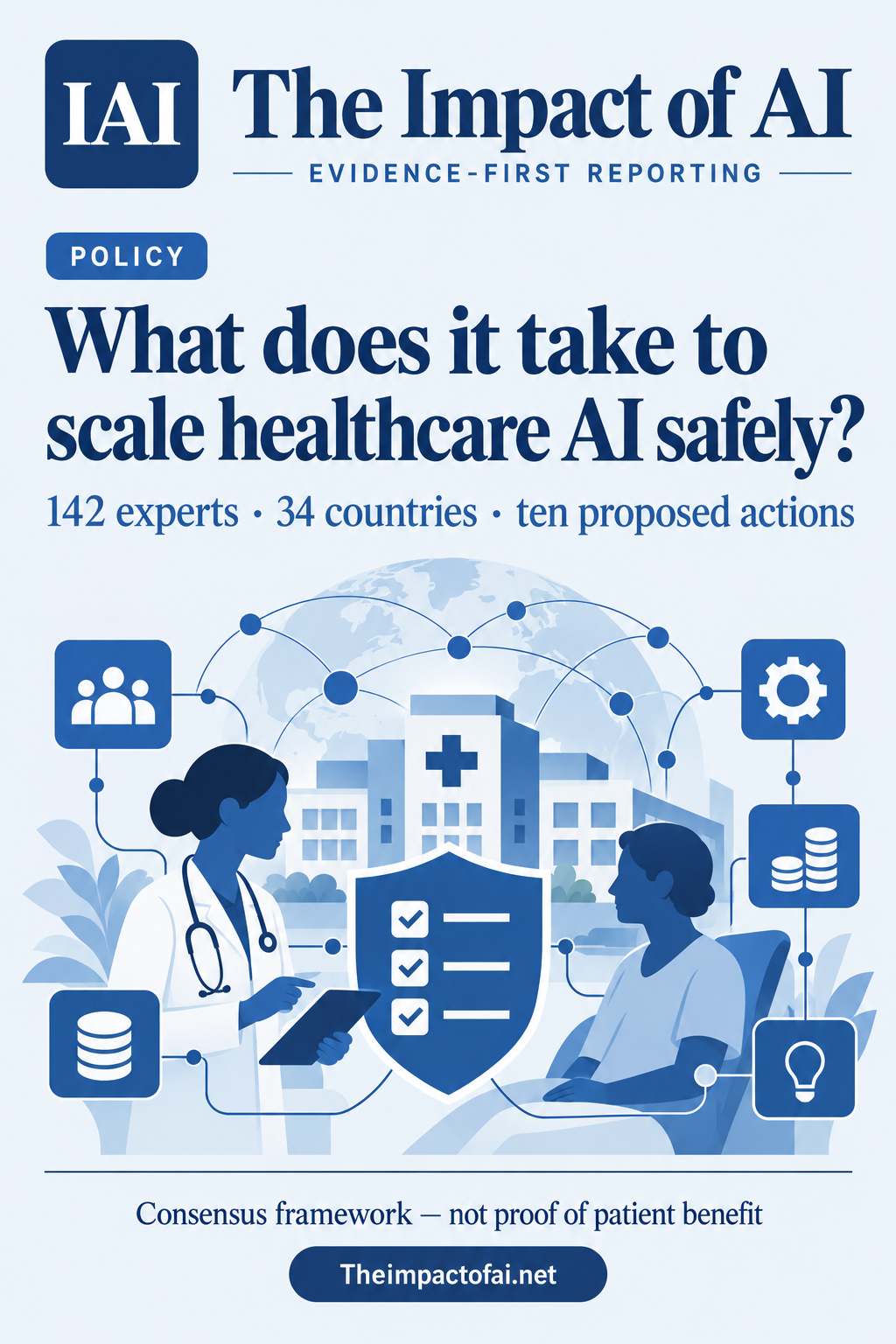
What does it take to scale healthcare AI safely?
An OECD conference report turns input from 142 experts across 34 countries into ten proposed actions for health systems. It is a practical consensus framework for trust, infrastructure and financing—not evidence that scaled AI has improved patient outcomes.
Editorial responsibility: The Impact of AI Editorial Desk · Report a factual concern
At a glance
- 1The OECD and Spain's Ministry of Health convened 142 experts from 34 countries and 35 partner organisations in Madrid on 28–29 May 2026, then organised their recommendations into a ten-action plan.
- 2The plan links trusted use cases and workforce competence to leadership, lifecycle oversight, data infrastructure, economic measurement and financial management; it argues that scale depends on a system, not a model alone.
- 3This is structured expert advice rather than outcome evidence: the report does not use a representative sample, intervention, comparator or patient-benefit endpoint, and it does not show that the proposed actions have been implemented.
Research topic
How health systems can move from isolated healthcare AI pilots to governed, measurable and financially sustainable deployment
Safe scale means building a health-system capability, not buying a model
The OECD's answer is that healthcare AI cannot be scaled safely through procurement alone. Its Expert-Led Madrid Action Plan, or EL-MAP, proposes ten connected priorities spanning trust, organisational foundations and economics. Health systems are asked to co-design valuable use cases, build role-specific competence, create partnerships, establish leadership and oversight, set baseline and lifecycle rules, improve data and digital infrastructure, remain adaptable, model economic returns and manage financing.
That structure matters because a technically strong system can still fail in practice. It may solve the wrong problem, arrive without a clinical owner, depend on fragmented records, shift work onto already stretched staff or produce benefits that nobody measures. The report therefore treats deployment as a change to a sociotechnical system: clinicians, patients, managers, funders, suppliers, data and regulation all affect whether a tool becomes useful, safe and sustainable.
For decision-makers, the immediate implication is practical. A purchase decision should follow a defined service problem, evidence standard, accountability map and measurement plan. The model's accuracy is one input; the wider question is whether the service can monitor performance, handle failure, protect patient choice, fund maintenance and stop or redesign use when evidence changes.[1][2]
What the report studied—and what it did not
The 39-page paper reports a conference co-hosted by the OECD and Spain's Ministry of Health in Madrid on 28 and 29 May 2026. It says 142 experts from 34 countries participated: 26 OECD members and eight accession candidates or key partners, alongside 35 partner organisations. Participants were nominated through several channels to seek geographic and disciplinary breadth, drawing from government, healthcare, academia, industry, civil society, clinicians and patients.
The programme used three sessions. Later sessions included breakout discussions on challenges and leading practices, and the authors synthesised the resulting ideas into the action plan. This is a legitimate method for gathering experienced perspectives and identifying implementation themes. It is not, however, a probability sample of health professionals or patients. The report does not publish an individual-response dataset, a denominator for agreement on each action, formal voting results or a comparison between countries.
There was also no intervention, control group or follow-up. No hospital implemented the complete plan within this study, and no patient outcome, error rate, waiting time, workload or cost endpoint was measured against usual practice. The paper should therefore be read as a policy proceeding and expert framework, not peer-reviewed clinical-effectiveness research. Its value lies in organising action and testable questions; its publication does not validate a particular AI product or establish that scale is beneficial.[2]
Trust begins with the use case and the people doing the work
The first group of actions focuses on trust. The report recommends co-designing use cases with the people affected, building competencies that match different roles and developing partnerships able to share knowledge and responsibility. This places patients and clinicians before the technology specification. A radiology triage system, an administrative summariser and a patient-facing symptom tool create different risks; each needs its own clinical purpose, workflow, consent and escalation arrangements.
Competence is broader than teaching staff to type prompts. Clinicians need to understand the tool's intended population, common failure modes, confidence limits and documentation duties. Managers need skills in procurement, change management and post-deployment monitoring. Technical teams need access controls, data-quality processes and incident response. Patients need understandable information about when AI is involved and how to question or appeal a decision.
The partnership recommendation also reflects a practical constraint: many hospitals cannot independently maintain specialist evaluation, cybersecurity, legal and economic teams for every system. Shared assessment resources can reduce duplication, but partnership does not remove accountability. A vendor benchmark, demonstration site or neighbouring hospital's success cannot substitute for local testing when the population, data pipeline, staffing and clinical pathway differ.[2]
Leadership, lifecycle oversight and infrastructure are the foundations
Five proposed actions cover organisational foundations. The report calls for clear leadership and oversight, baseline policy, lifecycle policies and approval processes, stronger data and digital infrastructure, and the capacity to adapt. Together, these move governance away from a one-off procurement gate. Models, clinical practice and patient populations change, so approval must be followed by monitoring, version control, incident review and an exit path.
Lifecycle oversight should specify who can authorise deployment, which changes trigger revalidation, what performance thresholds prompt investigation and who has power to pause the system. It should also capture distributional effects. An acceptable average can conceal worse performance for a smaller language group, disability, age band or poorly represented condition. Monitoring must therefore retain clinically meaningful subgroups rather than only a headline accuracy measure.
Infrastructure is equally consequential. Health AI depends on lawful, reliable access to data; compatible systems; secure compute; identity and access management; and a workflow that can present outputs without creating dangerous alert fatigue. The report points to mapping initiatives, including work across Nordic systems, Brazil and the WHO European region, as examples of efforts to understand existing activity. Those examples show the scale of coordination under way, but they are not outcome evaluations and should not be interpreted as proof that mapped projects are effective.[2]
Economics must be measured rather than assumed
The final two actions ask health systems to model economic returns and strengthen financial management. This is more demanding than attaching a speculative time-saving figure to a business case. A credible model needs the full cost of integration, licences, validation, training, oversight, cybersecurity, data preparation, workflow redesign, maintenance and replacement. It also needs to identify who pays and who receives the benefit.
A tool may save minutes for one professional while creating checking, correction or escalation work elsewhere. Faster documentation may improve staff experience without increasing capacity if saved time is too fragmented to change scheduling. Reduced admissions or earlier diagnoses can create valuable patient benefit yet shift costs between budgets. Economic assessment should therefore use an explicit comparator and measure realised effects after deployment, including harms and opportunity costs.
The report's financing focus is especially relevant for public systems and lower-resource settings. Pilot grants can fund a demonstration but not the permanent staff, infrastructure and monitoring required for safe operation. Sustainable adoption needs recurrent budgets and procurement terms that preserve access to performance data, incident information and exit options. Otherwise, a system can become technically embedded before its benefits, total costs or dependency risks are understood.[2]
What this could change for patients and healthcare workers
For patients, the best version of the plan would make healthcare AI less arbitrary. A defined use case and clear accountability could reduce opaque experimentation, while subgroup monitoring and accessible explanations could reveal who is helped or disadvantaged. Co-design may identify practical harms that a technical team misses, such as a digital pathway that excludes people without reliable internet or an automated message that creates anxiety without timely human follow-up.
For clinicians and other staff, the framework recognises that safe use requires time, training and authority. Workers should know when they can disregard an output, how to document disagreement and where to report a failure. They should not become unpaid safety layers for a system whose checking workload was omitted from the business case. When tools are genuinely useful, the same design principles could reduce repetitive work and direct attention toward patient care.
The global participant base gives the framework wider perspective than a single-country workshop, but it is not a complete map of world health systems. National rules, workforce shortages, digital maturity, financing and access to representative data differ sharply. The actions are best treated as a common set of questions whose implementation must be local, not as a universal certification that makes any product safe to scale.[2]
What would change the assessment
The framework will become stronger evidence if health systems publish implementation records. Those should name the action adopted, service context, patient population, comparator, costs, staff time, safety events, subgroup performance and outcomes over a meaningful period. Independent evaluation across several sites would show whether the actions transfer beyond organisations that already have unusually strong digital teams.
Confidence would also rise if future OECD work reports how priorities were selected and the degree of participant agreement, includes more systematic patient representation and follows the participating systems over time. A public readiness and impact dashboard could distinguish policy adoption from operational change. Procurement and regulatory records could show whether lifecycle oversight and economic measurement become enforceable requirements rather than recommendations.
Until then, the report supports a careful conclusion. It provides a useful, internationally informed checklist for moving beyond pilots, and its ten linked actions correctly expose the organisational work hidden behind the phrase ‘scale AI’. It does not establish that the plan improves outcomes, that every participant endorsed each element or that any named deployment is safe. The next evidence must come from transparent implementation and measured effects on people and services.[2]
What this means for people
- Patients could gain clearer explanations, stronger accountability and more equitable monitoring, but the report does not demonstrate improved health outcomes.
- Healthcare workers need role-specific training, protected time and authority to challenge outputs; otherwise adoption can add hidden checking work and liability.
- Health-system leaders and funders need full-cost and comparative evidence so scarce resources are not locked into tools whose benefits cannot be measured.
Global context
The conference included 142 experts from 34 countries—26 OECD members and eight accession candidates or key partners—and 35 partner organisations. That breadth makes the framework internationally relevant, but not statistically representative. Health systems differ in regulation, financing, digital infrastructure, workforce capacity and data availability, so the proposed actions require local adaptation and independent evaluation rather than direct transplantation.
What the evidence does not yet show
- The report is a synthesis of an expert conference, not a peer-reviewed clinical trial, systematic review or representative survey.
- Participants were nominated through several channels to increase breadth; they were not selected through probability sampling, so the 142 attendees cannot represent all patients, clinicians or health systems.
- The paper does not provide individual response data, a vote or agreement denominator for each action, an intervention comparator or post-conference outcome follow-up.
- Examples cited in the report have different methods and evidence quality; their inclusion does not independently validate their effectiveness.
- The ten actions do not come with a universal implementation timetable, budget, enforcement authority or proof of patient benefit.
What to watch next
- Health systems publishing implementation plans and named accountability for the ten proposed actions.
- Prospective evaluations with pre-specified patient, safety, workflow, equity and cost outcomes against usual practice.
- Transparent lifecycle rules covering model updates, subgroup drift, incidents, human override and withdrawal.
- Recurrent financing for infrastructure and monitoring rather than short-lived pilot funding.
- OECD follow-up showing which actions were adopted, by whom and with what measured effects.
Living evidence record
Impact record IAI-0QCG50D
Evidence stage
Observed
Confidence
Supported
Reporting basis
Source analysis
Independent or research support
Not yet
Record status
Monitoring
Last checked
7 October 2026
Source trail
2 direct sources across 1 source type.
People impact
Documented in this record.
Uncertainty
Limits and next checks are explicit.
Stages describe the evidence available—not whether a technology is good or bad. See the public method.
Related-source reporting disclosure
This record analyses 2 linked source records around the same underlying development. The extra records add method, date or context, but they do not by themselves constitute independent replication of every performance claim or predicted outcome.
Evidence trail
Sources used for this report
Links checked 7 October 2026
This report is labelled source analysis. We summarise and analyse source material in our own words; company statements remain attributed claims until independently supported. Translated summaries preserve the meaning of the original source and link back to it. Read our editorial standards.
Continue the story
Related reporting
Health & Life Sciences
Can mouse MRI predict glioblastoma treatment response?
A deep-learning model separated cure from relapse across 298 MRI examinations, but the effective test cohort was only 10 treated mice from one laboratory. It is preclinical evidence, not a patient-ready predictor.
7 min · 1 source
Health & Life Sciences
Can AI spot liposarcoma on ultrasound?
A peer-reviewed Chinese study reports strong results in a 95-patient internal test, including 0.97 accuracy. But all 317 patients came from one hospital and there was no external validation, so this is a proof of concept—not a clinically cleared diagnostic system.
9 min · 1 source
Health & Life Sciences
Can AI reliably predict facial growth?
A registered systematic review found 12 studies of AI-based craniofacial or mandibular growth prediction, with samples from 33 to 639 people. Seven studies were at high risk of bias and five at unclear risk; none had independent external validation.
9 min · 1 source
The Impact Brief
Keep the evidence trail, not the noise.
Get the most consequential AI developments with direct sources and clear limits.
Reader commentary
Add evidence, experience or a question
No account is required. Reader notes are published after a brief civility, relevance and safety check; disagreement is welcome.
Explore commentary across the portal →Published reader notes
0No published reader notes yet. You can start the evidence-led discussion above.
Prefer a private correction or response? Contact the newsroom.