What is changing in ChatGPT for teens?
OpenAI says a US College Planner for grades 10–12 is coming, alongside flashcards, easier quizzes and multi-photo note capture. The company also released large usage counts, but no study protocol, denominators for several comparisons or evidence that the tools improve learning or admissions outcomes.
Editorial responsibility: The Impact of AI Editorial Desk · Report a factual concern
At a glance
- 1OpenAI says College Planner will initially target US high-school students in grades 10–12 applying to four-year colleges; it did not provide a launch date in the announcement.
- 2The company reported one-week use by nearly 1.2 million teens for Learning Visualizations and more than 180,000 for Study Mode, but did not publish independent learning outcomes.
- 3A 22-student advisory programme with Boston Children’s Hospital’s Digital Wellness Lab is intended to inform safety defaults, parental controls, notifications and AI literacy; it is advisory, not a representative study.
Research topic
What OpenAI announced for teen users and what its company-reported usage figures do and do not establish
The direct answer: planning and study tools are expanding
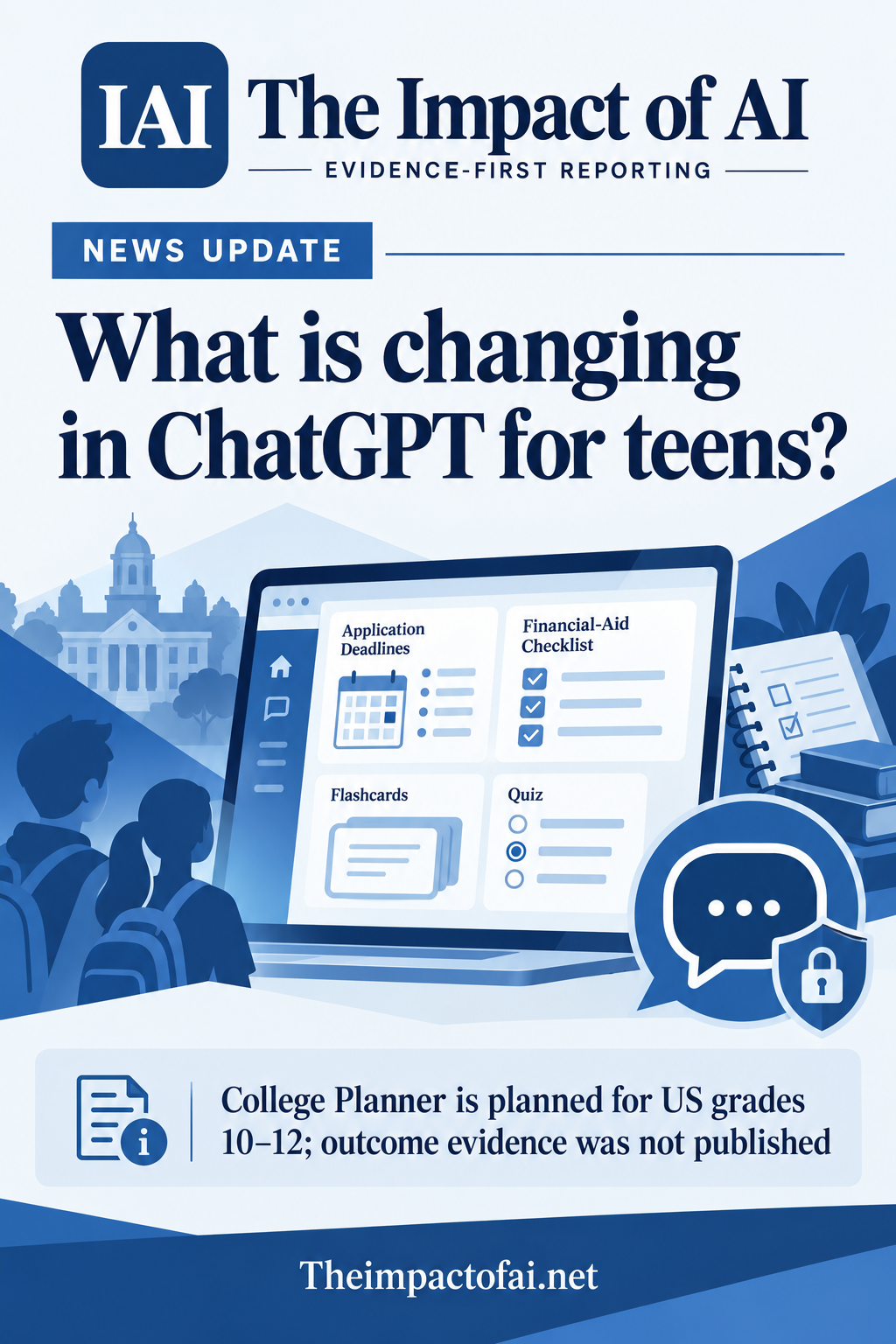
OpenAI announced a planned College Planner for teenagers in the United States, new flashcards, easier quiz creation and multi-photo capture that combines photographed notes into a PDF. College Planner is intended first for students in grades 10 to 12 preparing to apply to four-year colleges. It is designed to bring application requirements, deadlines, tasks and financial-aid steps into one plan. The announcement says it is coming soon but gives no public launch date.
The product could reduce administrative friction for families juggling multiple applications, particularly where counselling support is limited. It cannot decide which institution is right, guarantee that requirements are complete or replace a counsellor’s understanding of a student’s circumstances. OpenAI says the tool is meant to sit alongside advisers and families, and plans later expansion to more countries and to two-year colleges, technical colleges and trade schools.[1]
The usage numbers are large, but the evidence is incomplete
OpenAI says teens with access to its dedicated experience sent about 2.7 million more learning-related messages on average than teens who did not yet have access as rollout expanded. It also reports that, during one week, nearly 1.2 million teens used Learning Visualizations and more than 180,000 used Study Mode. Those are activity counts reported by the provider, not independent measures of learning, satisfaction or unique educational benefit.
The announcement does not describe the observation period for the 2.7 million comparison, group sizes, country mix, assignment process, definition of a learning-related message or statistical uncertainty. The phrase “on average” is therefore difficult to interpret. Rollout timing may create a natural comparison, but without a protocol it cannot support a causal claim that the teen experience produced the additional activity. More messages also do not necessarily mean more understanding.[1]
Break reminders show behaviour, not wellbeing outcomes
The company says teens spend under 15 minutes a day on ChatGPT on average and fewer than 2% spend more than three consecutive hours. In almost half of teen conversations where a break reminder appeared, the user took a break or ended the conversation within five minutes. Among sessions longer than three hours, more than 80% included at least one learning-related prompt.
These figures offer some visibility into use patterns, but they do not show why a session ended, whether a reminder caused the change or whether extended use was beneficial or harmful. A comparison with publicly reported social-media time is not like-for-like: ChatGPT and social platforms have different functions, measures and user populations. Independent wellbeing research would need consented longitudinal data, validated outcomes and attention to vulnerable subgroups.[1]
College Planner raises accuracy and equity questions
Application deadlines, financial-aid rules, fee waivers and institutional requirements change. A consolidated planner is useful only if its sources, update cadence and error handling are reliable. The announcement does not explain how college data will be obtained, verified or corrected, whether students can see the provenance of a requirement, or what happens when an institution changes a deadline. Those details will determine whether the tool saves time or creates a new point of failure.
The initial scope also matters. It targets US students planning for four-year colleges, so students pursuing community college, vocational education or non-US pathways are outside the first version. OpenAI says it intends to broaden coverage. Until that happens, presenting the feature as a general college-planning solution would overstate its reach. Access to ChatGPT, device quality, language support and disability accommodations may also shape who benefits.[1]
Advisers and teenagers are being brought into development
OpenAI says it is supporting College Advising Corps to expand into new states and create an AI fellowship in which advisers test and share practical uses. It is also funding a three-year programme with Boston Children’s Hospital’s Digital Wellness Lab and an independent Student Advisory Council. For the 2026–27 school year, about 22 students are expected across two tracks: roughly 12 aged 14–18 working on digital-wellbeing projects and roughly 10 aged 16–20 focused on chatbots and emerging technology.
The company expects feedback on teen safety defaults, parental controls, notifications and AI literacy. Direct participation can surface problems adult designers miss. A group of about 22 cannot represent the diversity of teen users across countries, languages, disabilities and risk profiles, and the announcement does not specify how recommendations, disagreements or rejected proposals will be documented. The useful test will be whether product changes and rationales are reported back as promised.[1]
What families and schools should verify
Students should confirm deadlines and aid requirements with the relevant institution or official application service, especially near a cutoff. Schools should decide whether AI planning is permitted on managed devices, how sensitive family financial information is handled and where human help is available when advice conflicts. Flashcards and quizzes can support retrieval practice, but automatically generated material should be checked against course notes and teacher guidance.
The announcement says continuous multi-photo capture is available on iOS, with Android support planned. Flashcard decks are saved in a teen’s Library, and users can create scheduled practice tasks. Those conveniences also create questions about retention, deletion, parental visibility and the treatment of photographed notes containing classmates’ names or copyrighted material. The product page does not answer all of those operational questions.[1]
What would change the assessment
Before concluding that these tools improve education or application access, independent evaluations should measure task completion, deadline errors, financial-aid understanding, adviser workload and equitable use across income, language and disability groups. Randomised or carefully matched designs could test Study Mode, visualisations and flashcards against ordinary study tools, using knowledge retention rather than message volume as the outcome.
OpenAI should publish clearer denominators and definitions for its teen metrics, document the College Planner’s authoritative data sources and correction process, and report how advisory feedback changes product decisions. The announcement is consequential because it describes a large provider expanding into decisions that shape education and family finances. It is not Breaking, and its company-reported activity figures should remain separate from evidence of learning, wellbeing or successful college entry.[1]
What this means for people
- A reliable planner could reduce deadline and paperwork burdens, especially where adviser time is scarce.
- Incorrect or stale application information could harm students at high-stakes moments, so official verification remains essential.
- Study tools may help practice, but families and schools still need clarity about accuracy, privacy and human support.
Global context
The initial College Planner is US-specific while ChatGPT for Teens is described as global. Application systems, age rules, education pathways, privacy law and counselling capacity differ widely. A feature that helps a US four-year-college applicant cannot be assumed to fit vocational, two-year or international pathways without local data and governance.
What the evidence does not yet show
- This is a first-party product announcement, not an independent evaluation or peer-reviewed study.
- Several usage comparisons lack group sizes, observation periods, definitions and uncertainty estimates.
- Message counts and feature use do not establish learning, wellbeing or admissions outcomes.
- College Planner had no published launch date and the initial scope excludes many education pathways and countries.
- The approximately 22-member advisory programme is valuable participation but not a representative sample of teen users.
What to watch next
- A firm launch date, supported institutions and the authoritative sources behind deadlines and financial-aid requirements.
- Independent evaluations measuring learning, planning errors and equity rather than activity alone.
- Public reporting on which teen-advisory recommendations change safety defaults and product design.
- Android availability, accessibility support, data retention and deletion controls for photographed notes and saved decks.
Living evidence record
Impact record IAI-026EV73
Evidence stage
Announced
Confidence
Developing
Reporting basis
Source analysis
Independent or research support
Not yet
Record status
Monitoring
Last checked
7 October 2026
Source trail
1 direct source across 1 source type.
People impact
Documented in this record.
Uncertainty
Limits and next checks are explicit.
Stages describe the evidence available—not whether a technology is good or bad. See the public method.
Single-source reporting disclosure
This record analyses one direct source. It can establish what OpenAI published or reported, but it is not independent corroboration of every performance claim or predicted outcome. The confidence label will change only when broader evidence is added.
Evidence trail
Sources used for this report
Links checked 7 October 2026
This report is labelled source analysis. We summarise and analyse source material in our own words; company statements remain attributed claims until independently supported. Translated summaries preserve the meaning of the original source and link back to it. Read our editorial standards.
Continue the story
Related reporting
Society & Media
What do people actually ask image-upload AI to do?
An unreviewed Microsoft-led study analysed 42,617 de-identified Copilot image-upload sessions and checked its taxonomy against 23,413 ChatGPT sessions. Users often chained recognition into writing, code and data tasks—but private, model-generated summaries limit what outsiders can verify.
8 min · 2 sources
Society & Media
What should AI companies prove before giving conversational agents to children?
A new World Economic Forum white paper sets out child-focused practices spanning design, privacy, learning, harmful interactions and accountability. It is useful guidance, but not a binding standard or an outcome study, and its public summary reports no sample or systematic-review method.
6 min · 1 source
Society & Media
Do safer-driving AVs change human behaviour?
A peer-reviewed quasi-experiment found that Lyft automated vehicles followed more smoothly and conservatively, while human drivers left shorter gaps behind matched automated leaders. The study analysed real trajectories, but it did not randomise drivers or measure crashes, injuries or current vehicle systems.
8 min · 3 sources
The Impact Brief
Keep the evidence trail, not the noise.
Get the most consequential AI developments with direct sources and clear limits.
Reader commentary
Add evidence, experience or a question
No account is required. Reader notes are published after a brief civility, relevance and safety check; disagreement is welcome.
Explore commentary across the portal →Published reader notes
0No published reader notes yet. You can start the evidence-led discussion above.
Prefer a private correction or response? Contact the newsroom.