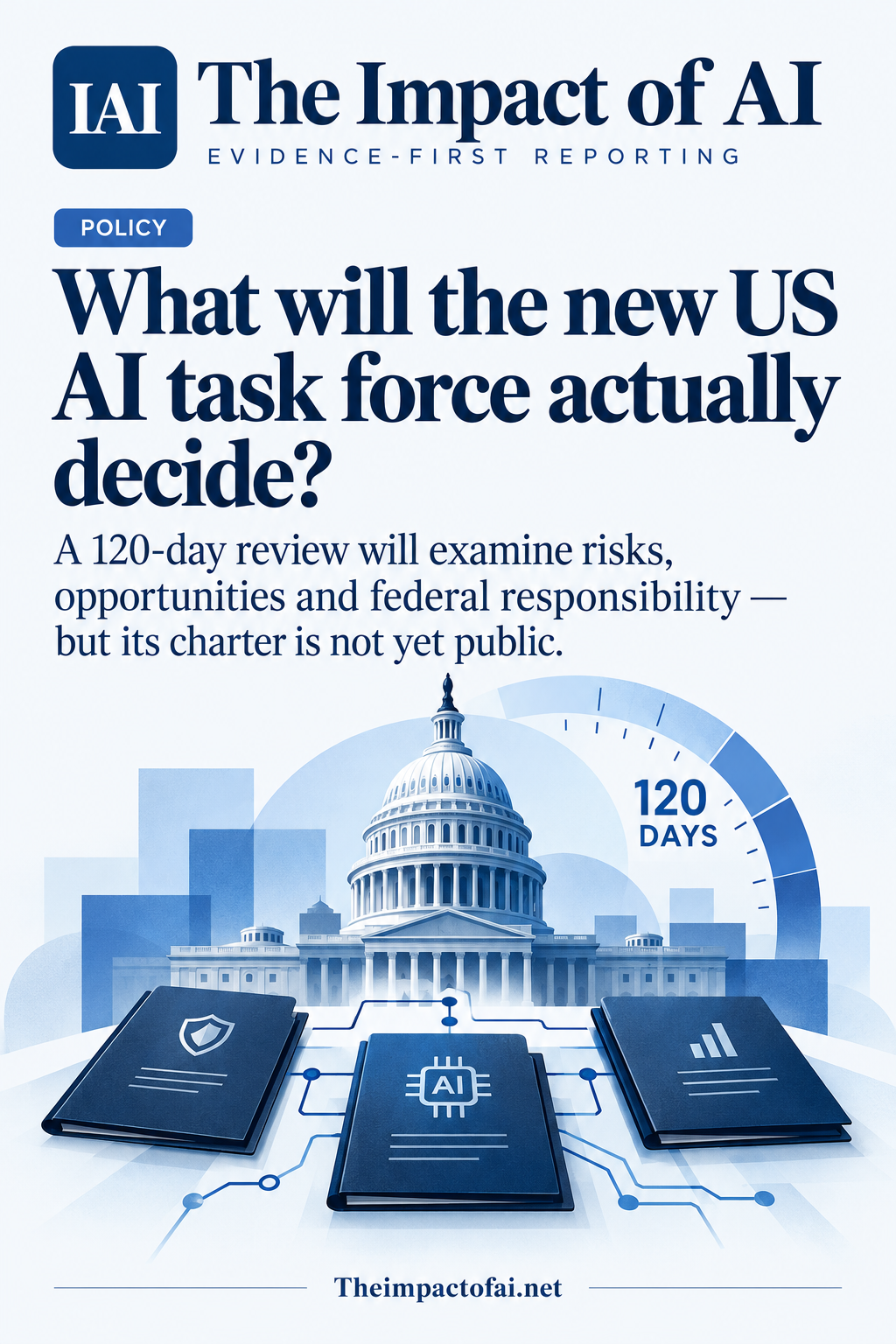
What will the new US AI task force actually decide?
A White House task force led by intelligence chief Jay Clayton has 120 days to examine AI risks, opportunities and federal responsibility. The chair confirmed the mandate in a direct interview, but the charter has not been published and the group has not yet announced a public evidence process, enforcement power or final policy test.
Editorial responsibility: The Impact of AI Editorial Desk · Report a factual concern
Research topic
How a new White House coordinating body will define AI risks and opportunities, assign federal responsibility and translate a 120-day review into accountable public policy
At a glance
- 1Jay Clayton told the Wall Street Journal that he will chair a White House 'Super Intelligence Force' with 120 days to assess AI risks and opportunities and the federal government's responsibility.
- 2Charter excerpts say the group will review reporting and response mechanisms for breaches, hacks, jailbreaks and other problems while trying to avoid overregulation and regulatory capture.
- 3The complete charter, formal appointment instrument, public evidence plan, budget, meeting schedule and success measures were not publicly available when this analysis was checked.
The Impact Brief
Keep the evidence trail, not the noise.
Get the most consequential AI developments with direct sources and clear limits.
Living evidence record
Impact record IAI-1657TDT
Evidence stage
Observed
Confidence
Corroborated
Reporting basis
Multi-source analysis
Independent support
Present
Record status
Monitoring
Last checked
4 October 2026
Source trail
4 direct sources across 2 source types.
People impact
Documented in this record.
Uncertainty
Limits and next checks are explicit.
Stages describe the evidence available—not whether a technology is good or bad. See the public method.
What is confirmed—and what still rests on one direct report
The Wall Street Journal reports that the White House has created a group called the Super Intelligence Force and that Director of National Intelligence Jay Clayton will chair it, effectively adding an administration-wide AI-policy role to his intelligence post. Clayton confirmed the assignment in an on-record interview. Reuters subsequently reported the same appointment and 120-day deadline, but explicitly attributed the task-force details to the Journal. That distinction matters: two publishers have carried the news, yet the public evidence trail for the mandate still begins with one direct interview and one newsroom's review of the charter.
Clayton's underlying government role is independently verifiable. The Office of the Director of National Intelligence says he was sworn in on 3 August 2026 as the ninth DNI, responsible for leading the US intelligence community, advising the president and integrating the National Intelligence Program. That official record supports his institutional position; it does not itself announce the new task force. As of this check, neither the White House nor ODNI had posted the charter, membership list or a standalone appointment announcement that readers could compare line by line with the reporting.[1][2][4]
A 120-day mandate wider than a conventional safety review
According to Clayton and the charter excerpts reported by the Journal, the group has 120 days to identify AI-related opportunities and risks and consider what responsibility belongs to the federal government. The brief is therefore broader than technical model evaluation. It covers national leadership, incident response, current law and possible congressional action, while leaving open whether the final product will recommend legislation, executive action, voluntary standards, procurement controls or some combination of them. The charter reportedly allows the work to be extended or transferred to an agency after the initial period.
The reported operational questions are concrete. The task force is expected to examine warnings and notifications to government about breaches, hacks, jailbreaks and other system failures, then recommend ways to improve response under existing authorities. It is also described as a coordinating body that should communicate emerging opportunities and risks to government, industry and the public. None of this establishes that a new incident-reporting regime already exists. A review of present mechanisms is a promise to examine the gap, not evidence that the gap has been closed.[1][2]
Who is reported to have a seat at the table
The Journal reports three vice chairs with different constituencies: defence research official Emil Michael would coordinate with AI companies; Office of Personnel Management director Scott Kupor would work with critical-infrastructure providers and other industry stakeholders; and Federal Trade Commission chair Andrew Ferguson would oversee consumer interests and groups concerned with children, privacy, speech, religion and association. Reported members include Vice President JD Vance, the defence and treasury secretaries and the White House chief of staff. Outside advisers are said to include David Sacks and former secretary of state Condoleezza Rice.
That roster signals a national-security and executive-branch centre of gravity, with industry coordination built into the design. It does not yet show how labour representatives, independent safety researchers, state regulators, civil-society groups, affected communities or international partners will contribute evidence. Nor does a diverse list of senior titles prove that disagreement will be recorded or minority views published. A credible review needs transparent procedures as well as prominent participants: who can submit evidence, what must be disclosed, how conflicts are managed and which recommendations were contested.[1][2]
Why the administration calls it 'Super Intelligence'
The name follows a 29 September executive order directing federal agencies, to the maximum extent allowed by law, to use 'Super Intelligence' and 'SI' in place of 'Artificial Intelligence' and 'AI' in non-statutory communications. The order does not create a new technical threshold such as human-level or superhuman intelligence. It says the new terms cover the technologies already included in the statutory definition of artificial intelligence. Readers should therefore avoid assuming that the task force is limited to a proven class of systems more capable than humans.
The same order gives the president's science and technology adviser 60 days to propose legislative language for a federal definition of SI and recommend related action. That is a separate timetable from the new group's reported 120-day review, although the two efforts may overlap. The terminology could shape legislation, procurement and public understanding. If an expansive political label becomes a legal category, policymakers will need to show which systems and activities fall inside it and how obligations differ by capability, context and consequence.[1][3]
The central policy tension is visible in the charter excerpts
The reported charter asks the group to develop responses to AI-enabled threats while preventing overregulation and regulatory capture that could suppress innovation and competition. Those goals can reinforce one another when clear rules improve trust and market entry. They can also collide. Large providers may be best placed to supply technical evidence, yet rules designed mainly around their systems and compliance capacity can entrench them. Conversely, a process that treats all mandatory oversight as a threat to innovation may leave users, workers and smaller competitors carrying risks they cannot inspect or insure against.
Clayton reportedly compared the likely dialogue with industry to risk frameworks developed in finance with the Federal Reserve and Securities and Exchange Commission. The analogy identifies a possible governance model, not a completed framework. Financial supervision relies on defined authorities, reporting obligations, examinations, enforcement tools and long institutional experience. A task force can recommend comparable mechanisms for advanced AI, but it cannot demonstrate their effectiveness before agencies publish standards, receive data, test compliance and respond consistently to failures.[1][2]
What this could change for people and organisations
For people, the practical stakes include whether government receives timely warning of systems that can facilitate cyberattacks, expose sensitive data, evade safeguards or disrupt essential services. Workers and communities also need the review to address less spectacular consequences: job redesign, automated decisions, concentration of power, access to remedies and the energy and infrastructure burden of computing. A national-security frame may capture hostile use while overlooking ordinary harms that accumulate through products, workplaces and public services.
For companies, a clear federal view could reduce uncertainty about incident reporting, evaluation, procurement and responsibility. The opposite is also possible if the process adds another layer of voluntary commitments without clarifying which agency acts when a serious event occurs. Smaller businesses need requirements proportionate to risk and access to shared testing infrastructure. Critical-infrastructure operators need usable thresholds for escalation. Researchers and watchdogs need enough disclosure to examine whether claimed safeguards work rather than relying only on private assurances.[1][2][3]
What evidence would change the assessment
The immediate evidence gap is documentary. Publication of the signed charter, appointment instrument, complete roster, meeting timetable and a formal request for evidence would turn a reported structure into an inspectable public process. The strongest interim signal would be a clear method: definitions of risk and opportunity, criteria for prioritising harms, rules for conflicts and classified material, treatment of international evidence, and a commitment to publish dissent, source notes and implementation responsibilities alongside the final report.
The assessment would strengthen further if the 120-day output maps each recommendation to an existing legal authority, a responsible agency, a deadline and a measurable outcome. It would weaken if the final document relies mainly on provider claims, treats competitiveness as a substitute for public benefit, or leaves incident reporting voluntary without explaining why. The task force is consequential because it can shape US policy across security, markets and public services. For now, it is a confirmed chair, a reported charter and a deadline—not yet an accountable oversight system.[1][2][3][4]
What this means for people
- People need clear routes for warning, redress and accountability when advanced AI contributes to cyber incidents, privacy loss or disruption of essential services.
- Workers and communities could be affected by recommendations on automation, critical infrastructure and federal procurement even if they are not represented directly on the task force.
- Smaller organisations may benefit from consistent national expectations, but compliance designed around the largest providers could raise barriers to entry.
Global context
US choices can influence multinational providers, security reporting and technical standards far beyond the country. Other jurisdictions are pursuing statutory AI rules, sector regulation and incident-reporting models, so the eventual recommendations will be judged against international approaches as well as domestic political goals. The present announcement does not create a global standard or bind another government.
What the evidence does not yet show
- The complete task-force charter and formal appointment document were not publicly available at the time of checking.
- Reuters and other follow-up reports attribute the key task-force details to the Wall Street Journal, so they do not constitute independent documentary confirmation.
- The reported 120-day review is a policy process, not evidence that any proposed reporting, oversight or response mechanism will be adopted or effective.
- The published accounts do not yet specify a budget, enforcement authority, public consultation process, meeting schedule or measurable success criteria.
- The administration's term 'Super Intelligence' currently maps to the statutory definition of artificial intelligence rather than a demonstrated capability threshold.
What to watch next
- Publication of the charter, formal appointment, complete membership list and evidence-submission process.
- Whether the 120-day report recommends mandatory incident reporting, independent evaluation or new statutory powers.
- Which agencies receive implementation responsibility and whether deadlines, resources and public metrics accompany recommendations.
- Whether labour, civil society, state regulators, independent researchers and affected communities have a documented role alongside industry.
Evidence trail
Sources used for this report
Links checked 4 October 2026
This report is labelled multi-source analysis. We summarise and analyse source material in our own words; company statements remain attributed claims until independently supported. Translated summaries preserve the meaning of the original source and link back to it. Read our editorial standards.
Continue the story
Related reporting
Government & Policy
Who sets the rules for genomic AI?
A peer-reviewed review mapped 90 publicly documented national genomics initiatives across 70 countries and territories. Thirty-two reported current or planned AI use, but the researchers found public AI-specific governance in only three programmes.
8 min · 4 sources
Government & Policy
Does renaming AI 'Super Intelligence' change US policy—or only federal language?
A 29 September executive order tells US agencies to replace 'AI' in non-statutory communications. Existing law still governs, historical documents stay unchanged and a new legal definition would require Congress or further action.
5 min · 2 sources
Government & Policy
Governments are using AI—but how many can prove it improves public services?
The OECD reports government AI use in 35 of 36 participating member countries, yet only 10 say they measure financial or non-financial impact. The comparison maps national practice; it does not audit individual systems or prove public benefit.
7 min · 2 sources
Reader discussion
Add evidence, experience or a question
No account is required. Reader notes are published after a brief civility, relevance and safety check; disagreement is welcome.
Published reader notes
0No published reader notes yet. You can start the evidence-led discussion above.
Prefer a private correction or response? Contact the newsroom.