Who is Anthropic training to deploy Claude?
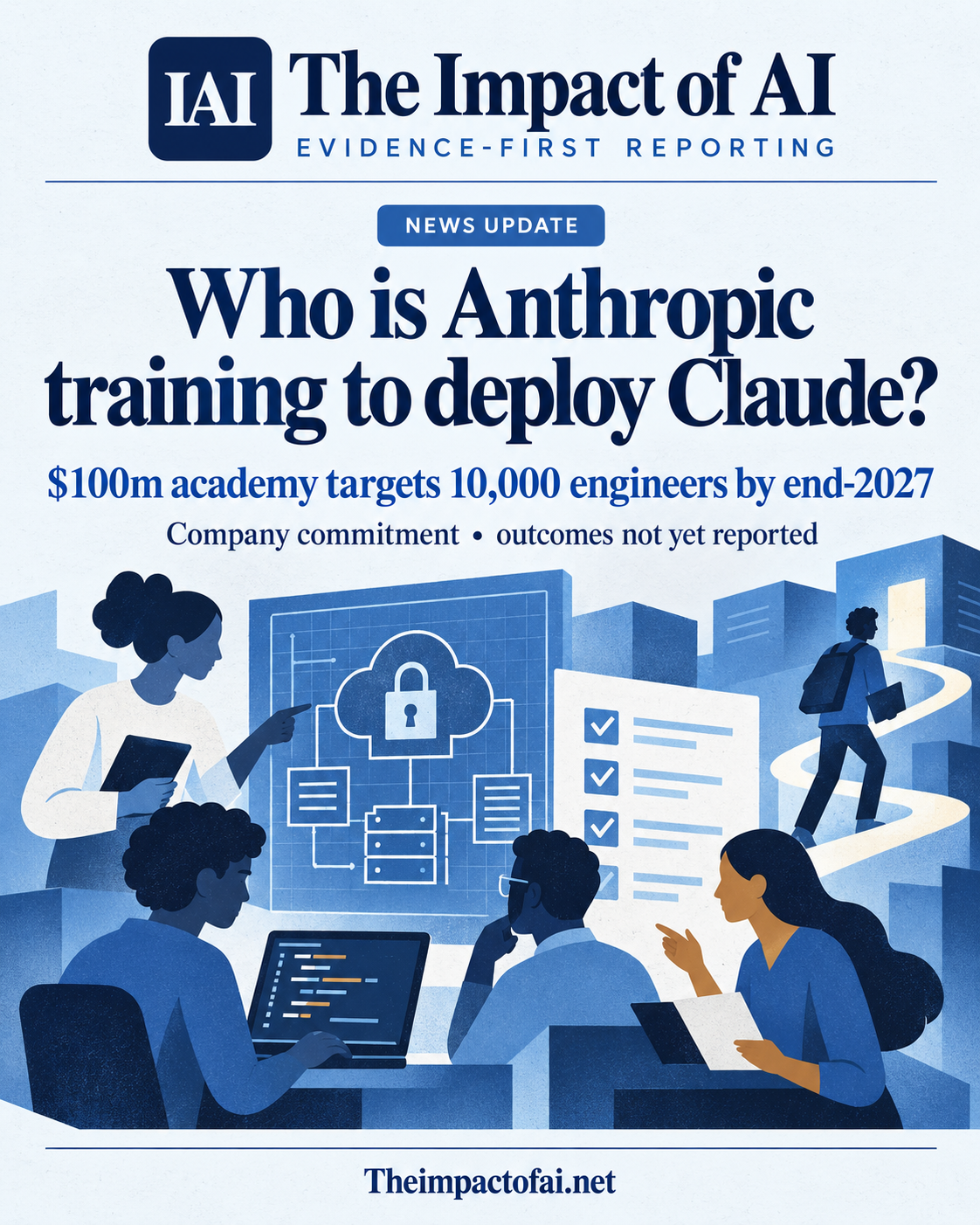
Anthropic says it will spend $100 million to train 10,000 nominated enterprise engineers by the end of 2027. The residency includes practical assessment and a 12-week workplace project, but the company has not reported completion, retention, safety or business-outcome evidence.
Editorial responsibility: The Impact of AI Editorial Desk · Report a factual concern
Research topic
Whether a provider-led residency can build enterprise AI deployment capability at scale and demonstrate safe, useful workplace outcomes
At a glance
- 1Anthropic says a $100 million commitment will support 10,000 Frontier Deployed Engineers by the end of 2027, with initial cohorts running in San Francisco, New York and London.
- 2Participants are nominated by their organisations, complete an in-person simulated deployment and graded practical, then lead a real Claude project during a 12-week residency before a final assessment.
- 3The announcement gives targets and testimonials, not measured outcomes: it does not report pass rates, participant demographics, project success, safety incidents, productivity gains or independent evaluation.
The Impact Brief
Keep the evidence trail, not the noise.
Get the most consequential AI developments with direct sources and clear limits.
Living evidence record
Impact record IAI-1BI0OPK
Evidence stage
Observed
Confidence
Supported
Reporting basis
Source analysis
Independent support
Not yet
Record status
Monitoring
Last checked
4 October 2026
Source trail
1 direct source across 1 source type.
People impact
Documented in this record.
Uncertainty
Limits and next checks are explicit.
Stages describe the evidence available—not whether a technology is good or bad. See the public method.
Single-source reporting disclosure
This record analyses one direct source. It can establish what Anthropic published or reported, but it is not independent corroboration of every performance claim or predicted outcome. The confidence label will change only when broader evidence is added.
The commitment is large, but it is still a commitment
Anthropic announced Claude Frontier Academy on 2 October with a stated $100 million commitment and a target to train 10,000 'Frontier Deployed Engineers' by the end of 2027. Initial cohorts include engineers nominated by consulting firms, banks, a pharmaceutical company and other large organisations. Cohorts are already running in San Francisco, New York and London, according to the company.
The headline numbers are material because provider-led training is becoming part of how large companies adopt generative AI. Model access alone does not redesign a workflow, pass a security review, connect to governed data or create a process that employees can challenge. Anthropic is betting that a small group of specialists can translate a general-purpose model into production systems inside complex institutions.
Readers should separate the verified announcement from the unproven result. Anthropic has described the budget, target, curriculum and named participating organisations. It has not shown that 10,000 people will graduate, that projects will reach production, that the work will be safe or that organisations will recover the cost. The first final credential holders are expected in early 2027.[1]
Who can take part
This is not an open introductory course. Anthropic says organisations nominate hands-on software engineers with strong fundamentals, experience building with large language models, a record of helping colleagues adopt AI and a habit of working on important business problems. Each participant is meant to arrive with a named Claude project to lead on returning to work. Prior experience building agents is not required, but the selection profile already favours experienced technical staff.
The first named organisations include Accenture, Bain, Capgemini, Commonwealth Bank of Australia, Deloitte, McKinsey, Morgan Stanley and Novo Nordisk. That list shows the programme's intended route to scale: train specialists inside influential customers and professional-services firms, then let those people spread a provider-specific deployment method through client and internal work.
Participation is by nomination and organisations are told to ask their Anthropic account or partner manager about eligibility. The company does not publish tuition, selection ratios, country availability, accessibility arrangements or the demographic composition of current cohorts. Those gaps matter if the Academy is presented as an answer to an industry-wide talent shortage rather than a commercial enablement programme for selected customers.[1]
What the residency actually includes
Participants begin with a multi-day, in-person programme taught by Anthropic engineers and licensed instructors. They work through a simulated enterprise deployment—from choosing a use case and passing security review to handover—and finish with a graded practical on a new scenario. Those who pass receive a Claude Resident Engineer badge and enter a 12-week workplace residency.
During the residency, engineers lead a real Claude use case at their own organisation with support from Anthropic and their cohort. A second assessment follows. Passing it earns the Claude Frontier Deployed Engineer badge. This sequence is more demanding than a video course or multiple-choice certification because it combines practice, assessment and a live workplace project.
Even so, the evidence is a programme description. The company has not published the scoring rubric, assessor independence, failure and retake policy, project-risk controls or criteria for deciding whether a workplace deployment is successful. A badge issued by the model provider can demonstrate completion of its standard, but it is not a licence, a regulated engineering qualification or independent proof of competence across other models.[1]
Why employers may want this role
Large organisations often have many AI pilots and few people who can connect technical capability with security, governance, operations and change management. A forward-deployed engineer works close to the business problem, translating requirements into a system and staying through testing, rollout and handover. The model resembles specialist teams that software and cloud vendors have long placed with important customers.
Anthropic's examples emphasise redesigning processes, modernising software, supporting research and building agentic systems. The participating organisations' testimonials say they want engineers who can move projects from experimentation to production. Those statements establish demand from partners, not measured effectiveness. Vendors and customers both benefit commercially if deployment expands, so testimonials should not be read like controlled evidence.
The relevant comparison is not training versus no training. Employers need to know whether this residency produces better decisions than internal mentoring, university programmes, independent certification or training from another provider. They also need total costs: salary time, travel, model use, infrastructure, security review, data preparation, supervision and the opportunity cost of choosing a project that may not work.[1]
What workers could gain—and what could narrow
For selected engineers, the Academy could provide access to experienced practitioners, realistic deployment constraints and a cohort working on comparable problems. Leading a real project may build skills that classroom instruction cannot. Employers may gain internal staff who can challenge vendors more effectively, document controls and help colleagues use AI without outsourcing every decision.
The opportunity is selective. Nomination by large organisations can concentrate training among already well-resourced employers and experienced engineers. Workers in smaller firms, public services, lower-income countries or non-engineering roles may not have the same route in. The announcement does not say how the $100 million is allocated or whether any places are reserved for underrepresented groups or public-interest work.
Provider-specific depth also creates a trade-off. Learning Claude's tools, deployment patterns and commercial ecosystem can be valuable, but organisations may become dependent on one vendor's interfaces, terminology and assumptions. A robust curriculum would teach participants how to test portability, compare models, preserve exit options and distinguish general engineering judgement from product-specific technique.[1]
The missing outcome evidence
Anthropic does not report pass rates, completion rates, participant retention, project cancellation, security incidents, audit findings or changes in software quality. It does not define a denominator for successful deployments or describe how outcomes will be measured against a comparison group. The named partners provide endorsements, while one bank cites more code changes in the past year; that is not evidence that this Academy caused better productivity or safer systems.
Useful evaluation would publish cohort size and composition, pre-registered competencies, blinded or independent assessment where possible, project status at six and 12 months, and both benefits and harms. Productivity measures should include review and correction time, reliability, maintainability and incidents—not only code volume. Business results should distinguish time saved from work shifted to supervisors or security teams.
Safety evidence is especially important because the programme aims to create agentic systems that can change how a business runs. Reports should cover data access, prompt injection, permission boundaries, human approval, logging, rollback and how participants respond when a model behaves unexpectedly. A credential has limited public value unless outsiders can understand what it tests and how consistently the standard is applied.[1]
What would change the assessment
Confidence would rise if Anthropic publishes transparent cohort and assessment data, invites independent evaluators and reports unsuccessful projects alongside successes. Employers could strengthen the evidence by comparing Academy graduates with matched teams using other training routes and measuring deployment quality, staff experience, customer effects and total cost over time.
It would also help to see geographic expansion beyond three wealthy-city hubs, public eligibility criteria, financial support for smaller organisations and evidence that the curriculum covers multiple models and exit strategies. Clear recertification and complaint processes would show whether the badge represents continuing competence rather than a one-time vendor relationship.
For now, the Academy is a consequential workforce investment with a concrete design and unusually large stated target. It may improve the difficult middle layer between a model demo and a governed production system. But it remains an employer-nominated, provider-run programme whose educational quality, labour-market value and organisational impact have not yet been independently measured. That makes it news, not proof that the enterprise AI talent gap has been solved.[1]
What this means for people
- Selected engineers gain intensive, project-based training and direct access to Anthropic practitioners.
- Employers may build internal deployment capability, but they also risk deeper dependence on one provider's tools and methods.
- Workers outside large nominated organisations may see little direct benefit unless access, funding and geography broaden.
Global context
The first cohorts run in the United States and United Kingdom, while named employers operate across finance, consulting and life sciences in many countries. AI deployment skills are in demand globally, but access to advanced training, cloud infrastructure and experienced mentors is uneven. Provider-led academies can spread practical knowledge quickly; they can also export one company's technical and governance assumptions. International employers will need to reconcile the curriculum with local labour rules, data protection, sector regulation, language needs and professional accountability.
What the evidence does not yet show
- All central facts and testimonials come from Anthropic's own announcement; no independent evaluation is available.
- The $100 million is a stated commitment, with no public breakdown of spending, cost per participant or delivery milestones.
- No completion, pass, retention, safety, productivity, customer or business-outcome data have been reported.
- Participation is employer-nominated and eligibility, pricing, demographic composition and geographic access are not fully published.
- The badges are provider-issued credentials, not regulated qualifications or independent evidence of competence across AI systems.
What to watch next
- The first final assessments in early 2027, including pass rates, published rubrics and any independent oversight.
- Six- and 12-month outcomes for workplace projects, including failures, security incidents and total implementation cost.
- Whether access expands beyond large customers and three initial cities, and whether smaller or public-interest organisations receive support.
- Evidence that graduates can compare providers, preserve portability and safely stop or roll back agentic deployments.
Evidence trail
Sources used for this report
Links checked 4 October 2026
This report is labelled source analysis. We summarise and analyse source material in our own words; company statements remain attributed claims until independently supported. Translated summaries preserve the meaning of the original source and link back to it. Read our editorial standards.
Continue the story
Related reporting
Work & Skills
Does an AI label bias code review—or does job rank matter more?
In a randomized vignette experiment, 447 Microsoft engineers did not penalize an AI-use disclosure on identical code, but rated the same code and author more favourably when the fictional author was labelled Principal rather than Level 1. One AI-normalized US workplace cannot settle how other teams respond.
9 min · 2 sources
Work & Skills
Should AI wait until people think first?
In an unreviewed study of 398 adults across five countries, a writing assistant withheld direct generation until users stated a position and supporting argument. The design shifted effort earlier and improved one conditional error-classification measure, but did not significantly improve overall judgment accuracy.
8 min · 2 sources
Work & Skills
Hiring experiment finds AI skills can improve interview prospects
A study with 1,700 recruiters in the UK and US reports that AI skills increased interview invitations across office, software and design roles, sometimes offsetting age or education disadvantages.
4 min · 1 source
Reader discussion
Add evidence, experience or a question
No account is required. Reader notes are published after a brief civility, relevance and safety check; disagreement is welcome.
Published reader notes
0No published reader notes yet. You can start the evidence-led discussion above.
Prefer a private correction or response? Contact the newsroom.