Who stands to gain from AI across the region?
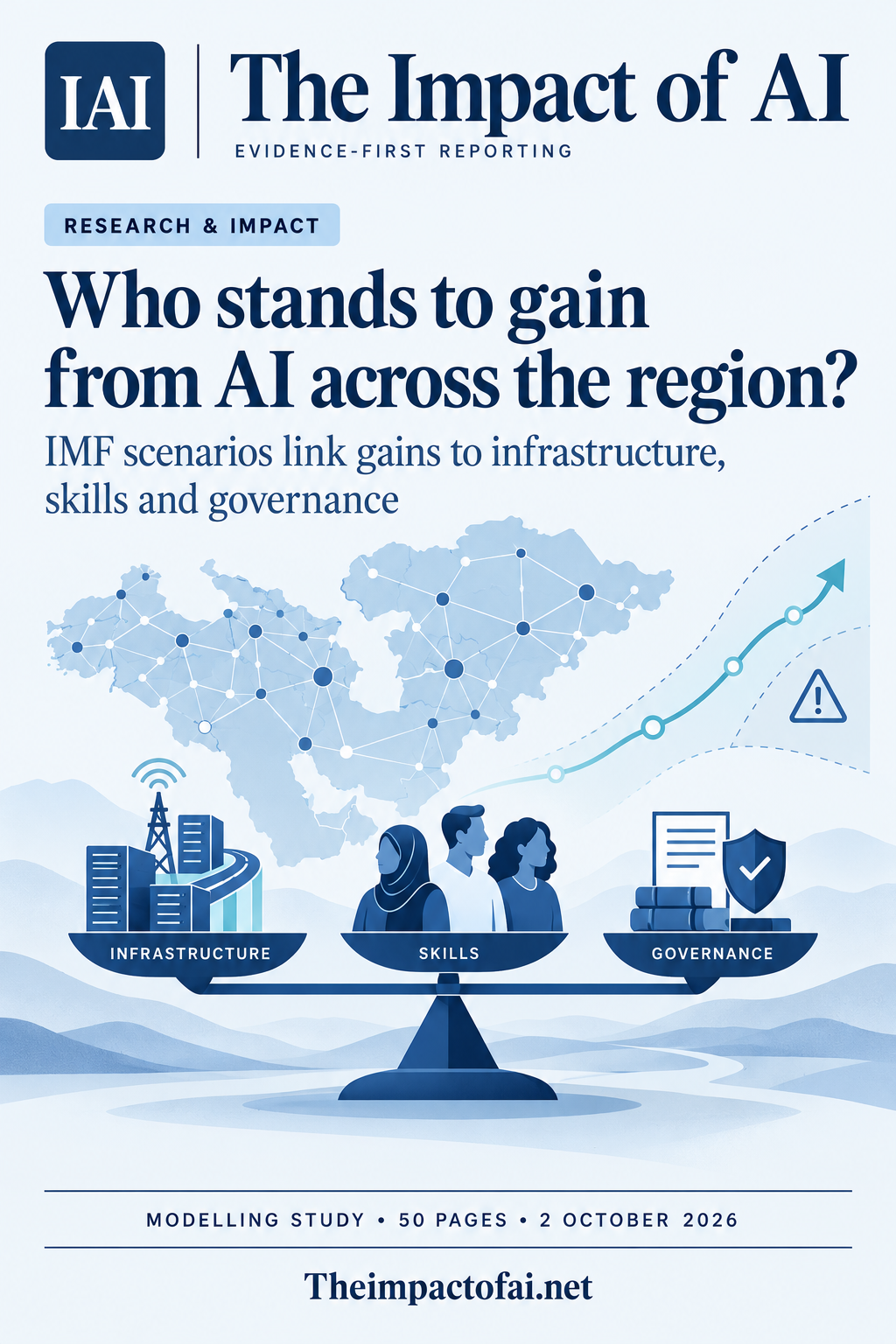
New analysis today of a 50-page IMF departmental paper published 2 October. It models uneven AI gains across the Middle East and Central Asia and warns that infrastructure spending can create financial risk if adoption disappoints; its growth ranges are scenarios, not forecasts of realised GDP or jobs.
Editorial responsibility: The Impact of AI Editorial Desk · Report a factual concern
Research topic
How AI exposure, adoption capacity, productivity assumptions and national preparedness shape modelled growth gains and risks across MENAP and the Caucasus and Central Asia
At a glance
- 1The IMF paper combines country preparedness indicators, occupation-level AI exposure and macroeconomic scenarios; it is not a business survey and has no single respondent denominator.
- 2Its cited ten-year low-productivity scenarios range from about 0.1% additional output in low-income economies to 0.8% in the United Arab Emirates, rising to roughly 0.3%–2.2% under higher-productivity assumptions.
- 3Large data-centre and compute investments could support diversification, but the paper warns of stranded capacity and financial-stability pressure if external demand, domestic adoption or cross-border regulatory access falls short.
The Impact Brief
Keep the evidence trail, not the noise.
Get the most consequential AI developments with direct sources and clear limits.
Living evidence record
Impact record IAI-1YC79SZ
Evidence stage
Studied
Confidence
Supported
Reporting basis
Source analysis
Independent support
Present
Record status
Monitoring
Last checked
4 October 2026
Source trail
2 direct sources across 1 source type.
People impact
Documented in this record.
Uncertainty
Limits and next checks are explicit.
Stages describe the evidence available—not whether a technology is good or bad. See the public method.
Related-source reporting disclosure
This record analyses 2 linked source records around the same underlying development. The extra records add method, date or context, but they do not by themselves constitute independent replication of every performance claim or predicted outcome.
The paper measures possibility, not realised growth
The IMF’s question is not whether AI has already added a known amount to regional GDP. It asks how potential gains could vary when economies differ in digital infrastructure, skills, innovation capacity, legal frameworks, occupational exposure and adoption. The two geographic groupings are the Middle East, North Africa, Afghanistan and Pakistan, known as MENAP, and the Caucasus and Central Asia, known as CCA.
This is a 50-page departmental paper, not a company announcement or a household survey. Its denominator is therefore not a fixed number of respondents. The authors assemble country-level indicators and external datasets, map occupation and task exposure, and run macroeconomic scenarios. Country coverage varies with source availability, so regional averages should not be read as a census of every worker, firm or AI system in each economy.[1][2]
Preparedness determines how much exposure can become adoption
The paper uses the IMF AI Preparedness Index as a diagnostic across four broad pillars: digital infrastructure, human capital and labour-market policy, innovation and economic integration, and regulation and ethics. A high score does not prove that firms are deploying AI effectively or that citizens receive the benefits. It indicates that the foundations for adoption are relatively stronger under the chosen indicators.
That framing separates capability from use. Gulf economies with capital, compute projects and stronger infrastructure may be positioned to adopt and supply AI services faster, while lower-income and conflict-affected economies face basic connectivity, electricity, skills and institutional constraints. The implication is not that every country should race immediately to frontier-model production. For many economies, reliable broadband, education, public-service capacity and rules for ordinary digital adoption may offer a more credible first return.[1]
The growth numbers are ranges conditioned on assumptions
The model links occupational exposure and the possibility that AI augments or replaces tasks to productivity and output. In the related ten-year scenarios reported for these regions, a lower total-factor-productivity case produces modest additional output ranging from around 0.1% in low-income economies to 0.8% in the United Arab Emirates. A higher-productivity case expands the range to roughly 0.3%–2.2%. These are level effects over a decade, not guaranteed annual growth rates.
The gap between scenarios is the story. Estimates depend on how quickly AI spreads, which tasks it changes, whether workers are complemented or displaced, how much productivity transfers from exposed tasks to the wider economy, and whether organisations possess the management and digital capacity to use the tools. A precise-looking upper bound should not be detached from those conditions or presented as an IMF forecast for a particular budget year.[1]
Workers face different exposure and different ability to adjust
AI exposure tends to be higher in information-processing occupations than in work dominated by physical tasks. That can create opportunities for augmentation in finance, professional services, government and other knowledge-intensive sectors, but exposure is not the same as job loss. Whether a task is automated, improved or reorganised depends on cost, reliability, regulation, workplace design and demand for the service.
The paper highlights greater disruption risks for women and younger workers because of where they are concentrated in labour markets and because early-career roles may contain tasks that current tools can perform. The practical policy response is not a generic promise to reskill everyone. Training has to match local employers, languages and adoption paths; social protection has to reach people during transitions; and labour-market data has to reveal which occupations and regions are actually changing.[1]
Infrastructure can be an export strategy—and a balance-sheet risk
Several Gulf economies are investing heavily in data centres, compute capacity and energy systems with the ambition of becoming global AI-service hubs. The paper treats that as a plausible diversification strategy, especially where power, capital and cross-border partnerships are available. Success, however, depends on customers outside the host country, access to advanced hardware and software, interoperable rules, talent and sustained utilisation of expensive infrastructure.
If global demand or domestic adoption falls below expectations, projects can become underused assets while debt, public guarantees or concentrated lending remain. That is the paper’s macro-financial warning. Policymakers and investors need stress tests that vary utilisation, electricity costs, export access, hardware replacement cycles and financing conditions. Announcing capacity is not evidence that it will earn the revenue assumed in a business case.[1]
What governments, firms and households can take from it
For governments, the sequencing lesson is concrete: strengthen the constraint that actually prevents adoption. A country with limited connectivity and foundational skills should not copy the spending mix of an economy building a global compute cluster. A more prepared economy may need competition policy, data governance, cross-border standards and independent evaluation so that infrastructure translates into broad productivity rather than a narrow asset boom.
For businesses, national preparedness is context rather than destiny. Firms still need suitable data, redesigned processes, accountable staff and evidence that a system improves an outcome. For households and workers, regional growth estimates say little about who receives income, which services improve or whether prices fall. Distribution depends on wages, ownership, taxation, social protection and access to training—choices that sit outside a productivity model’s central estimate.[1]
What evidence would change the assessment
The modelled ranges should be updated as comparable data arrive on firm-level adoption, task changes, wages, productivity, compute utilisation, electricity consumption and financial exposures. Quasi-experimental or longitudinal evidence could show whether early adopters outperform similar non-adopters after accounting for sector and management quality. Public reporting on project financing and utilisation would make the infrastructure-risk analysis more testable.
The assessment would strengthen if measured productivity gains spread beyond a small group of capital-intensive firms, if exposed workers move into higher-value tasks without sustained income loss, and if lower-preparedness countries close digital and skills gaps. It would weaken if compute projects remain underused, external access is restricted, debt builds faster than revenue or adoption widens gender, age and regional inequalities. The paper is a map of contingencies; outcomes still depend on policy and execution.[1][2]
What this means for people
- Workers in information-intensive roles may see tasks augmented or automated sooner, while access to relevant training and income support remains uneven.
- Citizens can benefit if adoption improves public and private services, but aggregate GDP scenarios do not show who receives those gains.
- Taxpayers, lenders and pension savers may bear risk when large infrastructure projects depend on optimistic demand or implicit public support.
Global context
MENAP and CCA include energy exporters, diversified middle-income economies, lower-income countries and states affected by conflict, so a single regional average conceals large differences. The paper also links regional strategies to global hardware supply, advanced-economy regulation and demand for cross-border AI services. Its central lesson travels beyond the region: compute spending, workforce exposure and governance must be analysed together, and scenario output should not be confused with observed prosperity.
What the evidence does not yet show
- The analysis is a regional modelling and diagnostic exercise, not a randomised evaluation, firm survey or forecast of realised GDP and employment.
- Country coverage and reference years vary across underlying datasets, so there is no single respondent or economy denominator for every result.
- Growth ranges are sensitive to assumed AI diffusion, task exposure, augmentation, displacement and total-factor-productivity effects.
- Preparedness indices compress infrastructure, skills, innovation and governance into comparable scores but cannot measure implementation quality or distributional outcomes directly.
- The authors state that their views do not necessarily represent the IMF Executive Board or IMF management.
What to watch next
- Comparable firm-level adoption and productivity data across MENAP and CCA economies.
- Utilisation, financing, energy cost and export access for major regional data-centre and compute investments.
- Worker outcomes by gender, age, occupation and location, including whether training leads to durable wage and job improvements.
Evidence trail
Sources used for this report
Links checked 4 October 2026
This report is labelled source analysis. We summarise and analyse source material in our own words; company statements remain attributed claims until independently supported. Translated summaries preserve the meaning of the original source and link back to it. Read our editorial standards.
Continue the story
Related reporting
Finance & Business
Is AI financing becoming circular?
A Bank for International Settlements analysis maps 1,246 AI firms and 972 investment relationships, finding that commercial links accompanied 16.1% of AI-to-AI deals by count but 46.4% by disclosed value. The pattern is consequential, yet it does not show that the transactions were improper, unprofitable or certain to spread financial stress.
10 min · 5 sources
Finance & Business
Could AI-linked debt become a financial-stability risk? The Bank of England widens its warning
The Financial Policy Committee says AI investment is exposing more investors and funding markets to a repricing. Its official record quantifies the build-out, but the underlying analyst estimates are not a stress test or forecast of losses.
5 min · 2 sources
Finance & Business
IMF urges central banks to prepare for faster, more connected AI-driven finance
The IMF says AI is compressing time in trading, credit and supervision, making operational resilience, third-party oversight and cross-border coordination more important.
4 min · 1 source
Reader discussion
Add evidence, experience or a question
No account is required. Reader notes are published after a brief civility, relevance and safety check; disagreement is welcome.
Published reader notes
0No published reader notes yet. You can start the evidence-led discussion above.
Prefer a private correction or response? Contact the newsroom.