Will AI answer engines narrow the open web?
They could, Europe’s telecom regulators warn: direct answers and agents may reduce source diversity, weaken publisher incentives and shift choice toward a few gateways. But this is a draft evidence review for consultation—not a final rule or a new causal study.
Editorial responsibility: The Impact of AI Editorial Desk · Report a factual concern
At a glance
- 1BEREC says generative AI is becoming a new layer between people and the web: it can cut search costs, but also concentrate decisions about which sources and services are seen.
- 2The draft highlights a structural tension: AI systems depend on high-quality online material while summaries, zero-click use and heavier crawling may weaken traffic, revenue and incentives for the organisations producing it.
- 3This is a 45-page draft review, not a new causal study or binding rule. The consultation closes on 11 November 2026, after which evidence and policy conclusions may change.
Research topic
How generative and agentic AI may change access to online information, user choice, competition and incentives to produce public web content
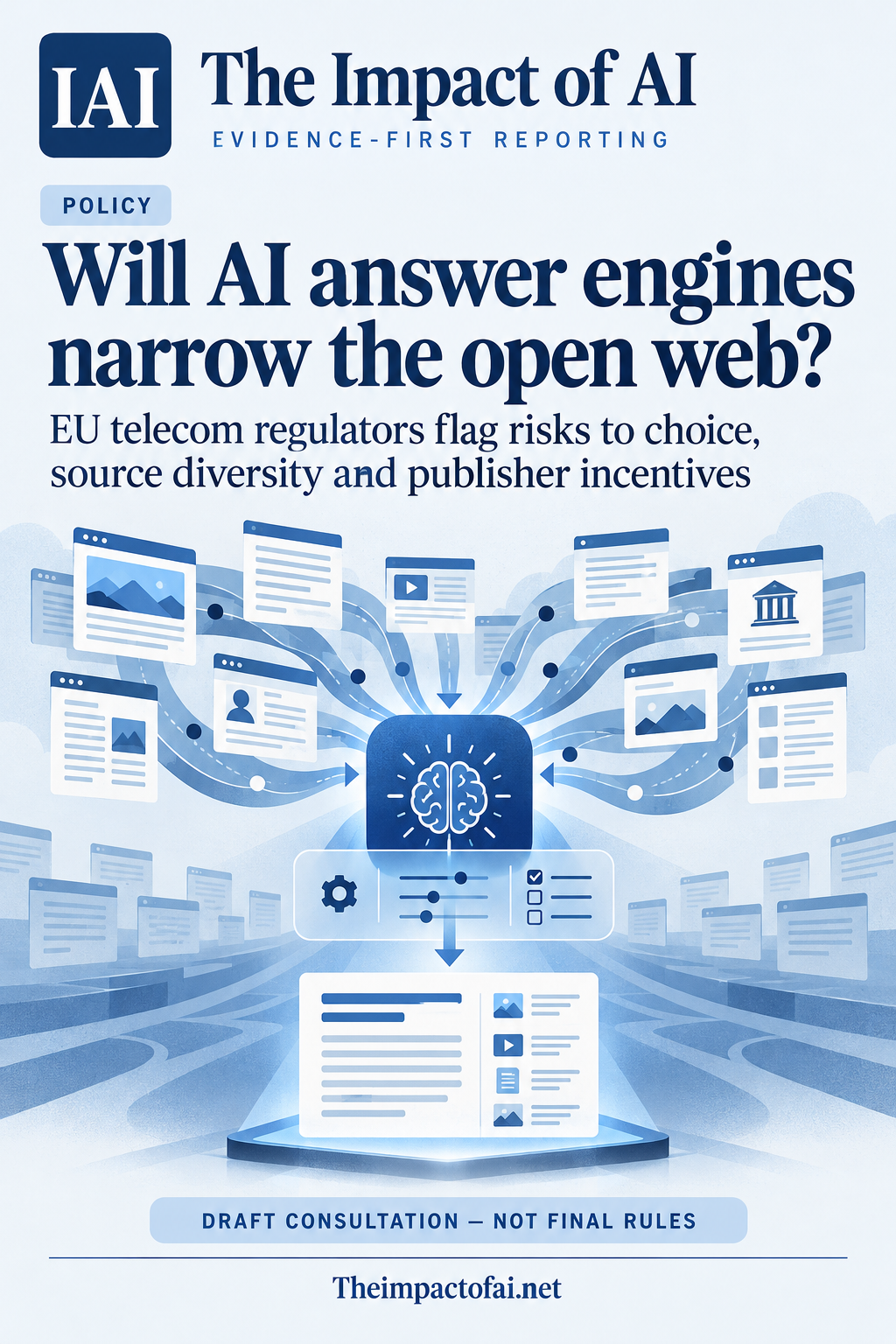
The direct answer: AI gateways could narrow choice, but the evidence is not yet decisive
AI answer engines and agents could make the open web less open if a small number of interfaces increasingly decide what people see, which services they reach and whether original sources receive attention. That is the core warning in a draft report from the Body of European Regulators for Electronic Communications, or BEREC. The regulator group also recognises real benefits: direct answers can reduce search costs, make complex information easier to use and let agents complete multi-step tasks. Its concern is that convenience can hide a transfer of choice from users to the systems selecting and synthesising information.
The status matters as much as the finding. BEREC’s 45-page document is dated 1 October 2026, and the organisation announced its public consultation on 7 October. It is a regulatory evidence review, not a controlled experiment and not a final policy. The consultation remains open until close of business on 11 November 2026. BEREC may revise its analysis after responses, so the report should be read as a structured diagnosis of risks and regulatory gaps rather than proof that a particular answer engine has caused a quantified loss of openness.[1][2][3]
What BEREC reviewed—and what it did not measure
The report brings together existing regulatory work, competition analysis, technical standards and published evidence about search, AI-mediated access, web crawling and online content economics. It maps the AI value chain from cloud infrastructure and foundation models to browsers, search tools, messaging services and downstream agents. It also examines technical protocols including the Model Context Protocol, WebMCP and robots.txt, then tests the issues against the EU’s Open Internet Regulation, AI Act, Digital Markets Act, Digital Services Act and Data Act.
There is no single study population or denominator. BEREC did not recruit a representative sample of users, randomly assign people to search or answer engines, or independently measure publisher traffic. The report cites earlier studies and market estimates, whose methods and dates vary. For example, its statement that OpenAI, Google and Anthropic together hold more than 84% of the global AI-agent market comes from a 2026 French competition-authority source, not a new BEREC census. That figure describes the cited market definition and should not be read as a stable share of every agent, assistant or geography.[1]
From a list of links to one synthesized answer
Traditional search engines already rank and filter the web, but they normally expose multiple destinations. An answer engine can instead present a synthesis inside the interface, while an agent can move beyond information retrieval to choose products, book services or act through connected tools. BEREC argues that this creates a deeper form of intermediation: the system may control both the description of the available options and the action taken on the user’s behalf. Defaults, pre-installation and integration with operating systems, browsers or messaging products can amplify that influence.
For an individual, the benefit may be immediate—fewer tabs, faster comparisons and simpler completion of routine tasks. The risk is harder to see. A concise answer can obscure why one source was selected, whether another view was excluded and how commercial relationships affected the result. If the criteria are not transparent or controllable, users may believe they exercised choice when the decisive filtering happened upstream. People using agents for legal, financial, health or civic information may therefore need access to sources, alternatives and a record of consequential selections, not only a fluent final answer.[1]
The publisher paradox: AI needs the web it may weaken
BEREC describes a structural paradox. Generative systems depend on material produced by publishers, creators, researchers, public bodies and community projects for training, retrieval and grounding. Yet if users receive a sufficient summary without visiting the origin, the organisations paying to create and verify that material may lose traffic, advertising revenue, subscriptions or public visibility. At the same time, automated crawling can impose bandwidth, infrastructure and access-control costs, particularly on smaller sites and digital commons.
The draft does not show that all publishers lose or that every zero-click interaction displaces a visit. Effects will differ by subject, provider, interface design, licensing arrangement and user intent. Some sources may gain discovery when cited prominently; others may be used without a meaningful referral. The policy question is therefore not simply whether AI produces summaries. It is whether content providers can express usable preferences, understand how their work is selected, negotiate on fair terms and remain economically capable of producing the diverse information on which accurate answers depend.[1]
Open protocols can reduce lock-in—and create new chokepoints
BEREC gives technical protocols an unusually central role. Shared interfaces such as MCP and WebMCP can lower integration costs, let more services connect to agents and make switching easier. In principle, that can reduce barriers for smaller providers and allow users to combine models, tools and data sources. But an open connection standard does not guarantee an open market. If one user-facing assistant controls discovery, permissions or the flow of requests, it can still become the gateway through which connected services compete for attention.
The report also examines robots.txt, the long-standing mechanism by which sites communicate crawler preferences. BEREC says it remains important but has limits in enforcement and transparency, especially when a publisher wants different choices for indexing, model training, retrieval and real-time grounding. A durable solution may require machine-readable controls that distinguish those uses, logs showing whether preferences were respected and remedies when they were not. The report does not settle the design, and overly rigid controls could also make public-interest search and research harder.[1]
Why existing EU laws only cover parts of the problem
BEREC does not propose one new law as the answer. It finds that different EU instruments address different parts of the stack: the Digital Markets Act can constrain some gatekeeper conduct and self-preferencing; the Digital Services Act can address systemic risks including media pluralism and access to information; the AI Act adds transparency, copyright and rights-reservation duties; and the Data Act supports some interoperability and switching. The Open Internet Regulation is narrower because it focuses on access services rather than every form of platform intermediation.
That division creates a coordination problem. A user’s reduced choice might arise from a mixture of model design, a default in an operating system, contractual access to content and the ranking logic of an agent. No single authority may see the entire pathway. BEREC’s practical case is for coordinated enforcement, meaningful user choice and stronger transparency across instruments. The draft does not demonstrate that coordination will be sufficient, nor does it quantify compliance costs or test whether extra disclosures actually change user behaviour.[1]
What would change this assessment
The strongest next evidence would measure outcomes rather than infer them from structure. Independent, repeated audits could compare answer engines on source diversity, citation visibility, referral traffic and the effects of defaults. Publisher studies should separate large commercial outlets from local news, specialist research, public-interest archives and community sites. User experiments could test whether source links, alternative answers, preference controls and explanations improve informed choice without overwhelming people. Agent studies should record which services were considered, selected and rejected during real tasks.
The assessment would become less concerning if open protocols produced measurable switching, sources received useful attribution and traffic, publishers could enforce granular preferences, and smaller services gained access without discriminatory terms. It would become more concerning if the same few providers kept control of models, distribution and agent interfaces while source diversity and original production declined. Consultation responses are due by 11 November; until BEREC publishes a final report, the responsible conclusion is conditional: AI gateways create a credible openness risk, but its scale and the right remedy remain unsettled.[1][3]
What this means for people
- People may save time with direct answers and agentic services but have less visibility into excluded sources and alternatives.
- Publishers, researchers and public-interest sites may face lower referrals and higher crawler costs even as AI systems depend on their work.
- Small online services could gain distribution through common protocols, provided the user-facing gateways do not discriminate against them.
Global context
BEREC’s legal analysis is European, but the market structure it examines is global. Major model, cloud, operating-system and browser providers operate across borders, while publishers and users face different copyright, competition and platform rules. Open protocols may spread internationally faster than regulation. Any durable approach therefore needs interoperable technical controls and cross-border evidence, not an assumption that an EU remedy alone will determine how answer engines treat the wider web.
What the evidence does not yet show
- The underlying report is a draft regulatory evidence review, not a new causal study, representative survey or final decision.
- Many quantitative claims are drawn from external studies and market estimates with different methods, dates and definitions.
- The report discusses risks across the AI ecosystem; it does not establish that every answer engine or agent produces the same effects.
- Publisher outcomes may differ substantially by geography, business model, topic, citation design and licensing arrangement.
- The analysis is EU-focused even though the largest AI and cloud providers, protocols and content markets are global.
What to watch next
- Whether BEREC changes its findings after the consultation closes on 11 November 2026.
- Independent audits of source diversity, referrals and service selection across answer engines and agents.
- Granular technical controls separating search indexing, model training, retrieval and live grounding.
- Coordination among EU telecom, competition, data-protection, AI and platform regulators.
- Evidence that open protocols produce real switching and market entry rather than a new gateway controlled by the same incumbents.
Living evidence record
Impact record IAI-1PIG7ZI
Evidence stage
Observed
Confidence
Supported
Reporting basis
Source analysis
Independent or research support
Not yet
Record status
Monitoring
Last checked
8 October 2026
Source trail
3 direct sources across 2 source types.
People impact
Documented in this record.
Uncertainty
Limits and next checks are explicit.
Stages describe the evidence available—not whether a technology is good or bad. See the public method.
Related-source reporting disclosure
This record analyses 3 linked source records around the same underlying development. The extra records add method, date or context, but they do not by themselves constitute independent replication of every performance claim or predicted outcome.
Evidence trail
Sources used for this report
Links checked 8 October 2026
This report is labelled source analysis. We summarise and analyse source material in our own words; company statements remain attributed claims until independently supported. Translated summaries preserve the meaning of the original source and link back to it. Read our editorial standards.
Continue the story
Related reporting
Government & Policy
Will EU text watermarks prove AI authorship?
No. OpenAI's new textGrain signal can indicate that eligible text passed through a supported system, but its own tests show detection falls sharply after editing and cannot establish who wrote, owns or verified a passage.
8 min · 3 sources
Government & Policy
Who sets the rules for genomic AI?
A peer-reviewed review mapped 90 publicly documented national genomics initiatives across 70 countries and territories. Thirty-two reported current or planned AI use, but the researchers found public AI-specific governance in only three programmes.
8 min · 4 sources
Government & Policy
EU AI Act moves from rulebook to staged implementation
The European Commission's official AI Act portal sets out the risk-based framework, prohibited practices, general-purpose AI obligations and the staged dates on which different duties apply.
2 min · 1 source
The Impact Brief
Keep the evidence trail, not the noise.
Get the most consequential AI developments with direct sources and clear limits.
Reader commentary
Add evidence, experience or a question
No account is required. Reader notes are published after a brief civility, relevance and safety check; disagreement is welcome.
Explore commentary across the portal →Published reader notes
0No published reader notes yet. You can start the evidence-led discussion above.
Prefer a private correction or response? Contact the newsroom.