Will Google’s nuclear deal add new grid power?
Google and Constellation say a 20-year agreement will support uprates adding 890 megawatts across 11 US nuclear units, with the first increase expected in 2028. The capacity is planned rather than delivered, and the companies have not disclosed the price or project-by-project schedule.
Editorial responsibility: The Impact of AI Editorial Desk · Report a factual concern
At a glance
- 1The companies say uprates at 11 Constellation nuclear units will add 890 MW of capacity to the PJM region; the first increase is expected in 2028, so none of the announced capacity is yet operating.
- 2A separate 15-year agreement covers 2,700 MW from existing plants. That electricity is not additional capacity and should not be added to the 890 MW as if both figures represented new generation.
- 3The announcement gives no contract price or project-by-project engineering, regulatory and delivery schedule. Jobs, investment and ratepayer claims are company estimates rather than audited outcomes.
Research topic
Whether a long-term corporate agreement can deliver additional output from existing nuclear plants while managing data-centre demand on a constrained regional grid
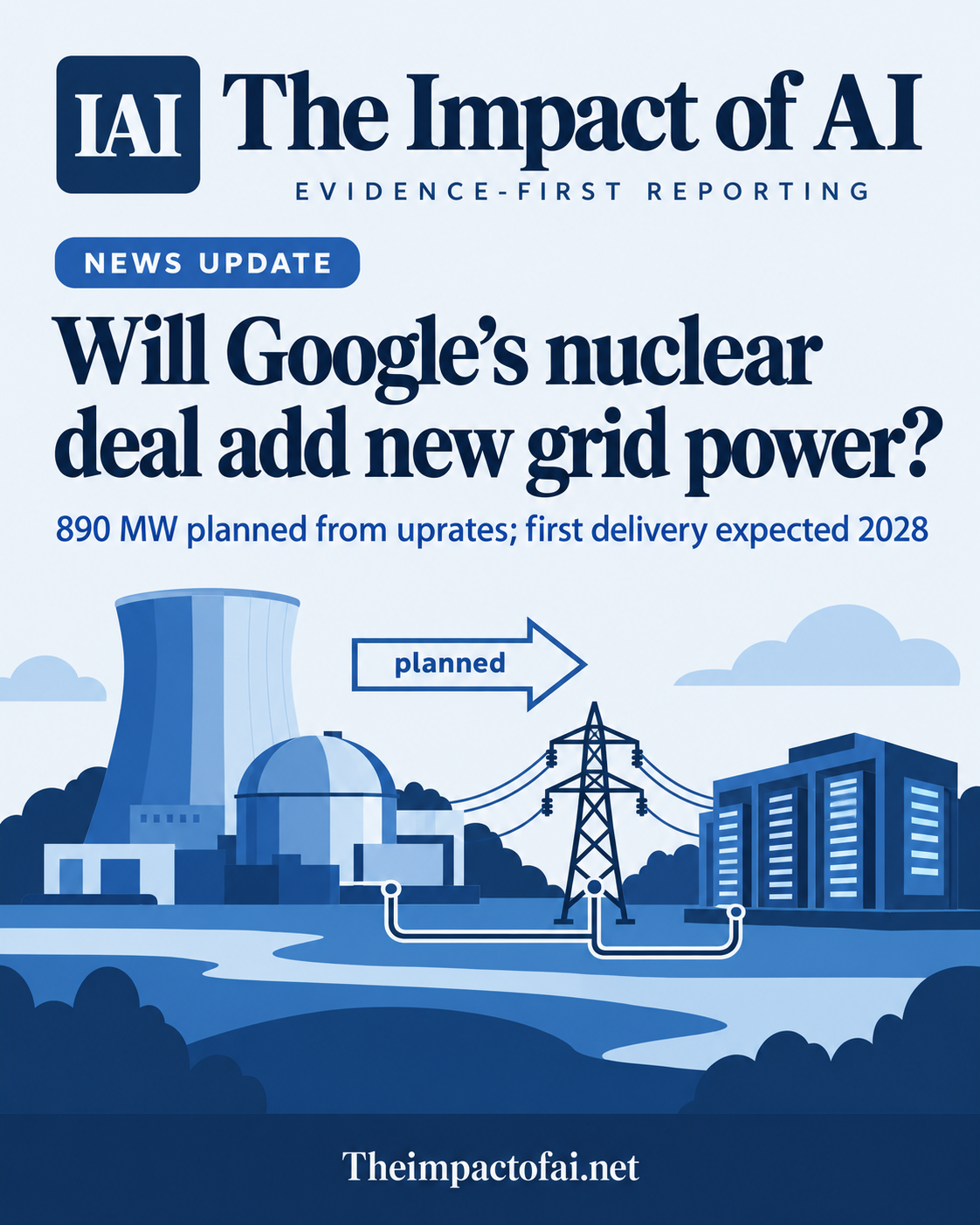
The deal is designed to add capacity, but the result begins after 2028
Google and Constellation have announced a 20-year agreement intended to support efficiency and output upgrades at 11 nuclear units in Illinois, Pennsylvania and New Jersey. Constellation calls the projects uprates: engineering changes that allow an existing reactor to generate more electricity within its licensed operating envelope. The company says the programme will add 890 megawatts to the PJM regional grid, with the first uprate expected to come online in 2028.
That is a material amount of proposed firm capacity, but the tense matters. The announcement is evidence of a commercial commitment, not evidence that 890 MW has already been built, licensed or delivered. Each project still has to pass its own engineering, outage-planning and regulatory milestones. The release does not provide a unit-by-unit capacity increase, construction timetable, approval status or performance guarantee, so readers cannot yet test how much of the headline total is near-term and how much depends on later work.[1]
The 890 MW and 2,700 MW figures describe different things
The agreement contains two numbers that can easily be blended into an inflated claim. The 890 MW refers to additional capacity Constellation says will come from uprates. Separately, Google has signed a 15-year energy supply agreement associated with 2,700 MW of output from Constellation's existing PJM nuclear fleet. The second figure supports continued operation and procurement of power that already exists; it is not another 2,700 MW of newly created generating capacity.
For energy planners, the distinction is important. Retaining existing low-carbon generation can avoid the reliability and emissions consequences of premature retirement, while uprates can add output without constructing an entirely new plant. But neither is equivalent to commissioning a new reactor, and the electricity still enters an interconnected regional system rather than travelling through a dedicated wire to a particular data centre. Contractual claims about matching demand should therefore be separated from the physics and accounting of grid operation.[1]
Private contracting may finance upgrades, but key economics remain undisclosed
Constellation says the arrangement will support $4.3 billion of investment, sustain about 4,400 existing jobs and create approximately 7,200 construction jobs. It also says the upgrades will be financed without shifting project costs to other ratepayers. These claims identify the intended economic mechanism: a large customer provides long-term revenue certainty, the generator invests in existing assets, and the wider grid receives additional output.
The announcement does not disclose the electricity price, escalation terms, allocation of construction and outage risk, treatment of delayed or under-delivered capacity, or how the no-cost-shift claim will be assessed across transmission and market charges. Job estimates are not accompanied by a method, duration or full-time-equivalent denominator. The numbers may prove useful, but they should be treated as company projections until contracts, regulatory filings or later reporting provide a basis for verification.[1]
Demand flexibility is part of the reliability case
The companies also say Google will develop ways for its data centres to reduce or reshape electricity use during periods of grid stress. That part of the announcement matters because data-centre demand can arrive faster than new generation and transmission. A genuinely flexible load can support reliability by moving discretionary computing away from the tightest hours, responding to operator signals or temporarily reducing demand when reserves are scarce.
No operating protocol, response time, minimum curtailment volume or audited performance target is published. Without those details, demand response remains a commitment to develop capabilities rather than a demonstrated reliability resource. Grid operators and regulators will need to know which workloads are flexible, how customer and service obligations are protected, how often curtailment can occur and whether promised reductions are additional to what the facility would have used anyway.[1]
The AI-for-energy partnership names use cases, not measured outcomes
Google and Constellation are extending a Google Cloud technology relationship for five years under an ‘AI for Energy’ programme. The announcement lists prospective uses including data-centre site selection, power-flow modelling, permitting and interconnection work, plant health and outage management, and operational-technology security. Those are plausible areas for forecasting, search, optimisation and document processing, especially where engineers face large data sets and slow administrative queues.
The release provides no benchmark, deployment denominator, error rate, avoided-outage measure, security evaluation or comparison with conventional software. It therefore does not establish that AI has shortened a permit, improved grid flows or prevented equipment failure. Utilities and public bodies should require domain-specific validation, protected operational data, human authority over safety-critical decisions and a record of failures as well as successes. Faster analysis is useful only when its outputs are accurate enough for the consequence of the decision.[1]
What the agreement could mean for people
If the uprates are completed, households and businesses in the PJM region could benefit from more round-the-clock generation without waiting for a new reactor project. Workers and host communities could gain construction activity and longer support for existing plants. At the same time, local residents bear the practical effects of outages, transmission work and industrial development, while electricity customers need confidence that a private data-centre contract does not quietly socialise network costs.
The fairest assessment is conditional. This is more substantial than a vague sustainability pledge because it names assets, a target capacity and an expected first delivery date. It is less certain than operating evidence because the capacity is future, commercial terms are private and the supporting AI claims are unevaluated. The agreement could become a replicable way for large loads to underwrite additional firm power; it could also encounter delays or deliver less than the headline total.[1]
What would change the assessment
Confidence would rise with public, project-level milestones: the named units, expected megawatts per uprate, regulator filings, outage windows, financing responsibility and achieved commercial-operation dates. PJM data could then show whether capacity was accredited and available during stressed periods. Independent reporting on construction employment, investment and customer-bill effects would test the announcement's economic promises rather than simply repeat them.
For the data-centre side, Google could publish a measurable flexibility protocol and later report verified demand reductions during specific grid events. For the technology alliance, preregistered or independently reviewed evaluations should compare AI-assisted workflows with established practice on accuracy, time, safety and cost. Until those records exist, the evidence supports a consequential plan for 890 MW of additional nuclear output—not a claim that the electricity, jobs or AI benefits have already arrived.[1]
What this means for people
- Electricity customers could gain additional reliable generation, but need transparent evidence that network and project costs are not shifted to them.
- Plant workers and host communities may see longer operating horizons and construction work; company job estimates do not reveal job duration or local distribution.
- Data-centre users may be largely unaffected by demand flexibility if non-urgent computing can move in time, but service and safety constraints must remain explicit.
Global context
The agreement concerns Constellation plants and Google demand in the US PJM market, so its regulatory and market design are not automatically transferable. Other regions are also looking for ways to match rapid data-centre growth with firm low-carbon power, but their nuclear fleets, approval systems, market rules and public-cost protections differ. Existing-plant uprates can arrive sooner than new reactors, while still depending on site-specific engineering and oversight.
What the evidence does not yet show
- The only published source for the agreement at the time of review is a joint company announcement; the commercial parties have incentives to present expected benefits positively.
- No contract price, unit-by-unit uprate plan, detailed regulatory timetable, delay protection or independent cost assessment is disclosed.
- The 890 MW is planned additional capacity and is not operating; first delivery is expected in 2028.
- The 2,700 MW supply agreement concerns existing generation and is not additional capacity.
- Investment, jobs, ratepayer protection and AI benefits are stated intentions or company estimates, not audited outcomes.
What to watch next
- Nuclear Regulatory Commission filings and approvals for the named uprates.
- Project-level construction, outage and commercial-operation dates beginning in 2028.
- PJM capacity accreditation and evidence of output during high-demand periods.
- A public demand-response protocol and verified data-centre load reductions during grid stress.
- Independent evaluation of the AI-for-energy tools against existing engineering and operational workflows.
Living evidence record
Impact record IAI-0QPX9HK
Evidence stage
Observed
Confidence
Supported
Reporting basis
Source analysis
Independent or research support
Not yet
Record status
Monitoring
Last checked
7 October 2026
Source trail
1 direct source across 1 source type.
People impact
Documented in this record.
Uncertainty
Limits and next checks are explicit.
Stages describe the evidence available—not whether a technology is good or bad. See the public method.
Single-source reporting disclosure
This record analyses one direct source. It can establish what Constellation published or reported, but it is not independent corroboration of every performance claim or predicted outcome. The confidence label will change only when broader evidence is added.
Evidence trail
Sources used for this report
Links checked 7 October 2026
This report is labelled source analysis. We summarise and analyse source material in our own words; company statements remain attributed claims until independently supported. Translated summaries preserve the meaning of the original source and link back to it. Read our editorial standards.
Continue the story
Related reporting
Climate & Energy
Can AI forecasts make a microgrid cheaper and cleaner?
Not on the evidence in this study. A peer-reviewed model found a grid-connected solar-and-battery design cheapest under its assumptions and hybrid neural networks forecast one building's net load, but the forecasts never controlled dispatch and the paper's renewable-fraction figures do not reconcile.
9 min · 1 source
Climate & Energy
Can AI control survive outside simulation for wave energy?
A US wave-flume study exposed a deep-reinforcement-learning controller's first failures, retrained it for physical losses and recovered competitive mechanical power. It tested one scaled device and one irregular sea state—not ocean deployment or electricity output.
7 min · 3 sources
Climate & Energy
Can weed-identification AI travel from a global dataset to your field?
WeedNet's journal publication offers a regional adaptation strategy. Earlier field and species-discovery research helps explain why an identification score is only the start of a farm decision.
6 min · 3 sources
The Impact Brief
Keep the evidence trail, not the noise.
Get the most consequential AI developments with direct sources and clear limits.
Reader commentary
Add evidence, experience or a question
No account is required. Reader notes are published after a brief civility, relevance and safety check; disagreement is welcome.
Explore commentary across the portal →Published reader notes
0No published reader notes yet. You can start the evidence-led discussion above.
Prefer a private correction or response? Contact the newsroom.