Did AI design an antibiotic that worked in mice?
A peer-reviewed model helped select 46 new lipopeptides; 44 inhibited at least one tested pathogen, and one reduced bacteria in two mouse-wound models. It is promising preclinical evidence—not a human treatment.
The short version
3 key points
- What changed
- The model learned first from 50,310 linear peptides, then from 477 experimentally labelled lipopeptides; its independent lipopeptide test set contained only 61 examples.
- Why it matters
- People with drug-resistant infections need genuinely new treatments, but the practical benefit here is still upstream: a more efficient way for researchers to choose compounds for synthesis, not an antibiotic available to patients.
- What to watch
- Independent replication, resistance-evolution studies, repeated-dose safety, a formulation that works in serum, larger animal comparisons and eventual human trials would determine whether LP630 is more than a promising topical lead.
The model found laboratory-active candidates unusually often
Researchers at Shanghai Jiao Tong University built a two-stage model that represents a peptide sequence together with its attached fatty-acid chain. It first learned antimicrobial patterns from 50,310 linear peptides, then specialised on 477 lipopeptides: 326 active and 151 inactive. In a homology-aware independent test of 61 lipopeptides, it correctly identified 35 of 44 active examples and 14 of 17 inactive ones, with 0.92 precision and 0.80 recall. The team then mined 96,911 bacterial genomes, derived 2,657 short peptide backbones, model-screened their virtual lipid forms and applied additional charge and fatty-acid filters. Of 46 selected candidates synthesized at random, 44 inhibited at least one of 11 laboratory-tested pathogens at 128 micromolar or below. That 95.7% hit rate is the clearest result, although the extra rule-based filters mean it cannot be credited to the neural network alone.[1]
Why it matters—and why this is not a drug
One candidate, LP630, inhibited Gram-positive, Gram-negative and mycobacterial strains and bound several bacterial-membrane components. In two wound experiments, 45 male mice were divided among nine groups of five. Wounds infected with Acinetobacter baumannii or Staphylococcus aureus received six hourly topical doses of LP630, saline or a comparator antibiotic. LP630 reduced bacterial loads by at least tenfold and the higher tested concentrations were associated with smaller wounds during 11 days of follow-up. For people facing antimicrobial-resistant infections, the work shows how computation can narrow an enormous search space before costly synthesis. It does not show safety or effectiveness in humans. The compound lost antibacterial activity in mouse serum, probably through protein binding, which is why the researchers tested a surface wound rather than a bloodstream or systemic infection.[1]
Who it affects
People with drug-resistant infections need genuinely new treatments, but the practical benefit here is still upstream: a more efficient way for researchers to choose compounds for synthesis, not an antibiotic available to patients.[1]
Keep in mind
Specialised training used 477 lipopeptides and the independent test used 61; animal groups contained five young male mice; treatment was topical and short; LP630 failed in mouse serum; no human safety, dosing or efficacy evidence exists.
Source analysis · 1 linked source. Original source date: 17 October 2026.
Read the full report · 5 min The evidence, methods, implications and limitations
The model found laboratory-active candidates unusually often
Researchers at Shanghai Jiao Tong University built a two-stage model that represents a peptide sequence together with its attached fatty-acid chain. It first learned antimicrobial patterns from 50,310 linear peptides, then specialised on 477 lipopeptides: 326 active and 151 inactive. In a homology-aware independent test of 61 lipopeptides, it correctly identified 35 of 44 active examples and 14 of 17 inactive ones, with 0.92 precision and 0.80 recall. The team then mined 96,911 bacterial genomes, derived 2,657 short peptide backbones, model-screened their virtual lipid forms and applied additional charge and fatty-acid filters. Of 46 selected candidates synthesized at random, 44 inhibited at least one of 11 laboratory-tested pathogens at 128 micromolar or below. That 95.7% hit rate is the clearest result, although the extra rule-based filters mean it cannot be credited to the neural network alone.[1]
Why it matters—and why this is not a drug
One candidate, LP630, inhibited Gram-positive, Gram-negative and mycobacterial strains and bound several bacterial-membrane components. In two wound experiments, 45 male mice were divided among nine groups of five. Wounds infected with Acinetobacter baumannii or Staphylococcus aureus received six hourly topical doses of LP630, saline or a comparator antibiotic. LP630 reduced bacterial loads by at least tenfold and the higher tested concentrations were associated with smaller wounds during 11 days of follow-up. For people facing antimicrobial-resistant infections, the work shows how computation can narrow an enormous search space before costly synthesis. It does not show safety or effectiveness in humans. The compound lost antibacterial activity in mouse serum, probably through protein binding, which is why the researchers tested a surface wound rather than a bloodstream or systemic infection.[1]
The distinction that matters
How the candidate moved from data to mice
The study combined model screening with successive laboratory and animal checks; each step narrowed the claim.
Learn
Train on 50,310 peptides, then 477 lipopeptides
A chain-aware activity classifier
Test
Synthesize 46 screened candidates
44 active against at least one laboratory strain
Validate
Apply LP630 to two infected mouse-wound models
Lower surface bacterial loads in five-mouse groups
The full evidence record
The model's specialised training base was modest, and its independent lipopeptide test included 44 active and 17 inactive examples. The authors reduced close-sequence overlap with an 80% identity cut-off, compared the chain prompt with sequence-only and other fusion designs, and weighted the minority class. On that test, accuracy was 0.80, Matthews correlation 0.57 and F1 0.85. The prospective synthesis step is more persuasive than benchmark performance because it checks predictions in the laboratory, but the reported positive definition was broad: activity against any tested strain at a minimum inhibitory concentration of 128 micromolar or less. LP630 was stronger against the two strains taken into mice, at 2 and 4 micromolar, yet it was generally less potent in vitro than colistin or daptomycin against their respective bacterial groups.
The animal study used two full-thickness wounds per mouse and five animals per group. It measured colony counts soon after six topical doses, body weight and wound area; it was not a blinded clinical-style comparison and used only young male BALB/c mice. Separate single-dose testing reported no death, weight loss or organ lesions up to 160 milligrams per kilogram over 14 days, but repeated-dose toxicity, pharmacokinetics, resistance evolution and systemic efficacy remain unknown. The authors specifically call for membrane-leakage work and resistance testing. Confidence would rise with independent replication, larger and sex-balanced animal studies, formulation work that overcomes serum binding, longer safety testing, head-to-head dosing against standard care and eventually phased human trials. Funding came from Shanghai municipal, Chinese national research and Shanghai Jiao Tong University programmes; the authors declared no competing interests.[1]
Watch the background, then check the evidence
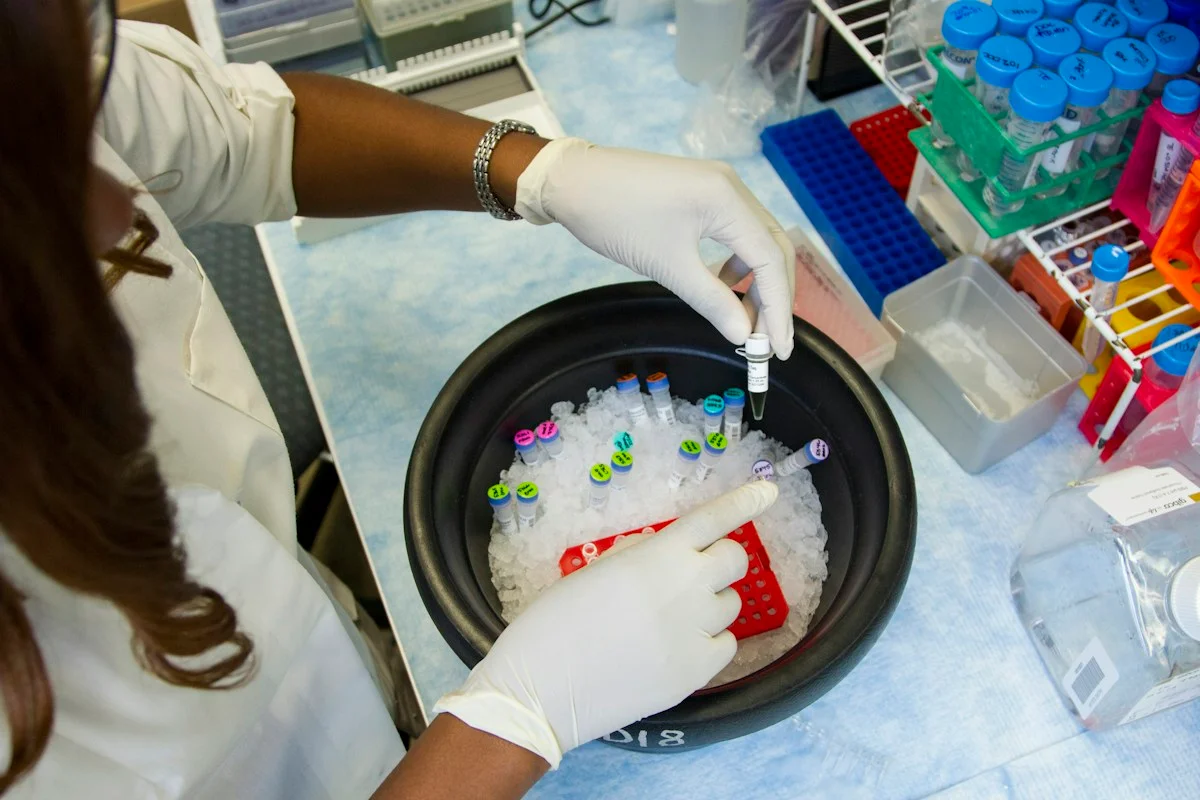
Illustrative photo · not a video frame
The Royal Society · 44 min 28 sec · Background explainer
Is this the AI future we want? | The Royal Society
YouTube loads only when you choose; playback starts when you press play.
A Royal Society discussion with Madhumita Murgia and biomedical engineer Alison Noble on AI’s potential in healthcare, science and culture, recorded at the 30 June 2026 event.
Evidence check: A discussion of opportunities and risks, including future possibilities. It is not evidence that every application described is available or clinically proven.
Published 2026-07-01. Source checked 14 October 2026. Check captions on the publisher’s video page.
Check the healthcare evidencePhoto: Daniel Sone / National Cancer Institute / Unsplash · Licence
Evidence check
Specialised training used 477 lipopeptides and the independent test used 61; animal groups contained five young male mice; treatment was topical and short; LP630 failed in mouse serum; no human safety, dosing or efficacy evidence exists.
Reporting basis: Source analysis. Original source date: 17 October 2026.
Continue the story
Read next
Also about deep learning
Can mouse MRI predict glioblastoma treatment response?
A deep-learning model separated cure from relapse across 298 MRI examinations, but the effective test cohort was only 10 treated mice from one laboratory. It is preclinical evidence, not a patient-ready predictor.
Read the 7 min reportAlso about drug discovery
Can we trust AI gene-perturbation models yet?
A peer-reviewed benchmark across 14 single-cell datasets and 18 metrics finds that common scores can hide useful gene-perturbation signals. Several deep-learning models beat uninformative baselines after calibration, but the study predicts gene-expression responses—not medicines, safety or patient benefit.
Read the 8 min reportExplore the full source and evidence record
What this means for people
- People with drug-resistant infections need genuinely new treatments, but the practical benefit here is still upstream: a more efficient way for researchers to choose compounds for synthesis, not an antibiotic available to patients.
Global context
Antimicrobial resistance is a worldwide health threat, while this discovery and validation programme came from one Chinese research group. Pathogen prevalence, laboratory capacity, access to standard antibiotics and regulatory requirements differ across health systems.
What the evidence does not yet show
- Specialised training used 477 lipopeptides and the independent test used 61; animal groups contained five young male mice; treatment was topical and short; LP630 failed in mouse serum; no human safety, dosing or efficacy evidence exists.
What to watch next
- Independent replication, resistance-evolution studies, repeated-dose safety, a formulation that works in serum, larger animal comparisons and eventual human trials would determine whether LP630 is more than a promising topical lead.
Living evidence record
Impact record IAI-02ETXR4
Evidence stage
Studied
Confidence
Supported
Reporting basis
Source analysis
Independent or research support
Present
Record status
Monitoring
Last checked
18 October 2026
Source trail
1 direct source across 1 source type.
People impact
Documented in this record.
Uncertainty
Limits and next checks are explicit.
Stages describe the evidence available—not whether a technology is good or bad. See the public method.
Single-source reporting disclosure
This record analyses one direct source. It can establish what Nature Communications published or reported, but it is not independent corroboration of every performance claim or predicted outcome. The confidence label will change only when broader evidence is added.
Evidence trail
Sources used for this report
Links checked 18 October 2026
Research question, topics and regions
Whether a model that represents both a peptide sequence and its attached fatty-acid chain can identify new antimicrobial lipopeptides that remain active in laboratory and animal tests
Topics: Antimicrobial resistance · Drug discovery · Deep learning · Lipopeptides · Preclinical research
Regions: China · East Asia · Global
This report is labelled source analysis. We summarise and analyse source material in our own words; company statements remain attributed claims until independently supported. Translated summaries preserve the meaning of the original source and link back to it. Read our editorial standards.
The Impact Brief · Free
Keep following the stories that matter to you.
Get our weekday briefing on what changed and why it matters. Choose your topics below.
Reader commentary
What does this mean where you are?
Tell us what you have seen at work, in your community or in everyday life. A question is welcome too. No account is needed; we review notes before publishing them.
Explore commentary across the portal →Published reader notes
0No published reader notes yet. You can start the evidence-led discussion above.
Prefer a private correction or response? Contact the newsroom.