Can AI support breast-ultrasound decisions across countries?
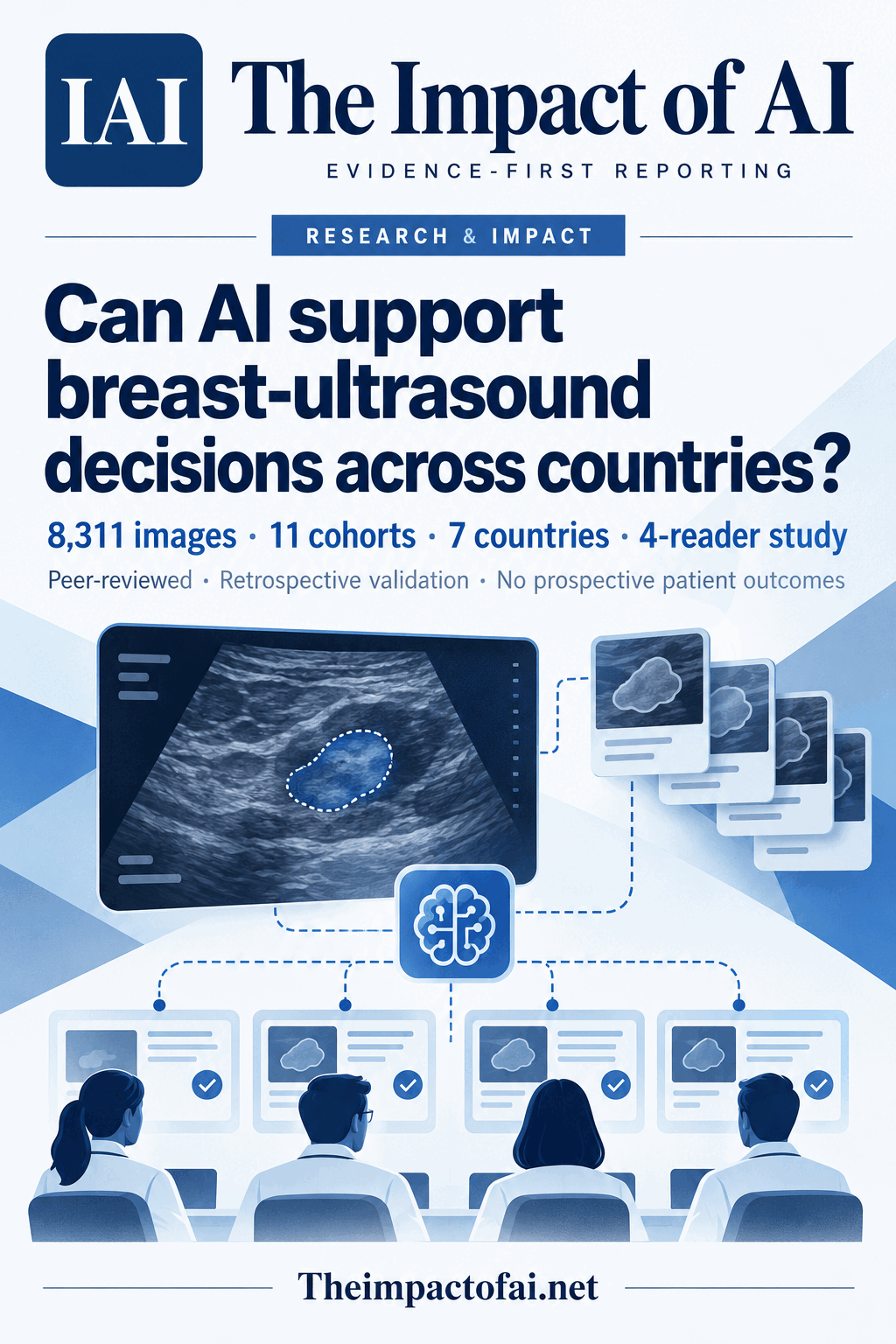
A peer-reviewed South Korean-led study validated an interpretable retrieval-augmented system across 8,311 images from 11 cohorts in seven countries and tested assistance with four readers. The retrospective evidence is encouraging, but it is not a prospective screening trial or proof of better patient outcomes.
Editorial responsibility: The Impact of AI Editorial Desk · Report a factual concern
Research topic
Whether a BI-RADS-aware retrieval-augmented system can generalise across breast-ultrasound cohorts and improve clinicians' image assessment without replacing human responsibility
At a glance
- 1The study covered 8,311 breast-ultrasound images across 11 cohorts from seven countries, including internal validation and three external cohorts; that breadth is stronger than a single-centre test but remains retrospective.
- 2On an independent institutional cohort, the complete pipeline reported an AUROC of 0.952 for biopsy triage without fine-tuning. AUROC measures ranking performance, not the clinical consequences of a chosen operating threshold.
- 3Four readers were tested with and without B-RAD assistance. The authors report higher accuracy, agreement moving from moderate to substantial and fewer missed malignancies across all readers, but no prospective patient outcomes or implementation harms were measured.
The Impact Brief
Keep the evidence trail, not the noise.
Get the most consequential AI developments with direct sources and clear limits.
Living evidence record
Impact record IAI-1Y9SIR4
Evidence stage
Studied
Confidence
Supported
Reporting basis
Source analysis
Independent support
Present
Record status
Monitoring
Last checked
3 October 2026
Source trail
3 direct sources across 1 source type.
People impact
Documented in this record.
Uncertainty
Limits and next checks are explicit.
Stages describe the evidence available—not whether a technology is good or bad. See the public method.
Related-source reporting disclosure
This record analyses 3 linked source records around the same underlying development. The extra records add method, date or context, but they do not by themselves constitute independent replication of every performance claim or predicted outcome.
The question is support, not autonomous diagnosis
Breast ultrasound is widely used to assess lesions, but its interpretation depends on image acquisition, lesion appearance and the reader's application of the Breast Imaging Reporting and Data System, or BI-RADS. The new study asks whether an AI system can make that reasoning more consistent across institutions while showing clinicians relevant visual precedents. It does not test an autonomous screening service, and it does not establish that a model can safely decide who receives a biopsy without clinical oversight.
The peer-reviewed accepted article was published in npj Digital Medicine on 3 October 2026 by researchers at Seoul National University, Seoul National University Hospital, Kookmin University and Kyungpook National University Chilgok Hospital. The journal labels this an early accepted version: it is citable and has a permanent DOI, but production edits may still change presentation before the final Version of Record. The central evidence comes from retrospective images and a four-reader experiment, not a prospective care pathway.[1][2]
How the B-RAD pipeline works
The system, called B-RAD, is designed to echo parts of a radiologist's workflow. A retrieval component first searches for relevant examples while learning the ordered structure of BI-RADS categories. The authors say it can learn visual-semantic alignment from unpaired data by penalising both cross-modal mismatch and errors in the ordinal category prediction. That is important because large, clean collections containing an ultrasound image and a matching expert report are scarce.
Retrieved examples then guide few-shot localisation of the lesion, its margin and posterior acoustic features. A segmentation model turns that detected region into a mask, and the mask drives a training-free foveal-attention step for final classification. In plain terms, the architecture tries to focus the model on the suspected lesion and place it in a clinically ordered category while retaining comparable examples a person can inspect. That is more interpretable than a single unexplained score, but retrieval does not guarantee that the chosen precedent is clinically appropriate or that the explanation caused the prediction.[1][2][3]
What 8,311 images across seven countries can establish
The reported validation spans 8,311 images from 11 cohorts in seven countries. It includes internal validation and three external cohorts, one of which came from an independent institution. This design tests more variation than a conventional random split within one hospital because scanners, acquisition practices, patient mix and labelling conventions can differ across sites. The complete pipeline achieved an AUROC of 0.952 for biopsy triage on the independent institutional cohort without site-specific fine-tuning and outperformed the vision-language comparators used by the authors.
That number is a discrimination measure: it summarises how well scores rank positive and negative cases across thresholds. It does not say how many unnecessary biopsies would occur at the threshold a clinic chooses, how many cancers would be missed, or whether calibration remains safe in a new population. Images are also not the same denominator as people or examinations; one person can contribute more than one image. The multinational label strengthens the generalisation claim, but it should not be read as proof that every geography, device, age group or screening programme is represented.[1][2]
The reader study is the most clinically relevant step
Four readers assessed cases with and without B-RAD assistance. The paper reports that assistance improved accuracy, moved inter-reader agreement from the moderate range to the substantial range and reduced missed malignancies for every reader. This matters because a tool that performs well alone can still distract clinicians, create automation bias or add unusable information. Testing the human-plus-system combination is therefore closer to the real question than reporting model AUROC alone.
The experiment nevertheless remains a controlled reader study. Four readers cannot represent all levels of experience, workloads or national practice. The public headline results do not demonstrate how performance changes over a full clinic day, whether the retrieval panel slows interpretation, how often a confident model is wrong, or whether readers become less vigilant after repeated correct suggestions. A future evaluation needs prespecified thresholds, per-reader uncertainty, subgroup results and error review—not only an average gain.[1][2]
What could change for patients and services
If the findings transfer prospectively, a retrieval-based aid could help clinicians apply BI-RADS more consistently and could be particularly useful where specialist breast radiology is scarce. Showing comparable examples may also support training and second review. For a patient, the practical benefits would be fewer missed malignancies, fewer avoidable biopsies and clearer escalation—not a higher model score. None of those downstream outcomes was directly measured here.
Deployment would require local validation against the service's scanners, prevalence, referral pathway and biopsy criteria. Every recommendation needs a visible source image, an uncertainty signal and a route for the reader to disagree. Services should monitor sensitivity and false-positive burden by site and subgroup, record when AI changes a decision, and audit delayed diagnoses as well as unnecessary procedures. The system should support a qualified reader; it should not turn a research ranking metric into an automatic biopsy order.[1][2]
Funding and commercial interests matter
The authors disclose support from several South Korean public and university programmes, including the National Research Foundation of Korea, Seoul National University Hospital, the Korea Health Technology R&D Project, the Korean Society of Magnetic Resonance in Medicine, Seoul National University College of Medicine, the Institute of Information & Communications Technology Planning & Evaluation and government-supported computing infrastructure. Public funding does not remove bias, but the declaration allows readers to assess who supported the work.
Four authors are named as inventors on a pending Korean patent application filed by Kookmin University and Seoul National University Hospital covering the end-to-end B-RAD pipeline from multimodal retrieval through lesion localisation and BI-RADS classification. That is a direct commercial interest in the reported system. It does not invalidate the findings, but it increases the importance of independent replication, locked prospective protocols and evaluation by institutions that are not seeking to license the method.[1][2]
What would change the assessment
This is stronger evidence than a single-dataset model paper: it is peer reviewed, spans multiple countries and cohorts, includes external validation and tests human readers. The main caution is that all evidence is retrospective. The system did not determine patient management in a prospective trial, and the study does not show cancer outcomes, time to diagnosis, complication rates, health-economic effects or equitable performance across the populations a public service would encounter.
Confidence would rise with independent external replication, a prospective multicentre silent deployment followed by a controlled assistance trial, patient-level rather than image-level denominators, calibrated decision thresholds and subgroup analysis by device, lesion type, age and care setting. The decisive evidence would show that clinician-plus-AI decisions improve timely cancer detection without an unacceptable increase in biopsies, delays or unequal errors. Until then, B-RAD is a well-tested research aid, not a substitute for clinical governance.[1][2][3]
What this means for people
- Patients could benefit if clinician assistance reduces missed malignancies without triggering unnecessary biopsies, but those outcomes remain unproven.
- Clinicians may gain a structured second view and comparable examples, while retaining responsibility for image quality, context and final BI-RADS assessment.
- Lower-resource services could gain decision support, although local validation, specialist escalation and reliable ultrasound acquisition remain essential.
Global context
The South Korean-led study combines 11 cohorts from seven countries, a valuable test of cross-site transportability. The article's headline geography does not establish representative coverage of all populations or health systems; prospective local validation remains necessary before adoption.
What the evidence does not yet show
- The 8,311 denominator is images across 11 cohorts, not necessarily 8,311 independent patients or examinations.
- All validation was retrospective; the system did not direct care in a prospective screening or diagnostic pathway.
- The reader study involved four readers and cannot establish performance across specialties, experience levels, workloads or health systems.
- The study reports discrimination and reader effects, but not patient outcomes, biopsy burden, implementation cost or long-term automation bias.
- Four authors are inventors on a pending patent covering the reported pipeline.
What to watch next
- Independent prospective validation using locked thresholds and patient-level denominators.
- Per-site and subgroup calibration, sensitivity, false-positive biopsy burden and reader-overreliance measures.
- Evidence that assistance improves timely diagnosis and outcomes without widening access or performance inequalities.
Evidence trail
Sources used for this report
Links checked 3 October 2026
This report is labelled source analysis. We summarise and analyse source material in our own words; company statements remain attributed claims until independently supported. Translated summaries preserve the meaning of the original source and link back to it. Read our editorial standards.
Continue the story
Related reporting
Health & Life Sciences
Can this MRI model draw brain-tumour boundaries reliably?
A peer-reviewed multimodal segmentation model was developed on 2,422 public MRI volumes and externally tested on 125 cases. Accuracy remained useful but fell outside the development data; no prospective clinical workflow, radiologist comparison or patient-outcome test was performed.
8 min · 2 sources
Health & Life Sciences
Is neonatal respiratory AI ready for routine care?
A peer-reviewed scoping review mapped 35 studies using AI and digital tools to predict, image or monitor newborn breathing problems. The evidence spans promising prototypes, but heterogeneity, small samples, limited external validation and few clinical-impact tests keep routine use unproven.
9 min · 2 sources
Health & Life Sciences
Can a high-AUC diabetes model still be unsafe?
A peer-reviewed audit of 12 machine-learning approaches on two public diabetes datasets finds that similarly ranked models can differ materially in calibration, uncertainty and safe deferral. The work is a benchmark study—not a clinical trial, diagnostic approval or evidence of improved patient outcomes.
7 min · 3 sources
Reader discussion
Add evidence, experience or a question
No account is required. Reader notes are published after a brief civility, relevance and safety check; disagreement is welcome.
Published reader notes
0No published reader notes yet. You can start the evidence-led discussion above.
Prefer a private correction or response? Contact the newsroom.