Can interpretable AI distinguish ovarian tumours before surgery?
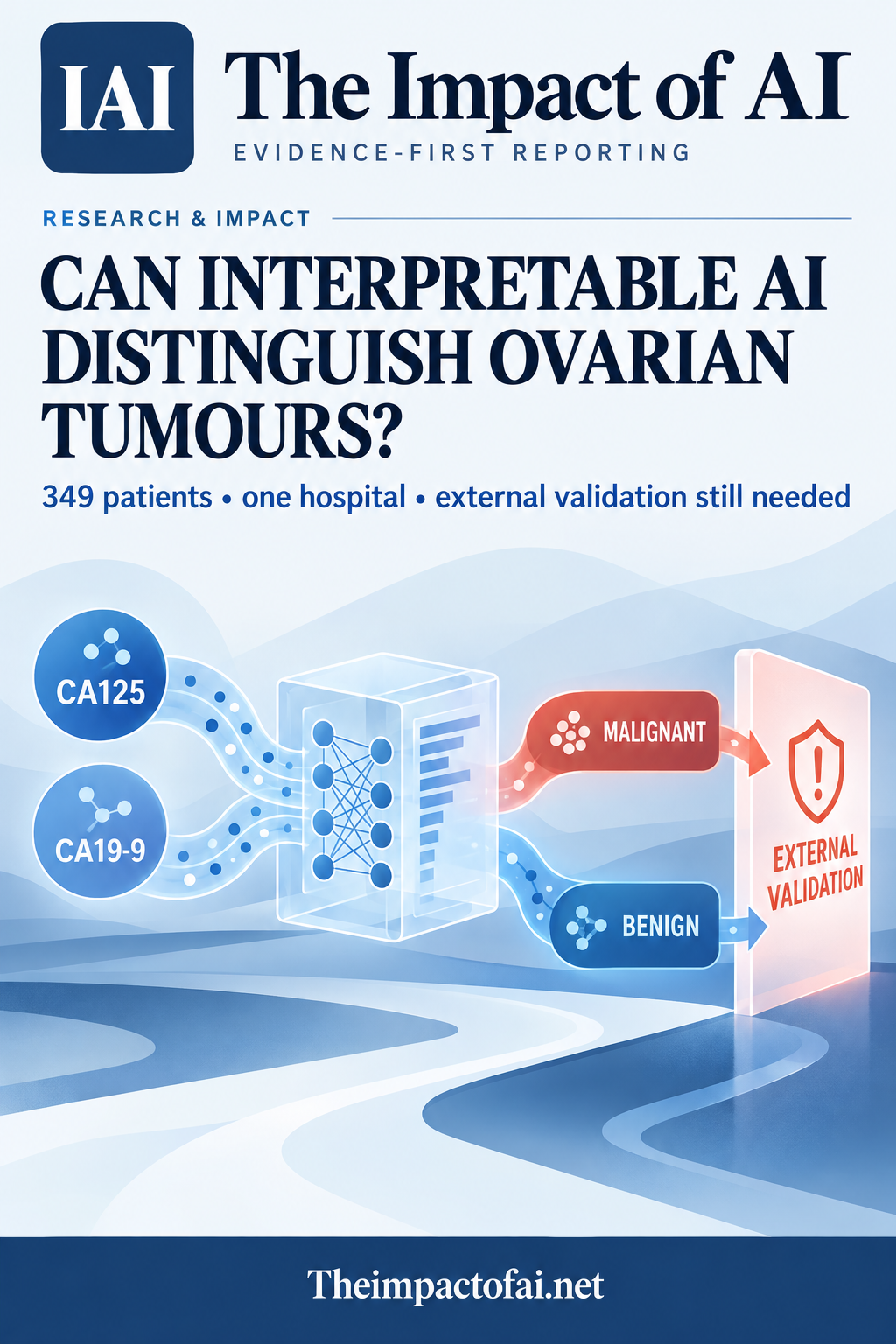
A peer-reviewed retrospective study trained five classifiers on laboratory data from 349 patients at one Chinese hospital. Its best model reached 93.7% leave-one-out accuracy, but the small reused cohort and absence of external or prospective validation rule out clinical deployment.
Editorial responsibility: The Impact of AI Editorial Desk · Report a factual concern
At a glance
- 1The public retrospective cohort contains 349 patients treated at one Chinese hospital: 171 malignant and 178 benign ovarian tumours.
- 2Five classifiers were tuned with Bayesian optimisation; the support-vector machine reported 93.7% accuracy and 95.3% sensitivity under leave-one-out cross-validation.
- 3An optimised LIME surrogate reached 91.9% fidelity to the classifier and highlighted CA125 and CA19-9, but explaining a model is not the same as validating a diagnosis.
Research topic
Retrospective machine-learning classification of malignant and benign ovarian tumours using routine clinical laboratory variables
The direct answer: the model separates this cohort well, but cannot yet support care
The study shows that an interpretable machine-learning pipeline can distinguish malignant from benign ovarian tumours with high apparent accuracy in one existing dataset. The best support-vector machine reported 93.7% accuracy and 95.3% sensitivity using leave-one-out cross-validation, while its locally interpretable surrogate preserved most of that performance. Those results justify independent testing because preoperative classification affects referrals, surgical planning and the risk of both delayed cancer treatment and unnecessary aggressive procedures.
They do not establish a clinically reliable diagnostic tool. All 349 records came from the Third Affiliated Hospital of Soochow University in China, were collected retrospectively and have been used in earlier modelling work. Each leave-one-out prediction was tested on one record after training on the rest of the same institutional cohort. That is stronger than reporting training accuracy, but it does not reproduce shifts in laboratory equipment, referral patterns, tumour prevalence, demographics or clinical practice at another hospital.[1][2]
What the researchers tested and how large the cohort was
The denominator is 349 patients with ovarian tumours: 171 malignant and 178 benign. The inputs were clinical laboratory variables rather than medical images or free-text notes. Variables with excessive missingness were removed. Remaining missing values were replaced with means and features were scaled between zero and one. Crucially, the imputation and scaling parameters were estimated from the training records and then applied to the held-out record, reducing a common source of information leakage.
Five classifier families were compared: support-vector machine, k-nearest neighbour, discriminant analysis, decision tree and logistic regression. Bayesian optimisation selected hyperparameters rather than relying on one hand-picked configuration. Leave-one-out cross-validation repeated the train-and-test process once per patient, so every record served as the held-out case once. This design makes efficient use of a small sample, but the folds overlap heavily and are not substitutes for a locked model evaluated on a new cohort.[1]
The best headline numbers need a clinical comparator
The support-vector machine produced the study's best reported accuracy of 93.7% and sensitivity of 95.3%. Accuracy is understandable because the classes were close to balanced, but it still compresses different errors into one figure. In practice, a missed malignancy and a false alarm do not carry equal consequences. Readers need specificity, predictive values, calibration and confidence intervals alongside sensitivity, ideally at pre-specified thresholds chosen for the intended referral decision.
The paper notes that stronger predictive results have previously been reported on the same public dataset. That is an important restraint: this study's contribution is not a new record score, but the attempt to optimise the explanation layer and benchmark it against the underlying classifier. A useful next trial should compare the model with existing risk indices and clinicians using the same blinded cases, then ask whether adding the model changes decisions or outcomes rather than merely reproducing the final pathology label.[1]
What LIME adds—and what it cannot prove
LIME explains an individual prediction by perturbing the input around that case and fitting a simpler local model. The researchers tuned both the number of perturbation samples and the kernel width used to weight nearby examples. Their optimised surrogate achieved 91.9% accuracy in following the support-vector machine, 1.8 percentage points below the classifier, and repeatedly emphasised the tumour markers CA125 and CA19-9 as positive signals for malignancy.
Agreement with familiar biomarkers can make an explanation more plausible, but it does not certify that the model reasons like a clinician or that the highlighted variables cause disease. A local surrogate can change when its perturbation distribution, random seed or neighbourhood width changes. Correlated laboratory values may share or swap apparent importance. The right test is stability across resampling and institutions, followed by clinician review of whether explanations are accurate, useful and safe in cases where the model is wrong.[1]
The study is geographically specific and clinically incomplete
The patient data came from one Chinese centre, while the two authors are based in an electrical-engineering department in Iran. That cross-border reuse of an open dataset makes the analysis auditable and inexpensive, but it also separates model development from the clinical setting that produced the records. The article reports no external hospital, prospective recruitment, temporal holdout, subgroup performance or assessment of how missingness arose during care.
Tumour prevalence and case mix shape predictive values. A tertiary referral hospital may see a different spectrum of malignancies and benign masses from a community clinic. Laboratory assays and reference ranges can differ. Age, menopausal status and local referral policy may alter the relationship between biomarkers and final pathology. Before transfer to another region, investigators should freeze the pipeline, document inclusion and exclusion criteria, test calibration and report performance by clinically important subgroups.[1]
What would change the assessment
The next decisive evidence would be a pre-registered external validation across several hospitals, including a site not involved in model selection. Investigators should publish the number screened, included and excluded; lock preprocessing before seeing outcomes; report confidence intervals and calibration; and compare the system with established clinical pathways. A prospective silent trial could then measure performance on consecutive patients without influencing care, exposing operational failures before any decision-support use.
For patients, the meaningful endpoint is not an explanation card or a cross-validation score. It is whether the tool helps the right people reach specialist surgery promptly while avoiding unnecessary anxiety, procedures and missed cancers. That requires workflow research, equity analysis, safety monitoring and clear accountability when the model conflicts with a clinician. Until those steps are completed, this is promising methods evidence and a useful replication target—not a diagnostic product.[1]
What this means for people
- Better preoperative triage could help patients with malignancy reach specialist surgery sooner.
- False positives could increase anxiety and invasive treatment, while false negatives could delay cancer care.
- A single-centre model may underperform for patients whose demographics, assays or referral pathways differ from the development cohort.
Global context
Ovarian-cancer pathways, biomarker testing and access to specialist gynaecological oncology vary widely. An inexpensive laboratory-data model could be attractive where imaging or specialists are scarce, but that setting is also where unvalidated transfer may be most dangerous. Each health system would need local prevalence, assay and workflow evidence before considering use.
What the evidence does not yet show
- The 349-patient cohort is retrospective, single-centre and reused from a public dataset.
- Leave-one-out cross-validation does not test a frozen model at a new hospital or later time.
- The article reports no prospective workflow study, clinician comparison or patient outcome.
- LIME fidelity measures agreement with the classifier, not biological truth or clinical safety.
- The early online article is peer reviewed and citable but may receive copy-editing before the final Version of Record.
What to watch next
- A locked external validation across multiple hospitals and assay systems.
- Calibration, confidence intervals, predictive values and subgroup results at a pre-specified threshold.
- Comparison with clinicians and established ovarian-tumour risk indices on identical cases.
- Prospective evidence that decision support improves referral or treatment without increasing harmful errors.
Living evidence record
Impact record IAI-12CZVHA
Evidence stage
Studied
Confidence
Supported
Reporting basis
Source analysis
Independent or research support
Present
Record status
Monitoring
Last checked
8 October 2026
Source trail
2 direct sources across 1 source type.
People impact
Documented in this record.
Uncertainty
Limits and next checks are explicit.
Stages describe the evidence available—not whether a technology is good or bad. See the public method.
Related-source reporting disclosure
This record analyses 2 linked source records around the same underlying development. The extra records add method, date or context, but they do not by themselves constitute independent replication of every performance claim or predicted outcome.
Evidence trail
Sources used for this report
Links checked 8 October 2026
This report is labelled source analysis. We summarise and analyse source material in our own words; company statements remain attributed claims until independently supported. Translated summaries preserve the meaning of the original source and link back to it. Read our editorial standards.
Continue the story
Related reporting
Health & Life Sciences
Can AI sort four stages of cognitive decline?
In one Egyptian dataset of 140 people, LightGBM produced the strongest average four-class result. The study used internal cross-validation, not an independent cohort or a prospective clinical test.
7 min · 1 source
Health & Life Sciences
Is operating-room AI ready for clinical use?
Not on the published evidence yet. A peer-reviewed scoping review screened 3,020 records but found only one completed feasibility study with five analysed patients; four larger prospective studies had no results posted.
8 min · 1 source
Health & Life Sciences
Can a burn-risk model help before the outcome is known?
A peer-reviewed Iranian study reports very high internal discrimination in 2,266 burn admissions. But the model uses hospital stay, ICU stay and infection information accumulated during care, overpredicted mortality in parts of the test set and has not been validated outside one hospital, so it is not an admission score or a deployable clinical tool.
10 min · 1 source
The Impact Brief
Keep the evidence trail, not the noise.
Get the most consequential AI developments with direct sources and clear limits.
Reader commentary
Add evidence, experience or a question
No account is required. Reader notes are published after a brief civility, relevance and safety check; disagreement is welcome.
Explore commentary across the portal →Published reader notes
0No published reader notes yet. You can start the evidence-led discussion above.
Prefer a private correction or response? Contact the newsroom.