Can $1.8bn of open biology data make virtual cells reliable?
Biohub, the US Department of Energy, NIH and technology partners have committed funding, facilities and existing resources to an open data foundation for predictive biology. The scale is significant, but it is an infrastructure pledge—not evidence that a universal cell model can yet predict disease or treatment effects.
Editorial responsibility: The Impact of AI Editorial Desk · Report a factual concern
At a glance
- 1The announced $1.8 billion total combines new five-year commitments, private technology investment and the alignment of previously funded public data resources; it is not a single cash grant.
- 2Biohub says the resulting resource will be open, with shared standards and access intended to support models that predict how cells respond to disease and interventions.
- 3NIH explicitly says many cell types and conditions remain under-measured and that present instruments cannot capture all required measurements at the needed scale and speed.
Research topic
Open multimodal biological data and measurement infrastructure for predictive models of cells and living systems
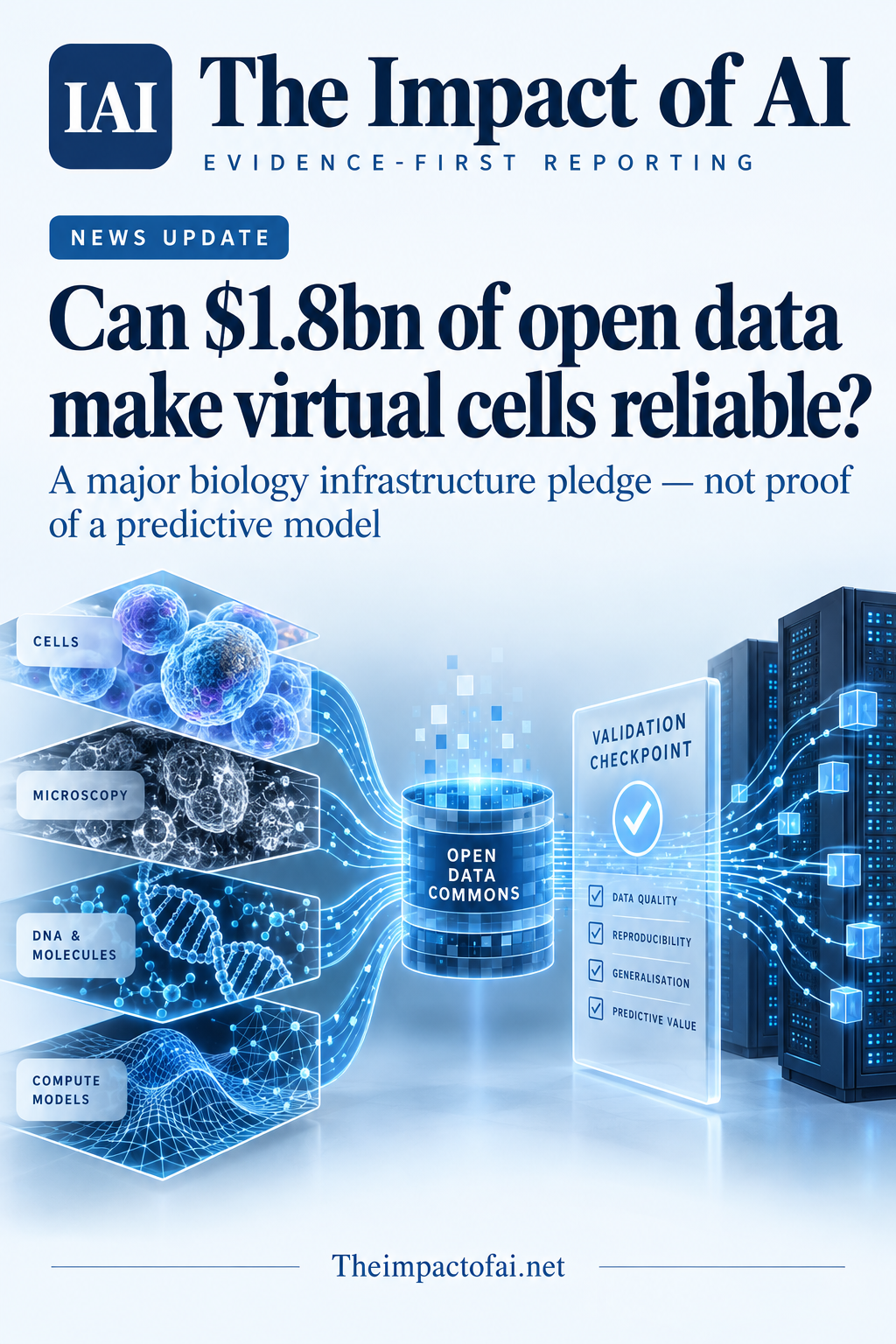
The direct answer: the commitment tackles a real bottleneck, but reliability is unproven
The $1.8 billion collaboration could make virtual-cell research more credible by funding what biological AI lacks most: large, comparable measurements of how cells behave before and after interventions. Biohub says the effort will combine new experiments, existing public repositories, advanced imaging, national-laboratory computing and shared standards into an open resource. That is a material infrastructure change, especially if the partners make heterogeneous datasets genuinely interoperable rather than merely placing them behind one catalogue.
It does not establish that a model can reliably simulate a human cell, predict a drug response or shorten a clinical-development programme. The three official announcements describe commitments, facilities and intentions. They report no prospective validation set, predictive accuracy, disease endpoint, patient cohort or head-to-head comparison with laboratory experiments. Calling this a breakthrough in treatment would therefore confuse an input to research with a demonstrated health outcome.[1][2][3]
What the $1.8 billion figure contains
Biohub's total is a package rather than a single award. Its founding commitment is $500 million: $400 million for measurement technologies and $100 million for external research. DOE says it will invest more than $500 million over five years in fundamental cell research spanning data collection, AI analysis, measurement, imaging, modelling and computation. Google DeepMind, Isomorphic Labs and Meta are collectively committing $300 million to the Virtual Biology Initiative. NIH is coordinating data and infrastructure built through more than $500 million of prior federal investment, rather than announcing that entire amount as new spending.
That accounting matters. Existing repositories, aligned programmes and in-kind access to national facilities can be extremely valuable, but they are not equivalent to $1.8 billion transferred to one governed project on 7 October. Delivery will depend on appropriations, partner agreements, technical milestones and continued participation across a five-year horizon. Readers should judge future progress through released datasets, documented licences and independent use—not the headline total alone.[1][3]
The proposed resource spans measurements, compute and standards
The planned work is unusually broad. Biohub lists cryo-electron tomography for near-atomic cellular detail, microscopy intended to image very large numbers of cells in living tissue, and tools to perturb biology from molecules to whole organisms. DOE adds exascale computing, X-ray and neutron scattering, cryo-electron facilities, autonomous laboratories and national-laboratory data systems. NIH brings national biomedical repositories, the National Center for Biotechnology Information and Common Fund programmes already building biological atlases and shared standards.
The integration layer may be as important as the hardware. The partners propose common identifiers, shared standards and a single point of access so that measurements produced for different purposes can be used together. Models trained on inconsistent labels, undocumented protocols or uneven populations can learn laboratory artefacts instead of biology. An open resource needs machine-readable provenance, versioning, negative results, quality-control metadata and clear rules for corrections if it is to support reproducible predictions.[1][2][3]
Why biological coverage is the central uncertainty
NIH's announcement states the limitation plainly: predictive models need measurements across many more cell types and conditions than have been studied, and technologies must operate at scales and speeds that current instruments cannot capture. A cell's response depends on tissue context, development, ancestry, age, disease state, dose, timing and interactions with neighbouring cells. Sampling a large number of convenient laboratory conditions can still leave the clinically important space thinly represented.
Scale also cannot substitute for experimental design. Replicates, intervention controls and independent batches are needed to distinguish biological response from measurement noise. Data from cell lines or organoids may not transfer to patients. A model that predicts an average response could fail for a rare cell state or genetically underrepresented population. The initiative will need public coverage maps showing where evidence is dense, sparse or absent so users do not mistake a confident model output for a well-supported one.[2]
Open access and governance will determine who benefits
Biohub calls the planned foundation an open resource and names international institutes including the Allen Institute, Broad Institute, Gladstone Institutes, Human Cell Atlas, Human Protein Atlas and Wellcome Sanger Institute. If access is timely and usable, smaller laboratories could test models without owning an exascale computer or bespoke imaging platform. Open standards could also make it easier to reproduce results across countries and to discover when a model trained in one setting fails elsewhere.
Openness requires more than a download link. Human-derived data may carry privacy, consent and group-harm risks even after direct identifiers are removed. Commercial partners may want early access, proprietary derived models or restrictions on redistribution. The announcements do not yet supply a complete governance charter, licence, access schedule, representation plan or process for resolving contested data use. Those details will shape whether the commons broadens scientific participation or mainly subsidises organisations already able to exploit it.[1][2][3]
What would change the assessment
The first convincing evidence would be a public release with explicit denominators: numbers of donors, cell types, perturbations, time points, replicates and participating laboratories, accompanied by protocol and demographic coverage. The next step would be prospective tests in which models predict withheld interventions before the measurements are made. Performance should be reported against simple baselines and experienced experimentalists, with calibration, failure analysis and results for underrepresented biological contexts.
For people affected by disease, the decisive test is not whether a virtual cell produces plausible graphics but whether it helps select experiments, targets or treatments more accurately and efficiently without hiding safety failures. Independent teams should reproduce claims, and clinical use would require a separate evidence path. Until those milestones arrive, the $1.8 billion effort is best understood as a substantial bet on open research infrastructure: potentially enabling, globally relevant and still scientifically unresolved.[1][2][3]
What this means for people
- Open data could give smaller research groups access to measurements they could not generate alone.
- Patients may benefit eventually if models select better experiments or drug targets, but no such benefit has been shown yet.
- Poor representation or weak consent and governance could transfer data burdens to communities without sharing benefits.
Global context
The effort is anchored by US institutions and companies but recruits international scientific organisations and describes a resource for global use. That ambition will meet different consent regimes, data-sovereignty rules, infrastructure capacity and disease priorities. A genuinely global commons will need equitable participation in setting standards and research questions, not only downstream access to data generated around wealthy-country priorities.
What the evidence does not yet show
- The $1.8 billion headline combines different kinds of commitments, including more than $500 million in prior NIH-backed resources.
- The announcements provide no model-performance denominator, external validation or patient outcome.
- Governance, licensing, access timing, representation targets and long-term operating costs are not yet fully specified.
- Cell and organoid measurements may not generalise to whole organisms or clinical care.
- Partner announcements are primary sources for commitments but are not independent evaluations of feasibility or value.
What to watch next
- A published governance charter, open licence and access timetable.
- Dataset releases with donor, cell-type, intervention and replicate denominators.
- Prospective prediction challenges using measurements withheld until after forecasts are locked.
- Independent evidence that models improve experimental or therapeutic decisions over credible baselines.
Living evidence record
Impact record IAI-1AL15KM
Evidence stage
Announced
Confidence
Supported
Reporting basis
Source analysis
Independent or research support
Not yet
Record status
Monitoring
Last checked
8 October 2026
Source trail
3 direct sources across 1 source type.
People impact
Documented in this record.
Uncertainty
Limits and next checks are explicit.
Stages describe the evidence available—not whether a technology is good or bad. See the public method.
Related-source reporting disclosure
This record analyses 3 linked source records around the same underlying development. The extra records add method, date or context, but they do not by themselves constitute independent replication of every performance claim or predicted outcome.
Evidence trail
Sources used for this report
Links checked 8 October 2026
This report is labelled source analysis. We summarise and analyse source material in our own words; company statements remain attributed claims until independently supported. Translated summaries preserve the meaning of the original source and link back to it. Read our editorial standards.
Continue the story
Related reporting
Health & Life Sciences
Can AI narrow the search for a phage—and what would prove a patient benefit?
A new strain-level prediction study offers a way to rank laboratory candidates. We compare its evidence stage with clinical-trial requirements and the wider antimicrobial-resistance challenge.
6 min · 3 sources
Health & Life Sciences
CSL plans AI and cloud tools for drug research with AWS
The Australian biotechnology company says the collaboration will support target discovery and clinical-development paperwork. No faster trial, approved treatment or patient benefit has yet been measured.
4 min · 1 source
Health & Life Sciences
Can AI flag sepsis risk early in trauma intensive care?
Models using the first 24 hours of records moderately separated trauma patients who developed sepsis over the next 48 hours in one US intensive-care database. The best AUROC was 0.734, with sensitivity below 69%; this supports further surveillance research, not autonomous alerts or treatment.
7 min · 1 source
The Impact Brief
Keep the evidence trail, not the noise.
Get the most consequential AI developments with direct sources and clear limits.
Reader commentary
Add evidence, experience or a question
No account is required. Reader notes are published after a brief civility, relevance and safety check; disagreement is welcome.
Explore commentary across the portal →Published reader notes
0No published reader notes yet. You can start the evidence-led discussion above.
Prefer a private correction or response? Contact the newsroom.