Can Tangermeme reveal what genomic AI has learned?
A peer-reviewed Nature Methods toolkit standardises prediction, perturbation, attribution and sequence-design operations around genomic deep-learning models. It can turn black-box outputs into testable hypotheses, but a model explanation is still not proof of a biological mechanism.
Editorial responsibility: The Impact of AI Editorial Desk · Report a factual concern
At a glance
- 1Tangermeme provides modular operations for prediction, sequence perturbation, attribution, motif analysis and design around PyTorch sequence models.
- 2The paper demonstrates the toolkit with five archived genomic deep-learning models; it is a methods paper with no patient cohort and no clinical endpoint.
- 3Extended data compare seqlet callers on 100 synthetic examples containing an inserted MYC motif, measuring whether called boundaries recover that known motif.
Research topic
Model-agnostic operations for interpreting sequence-to-function neural networks and testing learned cis-regulatory patterns
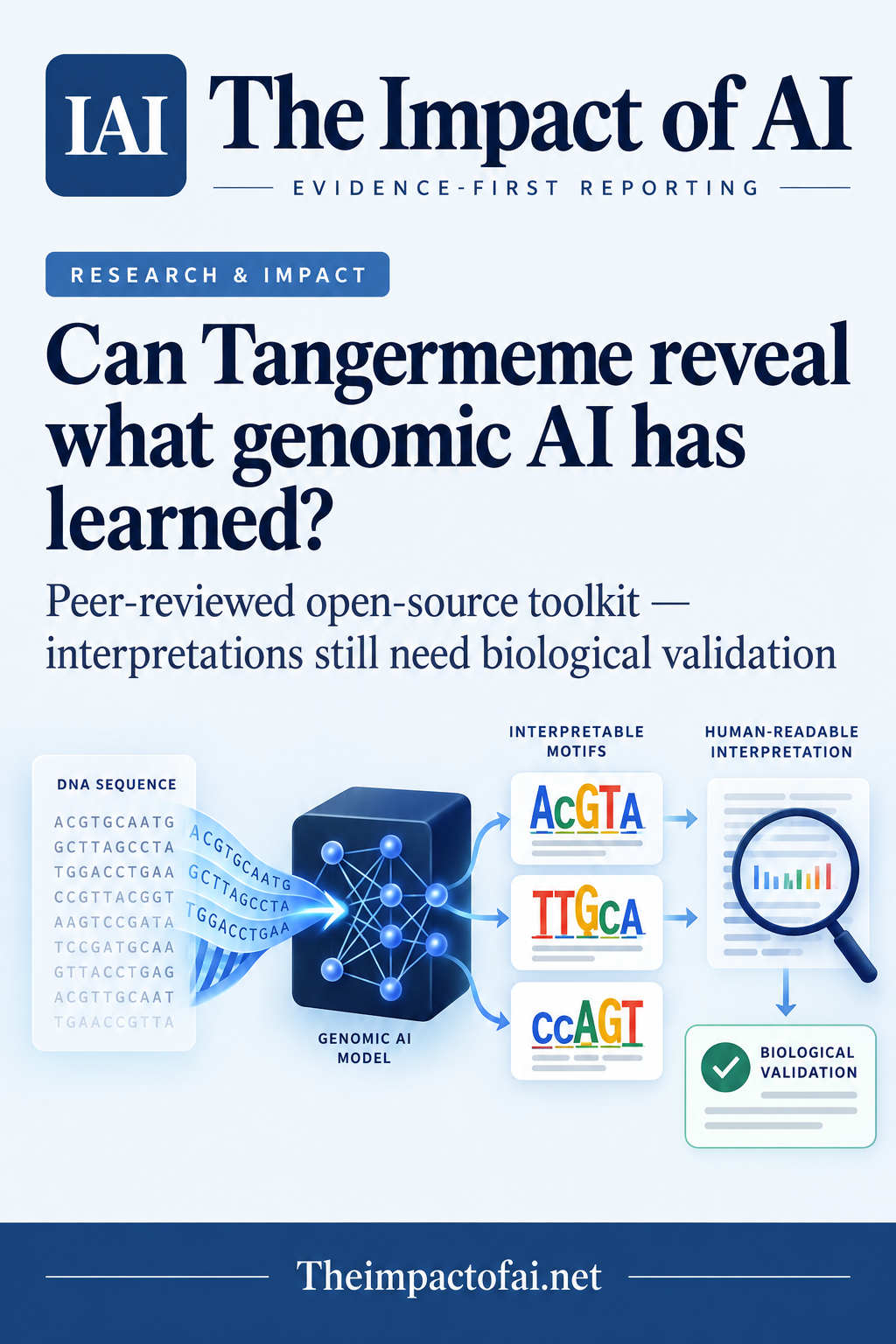
The direct answer: Tangermeme makes genomic AI easier to interrogate, not automatically true
Tangermeme can reveal which DNA patterns a trained genomic model relies on and how its predictions change when researchers insert, remove, move or redesign those patterns. The peer-reviewed toolkit packages these operations into a common, open-source interface so scientists can ask controlled counterfactual questions after a model has achieved predictive performance. That is valuable because an accurate sequence-to-function model can still be scientifically opaque.
The output is an interpretation of a model, not direct evidence that a transcription factor causes a cellular outcome. A model can learn confounding, technical bias or correlations specific to its training data. Tangermeme helps expose those learned rules in a reproducible way, but the rules must still be compared with held-out data and tested experimentally. Its strongest contribution is therefore methodological: turning a black box into a set of falsifiable biological hypotheses.[1][2][3]
What the toolkit puts under one interface
The software is designed for the work that happens after training a sequence model. Its prediction utilities run models efficiently; its sequence operations can insert a motif or shuffle a region; marginalisation estimates how a motif changes predictions across backgrounds; ablation asks what happens when a feature is removed; spacing experiments move motifs relative to one another; attribution methods assign importance to bases; seqlet and annotation tools collect important spans; and design routines search for sequences that move a model toward a target output.
The functions accept PyTorch models through their exposed forward operation and avoid assuming one input, one output or a particular distance metric. That flexibility matters because genomic models predict different quantities, from transcription-factor binding and chromatin accessibility to splicing or RNA behaviour. It also transfers responsibility to the analyst: the loss function, background sequences, target output and perturbation must match the biological question or a technically correct call can still answer the wrong one.[1][2]
The paper is a software demonstration, not a population study
There is no patient sample size because Tangermeme is not a diagnostic trial. The archived research object contains five genomic deep-learning models used across demonstrations. The paper applies the toolkit to models of transcription-factor binding and chromatin accessibility and shows how learned cis-regulatory patterns can be extracted, compared and perturbed. The relevant denominators are models, sequences and controlled examples, not people or treatment outcomes.
One extended-data benchmark compares a recursive seqlet caller with TF-MoDISco on 100 synthetic examples containing a known MYC motif. Precision and recall assess whether the returned boundaries identify the inserted motif and exclude surrounding bases across thresholds. This is a useful unit test because the answer is known, but it is deliberately narrow. Recovering one inserted motif in synthetic sequences does not establish performance across noisy tissues, rare regulatory grammars or every model architecture.[1][3]
Warnings and custom operations address a genuine attribution failure mode
Feature-attribution methods can produce misleading values when they approximate nonlinear operations poorly or when a model contains a custom output head. The paper says Tangermeme warns rather than silently continuing when convergence deltas are too high, can return those deltas for inspection and lets analysts register custom nonlinear functions. In the authors' comparison, that makes it possible to handle a custom profile-head operation that a generic attribution library does not easily represent.
A warning is a safeguard, not validation. Low convergence error only indicates that a particular attribution calculation satisfies its numerical check; it does not show that the reference sequence is appropriate, that the model generalises or that the highlighted bases have a causal effect in cells. Analysts need sensitivity tests across attribution methods, reference choices and random seeds, and they should report when an interpretation changes under reasonable alternatives.[1]
Perturbations can expose interactions that single-base scores miss
Cis-regulatory logic often depends on combinations: two motifs may work only at a particular spacing or orientation, while local sequence context can strengthen or suppress binding. Tangermeme's marginalisation, ablation and spacing functions let researchers compare predictions before and after controlled changes and test joint effects rather than reading an importance map as a complete explanation. The paper also notes that whole regulatory elements can be marginalised and nearby variants can be assessed individually and together.
Those counterfactuals remain in silico. Replacing a motif may create an unrealistic sequence, destroy overlapping features or move the example outside the model's training distribution. A large predicted effect may reflect the network's extrapolation rather than a viable enhancer. Good practice is to screen edited sequences for plausibility, compare several backgrounds, pre-register a small set of experimental predictions and then measure the perturbations in cells or organisms.[1][2]
Open code improves auditability, but reproducibility needs versions and maintenance
The project is available under an MIT licence with documentation, tutorials, unit tests and installable releases. Five paper models are archived separately on Zenodo. That combination lets other researchers inspect the implementation, repeat examples and challenge defaults. The repository also exposes issue reports and an evolving release history, useful reminders that scientific software contains bugs and changes after publication.
A reproducible paper should record the Tangermeme version or commit, model weights, preprocessing, random seeds, hardware-relevant settings and every perturbation parameter. Analysts should not assume that a newer release reproduces an older figure exactly. The author declares no competing interests; the indexed article does not turn that declaration into independent validation. Long-term value will depend on external users, maintained tests and comparisons with alternative interpretation frameworks.[2][3]
What would make an interpretation convincing
Confidence would rise if independent groups reproduced the paper's examples across multiple architectures and biological modalities, then prospectively selected model-derived motifs, spacing rules or variants for laboratory perturbation. Evaluation should distinguish discovery from confirmation, report negative results and compare Tangermeme workflows with simpler baselines and other interpretation tools. Robust findings should survive changes in model seed, background sequence and attribution method.
For people, the path to impact is indirect but important. Better interpretation could help researchers prioritise disease variants or design regulatory sequences, while bad interpretations could waste experiments or make genetic evidence look more certain than it is. Tangermeme makes the reasoning trace easier to inspect; it does not make the underlying model unbiased, the proposed mechanism causal or a designed sequence safe. That boundary is the central qualification on this promising piece of research infrastructure.[1][2][3]
What this means for people
- Researchers gain a reusable way to turn genomic model predictions into testable experiments.
- More transparent analyses could improve scrutiny of claims about disease variants or regulatory mechanisms.
- Overinterpreting a model explanation could misdirect scarce laboratory work or exaggerate the certainty of genetic evidence.
Global context
The code, paper and archived models are openly accessible, which lowers some barriers for computational laboratories worldwide. Practical access still depends on suitable hardware, genomic datasets and experimental partners. Most available genomic reference data overrepresent particular populations and assay systems, so globally reusable interpretation software does not by itself correct the geographic and ancestry biases present in the models it examines.
What the evidence does not yet show
- This is a methods and software paper with no patient cohort, clinical endpoint or direct health outcome.
- The archived demonstration set contains five genomic models and cannot represent every architecture or modality.
- The 100-example MYC seqlet benchmark uses synthetic sequences with a known inserted motif.
- Attribution and perturbation results depend on model quality, reference choices, sequence backgrounds and software versions.
- A model's learned pattern can reflect confounding or technical artefact rather than biological causality.
What to watch next
- Independent benchmarks across model families, tissues and genomic tasks.
- Prospective wet-lab validation of motif interactions and designed sequences selected before experiments begin.
- Versioned reproductions that test sensitivity to backgrounds, seeds and attribution methods.
- Maintenance evidence, resolved issue reports and comparisons with alternative toolkits.
Living evidence record
Impact record IAI-1RZX9TJ
Evidence stage
Studied
Confidence
Corroborated
Reporting basis
Source analysis
Independent or research support
Present
Record status
Monitoring
Last checked
8 October 2026
Source trail
3 direct sources across 2 source types.
People impact
Documented in this record.
Uncertainty
Limits and next checks are explicit.
Stages describe the evidence available—not whether a technology is good or bad. See the public method.
Related-source reporting disclosure
This record analyses 3 linked source records around the same underlying development. The extra records add method, date or context, but they do not by themselves constitute independent replication of every performance claim or predicted outcome.
Evidence trail
Sources used for this report
Links checked 8 October 2026
This report is labelled source analysis. We summarise and analyse source material in our own words; company statements remain attributed claims until independently supported. Translated summaries preserve the meaning of the original source and link back to it. Read our editorial standards.
Continue the story
Related reporting
Science & Research
Can AI reveal hidden disease patterns in tissue?
A peer-reviewed method used ensembles of neural networks and statistical testing to find disease-associated spatial structures across rheumatoid arthritis, ulcerative colitis and dementia datasets. It is a research-discovery tool, not a diagnostic test or evidence of improved patient care.
8 min · 2 sources
Science & Research
Robin links literature agents and laboratory data in a closed discovery loop
Researchers describe Robin, a multi-agent system that generates hypotheses, proposes experiments, analyses results and revises its ideas, including work on candidate therapies for dry age-related macular degeneration.
2 min · 1 source
Science & Research
Can an automated map keep pace with AI-oncology research?
A peer-reviewed study used transparent rules to classify 20,766 open-access cancer-AI papers from 2019 to 2025. Audits show useful article-level accuracy, but the map is not a clinical-readiness score, a complete field census or a comparison of which algorithms work best.
9 min · 2 sources
The Impact Brief
Keep the evidence trail, not the noise.
Get the most consequential AI developments with direct sources and clear limits.
Reader commentary
Add evidence, experience or a question
No account is required. Reader notes are published after a brief civility, relevance and safety check; disagreement is welcome.
Explore commentary across the portal →Published reader notes
0No published reader notes yet. You can start the evidence-led discussion above.
Prefer a private correction or response? Contact the newsroom.