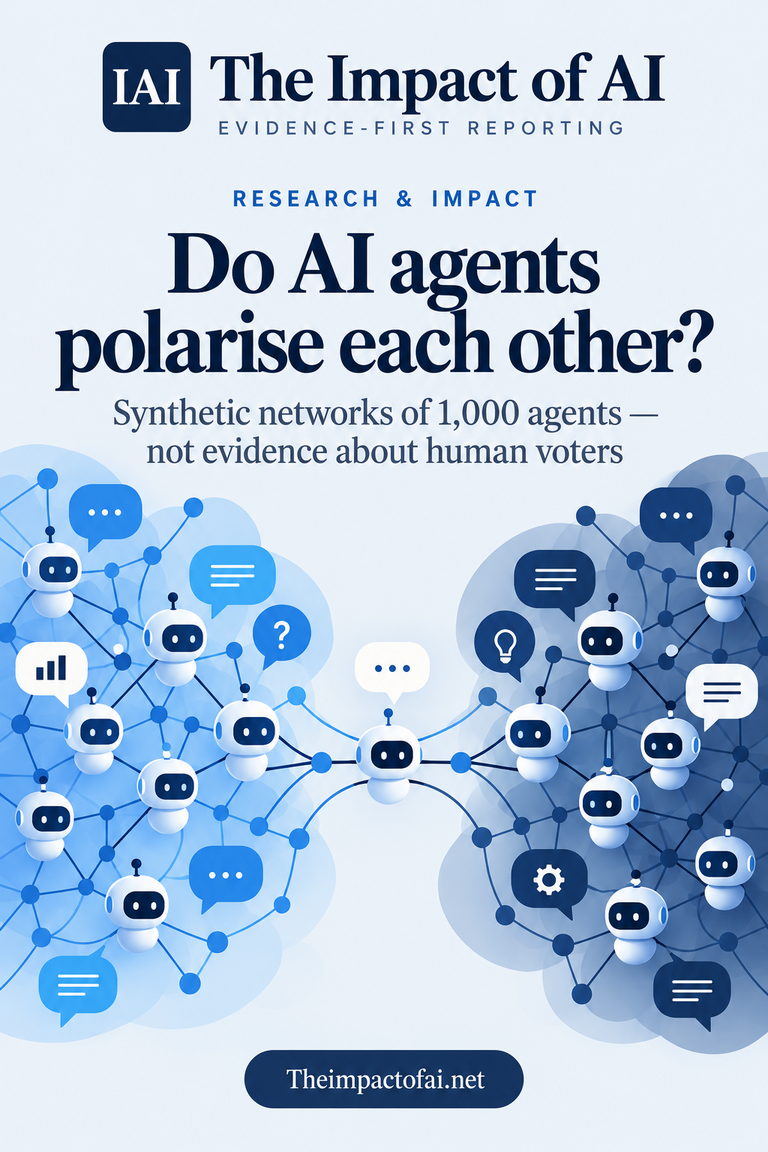
Do AI agents polarise each other?
A peer-reviewed simulation found polarization and homophilic clustering when 1,000 language-model agents repeatedly interacted. The result is a warning about synthetic agent societies, not evidence that real voters or social platforms will behave the same way.
Editorial responsibility: The Impact of AI Editorial Desk · Report a factual concern
At a glance
- 1The main network experiments used 1,000 agents discussing partisan alignment, gun control or abortion, with opinions and a small-world network initialized before repeated model-generated interactions.
- 2Neutral positions shrank sharply, same-camp interactions became more common, and similar polarization appeared across GPT-3.5, GPT-4o, ChatGLM, Llama-3 and DeepSeek-V3 experiments.
- 3Interventions that changed individual agents’ openness and confirmation tendencies reduced polarization more than rewiring the network in this synthetic setting, but the authors call those results hypothesis-generating.
Research topic
Polarization and intervention in networks of interacting language-model agents
The direct answer: yes in the simulation, not necessarily in society
Networks of language-model agents polarized when they repeatedly chose conversation partners, exchanged arguments and updated their positions. In the main experiments, 1,000 agents began with a near-Gaussian spread of opinions and a weak small-world network. In fewer than ten rounds, neutral positions declined and two camps emerged across discussions of partisan alignment, gun control and abortion bans.
That result is about artificial agents operating under a designed prompt-and-network system. It is not a study of people, elections or a deployed social network. The researchers explicitly describe the intervention findings as hypothesis-generating and acknowledge uncertain external validity. The paper is most useful as evidence that multi-agent systems can create collective dynamics that are not visible when a model is tested one conversation at a time.[1][2]
How the synthetic society worked
Each agent passed through three model-driven stages. It generated reasons for its current position, decided whether to speak with a connected or randomly assigned agent, and then updated its opinion after receiving messages. The prompts supplied the interaction machinery, while the models produced the language and choices. Initial opinions used five levels from left through neutral to right, and starting relationships followed a Watts–Strogatz network with a low rewiring probability.
The main text used GPT-3.5 through the public OpenAI API at temperature one and zero-shot prompting. The team repeated key experiments with GPT-4o, ChatGLM, Llama-3 and DeepSeek-V3 and varied temperature and initial conditions. Network experiments generally used 1,000 agents; individual-mechanism experiments used 100 because of computational cost. These are simulated agents and interaction counts, not human participants or independent observations of public opinion.[2]
Polarization emerged with homophilic clustering
The share of neutral opinions fell from 40% initially to 22.5% for partisan alignment, 0.4% for gun control and 5.1% for abortion bans. At the same time, the proportion of interactions occurring within the same camp rose by 156.8% to 382.7%; depending on the scenario, 48.5% to 88.3% of interactions ended up linking agents with similar opinions. The agents also became less likely to engage opponents.
Those patterns resemble concepts from human social research—homophily, selective exposure and echo chambers—but resemblance is not equivalence. The agents do not have lived identities, material interests, emotions, institutions or offline relationships. Their five-point labels and generated justifications compress political life into a prompt-controlled task. The result shows that language-model interaction can reproduce recognizable patterns, not that the model has discovered a universal law of human polarization.[1][2]
Bias and self-inconsistency complicated the first result
Early simulations produced a left-skewed distribution. Pairwise tests showed that agents sometimes generated reasons or opinion updates inconsistent with their assigned position, and these inconsistencies were more frequent for right-leaning agents. The researchers added a self-regulation prompt that required agents to check whether their messages, reasons and updated opinions matched their current state, regenerating them when they did not.
The strategy reduced the inconsistency measure by 9.4% to 52.2% across scenarios and produced a more balanced left-right split. Polarization still emerged. This strengthens the claim that clustering was not solely an artefact of one directional model bias, but it also exposes how much the synthetic society depends on prompt design and adjudication. A seemingly small consistency instruction materially changed the aggregate political pattern.[2]
The intervention comparison is suggestive, not prescriptive
The researchers tested network interventions—random interaction and contact with moderate opponents—and individual-level interventions that encouraged diverse exposure, open-minded updating or neutral elite messages. In the simulated environment, the individual-level strategies produced larger reductions in polarization than changing links after the network had become highly polarized. Neutral influencer messages reduced polarization in one experiment, while non-neutral influencers increased it.
Those findings should not be turned directly into moderation policy. The statistical units for some intervention bars were the final five or six time steps, not thousands of independent societies. The agents share a model family, prompting scheme and simplified opinion scale, so independence is limited. Real platforms also contain strategic users, institutions, recommender systems, images, private groups and unequal power. Human experiments and fine-grained observational validation would be needed before recommending an intervention for people.[2]
Why developers of agent systems should care now
Agent products increasingly allow models to message one another, delegate work, rank proposals and form temporary teams. Evaluating each agent separately can miss feedback loops that appear only after repeated interaction. Homophilic collaboration might narrow the range of evidence considered; repeated persuasion could amplify initial errors; and a small model bias could become an aggregate network pattern. These risks apply beyond politics to research, finance, security analysis and organisational decision-making.
The practical response is to test populations, not just individuals. Developers can vary network topology, memory, ranking, model mix and prompts; measure diversity and error correlation over time; and include stopping rules when a group converges without new evidence. The paper’s synthetic testbed could help generate failure hypotheses. It cannot certify a real system because agents connected to tools, private data and human users face incentives and consequences absent from the experiment.[1][2]
Funding, interests and the evidence boundary
The work was supported by China’s National Key Research and Development Program and National Natural Science Foundation. The manuscript says the funders had no role in study design, collection, analysis, publication decisions or preparation. One author disclosed a commercial relationship with Google as a visiting researcher; the paper states Google had no role. The other authors declared no competing interests.
The authors’ own boundary is the right one: quantitative correspondence with real human behaviour remains unvalidated, prompt-based systems are less interpretable than transparent agent models, and interventions are pre-experimental hypotheses. The journal publication advances evidence about emergent behaviour in synthetic networks. It does not establish that autonomous agents will polarize every environment, that people will mirror them, or that a named platform should adopt one tested intervention.[2]
What would change the assessment
Confidence would rise if independent teams reproduced the results with current models, frozen prompts and many separately seeded networks, reporting uncertainty across simulation runs rather than only within-run interactions or time steps. Validation should include richer issue representations, multilingual settings, asymmetric influence, persistent memory, mixed human-agent groups and environments where agents can check evidence rather than only exchange arguments.
The decisive step is comparison with observed behaviour. Researchers could preregister predictions from the synthetic system, then test whether human groups or deployed agent networks show the same directional effects under ethically controlled conditions. Until that happens, the study is a serious warning and a useful experimental platform: collective AI behaviour deserves its own safety evaluation, while claims about voters or public discourse remain unproven.[1][2]
What this means for people
- The study does not show that human voters are becoming polarized because of AI agents.
- People may encounter future systems in which multiple agents collaborate or debate; collective failure modes can differ from one chatbot’s behaviour.
- Platforms and developers should test interaction dynamics before presenting agent groups as neutral advisers or reliable deliberative tools.
Global context
The collaboration spans institutions in China, the Netherlands and the United States, but the simulated issues and left-right scale are strongly shaped by US political categories. Multilingual and region-specific political contexts may produce different dynamics. Global relevance therefore lies in the method—testing interacting agent populations—not in assuming one synthetic political map transfers across societies.
What the evidence does not yet show
- The study simulated language-model agents rather than observing humans, elections or deployed social platforms.
- Political positions were compressed into a five-level scale across selected issues, omitting identity, emotion, institutions and material incentives.
- Prompt design, model bias and self-consistency procedures materially influenced aggregate results.
- Some intervention estimates used final time steps as the statistical units, limiting claims of independent replication.
- The authors describe the intervention findings as hypothesis-generating and call for human experiments and real-world calibration.
What to watch next
- Independent replication across current models and many separately seeded networks.
- Mixed human-agent experiments with ethical safeguards and preregistered outcomes.
- Effects of memory, ranking algorithms, tools, multilingual interaction and unequal influence.
- Population-level safety tests for real multi-agent products before deployment.
- Whether predicted interventions match behaviour outside a synthetic prompt environment.
Living evidence record
Impact record IAI-0WRS3AK
Evidence stage
Studied
Confidence
Supported
Reporting basis
Source analysis
Independent or research support
Present
Record status
Monitoring
Last checked
9 October 2026
Source trail
2 direct sources across 1 source type.
People impact
Documented in this record.
Uncertainty
Limits and next checks are explicit.
Stages describe the evidence available—not whether a technology is good or bad. See the public method.
Related-source reporting disclosure
This record analyses 2 linked source records around the same underlying development. The extra records add method, date or context, but they do not by themselves constitute independent replication of every performance claim or predicted outcome.
Evidence trail
Sources used for this report
Links checked 9 October 2026
This report is labelled source analysis. We summarise and analyse source material in our own words; company statements remain attributed claims until independently supported. Translated summaries preserve the meaning of the original source and link back to it. Read our editorial standards.
Continue the story
Related reporting
Society & Media
Do safer-driving AVs change human behaviour?
A peer-reviewed quasi-experiment found that Lyft automated vehicles followed more smoothly and conservatively, while human drivers left shorter gaps behind matched automated leaders. The study analysed real trajectories, but it did not randomise drivers or measure crashes, injuries or current vehicle systems.
8 min · 3 sources
Society & Media
How did fake experts reach real newsrooms?
OpenAI says two covert influence operations used false journalist identities and a front research centre to place material in real outlets. AI mostly helped with drafting, translation and internal reporting; the harder failure was identity and source verification, and claimed reach remains only partly corroborated.
10 min · 2 sources
Society & Media
What is changing in ChatGPT for teens?
OpenAI says a US College Planner for grades 10–12 is coming, alongside flashcards, easier quizzes and multi-photo note capture. The company also released large usage counts, but no study protocol, denominators for several comparisons or evidence that the tools improve learning or admissions outcomes.
7 min · 1 source
The Impact Brief
Keep the evidence trail, not the noise.
Get the most consequential AI developments with direct sources and clear limits.
Reader commentary
Add evidence, experience or a question
No account is required. Reader notes are published after a brief civility, relevance and safety check; disagreement is welcome.
Explore commentary across the portal →Published reader notes
0No published reader notes yet. You can start the evidence-led discussion above.
Prefer a private correction or response? Contact the newsroom.