Can a lighter AI genotype hepatitis C as well as the standard tool?
A leakage-aware test put the best machine-learning pipeline at 92.2% accuracy. That is useful evidence for low-compute analysis, but the same sequences gave the existing NCBI alignment tool 96.62%.
The short version
3 key points
- 1.Researchers filtered 51,092 Los Alamos HCV records to 43,362 sequences—87 complete genomes and 43,275 partial sequences—covering ten genotype classes.
- 2.They clustered sequences at 90% identity before splitting them, reducing the risk that near-duplicates made the test look easier, and applied synthetic oversampling only to training data.
- 3.The best k-mer/XGBoost pipeline reached 92.2% accuracy, below the NCBI alignment-based genotyping tool's 96.62% on the same labelled sequences; neither result is prospective clinical validation.
A stricter split produced a credible—but lower—machine-learning score
Researchers in Egypt evaluated lightweight classifiers for hepatitis C virus genotyping using sequences downloaded from the Los Alamos HCV database in September 2023. They began with 51,092 records and, after removing duplicates and sequences with invalid or ambiguous nucleotides, retained 43,362: 87 complete genomes and 43,275 partial sequences across ten genotype classes. Crucially, they clustered sequences at 90% identity before the train/test split to reduce near-duplicate leakage. The best combination—k-mer features, XGBoost and training-only synthetic oversampling—reached 92.2% accuracy, macro F1 of 0.890 and Matthews correlation coefficient of 0.893.[1]
Why the comparison matters in clinical genomics
HCV genotype can inform laboratory interpretation and, in some settings, treatment or surveillance decisions. An alignment-free classifier could be faster or easier to run where specialist computing is limited. Yet the paper's most useful finding is comparative: the existing NCBI BLAST-based genotyping tool achieved 96.62% accuracy on the same database labels, 4.42 percentage points above the proposed model. The new pipeline may offer a low-compute alternative, but this experiment does not justify replacing the established tool in patient care.[1]
Who it affects
Laboratories with limited computing may value a lightweight, interpretable option, but patients need genotype results that are validated on real clinical samples; a lower benchmark score cannot be hidden behind claims of efficiency.[1]
Keep in mind
Retrospective public database; labels treated as ground truth; mostly partial sequences; class imbalance and synthetic oversampling; no prospective specimens, workflow study or patient outcome. The proposed model underperformed the NCBI comparator on accuracy.
Source analysis · 1 linked source. Original source date: 17 October 2026.
Read more The full report, methods and context
A stricter split produced a credible—but lower—machine-learning score
Researchers in Egypt evaluated lightweight classifiers for hepatitis C virus genotyping using sequences downloaded from the Los Alamos HCV database in September 2023. They began with 51,092 records and, after removing duplicates and sequences with invalid or ambiguous nucleotides, retained 43,362: 87 complete genomes and 43,275 partial sequences across ten genotype classes. Crucially, they clustered sequences at 90% identity before the train/test split to reduce near-duplicate leakage. The best combination—k-mer features, XGBoost and training-only synthetic oversampling—reached 92.2% accuracy, macro F1 of 0.890 and Matthews correlation coefficient of 0.893.[1]
Why the comparison matters in clinical genomics
HCV genotype can inform laboratory interpretation and, in some settings, treatment or surveillance decisions. An alignment-free classifier could be faster or easier to run where specialist computing is limited. Yet the paper's most useful finding is comparative: the existing NCBI BLAST-based genotyping tool achieved 96.62% accuracy on the same database labels, 4.42 percentage points above the proposed model. The new pipeline may offer a low-compute alternative, but this experiment does not justify replacing the established tool in patient care.[1]
The distinction that matters
What was compared on the same HCV sequence set
Both approaches used the database labels as the reference, but reached predictions differently.
Prepare
Filter 51,092 records to 43,362 and cluster before splitting
Reduce invalid inputs and sequence leakage
Learn
Encode k-mers and train XGBoost with training-only oversampling
92.2% accuracy on the held-out labels
Align
Run the NCBI similarity-based genotyping tool
96.62% accuracy on the same labels
What the design gets right—and what remains unproven
The team compared four encodings—frequency chaos game representation, k-mer counts, one-hot encoding and label encoding—across XGBoost, random forest, multilayer perceptron and k-nearest neighbours. Synthetic Minority Over-sampling Technique was confined to training data, leaving the test set untouched. Oversampling significantly improved random-forest performance, while added GC-content features did not produce a statistically significant benefit. That makes the paper more informative than a single headline score: it shows which design choices mattered and which did not.
The ground truth was the label already attached to each public database sequence, not a new laboratory determination. Most inputs were partial sequences; rare genotypes were unevenly represented; and synthetic samples in feature space may not capture real biological variation. A database benchmark also cannot measure sample preparation errors, mixed infections, recombination or whether a result changes patient management. The authors declared no competing interests and released accession numbers and code. Independent laboratories would still need to test geographically diverse, prospectively collected samples against reference genotyping and report errors by genotype before clinical use.[1]
Watch the background, then check the evidence
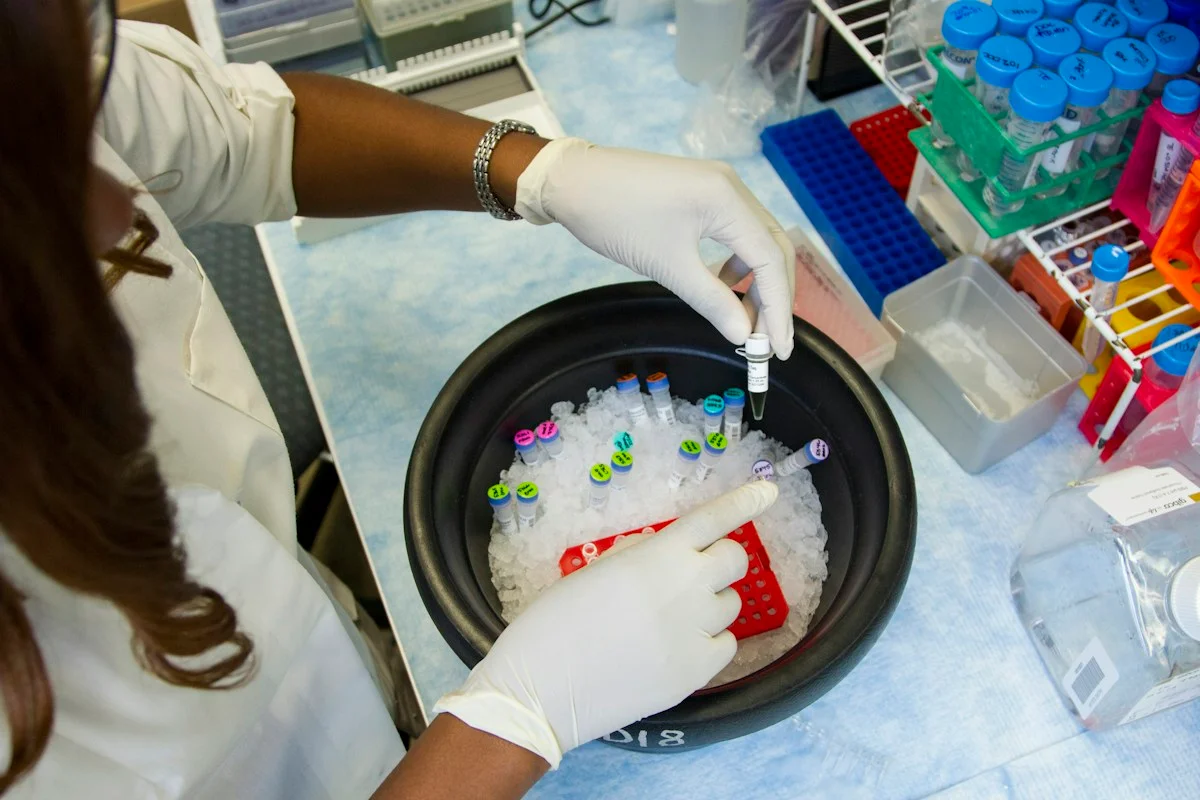
The Royal Society
Illustrative photo · not a video frame
Photo: Daniel Sone / National Cancer Institute / Unsplash · Licence
YouTube loads only when you choose. Press play in the player to start. If playback is unavailable, use “Watch on YouTube” below.
Healthcare, culture & human impact · Background explainer
Published 2026-07-01 · 44 min 28 sec
Is this the AI future we want? | The Royal Society
A Royal Society discussion with Madhumita Murgia and biomedical engineer Alison Noble on AI’s potential in healthcare, science and culture, recorded at the 30 June 2026 event.
Evidence check: A discussion of opportunities and risks, including future possibilities. It is not evidence that every application described is available or clinically proven.
Source checked 14 October 2026. Check available captions on the publisher’s video page.
Evidence check
Retrospective public database; labels treated as ground truth; mostly partial sequences; class imbalance and synthetic oversampling; no prospective specimens, workflow study or patient outcome. The proposed model underperformed the NCBI comparator on accuracy.
Reporting basis: Source analysis. Original source date: 17 October 2026.
Explore the full source and evidence record
What this means for people
- Laboratories with limited computing may value a lightweight, interpretable option, but patients need genotype results that are validated on real clinical samples; a lower benchmark score cannot be hidden behind claims of efficiency.
Global context
The models were developed by Egyptian university teams using an international sequence database. HCV subtype prevalence and sequencing capacity vary by region, so performance must be reported for locally prevalent and underrepresented genotypes.
What the evidence does not yet show
- Retrospective public database; labels treated as ground truth; mostly partial sequences; class imbalance and synthetic oversampling; no prospective specimens, workflow study or patient outcome. The proposed model underperformed the NCBI comparator on accuracy.
What to watch next
- Prospective multi-laboratory validation, error rates by genotype and sequence region, mixed and recombinant infections, compute and turnaround comparisons, and evidence that discordant calls are safely resolved.
Living evidence record
Impact record IAI-007YFEU
Evidence stage
Studied
Confidence
Supported
Reporting basis
Source analysis
Independent or research support
Present
Record status
Monitoring
Last checked
17 October 2026
Source trail
1 direct source across 1 source type.
People impact
Documented in this record.
Uncertainty
Limits and next checks are explicit.
Stages describe the evidence available—not whether a technology is good or bad. See the public method.
Single-source reporting disclosure
This record analyses one direct source. It can establish what Scientific Reports published or reported, but it is not independent corroboration of every performance claim or predicted outcome. The confidence label will change only when broader evidence is added.
Evidence trail
Sources used for this report
Links checked 17 October 2026
Research question, topics and regions
Alignment-free machine learning for viral genotyping
Topics: Hepatitis C · Genomics · Clinical laboratory · Machine learning · Validation
Regions: Egypt · Africa · Global
This report is labelled source analysis. We summarise and analyse source material in our own words; company statements remain attributed claims until independently supported. Translated summaries preserve the meaning of the original source and link back to it. Read our editorial standards.
The Impact Brief · Free
Keep following the stories that matter to you.
Get our weekday briefing on what changed and why it matters. Choose your topics below.
Continue the story
There’s more to this story
Health & Life Sciences
Can routine lab results distinguish two stroke types?
A ten-biomarker model reached an AUC of 0.902 in 495 later patients at the same Chinese hospital. The result is promising decision-support research, but unknown blood-draw timing, no stroke mimics and no external hospital mean it cannot replace emergency brain imaging.
2 min · 1 source
Health & Life Sciences
Did a breast-cancer AI score survive external validation?
A 50-gene machine-learning signature looked moderately accurate in 101 development cases, but its transferable component fell to an AUC of 0.55 in 320 external cases and added no value beyond routine clinical factors.
2 min · 1 source
Health & Life Sciences
Can genomic AI reduce missed antibiotic resistance?
A peer-reviewed model trained on 5,942 Klebsiella pneumoniae genomes made fewer false-susceptible predictions than two established genomic tools in retrospective global, African and Thai benchmarks. It has not yet shown that it improves prescribing or patient outcomes in live care.
3 min · 1 source
Reader commentary
What does this mean where you are?
Tell us what you have seen at work, in your community or in everyday life. A question is welcome too. No account is needed; we review notes before publishing them.
Explore commentary across the portal →Published reader notes
0No published reader notes yet. You can start the evidence-led discussion above.
Prefer a private correction or response? Contact the newsroom.