How far has AI reached in low-resource radiotherapy?
A peer-reviewed systematic review found 18 eligible AI deployment studies in low- and middle-income countries. Only one joined multiple stages of the radiotherapy workflow, none showed fully operational use, and no study reported continuous performance monitoring.
Editorial responsibility: The Impact of AI Editorial Desk · Report a factual concern
At a glance
- 1The review searched six databases for work published from January 2000 through December 2025 and included 18 eligible studies from low- and middle-income countries.
- 2Nine studies reported isolated task-level uses, six reported clinician-supervised workflow integration, one linked multiple workflow stages, and none documented fully operational use.
- 3Validation was mainly retrospective and no study reported continuous performance monitoring, so the review does not establish safer care, shorter waits or improved cancer outcomes.
Research topic
AI deployment maturity in low-resource radiation oncology
The direct answer: deployment remains early and narrowly integrated
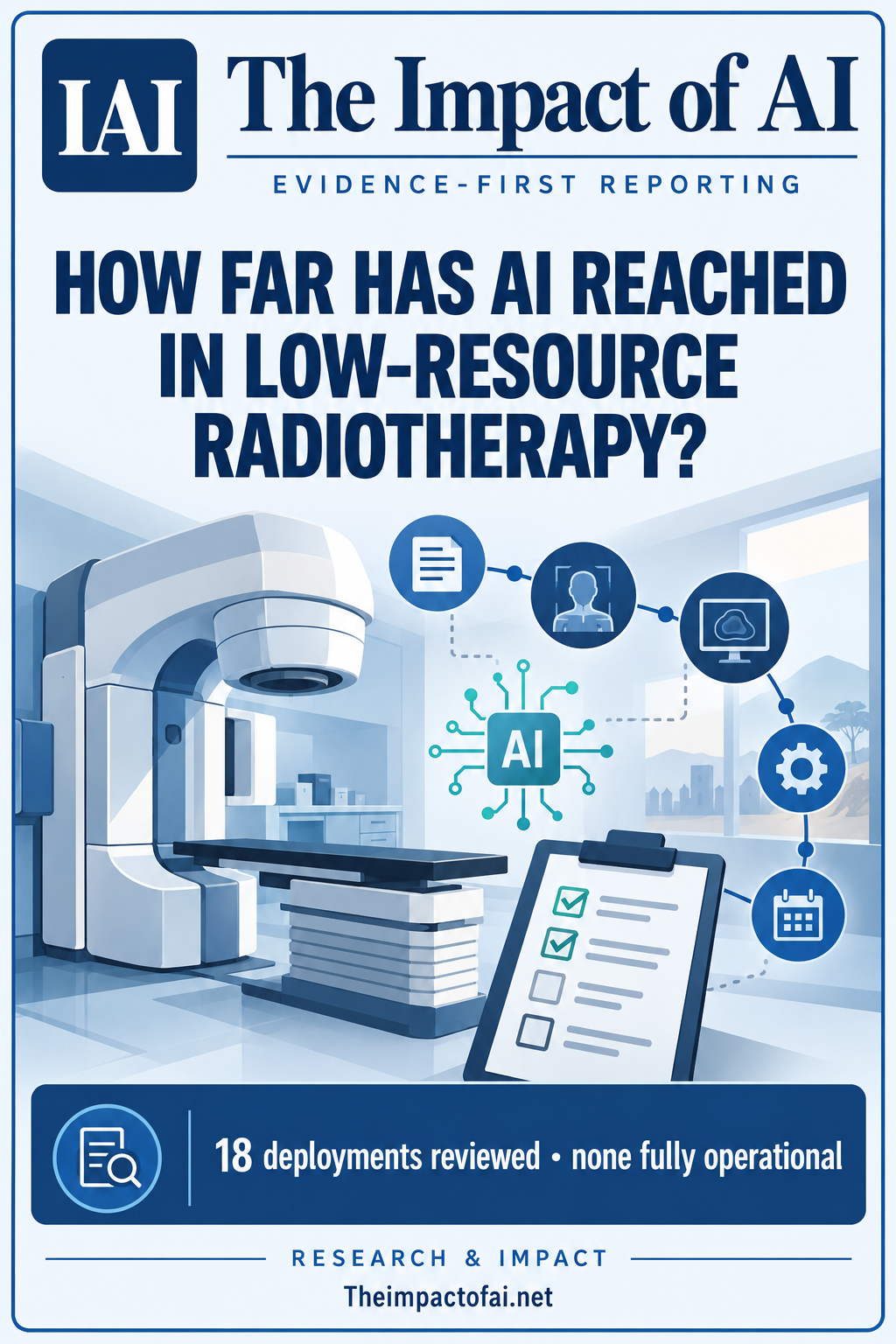
AI has reached parts of the radiotherapy workflow in low- and middle-income countries, but the published evidence does not show a mature, continuously monitored service. The new systematic review found 18 eligible studies. Nine, or 50%, described an isolated task-level application; six, or 33.3%, reported clinician-supervised integration into a workflow; and one, or 5.6%, joined activities across multiple stages. No study supplied enough evidence to count as fully operational use.
That distinction matters because a model can perform one technical task without becoming a safe clinical system. Radiotherapy combines imaging, tumour and organ contouring, treatment planning, quality assurance, machine delivery and follow-up. A useful algorithm at one stage may still fail to exchange data reliably, fit staff routines or remain accurate when equipment and patients change. The review's answer is therefore not that AI is absent, but that most reported use has not crossed from a promising component into a proven service.[1]
What the researchers reviewed
The authors followed PRISMA 2020 guidance and searched six databases for studies published from January 2000 through December 2025. Eligible work had to concern AI deployment in radiation oncology in a low- or middle-income country. Eighteen studies survived that process. This is the denominator behind the percentages; it is not a cohort of 18 hospitals, 18 countries or 18 independently operating products, and the paper does not pool patient-level treatment outcomes into one effect estimate.
Each study was classified on a radiation-oncology-specific spectrum from level zero to level four. Level zero covered readiness or governance work without a clinical AI deployment. Level one captured an application performing a bounded task. Level two required clinician-supervised workflow integration, level three involved orchestration across workflow stages, and level four represented operational use at the most mature end of the framework. The reviewers also examined validation, deployment and governance characteristics rather than treating technical accuracy as the whole implementation story.[1]
The distribution shows where the evidence stops
Two studies, or 11.1%, sat at level zero because they addressed readiness or governance without deploying clinical AI. Nine were level one, six were level two and one reached level three. None met the level-four standard. The categories are an author-developed way to organise heterogeneous studies, not a regulator's approval scale, but they make the central pattern visible: most literature describes preparation, a single technical task or supervised integration rather than durable operation across a cancer service.
The one level-three report should not be read as proof that an end-to-end autonomous pathway is ready. Cross-stage orchestration means more of the workflow was connected, not that a model made unsupervised treatment decisions or that patient outcomes improved. The absence of level-four evidence is equally specific: it says the published record did not provide the required operational evidence. It does not prove that no clinic uses AI beyond what the literature captured, and publication lag may hide newer local practice.[1]
Retrospective validation leaves the live-workflow question open
Validation was predominantly retrospective. That usually means researchers tested a system on data already collected rather than evaluating a frozen tool while clinicians used it for incoming patients. Retrospective work can reveal discrimination, segmentation accuracy or planning consistency under controlled conditions. It is less able to show whether staff act on an output, whether integration creates delay, how often a model is overridden or whether failures cluster around particular scanners, tumour types or patient groups.
The review also found no report of continuous performance monitoring. Once a model enters practice, performance can drift because equipment, protocols, staffing, disease mix and data systems change. Monitoring should define the unit being checked, acceptable thresholds, responsibility for responding and a route to suspend or update the tool. Without those elements, a successful validation result is a snapshot. It cannot establish that benefit persists or that newly emerging errors will be detected before they affect treatment.[1]
Why low-resource settings make implementation unusually consequential
Radiotherapy capacity is scarce in many low- and middle-income countries, and specialist shortages can delay planning or restrict access. A well-chosen AI tool could help staff complete repetitive imaging or planning work, standardise quality checks and extend expertise across sites. The potential people-level gain is practical: shorter waits, fewer avoidable trips, more consistent plans and better use of limited clinician time. None of those outcomes, however, can be inferred from a task-level model alone.
The same constraint that makes automation attractive can make failure harder to absorb. Unreliable power, ageing equipment, limited network connectivity, fragmented records and thin technical support can turn a small integration problem into cancelled treatment. Imported models may have been trained on different machines and populations, while recurring licence, cloud and data-transfer costs can outlast a pilot grant. Safe adoption therefore depends on infrastructure, maintenance and local clinical ownership as much as on model accuracy.[1]
What this means for patients and clinical teams now
The review does not justify changing an individual's treatment or accepting an AI-generated plan without qualified review. It found no pooled evidence that AI improved tumour control, survival, toxicity, waiting time or access. Patients should expect clinicians to remain accountable for planning and delivery, and health services should disclose when an AI system materially influences care, what it is intended to do and how a person can question or appeal its output.
For clinical teams, the most defensible near-term uses are bounded, measurable and reversible. A service can choose a bottleneck, compare the proposed tool with current practice, validate it locally on representative cases and predefine human checks. Evaluation should count severe errors and workflow failures, not only average accuracy. It should also measure staff time, treatment delay, override behaviour and subgroup performance, because a model that saves minutes on straightforward cases may add risk or work on uncommon ones.[1]
Funding, interests and the scope of the claim
The paper says the authors received no specific funding for the review. It acknowledges US National Institutes of Health awards that supported related work in part and thanks the HypoAfrica team and collaborators for feedback. The authors declared no competing financial or non-financial interests. ChatGPT was used to assist with graphical refinement of one author-generated figure; the authors state that they reviewed and approved its scientific content, labels and final design.
Those disclosures support scrutiny but do not remove the review's structural limits. Eighteen studies are a small and heterogeneous evidence base, and classification depends on what papers reported. English-language publication patterns, uneven indexing and the tendency to publish successful pilots may leave local failures or non-academic deployments invisible. The review maps the available record through December 2025; it does not audit every radiotherapy centre or establish how common each deployment level is across all eligible countries.[1]
What would change the assessment
Confidence would rise with prospectively registered, multi-centre evaluations of frozen systems used in routine care. They should compare an AI-supported pathway with the existing pathway and report patient and workflow denominators, treatment delays, plan changes, serious errors, subgroup performance, uptime, maintenance and costs. Independent evaluation outside the development site would show whether the tool transfers across machines, protocols and populations rather than reproducing one centre's data and practice.
The strongest next evidence would also show continuous monitoring with predefined thresholds and governance that survives beyond a pilot. Health ministries, hospitals and funders need to know who owns the data, who maintains software, how updates are validated and what happens when connectivity or performance fails. Until studies document those conditions and measurable effects on care, the review supports cautious, locally validated assistance—not claims that autonomous radiotherapy has arrived in low-resource health systems.[1]
What this means for people
- Patients should still expect qualified clinicians to review treatment planning and remain accountable for decisions.
- Well-bounded tools could reduce repetitive work and delays where specialist capacity is scarce, but the review did not measure those benefits.
- Weak infrastructure or unsupported imported systems could add cancellations, inequity or silent errors instead of expanding access.
Global context
The review centres low- and middle-income countries, where cancer burden, equipment, staffing, connectivity and financing differ greatly within and between regions. A result from one clinic cannot stand in for this diversity. Regional networks can share validation protocols and technical expertise, but each service still needs evidence for its own machines, data flows, populations and fallback procedures before relying on an AI system in treatment.
What the evidence does not yet show
- Only 18 studies met the review criteria, and their tasks, settings and reporting were heterogeneous.
- Validation was predominantly retrospective, so the evidence does not show how frozen systems perform in routine incoming care.
- No included study reported continuous performance monitoring.
- The integration levels organise reported evidence but are not regulatory approval categories or direct measures of patient benefit.
- The search ended in December 2025, so newer or unpublished local deployments are outside the review.
What to watch next
- Prospective multi-centre evaluations in the intended hospitals and populations.
- Continuous monitoring with predefined alert, update and suspension thresholds.
- Patient outcomes, waiting times, severe errors, staff time and completed treatment rather than technical accuracy alone.
- Independent validation across equipment, tumour types, languages and demographic groups.
- Long-term financing, local maintenance, data governance and failure-recovery plans after pilot funding ends.
Living evidence record
Impact record IAI-0Y44804
Evidence stage
Studied
Confidence
Supported
Reporting basis
Source analysis
Independent or research support
Present
Record status
Monitoring
Last checked
9 October 2026
Source trail
1 direct source across 1 source type.
People impact
Documented in this record.
Uncertainty
Limits and next checks are explicit.
Stages describe the evidence available—not whether a technology is good or bad. See the public method.
Single-source reporting disclosure
This record analyses one direct source. It can establish what npj Digital Medicine published or reported, but it is not independent corroboration of every performance claim or predicted outcome. The confidence label will change only when broader evidence is added.
Evidence trail
Sources used for this report
Links checked 9 October 2026
This report is labelled source analysis. We summarise and analyse source material in our own words; company statements remain attributed claims until independently supported. Translated summaries preserve the meaning of the original source and link back to it. Read our editorial standards.
Continue the story
Related reporting
Health & Life Sciences
Can a chest X-ray flag osteoporosis?
A peer-reviewed Korean study externally validated an AI prescreener in three cohorts totalling 153,058 people. Its simulated workflow preserved most osteoporosis detections while halving DXA use, but it has not yet proved benefit in prospective care.
7 min · 2 sources
Health & Life Sciences
How much does MedGemma improve medical AI?
A peer-reviewed study reports gains over similarly sized base models across medical image questions, chest X-ray classification and simulated agent tasks. The evidence comes from benchmarks and small specialist reviews, not prospective clinical deployment or patient outcomes.
9 min · 2 sources
Health & Life Sciences
Can AI make tumour mitosis counts more consistent?
A preprint study paired 13 pathologists' unaided and AI-assisted reviews of 385 tumour slides from three European centres. Agreement rose and counting time fell, but the unreviewed study did not establish which counts were correct, whether diagnoses improved or whether patients benefited.
11 min · 1 source
The Impact Brief
Keep the evidence trail, not the noise.
Get the most consequential AI developments with direct sources and clear limits.
Reader commentary
Add evidence, experience or a question
No account is required. Reader notes are published after a brief civility, relevance and safety check; disagreement is welcome.
Explore commentary across the portal →Published reader notes
0No published reader notes yet. You can start the evidence-led discussion above.
Prefer a private correction or response? Contact the newsroom.