Is AI good or bad for the climate?
A new BIS paper concludes that the net effect remains uncertain: AI may improve grids, forecasting and climate innovation while increasing electricity, water and material demand. The report synthesises evidence and scenarios; it does not calculate a global net emissions balance.
Editorial responsibility: The Impact of AI Editorial Desk · Report a factual concern
At a glance
- 1The 27-page BIS paper does not estimate a net global climate effect. It argues that the answer depends on the carbon intensity and timing of extra electricity, whether efficiency gains survive rebound effects and how AI capability develops.
- 2Its two stylised cases—human-directed copilots and more transformative general-purpose systems—are scenarios for organising risks, not probability-weighted forecasts.
- 3The authors link AI-related grid demand, infrastructure finance and transition risk to central-bank mandates, while stressing transparency, sustainability incentives and international cooperation.
Research topic
Artificial intelligence, energy demand, climate mitigation and macro-financial risk
The direct answer: the net climate effect is not known
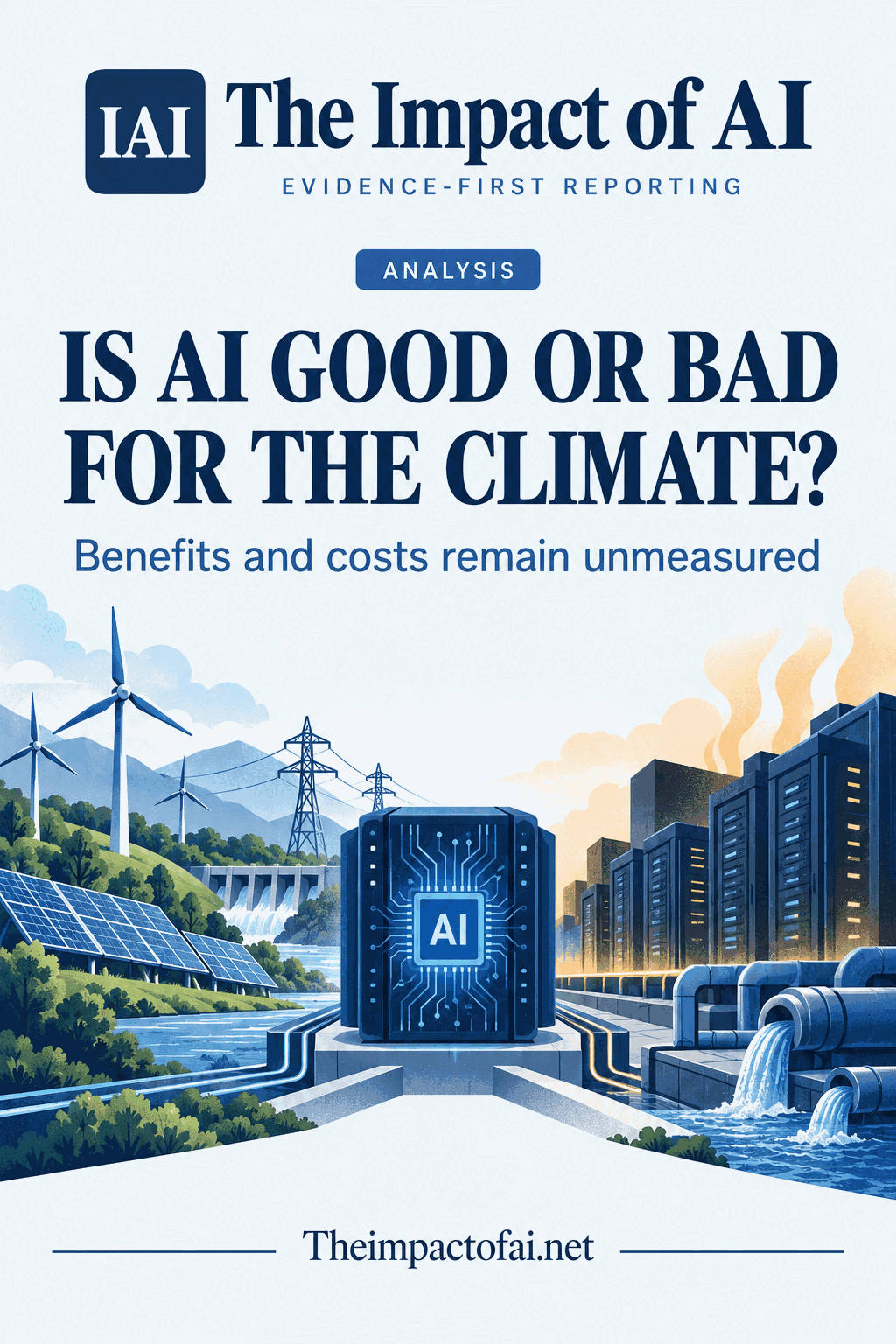
AI is neither inherently good nor inherently bad for the climate. That is the central conclusion of a new Bank for International Settlements paper. Machine learning can improve electricity forecasting, grid operation, transport, industrial efficiency, weather prediction and materials discovery. The same expansion requires data centres, chips, cooling water, transmission capacity and round-the-clock power. Whether the balance helps the climate depends on what the systems do, when and where they consume electricity, and whether efficiency produces absolute reductions or encourages more activity.
The paper does not calculate that balance. It is a 27-page narrative synthesis of existing studies, examples and policy responses, organised around opportunities, costs and two stylised technology scenarios. There is no original global emissions dataset, modelled confidence interval, sample denominator or systematic-review protocol. Its value is a decision framework for central banks and policymakers; it should not be read as a measured forecast that AI will cut or raise global emissions by a stated amount.[1][2]
The opportunity side starts with energy systems
The authors identify practical channels through which AI can support mitigation. Forecasting wind and solar output can help grid operators schedule power, while predictive maintenance can detect equipment problems and reduce losses. Some training and batch-computing workloads can move to periods or locations with more low-carbon electricity. Building controls, industrial process optimisation, traffic routing, methane detection and carbon-capture research provide further possibilities. Better weather and hazard forecasts can also support adaptation before floods, heat or crop stress cause damage.
These examples are heterogeneous. A percentage reported for one building-control study is not an estimate for the global building stock, and a company's avoided-emissions claim is not equivalent to an independently audited economy-wide reduction. The paper appropriately presents them as possible channels rather than adding them into one total. The climate result also depends on system boundaries: an efficient model can reduce energy per task while total electricity still rises because the service becomes cheaper and more widely used.[1]
The cost side is larger than model training
Public debate often focuses on the energy used to train a large model. The BIS paper broadens the lens to inference—the repeated computation when people and organisations use a deployed service—and to supporting infrastructure. New demand can intensify peak loads, grid congestion and reliability pressures when workloads are inflexible or concentrated. Carbon impact changes with the marginal generator supplying an extra unit of power, so shifting a job to a cheaper off-peak hour does not necessarily shift it to cleaner electricity.
Water use for cooling, semiconductor production, construction and critical-mineral supply chains add environmental and geopolitical exposure. New gas or other carbon-intensive generation built for data-centre demand can create transition risk if climate rules later tighten. Conversely, transmission, storage and clean generation built alongside computing infrastructure could help a wider system. The paper's framework makes location, timing, additionality and infrastructure lifetime more informative than a single global average for electricity consumption.[1]
Rebound effects decide whether efficiency survives
An AI system may make a task require fewer resources, but lower cost can increase demand for that task. This is the rebound problem. More efficient inference can support more queries; more productive firms can expand output; better fossil-fuel exploration or logistics can strengthen carbon-intensive activity as easily as AI can accelerate batteries or solar materials. The technology is general purpose, not automatically directed towards emissions reduction.
That distinction matters for corporate claims. Reporting energy per model query or emissions intensity without total activity can hide an absolute increase. A credible assessment needs both: the resources consumed per useful output and the resulting change in total electricity, water, materials and emissions. It should also distinguish avoided emissions caused by the AI application from changes that would have happened anyway. The BIS paper does not supply that accounting, but it makes the missing denominator visible.[1]
Two scenarios structure uncertainty rather than predict it
In the first stylised scenario, AI remains mainly a copilot that assists human work. Benefits and environmental costs build gradually as organisations adopt tools, reorganise processes and add infrastructure. The net effect depends on electricity mix, deployment scale and whether productivity gains reduce resource use or increase production. This pathway is easier to connect to today's evidence, although even here aggregate results remain unclear because firm-level productivity estimates do not automatically become economy-wide gains.
The second scenario considers far more autonomous, broadly capable systems. The authors argue that both potential climate benefits and resource risks could become much larger. Such systems might accelerate research and coordination, but could also trigger much greater computation, output and infrastructure demand. This is not an estimate that artificial general intelligence will arrive or a probability assigned to a date. Treating the endpoints as a continuum is more useful: policy can watch capability, autonomy and energy demand without betting on one label.[1]
Why a climate paper addresses central banks
Central banks care because the AI-climate interaction can affect potential output, inflation, financial stability and the transmission of climate risk. Data-centre and power investment may raise demand for capital and energy. Grid constraints or volatile electricity prices can affect costs. If expected AI returns fail to materialise, highly financed infrastructure may lose value; if climate policy tightens, carbon-intensive power assets built to serve computing may face transition losses.
The paper does not say central banks should decide which AI services deserve electricity. Its more defensible implication is that supervisors and economic analysts need better exposure data, scenario analysis and consistent disclosure. Financial institutions may hold loans, bonds and equity tied to data centres, semiconductor supply, utilities and grids. Without location-specific energy and emissions information, models of inflation or climate-related financial risk can miss where those dependencies concentrate.[1][2]
What changes for households, workers and communities
For people living near new data centres or generation, the relevant questions are concrete: Will power bills change? Who pays for grid upgrades? How much water will be withdrawn during drought? What jobs and tax revenue arrive, and how durable are they? Aggregate claims about innovation do not answer distributional questions. The paper warns that technologically advanced countries and firms may capture more of the gains while climate-vulnerable and less connected economies bear costs or receive fewer tools for adaptation.
For workers and consumers, efficiency may improve services without reducing total environmental pressure. Productive AI-assisted work can raise output and income, but those gains can translate into more consumption. Policymakers therefore need to separate welfare benefits from emissions outcomes rather than assuming they move together. Transparent local planning, electricity-market rules and environmental review can make trade-offs visible before long-lived infrastructure is locked in.[1]
Evidence limits and what would change the assessment
The paper is a selective synthesis, not a systematic review. Its examples combine experiments, company estimates, modelling exercises and institutional analysis with different boundaries and dates. Some cited productivity and climate figures are scenario-dependent and cannot be aggregated. The authors also acknowledge using AI for research assistance and editorial refinement; they retain responsibility for errors. One author works at the BIS and the other at the University of Palermo, and the stated views do not necessarily represent the BIS or its member central banks.
The assessment would become firmer with audited, location- and time-specific data on electricity, water, hardware and emissions for training and inference; matched studies of AI-enabled climate interventions; and economy-wide models that include rebound effects. Regulators also need disclosure that links facilities to power sources and financing exposures. Until then, the most accurate answer is conditional: AI can advance climate work and increase environmental pressure at the same time. Policy determines which uses grow, how clean the marginal power is and who absorbs the costs.[1][2]
What this means for people
- Communities hosting computing and power infrastructure can face changes in electricity demand, water use, investment and local revenue.
- Consumers may benefit from better forecasting and services while still paying part of the grid and generation costs.
- Climate-vulnerable countries need access to useful forecasting and adaptation tools without being left with higher infrastructure or supply-chain costs.
Global context
The BIS frames AI and climate as a global macro-financial issue because computing supply chains, electricity markets, emissions and capital flows cross borders. Benefits may accrue where models, chips and data centres are concentrated, while climate damage falls disproportionately on vulnerable economies. Comparable international disclosure and cooperation are therefore necessary, but local electricity mix, water stress and regulatory capacity will continue to determine the real balance.
What the evidence does not yet show
- The paper is a narrative synthesis and scenario analysis, not a systematic review or original global emissions inventory.
- It does not estimate a single net climate effect, probability for either technology scenario or confidence interval.
- Examples combine studies with different methods, years and system boundaries and should not be added together.
- Several cited benefits and costs depend on company estimates or modelling assumptions rather than observed economy-wide outcomes.
- The climate impact of extra computation remains highly location- and time-dependent because marginal electricity and infrastructure differ.
What to watch next
- Audited disclosure of training and inference electricity, water, hardware and emissions by location and time.
- Whether data-centre demand is matched by additional low-carbon generation, transmission and storage.
- Economy-wide studies that measure rebound rather than only per-task efficiency.
- Financial exposures to data centres, utilities and carbon-intensive power built for AI demand.
- Distributional evidence on bills, water, jobs and climate benefits in host communities and developing economies.
Living evidence record
Impact record IAI-1SQGYRU
Evidence stage
Observed
Confidence
Supported
Reporting basis
Source analysis
Independent or research support
Not yet
Record status
Monitoring
Last checked
9 October 2026
Source trail
2 direct sources across 1 source type.
People impact
Documented in this record.
Uncertainty
Limits and next checks are explicit.
Stages describe the evidence available—not whether a technology is good or bad. See the public method.
Related-source reporting disclosure
This record analyses 2 linked source records around the same underlying development. The extra records add method, date or context, but they do not by themselves constitute independent replication of every performance claim or predicted outcome.
Evidence trail
Sources used for this report
Links checked 9 October 2026
This report is labelled source analysis. We summarise and analyse source material in our own words; company statements remain attributed claims until independently supported. Translated summaries preserve the meaning of the original source and link back to it. Read our editorial standards.
Continue the story
Related reporting
Climate & Energy
Will AI make warm East Asian winters more predictable?
A Korean-led study trained convolutional networks on a 100-member climate-model ensemble and found higher simulated skill for extreme warm East Asian winters under a high-emissions future scenario, while cold-extreme skill stayed modest. The result is a perfect-model experiment, not an operational forecast guarantee.
7 min · 3 sources
Climate & Energy
Will Google’s nuclear deal add new grid power?
Google and Constellation say a 20-year agreement will support uprates adding 890 megawatts across 11 US nuclear units, with the first increase expected in 2028. The capacity is planned rather than delivered, and the companies have not disclosed the price or project-by-project schedule.
8 min · 1 source
Climate & Energy
Can Japan's planned 400MW AI data centre grow without locking in gas?
JERA, Dell and RHAELM plan a more than $15 billion AI-computing site beside a Chiba power station. The 400MW figure describes intended capacity—not measured electricity use—and the announcement provides no emissions, water or efficiency forecast.
6 min · 3 sources
The Impact Brief
Keep the evidence trail, not the noise.
Get the most consequential AI developments with direct sources and clear limits.
Reader commentary
Add evidence, experience or a question
No account is required. Reader notes are published after a brief civility, relevance and safety check; disagreement is welcome.
Explore commentary across the portal →Published reader notes
0No published reader notes yet. You can start the evidence-led discussion above.
Prefer a private correction or response? Contact the newsroom.