Will the UK's new robot hubs change your work?
Eight new Robotics Adoption Hubs, backed by £40 million, aim to help organisations test and adopt robots. The immediate change is access to advice and demonstrations; better jobs, faster recovery and productivity gains still need evidence.
Editorial responsibility: The Impact of AI Editorial Desk · Report a factual concern
What changed · 10 October 2026 at 10:57 BST
Updated 10 October 2026, 10:57 BST: expanded the original brief into a substantive report, clarified what the £40 million announcement does and does not fund, and added task selection, procurement, workforce and evaluation questions. The 9 October source date and original publication time are unchanged.
At a glance
- 1The 9 October government announcement names eight hubs and £40 million in backing.
- 2Support is intended to connect organisations with advice, demonstrations and practical adoption expertise.
- 3Neither the national release nor the council announcement measures jobs created or productivity gained.
What is actually new
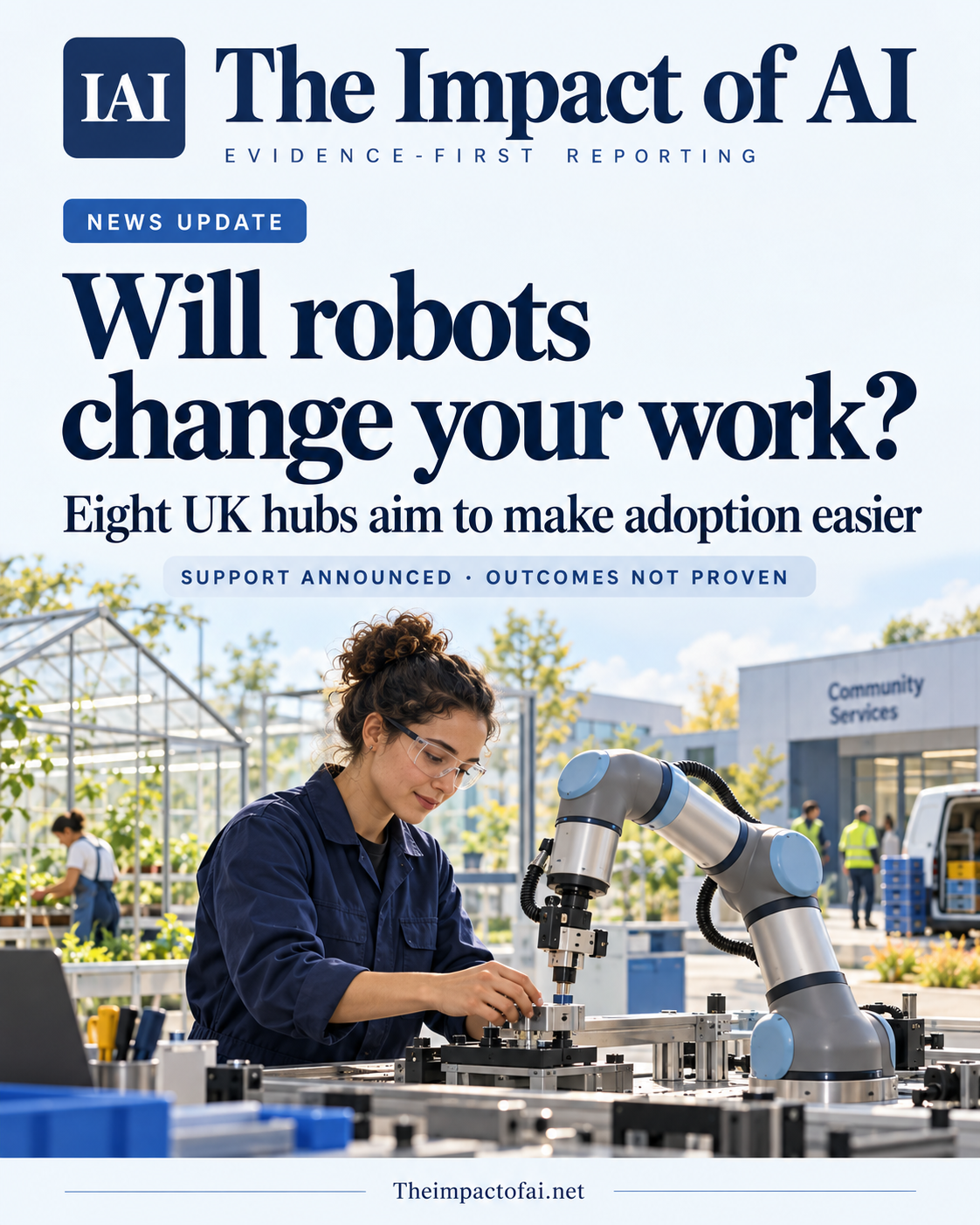
The UK government announced eight Robotics Adoption Hubs on 9 October, backed by £40 million. The network covers areas including surgery, farming, manufacturing, public spaces and recycling. Its offer is help with adoption: specialist advice, demonstrations and connections to suppliers, integrators and finance providers. The announcement is not evidence that every service is already operating at full capacity.
The national release presents the hubs as a bridge between organisations with practical problems and a robotics ecosystem that can demonstrate, finance and integrate machines. That is a programme design, not a measured outcome. It does not tell readers how the £40 million is divided, what each organisation must contribute, how many deployments the network can support or whether access will be free. Those details determine whether a small manufacturer, farm, hospital team or local authority can use the service in practice.
Robotics and AI overlap but are not interchangeable. A robot may follow fixed instructions, use conventional control systems or incorporate machine-learning components for perception and planning. The announcement groups these technologies under a robotics-adoption programme. It should not be read as evidence that every funded machine is autonomous, that an AI model makes clinical decisions or that one technical approach suits all eight regions.[1]
The Impact Brief · Free
Follow the evidence in finance & business.
Get a five-minute weekday briefing on what changed, why it matters and where the evidence comes from. Choose the topics you care about.
What a business can look for
Milton Keynes provides one concrete example. Its council says a Smart City MK CIC-led consortium will work on robots in public spaces, with impartial advice, structured support and access to industry specialists. This is a participating council's description of the intended service, not an independent assessment of results.
Our analysis: the useful starting point is a specific task. Could a robot handle a repetitive movement, inspect a difficult location or make a process more consistent? Before committing, ask a hub about available demonstrations, eligibility, any charges, workforce training and how it separates impartial advice from a supplier's sales claim.
A credible trial needs a comparator. An organisation should record the current task's time, error rate, injuries or near misses, downtime, staffing, energy use and total cost before a robot is introduced. It should then measure the same outcomes during a sufficiently long trial, including maintenance and recovery from failure. A successful demonstration in a controlled room is useful evidence of capability, but it is not a substitute for performance in the organisation's own workflow.[1][2]
The procurement questions behind a demonstration
The visible machine is only one part of a deployment. Buyers may need fixtures, sensors, software licences, connectivity, safety guarding, cyber-security controls, training, maintenance and insurance. They also need to know who owns data produced by the system and whether a supplier can change cloud services or pricing after installation. The sources announce advice and links to finance, but they do not set out procurement terms or total lifetime costs.
For public bodies and health services, accountability must remain legible. A team should be able to pause the system, identify who approved its use and explain how safety incidents are handled. If machine learning affects perception or recommendations, monitoring should check whether performance changes across conditions and users. The government release's references to faster recovery and improved public services are intended benefits; they are not clinical trial results or service-level guarantees.
Smaller organisations may gain most from access to shared expertise, but they also have less capacity to absorb an unsuccessful pilot. A hub can add value by helping them reject unsuitable projects early, compare vendors on the same task and price the full transition. Publication of eligibility, charges, conflicts of interest and vendor-selection rules would make the promise of impartial support easier to test.[1][2]
What happens to people's jobs?
A demonstration can show that a machine performs a task; it cannot establish the effect on a whole job. The outcome depends on what work remains, who learns to operate and maintain the equipment, and how an employer handles the transition. Those are questions for each deployment.
The government's claims about better productivity, patient recovery and agricultural output are ambitions. The releases do not provide controlled evaluations of this new programme. Workers should be involved in identifying the problem and assessing a trial, including changes to workload, safety and responsibility.
Automation can remove an unpleasant movement while adding monitoring, exception handling and maintenance. It can also shift pressure elsewhere—for example, by increasing line speed or concentrating difficult cases on fewer people. Staff involvement is therefore not just a consultation exercise. Operators often know the edge cases that a demonstration misses, and their experience can determine whether a deployment becomes a safer tool or a source of new workarounds.
Training should be tied to real responsibilities. A short vendor demonstration does not establish competence to restart equipment after a fault, interpret warnings or decide when manual work is safer. Employers should define paid training time, escalation routes and accountability before a pilot becomes routine. Where roles may change, workers need early information about redeployment and progression rather than a retrospective assurance that technology will create better jobs.[1][2]
Why regional delivery matters
Eight hubs could reduce the distance between national policy and local workplaces if each develops sector-specific expertise and accessible test facilities. A farming problem, a surgical workflow and a recycling line demand different safety standards, evidence and skills. The national network will need to share lessons without assuming that a result transfers automatically from one task or region to another.
Geographic coverage is also not the same as equitable access. Travel time, application burden, matched funding and staff availability can still exclude small or remote organisations. Reporting which applicants receive support, by sector, region and organisation size, would show whether the network reaches beyond already well-resourced adopters. Such denominators matter more than a count of demonstrations alone.[1][2]
What would demonstrate a useful result?
Our assessment would strengthen with published results from participating sites: reliability, total cost, staff time, training needs and outcomes against a clear baseline. For public services, access and safety matter alongside efficiency. Those measures would show whether support became a useful working system, rather than simply a successful launch.
The programme should distinguish activity from impact. Organisations advised, demonstrations delivered and finance referrals are useful delivery counts; they are not proof of productivity, safer care or better jobs. Stronger evaluation would follow deployments long enough to capture breakdowns, seasonal variation, staff turnover and the cost of integration. It would also report failed and abandoned trials, because knowing when robotics did not fit is part of the public value of an adoption hub.
The immediate conclusion is deliberately narrower than the launch language. The hubs create a potentially useful route to advice and testing. Whether they change work for the better will depend on access, procurement discipline, worker involvement and published outcomes. Those are observable questions, and future reporting should judge the network against them rather than repeating its ambitions.[1][2]
What this means for people
- Business owners may get a clearer route to test robotics before deciding whether it fits a real task.
- Workers need time, training and a voice in how a trial changes their responsibilities.
Global context
This is UK adoption support, not a claim that every robot uses AI or that automation produces the same result across industries and countries.
What the evidence does not yet show
- Both sources are announcements from organisations involved in the programme, not independent evaluations.
- The releases do not establish measured job creation, productivity gains or clinical benefit from the new hubs.
What to watch next
- Confirmed service access, eligibility and practical demonstrations at individual hubs.
- Published deployment results, workforce training and transparent costs against a baseline.
Living evidence record
Impact record IAI-1O7NERY
Evidence stage
Announced
Confidence
Supported
Reporting basis
Multi-source analysis
Independent or research support
Not yet
Record status
Monitoring
Last checked
10 October 2026
Source trail
2 direct sources across 1 source type.
People impact
Documented in this record.
Uncertainty
Limits and next checks are explicit.
Stages describe the evidence available—not whether a technology is good or bad. See the public method.
Evidence trail
Sources used for this report
Links checked 10 October 2026
This report is labelled multi-source analysis. We summarise and analyse source material in our own words; company statements remain attributed claims until independently supported. Translated summaries preserve the meaning of the original source and link back to it. Read our editorial standards.
Continue the story
Related reporting
Finance & Business
Does human oversight improve perceived AI-audit outcomes?
A survey of 150 ESG-audit professionals linked automation and human oversight with higher self-rated efficiency, accountability and transparency. It measured perceptions—not audit speed, accuracy or detected greenwashing—and cannot establish cause.
7 min · 1 source
Finance & Business
Do retailers need deep learning to forecast demand?
Not in this benchmark. XGBoost matched or beat five linear and neural-network alternatives on 913,000 historical sales records, while training faster than every neural model. The study does not prove the same choice will work in a live retailer.
9 min · 3 sources
Finance & Business
How much of TCS's revenue now comes from AI?
Tata Consultancy Services says annualised AI services revenue reached $3.1 billion in its September quarter—more than 10% of group revenue and up from $2.6 billion three months earlier. It is a company-defined run rate, not a separately reported or audited revenue segment, and does not show what customers gained or how jobs changed.
10 min · 2 sources
Reader commentary
Add evidence, experience or a question
No account is required. Reader notes are published after a brief civility, relevance and safety check; disagreement is welcome.
Explore commentary across the portal →Published reader notes
0No published reader notes yet. You can start the evidence-led discussion above.
Prefer a private correction or response? Contact the newsroom.