Thousands of AI agents read a mouse-brain atlas in 32 minutes—what did they actually discover?
Parallel agents analysed 1,946 gene disruptions in an existing whole-brain mouse-cell atlas and produced linked hypotheses in 32 minutes. The preprint reports stronger expert preference and held-out prediction than one general agent—but no mechanism has yet been validated in the lab.
The short version
- What happened
- Agents were assigned to 1,946 gene perturbations in an existing mouse-brain single-cell dataset. The distributed analysis took 32 minutes after the biological data had been generated.
- Who it affects
- For neuroscience teams, the immediate value is triage: a large atlas can produce mechanisms and cross-gene links for scientists to inspect. Patients should not read this as evidence of a new therapy or a validated explanation of human disease.
- What remains unproven
- The manuscript is a preprint and has not completed peer review.
The agents divided a large dataset into linked questions
The team gave specialised agents responsibility for 1,946 gene disruptions in an existing whole-brain mouse-cell atlas. Each agent examined the cellular response, searched literature and proposed a mechanism; a second stage connected findings across perturbations. The reported 32-minute runtime covers this computational analysis, not the time required to create the mice, perform CRISPR perturbations, sequence millions of cells or curate the dataset.[1][2]
Who it affects
For neuroscience teams, the immediate value is triage: a large atlas can produce mechanisms and cross-gene links for scientists to inspect. Patients should not read this as evidence of a new therapy or a validated explanation of human disease.[1][2]
Keep in mind
The manuscript is a preprint and has not completed peer review.
The data come from mouse brain cells; translation to human disease is unproven.
Expert preference measures report quality, not biological correctness.
The 32-minute figure excludes data generation, curation and validation.
OpenAI and PerturbAI helped build the system and have commercial interests.
Multi-source analysis · 2 linked sources. Original source date: 16 October 2026. Latest supporting source: 21 October 2026.
Keep following the evidence
Join The Impact Brief founding list for selected AI reports, their effect on people and the evidence limits. Read a sample first.
Read the full report · 3 min The evidence, methods, implications and limitations
The agents divided a large dataset into linked questions
The team gave specialised agents responsibility for 1,946 gene disruptions in an existing whole-brain mouse-cell atlas. Each agent examined the cellular response, searched literature and proposed a mechanism; a second stage connected findings across perturbations. The reported 32-minute runtime covers this computational analysis, not the time required to create the mice, perform CRISPR perturbations, sequence millions of cells or curate the dataset.[1][2]
Blind review and held-out tests provide useful comparators
Thirty doctoral-level experts compared 60 reports without being told which method produced them and preferred the distributed version in 45 cases. The authors also withheld perturbations: the system identified 59 of 100 effect-strength cases and 142 of 172 no-effect cases. Those tests are more informative than a showcase example, yet preference is not biological truth and the prediction errors remain material.[1]
The distinction that matters
What the 32-minute run did—and did not do
The agents worked on an existing atlas; they did not generate or validate the biology.
Input
Existing mouse-brain perturbation data
1,946 gene-level assignments
Reasoning
Parallel analysis and synthesis
Linked hypotheses and predictions
Next test
Independent laboratory validation
Determine which mechanisms are real
The output is a research map, not a validated mechanism
The work is a company-linked preprint and has not been peer reviewed. It concerns mouse cells, and proposed links to ageing or neurodegeneration require targeted experiments. Independent groups would need to reproduce the predictions, test mechanisms in new biological systems and compare the approach with human research teams given equivalent time and tools before the result supports claims about faster drug discovery.[1][2]
Watch the background, then check the evidence
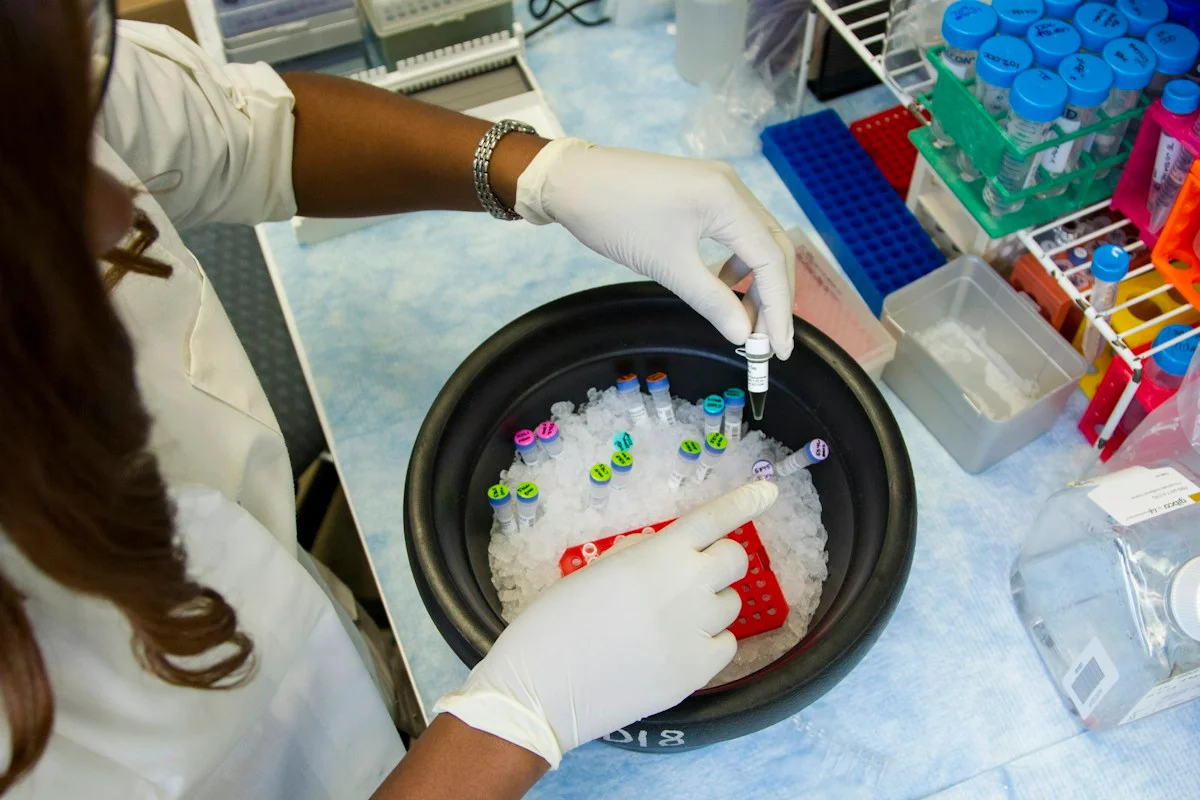
Illustrative photo · not a video frame
The Royal Society · 44 min 28 sec · Background explainer
Is this the AI future we want? | The Royal Society
YouTube loads only when you choose; playback starts when you press play.
A Royal Society discussion with Madhumita Murgia and biomedical engineer Alison Noble on AI’s potential in healthcare, science and culture, recorded at the 30 June 2026 event.
Evidence check: A discussion of opportunities and risks, including future possibilities. It is not evidence that every application described is available or clinically proven.
Published 2026-07-01. Source checked 14 October 2026. Check captions on the publisher’s video page.
Check the healthcare evidencePhoto: Daniel Sone / National Cancer Institute / Unsplash · Licence
Evidence check
The manuscript is a preprint and has not completed peer review.
The data come from mouse brain cells; translation to human disease is unproven.
Expert preference measures report quality, not biological correctness.
The 32-minute figure excludes data generation, curation and validation.
OpenAI and PerturbAI helped build the system and have commercial interests.
Reporting basis: Multi-source analysis. Original source date: 16 October 2026. Latest supporting source: 21 October 2026.
Continue the story
Read next
Continue exploring single-cell biology: compare the finding and its evidence limits.
Can we trust AI gene-perturbation models yet?
A peer-reviewed benchmark across 14 single-cell datasets and 18 metrics finds that common scores can hide useful gene-perturbation signals. Several deep-learning models beat uninformative baselines after calibration, but the study predicts gene-expression responses—not medicines, safety or patient benefit.
Read the next reportExplore the full source and evidence record
What this means for people
- For neuroscience teams, the immediate value is triage: a large atlas can produce mechanisms and cross-gene links for scientists to inspect. Patients should not read this as evidence of a new therapy or a validated explanation of human disease.
Global context
Single-cell atlases are becoming too large for one researcher to inspect exhaustively. Distributed agents could make them more navigable, but access to computing, experimental data and validation capacity will shape who benefits.
What the evidence does not yet show
- The manuscript is a preprint and has not completed peer review.
- The data come from mouse brain cells; translation to human disease is unproven.
- Expert preference measures report quality, not biological correctness.
- The 32-minute figure excludes data generation, curation and validation.
- OpenAI and PerturbAI helped build the system and have commercial interests.
What to watch next
- Independent reproduction
- Laboratory validation
- Peer-review changes
- Comparisons with human teams under matched conditions
Living evidence record
Impact record IAI-1OWC8M0
Evidence stage
Studied
Confidence
Supported
Reporting basis
Multi-source analysis
Independent or research support
Not yet
Record status
Monitoring
Last checked
21 October 2026
Source trail
2 direct sources across 2 source types.
People impact
Documented in this record.
Uncertainty
Limits and next checks are explicit.
Stages describe the evidence available—not whether a technology is good or bad. See the public method.
Evidence trail
Sources used for this report
Links checked 21 October 2026
Research question, topics and regions
Whether parallel specialised agents can synthesize and predict results across a whole-brain perturbation atlas better than a single general agent
Topics: AI agents · Neuroscience · Single-cell biology · CRISPR · Preprint
Regions: United States · Global
This report is labelled multi-source analysis. We summarise and analyse source material in our own words; company statements remain attributed claims until independently supported. Translated summaries preserve the meaning of the original source and link back to it. Read our editorial standards.
Reader commentary
What does this mean where you are?
Tell us what you have seen at work, in your community or in everyday life. A question is welcome too. No account is needed; we review notes before publishing them.
Explore commentary across the portal →Published reader notes
0No published reader notes yet. You can start the evidence-led discussion above.
Prefer a private correction or response? Contact the newsroom.