An Alzheimer’s blood test found a signal—the blind test had 23 people
A cell-based assay used machine learning to distinguish early Alzheimer’s disease from unaffected controls. The result is exploratory: external validation was modest, the blind test was small and the platform’s developers held a commercial interest.
The short version
3 key points
- What changed
- The exploratory model used 191 archived plasma samples: 86 for training, 82 from two external cohorts for validation and 23 in a held-out blind test.
- Why it matters
- People seeking answers about memory symptoms need tests that work in the messy reality of clinical care. This study is too small and selected to support an individual diagnosis or treatment decision.
- What to watch
- A preregistered prospective study with a new independent test set, representative diagnostic uncertainty, standardised processing and direct comparison with plasma amyloid and phosphorylated-tau assays.
The assay asks cultured neurons to reveal a blood signal
Instead of directly measuring amyloid or tau, the iCAP method exposed standardised cultured neurons to participant plasma and read the cells’ gene-expression response. A random-forest classifier then used five genes selected from an independently derived 84-gene panel to separate early symptomatic Alzheimer’s disease from unaffected controls.[1]
Why the uncertainty matters for families
An AUC measures ranking, not the number of people correctly diagnosed at a chosen threshold. The study did not establish sensitivity, specificity or predictive value for a real memory-clinic population, and it deliberately focused on participants with high-confidence classifications rather than ambiguous cases where a new test is most needed.[1]
Who it affects
People seeking answers about memory symptoms need tests that work in the messy reality of clinical care. This study is too small and selected to support an individual diagnosis or treatment decision.[1]
Keep in mind
Retrospective archived samples; 23-person blind set; blind-set reuse across 12 prior evaluations; selected high-confidence classes; cohort storage differences; no clinical threshold analysis; developer employment and equity interests.
Source analysis · 1 linked source. Original source date: 17 October 2026.
Continue the story
Read next
Health & Life Sciences
Can AI predict five-year colorectal cancer survival from pathology slides?
A retrospective preprint reports moderate discrimination across a US trial cohort and an external NHS dataset. The model is not ready to guide treatment, and its selected ensemble did not clearly beat the strongest comparator.
2 min · 1 source
Health & Life Sciences
Can a lighter AI genotype hepatitis C as well as the standard tool?
A leakage-aware test put the best machine-learning pipeline at 92.2% accuracy. That is useful evidence for low-compute analysis, but the same sequences gave the existing NCBI alignment tool 96.62%.
2 min · 1 source
Read more The full report, methods and context
The assay asks cultured neurons to reveal a blood signal
Instead of directly measuring amyloid or tau, the iCAP method exposed standardised cultured neurons to participant plasma and read the cells’ gene-expression response. A random-forest classifier then used five genes selected from an independently derived 84-gene panel to separate early symptomatic Alzheimer’s disease from unaffected controls.
The primary model included 191 retrospective samples: 86 for training, 82 from two other cohorts for external validation and 23 held blind. The training cross-validation AUC was 0.79, external validation fell to 0.64, and the blind set produced 0.77 with a 95% confidence interval spanning 0.57 to 0.96.[1]
Why the uncertainty matters for families
An AUC measures ranking, not the number of people correctly diagnosed at a chosen threshold. The study did not establish sensitivity, specificity or predictive value for a real memory-clinic population, and it deliberately focused on participants with high-confidence classifications rather than ambiguous cases where a new test is most needed.
The blind set contained only eight early-stage cases and 15 controls. It had also been reused across 12 previous model evaluations, which the authors say can inflate family-wise error. Samples were archived for years, and the external cohorts used different stabilisation and storage conditions from the training and blind samples.[1]
The distinction that matters
What the experimental test actually measures
The platform turns a person’s plasma into a cellular response before machine learning classifies the pattern.
Expose
Add archived plasma to standardised neurons
Cells produce a gene-expression response
Classify
Use five genes in a random-forest model
Rank early-stage cases against controls
Validate
Test 82 external and 23 blind samples
Promising but imprecise discrimination
The next study must be prospective and independent
A genuinely complementary blood signal could help researchers stratify trials or investigate disease biology beyond amyloid. It should not yet guide a diagnosis, reassure a worried person or determine access to treatment.
Confidence would rise with a preregistered prospective cohort, a new untouched test set, representative memory-clinic patients, standardised sample handling and head-to-head comparison with established plasma biomarkers. Independent replication matters because several authors were PreCyte employees or shareholders and the company developed iCAP.[1]
Watch the background, then check the evidence
Illustrative photo · not a video frame
The Royal Society · 44 min 28 sec · Background explainer
Is this the AI future we want? | The Royal Society
YouTube loads only when you choose; playback starts when you press play.
A Royal Society discussion with Madhumita Murgia and biomedical engineer Alison Noble on AI’s potential in healthcare, science and culture, recorded at the 30 June 2026 event.
Evidence check: A discussion of opportunities and risks, including future possibilities. It is not evidence that every application described is available or clinically proven.
Published 2026-07-01. Source checked 14 October 2026. Check captions on the publisher’s video page.
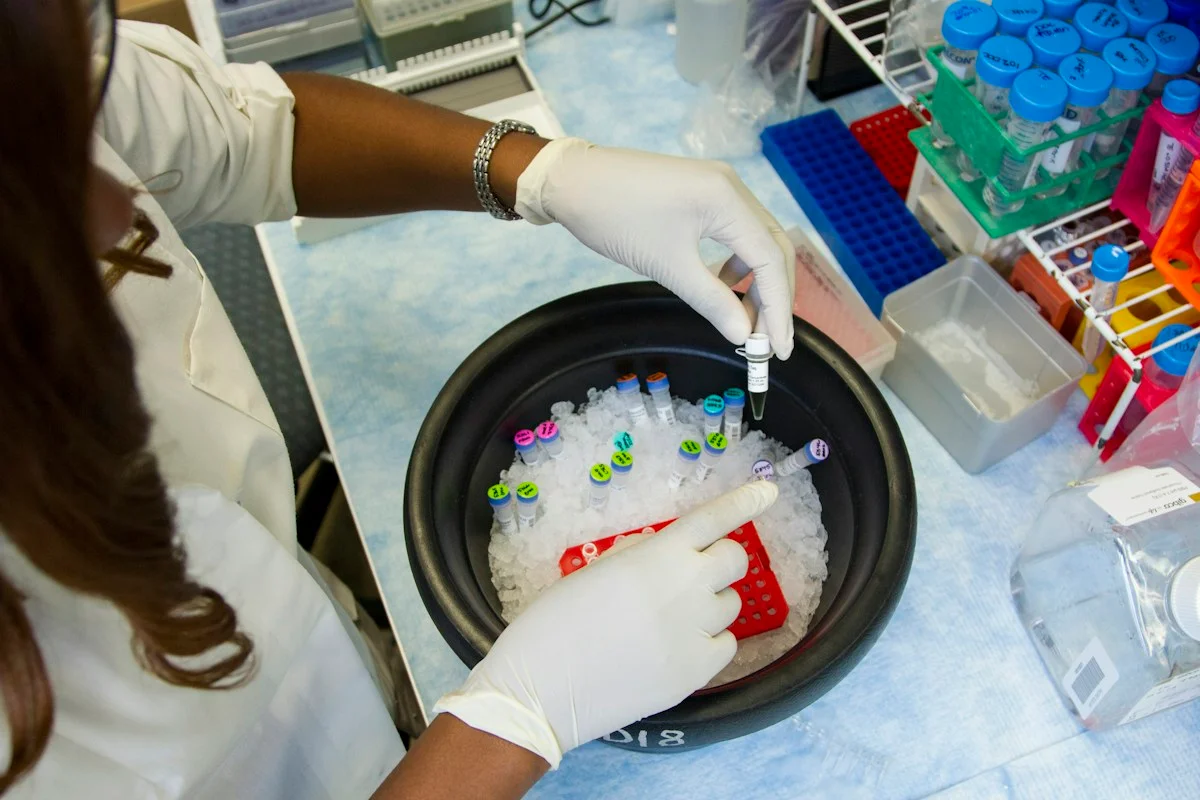
Check the healthcare evidencePhoto: Daniel Sone / National Cancer Institute / Unsplash · Licence
Evidence check
Retrospective archived samples; 23-person blind set; blind-set reuse across 12 prior evaluations; selected high-confidence classes; cohort storage differences; no clinical threshold analysis; developer employment and equity interests.
Reporting basis: Source analysis. Original source date: 17 October 2026.
Explore the full source and evidence record
What this means for people
- People seeking answers about memory symptoms need tests that work in the messy reality of clinical care. This study is too small and selected to support an individual diagnosis or treatment decision.
Global context
Samples came from Australian and US ageing cohorts. Performance may change with ancestry, coexisting illness, sample handling and the prevalence and spectrum of cognitive disorders in other health systems.
What the evidence does not yet show
- Retrospective archived samples; 23-person blind set; blind-set reuse across 12 prior evaluations; selected high-confidence classes; cohort storage differences; no clinical threshold analysis; developer employment and equity interests.
What to watch next
- A preregistered prospective study with a new independent test set, representative diagnostic uncertainty, standardised processing and direct comparison with plasma amyloid and phosphorylated-tau assays.
Living evidence record
Impact record IAI-0475K05
Evidence stage
Studied
Confidence
Supported
Reporting basis
Source analysis
Independent or research support
Present
Record status
Monitoring
Last checked
18 October 2026
Source trail
1 direct source across 1 source type.
People impact
Documented in this record.
Uncertainty
Limits and next checks are explicit.
Stages describe the evidence available—not whether a technology is good or bad. See the public method.
Single-source reporting disclosure
This record analyses one direct source. It can establish what Scientific Reports published or reported, but it is not independent corroboration of every performance claim or predicted outcome. The confidence label will change only when broader evidence is added.
Evidence trail
Sources used for this report
Links checked 18 October 2026
Research question, topics and regions
Whether gene-expression responses from standardised neurons exposed to plasma can distinguish early-stage Alzheimer’s disease from unaffected controls
Topics: Alzheimer’s disease · Blood tests · Biomarkers · Machine learning · Diagnostic evidence
Regions: United States · Australia · Global
This report is labelled source analysis. We summarise and analyse source material in our own words; company statements remain attributed claims until independently supported. Translated summaries preserve the meaning of the original source and link back to it. Read our editorial standards.
The Impact Brief · Free
Keep following the stories that matter to you.
Get our weekday briefing on what changed and why it matters. Choose your topics below.
Reader commentary
What does this mean where you are?
Tell us what you have seen at work, in your community or in everyday life. A question is welcome too. No account is needed; we review notes before publishing them.
Explore commentary across the portal →Published reader notes
0No published reader notes yet. You can start the evidence-led discussion above.
Prefer a private correction or response? Contact the newsroom.