Can an AI tell whether an Amharic sentence is a warning, refusal or joke?
A new nine-class benchmark tested five approaches on 11,475 labelled sentences. AfroXLM-R led the held-out comparison, but its 76.93% macro-F1 leaves consequential errors unresolved.
The short version
- What happened
- The study created a balanced dataset of 11,475 Amharic sentences across nine intentions, including complaint, refusal, request, sarcasm or irony, suggestion and warning.
- Who it affects
- Better Amharic language tools could improve access to search, education and digital services for speakers whose language is often underrepresented in commercial AI systems.
- What remains unproven
- The accessible accepted-version record reports the dataset, split, comparators and headline test metrics, but does not establish performance across dialects, institutions, conversational speech or code-switching.
The benchmark covers meanings that literal translation can miss
Amharic speakers are poorly served by many language technologies, particularly when meaning depends on intention rather than literal words. Lingerew Bantie Asmare at Debre Berhan University built a nine-class dataset covering assertion, complaint, phatic language, promise, refusal, request, sarcasm or irony, suggestion and warning. The 11,475 sentences were split into 7,955 training examples, 1,857 validation examples and 1,663 held-out test examples.[1]
Who it affects
Better Amharic language tools could improve access to search, education and digital services for speakers whose language is often underrepresented in commercial AI systems.[1]
Keep in mind
The accessible accepted-version record reports the dataset, split, comparators and headline test metrics, but does not establish performance across dialects, institutions, conversational speech or code-switching.
A 76.93% macro-F1 is a benchmark result, not a guarantee for any class, speaker or deployment; class-level error patterns and consequences need separate assessment.
The journal is sharing an accepted peer-reviewed version before the final Version of Record, so copy-editing or other editorial changes may follow.
The study has one author, reports no external funding and declares no competing interests; independent replication and community review would strengthen confidence.
Source analysis · 1 linked source. Original source date: 20 October 2026.
Keep following the evidence
Join The Impact Brief founding list for selected AI reports, their effect on people and the evidence limits. Read a sample first.
Read the full report · 3 min The evidence, methods, implications and limitations

The benchmark covers meanings that literal translation can miss
Amharic speakers are poorly served by many language technologies, particularly when meaning depends on intention rather than literal words. Lingerew Bantie Asmare at Debre Berhan University built a nine-class dataset covering assertion, complaint, phatic language, promise, refusal, request, sarcasm or irony, suggestion and warning. The 11,475 sentences were split into 7,955 training examples, 1,857 validation examples and 1,663 held-out test examples.
Three independent annotators produced the labels. The paper reports 99.90% agreement and a Fleiss' kappa of 0.9993, unusually high agreement that makes the task definition look consistent inside this dataset. It does not by itself prove that ambiguous, dialectal or conversational Amharic will be labelled as consistently outside the benchmark.[1]
The strongest model won the comparison, not the deployment question
The study compared a TF-IDF support-vector machine, a bidirectional LSTM and multilingual transformer approaches including mBERT, XLM-R and AfroXLM-R. AfroXLM-R performed best on the held-out set, reaching 79.98% accuracy and 76.93% macro-F1. A McNemar exact test found its result significantly better than XLM-R at p<0.001.
For people building Amharic search, moderation, education or public-service tools, the result provides a reproducible starting point rather than permission to automate consequential decisions. Macro-F1 below 77% means performance across the nine classes remains imperfect, and a benchmark cannot show how errors affect speakers in live systems. External tests across dialects, informal speech, code-switching and new institutions would change the assessment.[1]
The distinction that matters
What the study tested—and what it did not
The result moves from labelled sentences to a held-out benchmark, not to proven real-world understanding.
Label
Three annotators assign nine intentions
11,475 balanced examples
Compare
Train machine-learning and transformer approaches
AfroXLM-R leads the held-out set
Deploy
Test dialects, domains and human consequences
Evidence still missing
Watch the background, then check the evidence
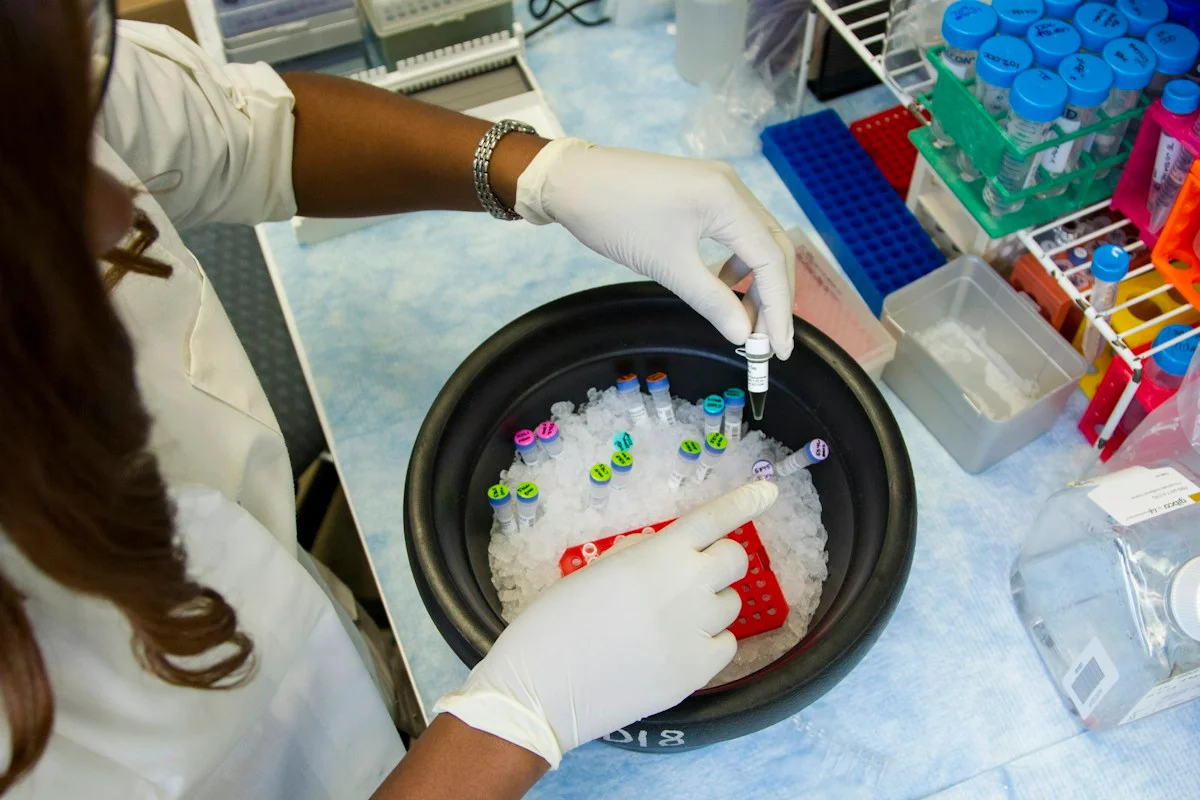
Illustrative photo · not a video frame
The Royal Society · 44 min 28 sec · Background explainer
Is this the AI future we want? | The Royal Society
YouTube loads only when you choose; playback starts when you press play.
A Royal Society discussion with Madhumita Murgia and biomedical engineer Alison Noble on AI’s potential in healthcare, science and culture, recorded at the 30 June 2026 event.
Evidence check: A discussion of opportunities and risks, including future possibilities. It is not evidence that every application described is available or clinically proven.
Published 2026-07-01. Source checked 14 October 2026. Check captions on the publisher’s video page.
Check the healthcare evidencePhoto: Daniel Sone / National Cancer Institute / Unsplash · Licence
Evidence check
The accessible accepted-version record reports the dataset, split, comparators and headline test metrics, but does not establish performance across dialects, institutions, conversational speech or code-switching.
A 76.93% macro-F1 is a benchmark result, not a guarantee for any class, speaker or deployment; class-level error patterns and consequences need separate assessment.
The journal is sharing an accepted peer-reviewed version before the final Version of Record, so copy-editing or other editorial changes may follow.
The study has one author, reports no external funding and declares no competing interests; independent replication and community review would strengthen confidence.
Reporting basis: Source analysis. Original source date: 20 October 2026.
Continue the story
Read next
Continue exploring transformers: compare the finding and its evidence limits.
Can AI detect attack types it never saw in training?
A hybrid Transformer–LSTM detected two held-out categories in the UNSW-NB15 benchmark, with 88.13% recall on the combined unseen subset. It was a binary, row-level laboratory test—not evidence of live zero-day defence.
Read the next reportExplore the full source and evidence record
What this means for people
- Better Amharic language tools could improve access to search, education and digital services for speakers whose language is often underrepresented in commercial AI systems.
- Misreading a warning, refusal or sarcastic remark could also cause harm in moderation or public-service workflows, so people need review and appeal routes before consequential use.
Global context
Most high-performing language systems are built and tested most heavily in a small group of widely resourced languages. A documented Amharic benchmark helps widen the evidence base, but language inclusion also requires speaker-led evaluation, local governance and testing in the settings where a system will be used.
What the evidence does not yet show
- The accessible accepted-version record reports the dataset, split, comparators and headline test metrics, but does not establish performance across dialects, institutions, conversational speech or code-switching.
- A 76.93% macro-F1 is a benchmark result, not a guarantee for any class, speaker or deployment; class-level error patterns and consequences need separate assessment.
- The journal is sharing an accepted peer-reviewed version before the final Version of Record, so copy-editing or other editorial changes may follow.
- The study has one author, reports no external funding and declares no competing interests; independent replication and community review would strengthen confidence.
What to watch next
- Public release of the dataset, code and class-level confusion results for independent reproduction
- External tests covering regional varieties, informal speech, code-switching and new domains
- Human review, appeal and error-monitoring evidence from any real service using intention classification
Living evidence record
Impact record IAI-10S8DJ3
Evidence stage
Studied
Confidence
Supported
Reporting basis
Source analysis
Independent or research support
Present
Record status
Monitoring
Last checked
20 October 2026
Source trail
1 direct source across 1 source type.
People impact
Documented in this record.
Uncertainty
Limits and next checks are explicit.
Stages describe the evidence available—not whether a technology is good or bad. See the public method.
Single-source reporting disclosure
This record analyses one direct source. It can establish what Scientific Reports published or reported, but it is not independent corroboration of every performance claim or predicted outcome. The confidence label will change only when broader evidence is added.
Evidence trail
Sources used for this report
Links checked 20 October 2026
Research question, topics and regions
Pragmatic intention detection in Amharic
Topics: Amharic · Low-resource languages · Natural language processing · Language inclusion · Transformers
Regions: Ethiopia · Africa · Global
This report is labelled source analysis. We summarise and analyse source material in our own words; company statements remain attributed claims until independently supported. Translated summaries preserve the meaning of the original source and link back to it. Read our editorial standards.
Reader commentary
What does this mean where you are?
Tell us what you have seen at work, in your community or in everyday life. A question is welcome too. No account is needed; we review notes before publishing them.
Explore commentary across the portal →Published reader notes
0No published reader notes yet. You can start the evidence-led discussion above.
Prefer a private correction or response? Contact the newsroom.