AI made three pathologists more consistent on bladder-cancer grade—but prospective evidence is missing
Across 465 retrospective cases, model-assisted grading reduced disagreement and raised average discrimination. The external accuracy gain did not reach statistical significance, and no treatment or patient outcome was tested.
The short version
- What happened
- The model was trained on 91,183 image patches with 318,893 annotations; three pathologists then graded 149 internal and 316 external cases with and without assistance.
- Who it affects
- Patients may benefit if a reproducible mitotic count reduces avoidable grading disagreement, but the study does not show that an AI-assisted grade improves treatment selection or outcomes.
- What remains unproven
- Only three pathologists participated
Keep in mind
Only three pathologists participated
Retrospective crossover design may not reproduce routine workflow
External AUC improvement was not statistically significant
No treatment, safety, recurrence or survival endpoint
Source analysis · 1 linked source. Primary analysed source date: 22 October 2026.
Keep following the evidence
Join The Impact Brief founding list for selected AI reports, their effect on people and the evidence limits. Read a sample first.
Read the full report · 3 min The evidence, methods, implications and limitations

The strongest result was less disagreement between readers
Researchers trained a whole-slide mitosis detector on 91,183 image patches containing 318,893 annotations. Three independent pathologists then completed a crossover exercise on 465 urothelial-carcinoma cases: 149 from an internal cohort and 316 from external hospitals, first grading without the model and then with its mitotic count.
The model's count alone distinguished high-grade disease with an area under the receiver-operating-characteristic curve of 0.91 (95% confidence interval 0.89–0.94). Assistance raised mean reader AUC from 0.90 to 0.98 internally. Externally it rose from 0.84 to 0.95, but the p value of 0.11 means the study could not rule out chance for that accuracy difference. Agreement improved in both cohorts: Fleiss's kappa rose from 0.72 to 0.93 internally and from 0.62 to 0.85 externally.[1]
A useful second opinion is not yet a clinical outcome
For a patient, tumour grade can influence treatment intensity and follow-up. More consistent measurement could therefore matter, but the study retrospectively reused digitised cases in a controlled reader exercise. It did not test whether pathologists work faster, whether disagreements are resolved safely or whether assisted grading improves treatment choices or outcomes.
The authors call for prospective validation. A convincing next study would pre-register thresholds, enrol consecutive cases from varied laboratories and scanners, measure errors and turnaround time, and follow how model-assisted grades alter multidisciplinary decisions. The work received Korean government health-research funding; the authors declared no competing interests.[1]
The distinction that matters
What the reader study actually compared
The same three-reader design was applied to an internal and an external cohort.
Internal: 149 cases
Grade without and with AI
AUC 0.90 → 0.98; kappa 0.72 → 0.93
External: 316 cases
Grade without and with AI
AUC 0.84 → 0.95; kappa 0.62 → 0.85
Clinical deployment
Not tested
No treatment or patient outcomes
Watch the background, then check the evidence
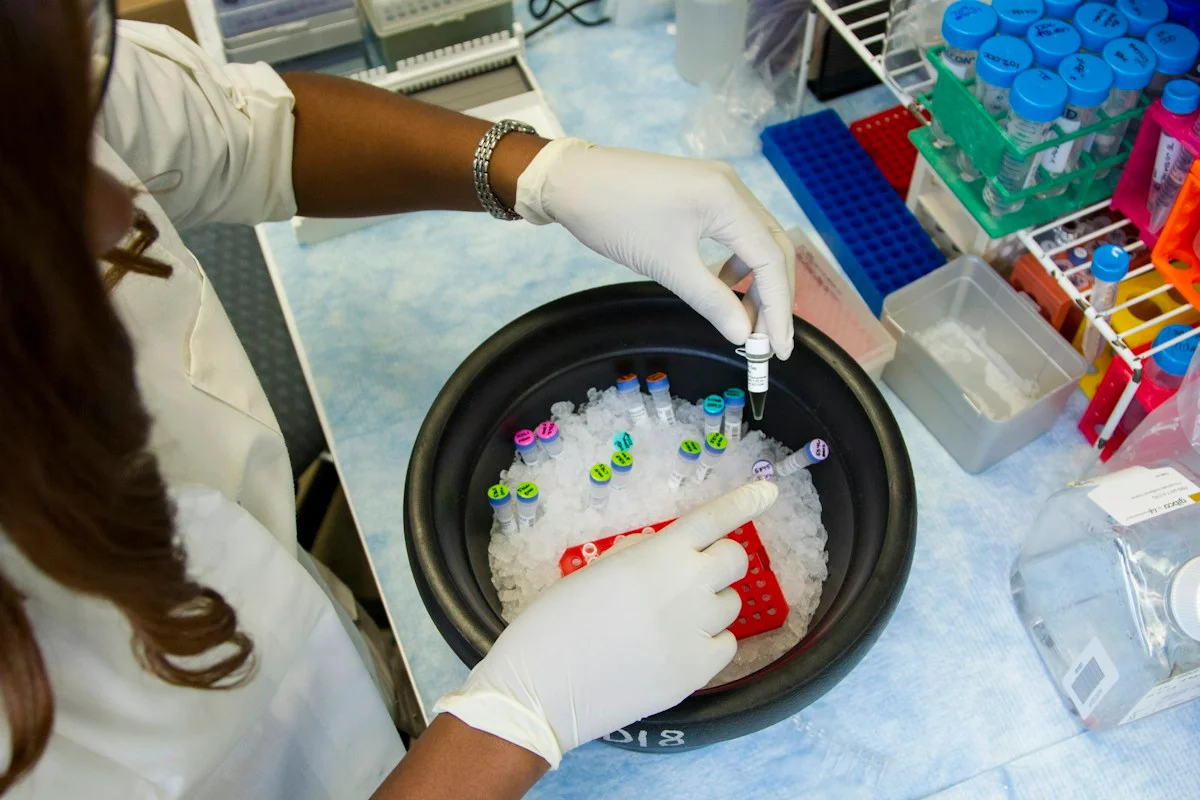
Illustrative photo · not a video frame
The Royal Society · 44 min 28 sec · Background explainer
Is this the AI future we want? | The Royal Society
YouTube loads only when you choose; playback starts when you press play.
A Royal Society discussion with Madhumita Murgia and biomedical engineer Alison Noble on AI’s potential in healthcare, science and culture, recorded at the 30 June 2026 event.
Evidence check: A discussion of opportunities and risks, including future possibilities. It is not evidence that every application described is available or clinically proven.
Published 2026-07-01. Source checked 14 October 2026. Check captions on the publisher’s video page.
Check the healthcare evidencePhoto: Daniel Sone / National Cancer Institute / Unsplash · Licence
Continue the story
Read next
Continue exploring digital pathology: compare the finding and its evidence limits.
Can AI make tumour mitosis counts more consistent?
A preprint study paired 13 pathologists' unaided and AI-assisted reviews of 385 tumour slides from three European centres. Agreement rose and counting time fell, but the unreviewed study did not establish which counts were correct, whether diagnoses improved or whether patients benefited.
Read the next reportExplore the full source and evidence record
What this means for people
- Patients may benefit if a reproducible mitotic count reduces avoidable grading disagreement, but the study does not show that an AI-assisted grade improves treatment selection or outcomes.
Global context
All clinical cohorts came from South Korean institutions. Slide preparation, scanners, grading practice and disease mix need independent testing elsewhere before wider adoption.
What the evidence does not yet show
- Only three pathologists participated
- Retrospective crossover design may not reproduce routine workflow
- External AUC improvement was not statistically significant
- No treatment, safety, recurrence or survival endpoint
What to watch next
- Prospective consecutive-case validation
- Independent hospitals and scanner types
- Turnaround time and error analysis
- Effects on treatment decisions and patient outcomes
Living evidence record
Impact record IAI-0FITW88
Evidence stage
Studied
Confidence
Supported
Reporting basis
Source analysis
Independent or research support
Present
Record status
Monitoring
Last checked
25 October 2026
Source trail
1 direct source across 1 source type.
People impact
Documented in this record.
Uncertainty
Limits and next checks are explicit.
Stages describe the evidence available—not whether a technology is good or bad. See the public method.
Single-source reporting disclosure
This record analyses one direct source. It can establish what Scientific Reports published or reported, but it is not independent corroboration of every performance claim or predicted outcome. The confidence label will change only when broader evidence is added.
Evidence trail
Sources used for this report
Links checked 25 October 2026
Research question, topics and regions
Whether automated mitotic counting can improve the accuracy and consistency of pathologists grading urothelial carcinoma
Topics: Bladder cancer · Digital pathology · Clinical decision support · Diagnostic validation
Regions: South Korea · Asia · Global
This report is labelled source analysis. We summarise and analyse source material in our own words; company statements remain attributed claims until independently supported. Translated summaries preserve the meaning of the original source and link back to it. Read our editorial standards.
Reader commentary
What does this mean where you are?
Tell us what you have seen at work, in your community or in everyday life. A question is welcome too. No account is needed; we review notes before publishing them.
Explore commentary across the portal →Published reader notes
0No published reader notes yet. You can start the evidence-led discussion above.
Prefer a private correction or response? Contact the newsroom.