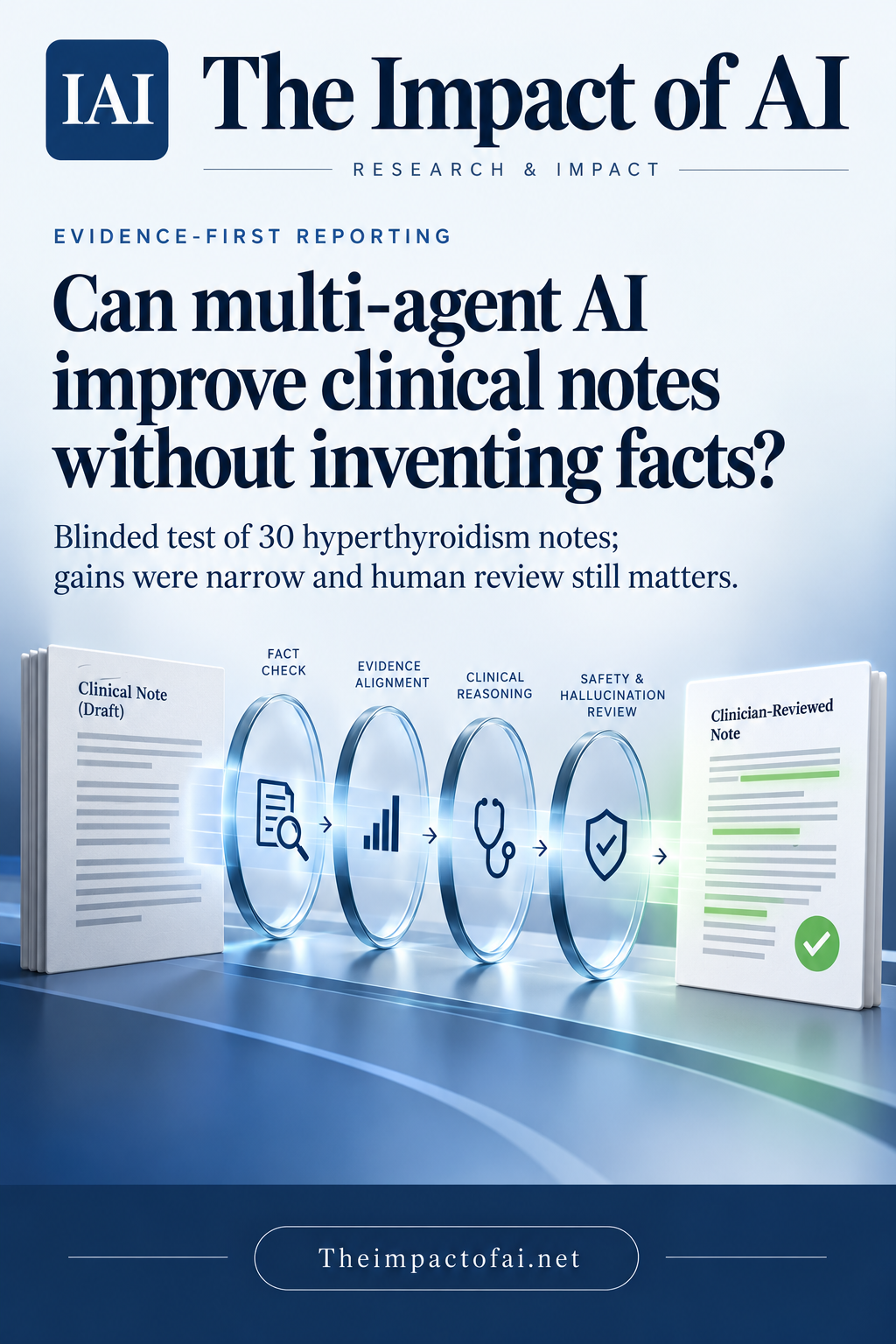
Can multi-agent AI improve clinical notes without inventing facts?
In a blinded test of 30 resident-written hyperthyroidism notes, the specialist system raised median documentation scores from 39 to 42, cut positive factual hallucinations to 6.67% versus 26.67% for a general model and saved 112.9 seconds of physician editing per note. The scope is narrow and human review remains essential.
Editorial responsibility: The Impact of AI Editorial Desk · Report a factual concern
At a glance
- 1The blinded evaluation used 30 resident-drafted hyperthyroidism admission notes and compared a specialist multi-agent RAG workflow with a general Qwen3-32B prompting baseline.
- 2Median PDQI-9 documentation scores increased from 39 to 42, while positive factual hallucinations occurred in 6.67% of specialist-system outputs versus 26.67% for the general-model chain-of-thought baseline.
- 3Physician refinement time fell by an average of 112.9 seconds per note, but the study did not test other conditions, hospitals, languages or downstream patient outcomes.
Research topic
Whether a hyperthyroidism-specific multi-agent and retrieval-augmented language-model system can improve histories of present illness while reducing positive factual hallucinations and physician editing time
The specialist workflow improved a narrow task
The study found better documentation quality, fewer positive factual inventions and shorter physician editing time when a specialist multi-agent system refined the history of present illness in 30 hyperthyroidism admission notes. Median scores on the nine-item Physician Documentation Quality Instrument rose from 39 to 42. Positive factual hallucinations were recorded in 6.67% of the specialist system’s outputs, compared with 26.67% from a general model using chain-of-thought prompting.
Those results answer a specific question: can a diagnosis-focused workflow improve a small set of resident drafts under blinded evaluation? They do not show that multi-agent AI is generally safe for medical records. Thirty notes from one specialty are too narrow to establish performance across hospitals, diagnoses, languages or atypical cases. The system refines clinician-written material; it does not autonomously interview patients or create a complete record from raw conversation.[1]
Several agents divide symptoms, examinations and treatment
The researchers built HQ-ANR around Qwen3-32B, a general-purpose language model. Instead of asking one prompt to rewrite the whole note, the workflow uses separate agents concerned with symptoms, examinations and treatments, then anchors their work to a dual-source knowledge base containing guidelines and expert notes. The design aims to make clinical logic and evidence retrieval explicit rather than relying only on the model’s internal parameters.
That architecture is plausible because clinical-note errors are heterogeneous. Missing symptom chronology is different from an unsupported examination or treatment claim, and separate checks may catch different problems. But multiple agents do not guarantee truth. They can share the same model weakness, retrieve the same misleading source or reinforce one another’s assumptions. The study’s value comes from measured comparison, not the number of agents in the diagram.[1]
Thirty notes define the evidence boundary
The blinded test used 30 histories of present illness drafted by residents for people admitted with hyperthyroidism. That denominator should remain visible beside every performance number. A change from 26.67% to 6.67% corresponds to a small number of notes, so one or two additional errors would materially alter the percentage. Statistical significance on a scored outcome does not remove the uncertainty created by a small, specialised sample.
The comparator was a general LLM with chain-of-thought prompting, not a strong specialist rules system, a different RAG design or independent physician rewriting from scratch. The study therefore shows an advantage over that baseline under its evaluation conditions. It does not establish that HQ-ANR is the best available system or that each component—retrieval, agents and expert-note knowledge base—contributed independently.[1]
The hallucination measure covered positive factual additions
The reported hallucination rate concerns positive factual hallucinations: information asserted as present when it was not supported. That is an important clinical risk because an invented symptom, examination finding or treatment can distort decisions and contaminate future records. Reducing that outcome from the general-model baseline is meaningful, but the label does not capture every harmful failure.
A system can omit a crucial fact, change chronology, soften uncertainty, mis-prioritise a problem or make the note more internally coherent while preserving a wrong premise. Documentation-quality scores may reward organisation and readability without proving clinical correctness. A robust safety evaluation needs separate denominators for additions, omissions, contradictions, temporal errors and changes that could alter care.[1]
Time saved is editing time, not total workflow benefit
Physicians spent an average of 112.9 fewer seconds refining each note produced by HQ-ANR, with p below 0.001. Saving nearly two minutes can matter in a busy service, especially if it reduces repetitive cleanup. The result should be described as measured editing time in this experiment, not as a guaranteed productivity gain or reduction in staffing.
Real deployment adds tasks the experiment may not capture: reviewing highlighted changes, checking retrieved sources, resolving failures, monitoring performance and correcting errors that propagate through the record. Faster review can also encourage automation bias if clinicians assume a polished note is accurate. The practical goal is not the shortest edit; it is a reliable note produced with an auditable human check and no loss of attention to the patient.[1]
What would change the assessment
Confidence would rise with a preregistered, multi-centre evaluation covering several diagnoses, rare presentations, incomplete histories and different documentation styles. Notes should be held out from all system development, evaluated by multiple independent clinicians and compared with strong baselines. Results should report absolute error counts and reviewer agreement, not only percentages, and distinguish additions, omissions, contradictions and clinically consequential changes.
The strongest test would embed a locked version into a supervised workflow and measure whether it reduces total documentation time without increasing corrections, delayed decisions or downstream chart errors. Performance should be audited across languages, clinician seniority and patient groups, with a safe rollback and clear responsibility for final sign-off. Until then, HQ-ANR is a promising specialist refinement approach, not a substitute for physician authorship or review.[1]
What this means for people
- Cleaner notes may save clinician time, but patients bear the risk when unsupported details enter a durable medical record.
- Human sign-off must remain meaningful, with changes and retrieved evidence easy to inspect.
- Benefits shown in one specialist Chinese setting should not be assumed for other conditions, languages or health systems.
Global context
The study was conducted by clinical and computing teams in Fujian, China, and used a Chinese specialist workflow reported in English. Documentation structure, terminology, staffing and legal responsibility vary internationally. Systems trained around one disease and local expert notes may not transfer to another language or record standard, while hospitals with fewer informatics resources may find source governance and audit more burdensome than model access itself.
What the evidence does not yet show
- The blinded evaluation covered only 30 resident-drafted hyperthyroidism notes.
- The reported hallucination rate concerns positive factual additions and does not capture every clinically important omission, contradiction or temporal error.
- The comparator was a general Qwen3-32B chain-of-thought workflow rather than every plausible specialist system or human-only process.
- Editing-time savings do not include all monitoring, source-checking and governance costs of live deployment.
- The study did not measure patient outcomes, downstream clinical decisions or performance across other hospitals, diagnoses and languages.
What to watch next
- Larger multi-centre tests with locked models and genuinely held-out notes.
- Absolute counts for additions, omissions, contradictions and clinically consequential errors.
- Independent clinician agreement and head-to-head comparison with strong specialist baselines.
- Supervised deployment studies measuring total workflow time and downstream record corrections.
Living evidence record
Impact record IAI-11AR2LK
Evidence stage
Studied
Confidence
Supported
Reporting basis
Source analysis
Independent or research support
Present
Record status
Monitoring
Last checked
7 October 2026
Source trail
1 direct source across 1 source type.
People impact
Documented in this record.
Uncertainty
Limits and next checks are explicit.
Stages describe the evidence available—not whether a technology is good or bad. See the public method.
Single-source reporting disclosure
This record analyses one direct source. It can establish what npj Digital Medicine published or reported, but it is not independent corroboration of every performance claim or predicted outcome. The confidence label will change only when broader evidence is added.
Evidence trail
Sources used for this report
Links checked 7 October 2026
This report is labelled source analysis. We summarise and analyse source material in our own words; company statements remain attributed claims until independently supported. Translated summaries preserve the meaning of the original source and link back to it. Read our editorial standards.
Continue the story
Related reporting
Health & Life Sciences
Can AI support breast-ultrasound decisions across countries?
A peer-reviewed South Korean-led study validated an interpretable retrieval-augmented system across 8,311 images from 11 cohorts in seven countries and tested assistance with four readers. The retrospective evidence is encouraging, but it is not a prospective screening trial or proof of better patient outcomes.
8 min · 3 sources
Health & Life Sciences
Can AI discover new MRI signs for glioblastoma?
It generated eight candidate visual signs from 106 glioblastoma scans, but only one was externally tested. Two radiologists achieved moderate discrimination between 50 glioblastomas and 50 metastases, so this is a discovery signal—not a clinical diagnostic.
7 min · 1 source
Health & Life Sciences
Did longer AI-assisted Parkinson’s rehab improve movement?
No clear motor advantage emerged between one, two and three months of home training. The peer-reviewed Chinese trial randomized 120 people, analysed 71 and had no usual-care group, so its exploratory cognitive signal cannot establish benefit.
7 min · 1 source
The Impact Brief
Keep the evidence trail, not the noise.
Get the most consequential AI developments with direct sources and clear limits.
Reader commentary
Add evidence, experience or a question
No account is required. Reader notes are published after a brief civility, relevance and safety check; disagreement is welcome.
Explore commentary across the portal →Published reader notes
0No published reader notes yet. You can start the evidence-led discussion above.
Prefer a private correction or response? Contact the newsroom.