How do eye-care nurses decide when to trust generative AI?
Interviews with 26 ophthalmic nurses in China found neither blanket acceptance nor rejection. Nurses described checking AI task by task, protecting professional boundaries and relying on organisational support—useful design evidence, but not a test of patient safety or clinical performance.
The short version
- What happened
- Researchers conducted semi-structured critical-incident interviews with 26 ophthalmic nurses recruited for variation across primary, secondary and tertiary eye-care settings in eastern, central and western China.
- Who it affects
- Nurses and clinical leaders need task-level rules, reliable escalation and time to check AI output—especially where an error could affect medication or an irreversible visual outcome.
- What remains unproven
- The sample comprises 26 ophthalmic nurses and cannot estimate how common each view is.
Trust changed with the task rather than moving in one direction
The researchers used maximum-variation sampling and interviewed 26 ophthalmic nurses from different levels of care across three broad Chinese regions. Critical-incident prompts asked participants to describe concrete encounters, and transcripts were analysed with reflexive thematic analysis following the COREQ reporting framework. Nurses described beginning with curiosity, checking whether an AI appeared competent and then granting only conditional, task-specific trust.[1]
Who it affects
Nurses and clinical leaders need task-level rules, reliable escalation and time to check AI output—especially where an error could affect medication or an irreversible visual outcome.[1]
Keep in mind
The sample comprises 26 ophthalmic nurses and cannot estimate how common each view is.
Interviews capture reported experience rather than observed behaviour or patient outcomes.
No specific generative-AI product, diagnostic comparison or error rate was tested.
Transferability beyond Chinese ophthalmic settings requires further study.
The study was supported by two Chinese military health and nursing-education grants; the authors declared no competing interests.
Source analysis · 1 linked source. Original source date: 21 October 2026.
Keep following the evidence
Join The Impact Brief founding list for selected AI reports, their effect on people and the evidence limits. Read a sample first.
Read the full report · 3 min The evidence, methods, implications and limitations
Trust changed with the task rather than moving in one direction
The researchers used maximum-variation sampling and interviewed 26 ophthalmic nurses from different levels of care across three broad Chinese regions. Critical-incident prompts asked participants to describe concrete encounters, and transcripts were analysed with reflexive thematic analysis following the COREQ reporting framework. Nurses described beginning with curiosity, checking whether an AI appeared competent and then granting only conditional, task-specific trust.[1]
Professional responsibility and patient relationships set limits
The three themes covered tentative competence appraisal, protection of professional boundaries and trust within an organisational ecology. Participants described particular sensitivity to irreversible visual harm, precise medication tasks and the dependence of visually impaired patients on nurse-mediated care. The authors call the resulting pattern “gradient calibration”: trust was adjusted by task, ethical duty, patient relationship and workplace support rather than treated as a yes-or-no attitude.[1]
The distinction that matters
What shaped nurses’ trust
The interviews point to three connected layers rather than a single trust score.
Task
Check competence for the specific use
Conditional reliance
Duty
Protect professional and patient boundaries
Human accountability stays visible
Organisation
Provide rules, training and escalation
Trust can be calibrated in practice
The findings guide implementation questions, not clinical claims
This qualitative design can reveal recurring experiences but cannot estimate prevalence or prove that a trust strategy improves care. The sample is small and specialty-specific, participants' accounts may not transfer outside China, and no named model was evaluated. The immediate implication is practical: hospitals introducing generative AI should define permitted tasks, escalation and accountability, then observe how those rules work in real care rather than assuming staff trust is fixed.[1]
Watch the background, then check the evidence
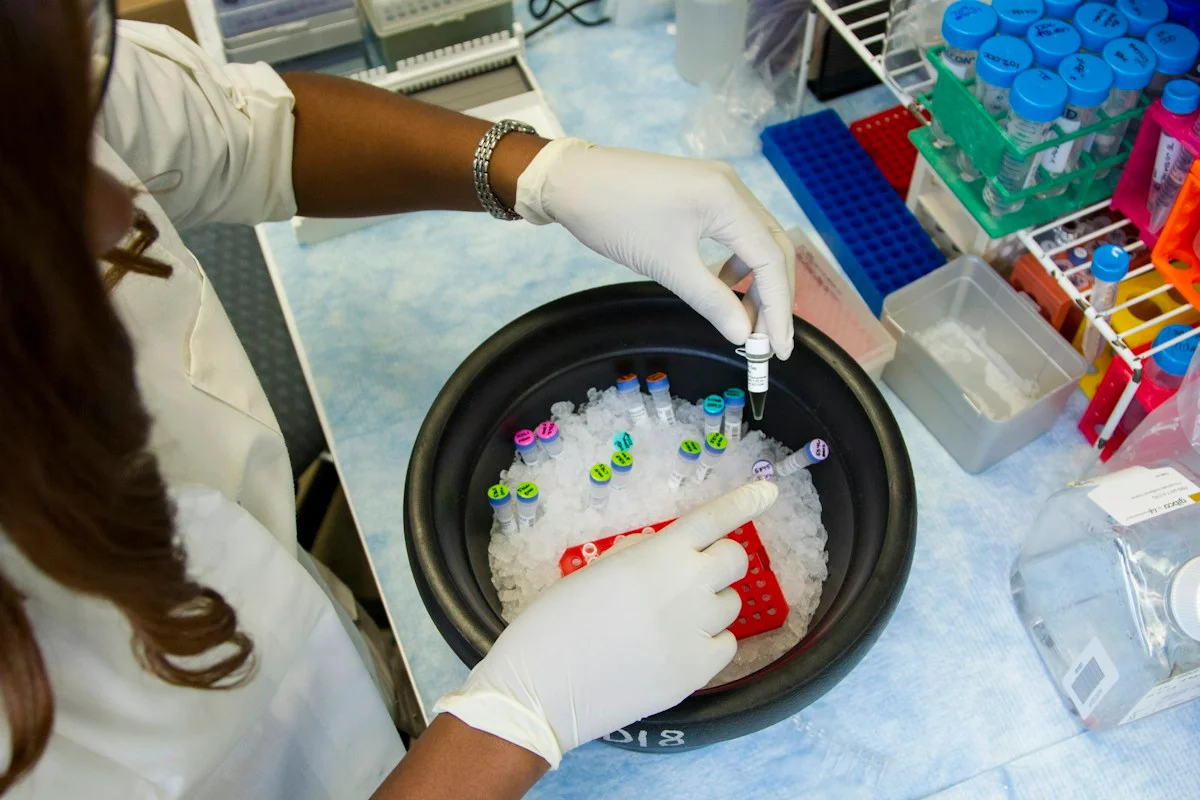
Illustrative photo · not a video frame
The Royal Society · 44 min 28 sec · Background explainer
Is this the AI future we want? | The Royal Society
YouTube loads only when you choose; playback starts when you press play.
A Royal Society discussion with Madhumita Murgia and biomedical engineer Alison Noble on AI’s potential in healthcare, science and culture, recorded at the 30 June 2026 event.
Evidence check: A discussion of opportunities and risks, including future possibilities. It is not evidence that every application described is available or clinically proven.
Published 2026-07-01. Source checked 14 October 2026. Check captions on the publisher’s video page.
Check the healthcare evidencePhoto: Daniel Sone / National Cancer Institute / Unsplash · Licence
Evidence check
The sample comprises 26 ophthalmic nurses and cannot estimate how common each view is.
Interviews capture reported experience rather than observed behaviour or patient outcomes.
No specific generative-AI product, diagnostic comparison or error rate was tested.
Transferability beyond Chinese ophthalmic settings requires further study.
The study was supported by two Chinese military health and nursing-education grants; the authors declared no competing interests.
Reporting basis: Source analysis. Original source date: 21 October 2026.
Continue the story
Read next
Continue exploring clinical ai: compare the finding and its evidence limits.
Neonatologists want AI as a second set of eyes—not the final word
Seventeen clinicians at one Dutch academic hospital welcomed AI for monitoring fragile newborns, but tied trust to local validation, human override and skills that must survive automation. The interviews reveal conditions for adoption, not evidence that an AI tool improved care.
Read the next reportExplore the full source and evidence record
What this means for people
- Nurses and clinical leaders need task-level rules, reliable escalation and time to check AI output—especially where an error could affect medication or an irreversible visual outcome.
Global context
Clinical AI governance often focuses on model accuracy. This study adds an implementation question: whether staff can tell when to rely, verify, escalate or refuse in a particular task and organisational setting.
What the evidence does not yet show
- The sample comprises 26 ophthalmic nurses and cannot estimate how common each view is.
- Interviews capture reported experience rather than observed behaviour or patient outcomes.
- No specific generative-AI product, diagnostic comparison or error rate was tested.
- Transferability beyond Chinese ophthalmic settings requires further study.
- The study was supported by two Chinese military health and nursing-education grants; the authors declared no competing interests.
What to watch next
- Direct observation in live workflows
- Patient-safety and medication outcomes
- Comparative studies across specialties and countries
- Evaluation of training and escalation protocols
Living evidence record
Impact record IAI-1TT2VAT
Evidence stage
Studied
Confidence
Supported
Reporting basis
Source analysis
Independent or research support
Present
Record status
Monitoring
Last checked
21 October 2026
Source trail
1 direct source across 1 source type.
People impact
Documented in this record.
Uncertainty
Limits and next checks are explicit.
Stages describe the evidence available—not whether a technology is good or bad. See the public method.
Single-source reporting disclosure
This record analyses one direct source. It can establish what BMC Nursing published or reported, but it is not independent corroboration of every performance claim or predicted outcome. The confidence label will change only when broader evidence is added.
Evidence trail
Sources used for this report
Links checked 21 October 2026
Research question, topics and regions
How ophthalmic nurses in different Chinese care settings describe calibrating trust in generative AI during clinical work
Topics: Nursing · Clinical AI · Trust · Ophthalmology · Qualitative research
Regions: China
This report is labelled source analysis. We summarise and analyse source material in our own words; company statements remain attributed claims until independently supported. Translated summaries preserve the meaning of the original source and link back to it. Read our editorial standards.
Reader commentary
What does this mean where you are?
Tell us what you have seen at work, in your community or in everyday life. A question is welcome too. No account is needed; we review notes before publishing them.
Explore commentary across the portal →Published reader notes
0No published reader notes yet. You can start the evidence-led discussion above.
Prefer a private correction or response? Contact the newsroom.