A small clinical model screened records faster—but is it ready to guide care?
CS1-4B was trained on 12.4 million question–answer pairs from 3.6 million patients and tested on 963,408 held-out patients. Its authors say it is for research, operations and review—not autonomous patient decisions.
The short version
- What happened
- CS1-4B was trained on 12.4 million document–question pairs from 3.64 million patients across 24 Mass General Brigham sites.
- Who it affects
- A well-calibrated screening tool could help research staff find candidates sooner, but a confident error could wrongly exclude someone unless a person reviews the underlying record.
- What remains unproven
- This is an unreviewed retrospective study from one training health system. Some labels and the trial-ranking judge came from LLMs, prospective clinical outcomes were not measured and the model weights await institutional approval.
The model reads once, then answers many narrow questions
Researchers at Mass General Brigham, Harvard and MIT report a 4.2-billion-parameter model designed to answer many predefined questions from the same clinical record in one pass. CS1-4B learned from 12,416,448 document–question pairs covering 3,643,798 patients. Labels came from structured rules, observed outcomes and GLM-5.3-Flash supervision. On 963,408 held-out patients, it led the compared open decision models on 13 of 14 tasks whose answers did not come from its training teacher.[1]
Who it affects
A well-calibrated screening tool could help research staff find candidates sooner, but a confident error could wrongly exclude someone unless a person reviews the underlying record.[1]
Keep in mind
This is an unreviewed retrospective study from one training health system. Some labels and the trial-ranking judge came from LLMs, prospective clinical outcomes were not measured and the model weights await institutional approval.
Source analysis · 1 linked source. Original source date: 19 October 2026.
Keep following the evidence
Join The Impact Brief founding list for selected AI reports, their effect on people and the evidence limits. Read a sample first.
Read the full report · 3 min The evidence, methods, implications and limitations

The model reads once, then answers many narrow questions
Researchers at Mass General Brigham, Harvard and MIT report a 4.2-billion-parameter model designed to answer many predefined questions from the same clinical record in one pass. CS1-4B learned from 12,416,448 document–question pairs covering 3,643,798 patients. Labels came from structured rules, observed outcomes and GLM-5.3-Flash supervision. On 963,408 held-out patients, it led the compared open decision models on 13 of 14 tasks whose answers did not come from its training teacher.
Across 21 external datasets, CS1 scored 86.7 averaged over six task types, below the strongest 27-billion-parameter comparator at 88.6 but above its own 4B initialization at 81.7. In a matched hardware test it was 6.4 times faster than that 27B model. Its absolute outcome risks did not transfer cleanly: mean predicted risk was 0.39 where observed incidence was 0.19 before site-level recalibration.[1]
Trial screening looked promising, but clinicians did not adjudicate the headline result
The team also screened 1,000 MIMIC-IV patients against 17 registered trials. For 13 trials with at least one judged eligible candidate, the system ranked 3.5 judged-eligible patients in the top 20 on average, versus 0.8 for keyword search, while using far fewer general-model tokens. A blinded GLM-5.3 judge—not a clinical panel—graded the ranking, and the same model family wrote questions and some reference keys.
For trial teams, the approach could reduce repetitive chart reading while showing sentences that support a decision. It cannot establish eligibility or safe care on its own. The authors explicitly limit CS1 to research, operations and review with a person in the loop. Prospective evaluation, independent clinician adjudication, demographic subgroup analysis and validation at hospitals outside the training network would be needed before clinical use.[1]
The distinction that matters
How CS1 divides record screening from final judgment
A general model plans questions; the compact model scans records; a person must review uncertain or consequential cases.
Plan
Criteria become typed questions
Scope is explicit
Screen
CS1 answers across records
Probabilities and evidence sentences are returned
Review
Low-confidence or high-stakes cases escalate
Human judgment remains required
Watch the background, then check the evidence
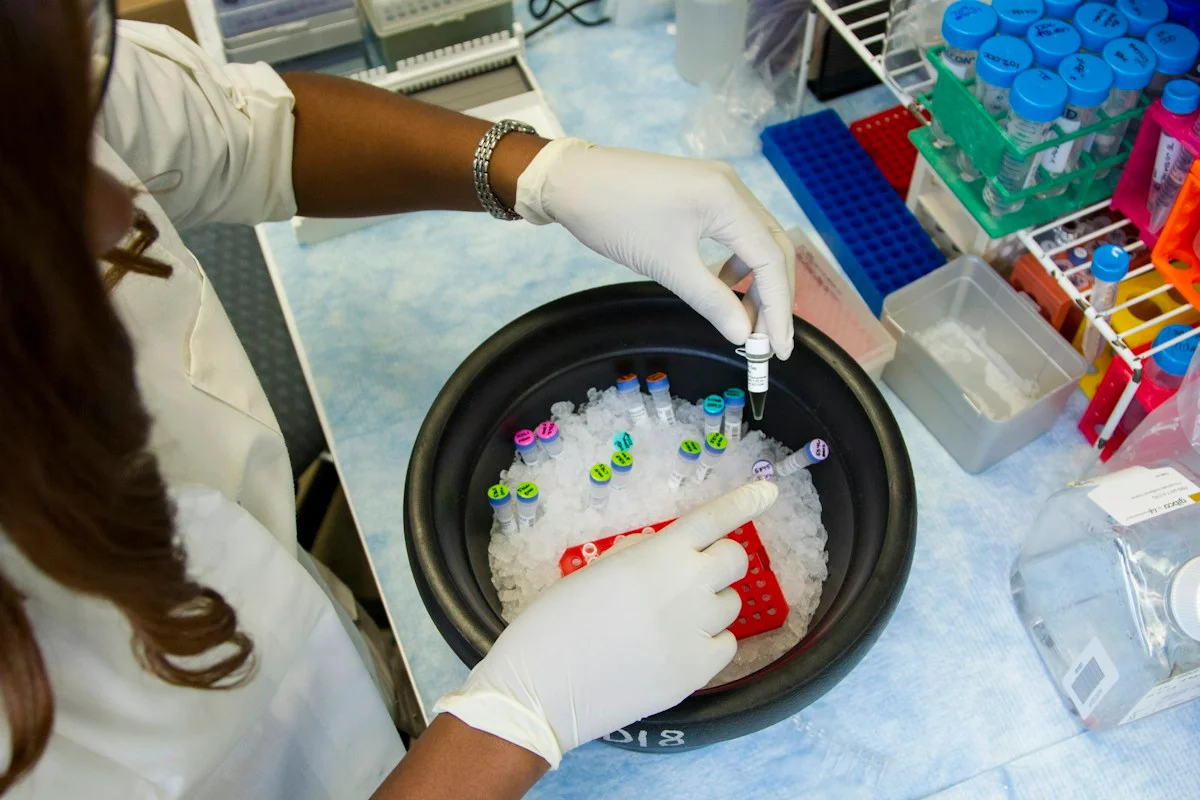
Illustrative photo · not a video frame
The Royal Society · 44 min 28 sec · Background explainer
Is this the AI future we want? | The Royal Society
YouTube loads only when you choose; playback starts when you press play.
A Royal Society discussion with Madhumita Murgia and biomedical engineer Alison Noble on AI’s potential in healthcare, science and culture, recorded at the 30 June 2026 event.
Evidence check: A discussion of opportunities and risks, including future possibilities. It is not evidence that every application described is available or clinically proven.
Published 2026-07-01. Source checked 14 October 2026. Check captions on the publisher’s video page.
Check the healthcare evidencePhoto: Daniel Sone / National Cancer Institute / Unsplash · Licence
Evidence check
This is an unreviewed retrospective study from one training health system. Some labels and the trial-ranking judge came from LLMs, prospective clinical outcomes were not measured and the model weights await institutional approval.
Reporting basis: Source analysis. Original source date: 19 October 2026.
Continue the story
Read next
Continue exploring clinical records: compare the finding and its evidence limits.
Can an AI agent safely summarise years of myeloma care?
A retrospective study found that a skill-guided agent agreed with expert answers on 80.1% of 469 questions from 100 patient records. It helped most on very long records, but most system errors were judged clinically significant and no live-care benefit was tested.
Read the next reportExplore the full source and evidence record
What this means for people
- A well-calibrated screening tool could help research staff find candidates sooner, but a confident error could wrongly exclude someone unless a person reviews the underlying record.
Global context
The training data came from a large US academic health system. Coding, documentation, disease prevalence and legal requirements differ across countries and care settings.
What the evidence does not yet show
- This is an unreviewed retrospective study from one training health system. Some labels and the trial-ranking judge came from LLMs, prospective clinical outcomes were not measured and the model weights await institutional approval.
What to watch next
- Prospective multi-site trials, clinician-adjudicated eligibility, subgroup calibration, error escalation rates and evidence that use improves recruitment or care without new exclusions.
Living evidence record
Impact record IAI-14NPP5U
Evidence stage
Studied
Confidence
Supported
Reporting basis
Source analysis
Independent or research support
Not yet
Record status
Monitoring
Last checked
21 October 2026
Source trail
1 direct source across 1 source type.
People impact
Documented in this record.
Uncertainty
Limits and next checks are explicit.
Stages describe the evidence available—not whether a technology is good or bad. See the public method.
Single-source reporting disclosure
This record analyses one direct source. It can establish what arXiv published or reported, but it is not independent corroboration of every performance claim or predicted outcome. The confidence label will change only when broader evidence is added.
Evidence trail
Sources used for this report
Links checked 21 October 2026
Research question, topics and regions
Whether a compact decision model can answer many typed questions over clinical records efficiently, transfer beyond its training health system and support evidence-linked population screening
Topics: Clinical records · Trial screening · Health operations · Human review · Medical AI
Regions: United States · North America · Global
This report is labelled source analysis. We summarise and analyse source material in our own words; company statements remain attributed claims until independently supported. Translated summaries preserve the meaning of the original source and link back to it. Read our editorial standards.
Reader commentary
What does this mean where you are?
Tell us what you have seen at work, in your community or in everyday life. A question is welcome too. No account is needed; we review notes before publishing them.
Explore commentary across the portal →Published reader notes
0No published reader notes yet. You can start the evidence-led discussion above.
Prefer a private correction or response? Contact the newsroom.