Can a depression AI be ‘correct’ when the dialogue never supplied the evidence?
An audit of 2,744 symptom cells found most lacked sufficient textual evidence. In a smaller model test, many benchmark-correct predictions were still unsupported by the dialogue.
The short version
- What happened
- EviDial contains 2,744 symptom cells from 343 clinical participants across Chinese PDCH and English E-DAIC interviews; 82.8% lacked sufficient textual evidence under the authors' working reference.
- Who it affects
- If benchmark accuracy is mistaken for clinical readiness, people could face assessments that sound decisive even when the conversation did not supply the required evidence. The study supports better evaluation, not deployment.
- What remains unproven
- The work is an unreviewed preprint and does not test diagnosis, treatment, patient outcomes or clinical deployment.
Matching the recorded label was not the same as being justified
Depression-dialogue systems are often scored against symptom labels derived from clinical scales. EviDial asks a different question: did the transcript shown to the model contain enough evidence for that symptom judgment? The preprint covers 99 Chinese PDCH interviews from 72 participants and 271 English E-DAIC interviews from 271 participants, producing 2,744 participant–symptom cells. Twelve simulated TalkDep dialogues were analysed separately from the main clinical reference.[1]
Who it affects
If benchmark accuracy is mistaken for clinical readiness, people could face assessments that sound decisive even when the conversation did not supply the required evidence. The study supports better evaluation, not deployment.[1]
Keep in mind
The work is an unreviewed preprint and does not test diagnosis, treatment, patient outcomes or clinical deployment.
The model audit used 87 development cells, lightweight models and single runs, so it cannot support model rankings.
E-DAIC provided 79% of the main reference cells; language, source and clinical instrument are confounded.
The working reference was generated from overlapping LLM judge families and remains measurement-dependent despite a 120-cell human validation.
Source analysis · 1 linked source. Original source date: 20 October 2026.
Keep following the evidence
Join The Impact Brief founding list for selected AI reports, their effect on people and the evidence limits. Read a sample first.
Read the full report · 3 min The evidence, methods, implications and limitations

Matching the recorded label was not the same as being justified
Depression-dialogue systems are often scored against symptom labels derived from clinical scales. EviDial asks a different question: did the transcript shown to the model contain enough evidence for that symptom judgment? The preprint covers 99 Chinese PDCH interviews from 72 participants and 271 English E-DAIC interviews from 271 participants, producing 2,744 participant–symptom cells. Twelve simulated TalkDep dialogues were analysed separately from the main clinical reference.
The authors classified each cell as having absent, partial, conflicting or sufficient textual evidence after checking who a statement concerned, its time window, scope and any retraction. Because there is no direct gold standard for evidence sufficiency, they combined 5,240 valid judgments from three language-stratified LLM judges using a random-effects latent-class model. Under that working reference, 82.8% of clinical cells lacked sufficient evidence, with a 95% confidence interval of 82.1% to 83.5%.[1]
The model audit found unsupported correctness—not clinical failure
On 87 development cells from 76 participants, the researchers tested Gemini, GPT and Qwen families with four prompting methods. Among predictions counted as correct by the native benchmark label, 69.2% to 96.9% lacked sufficient dialogue support. A prompt that required a quotation did not remove the problem; a sufficiency gate reduced the unsupported-correct rate but often abstained, leaving coverage between 34.5% and 67.8%.
The result warns researchers against treating label accuracy as proof of evidence-grounded clinical judgment. It does not show that a participant's clinical label was wrong, reveal how a model reasoned or establish diagnostic safety. E-DAIC supplied 79% of reference cells, its transcripts were reformatted by another model, and the automated reference disagreed with plurality on 13.3% of jointly labelled cells. A blinded 120-cell human check broadly preserved the pattern, but broader human annotation, repeated tests with stronger models and prospective clinical evaluation would change the assessment.[1]
The distinction that matters
Two questions a benchmark should keep separate
A prediction can match the stored label even when the visible dialogue cannot justify it.
Label match
Compare prediction with the recorded score
Measures agreement
Text support
Check eligible dialogue evidence
Measures justification
Clinical validity
Test with people and outcomes
Not established here
Watch the background, then check the evidence
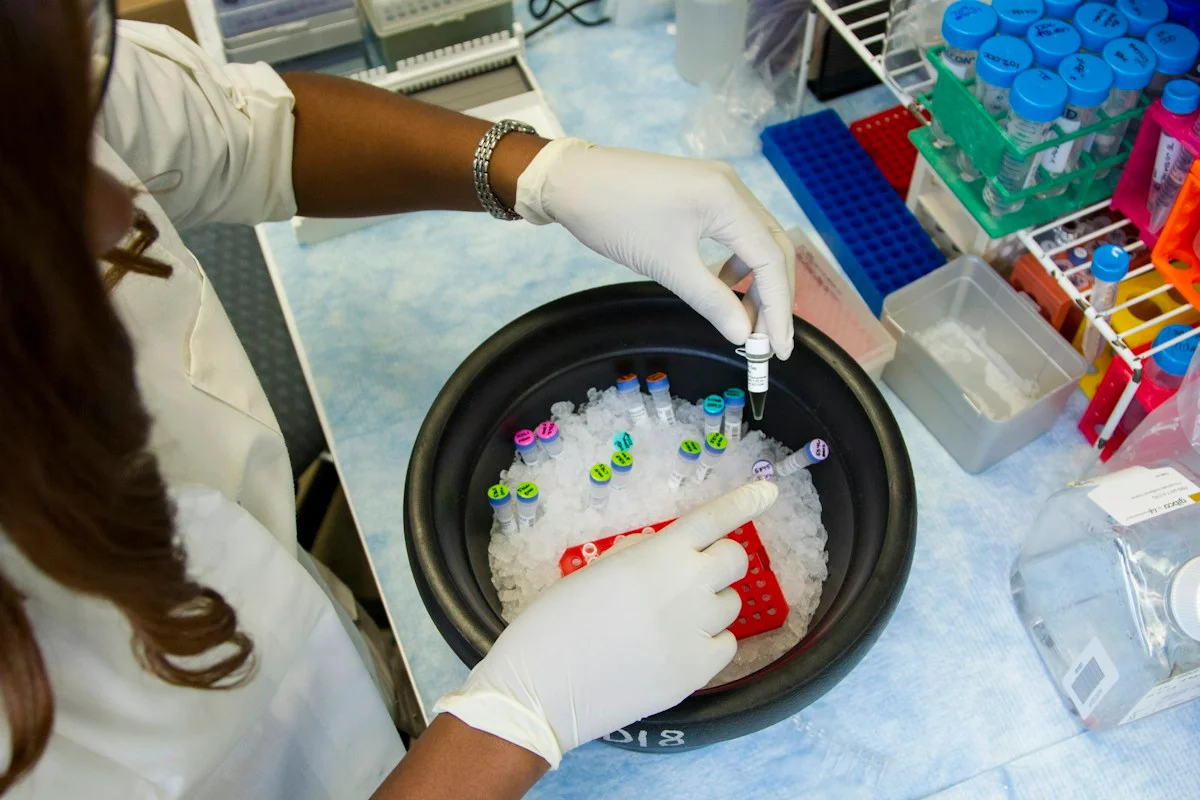
Illustrative photo · not a video frame
The Royal Society · 44 min 28 sec · Background explainer
Is this the AI future we want? | The Royal Society
YouTube loads only when you choose; playback starts when you press play.
A Royal Society discussion with Madhumita Murgia and biomedical engineer Alison Noble on AI’s potential in healthcare, science and culture, recorded at the 30 June 2026 event.
Evidence check: A discussion of opportunities and risks, including future possibilities. It is not evidence that every application described is available or clinically proven.
Published 2026-07-01. Source checked 14 October 2026. Check captions on the publisher’s video page.
Check the healthcare evidencePhoto: Daniel Sone / National Cancer Institute / Unsplash · Licence
Evidence check
The work is an unreviewed preprint and does not test diagnosis, treatment, patient outcomes or clinical deployment.
The model audit used 87 development cells, lightweight models and single runs, so it cannot support model rankings.
E-DAIC provided 79% of the main reference cells; language, source and clinical instrument are confounded.
The working reference was generated from overlapping LLM judge families and remains measurement-dependent despite a 120-cell human validation.
Reporting basis: Source analysis. Original source date: 20 October 2026.
Continue the story
Read next
Continue exploring mental health: compare the finding and its evidence limits.
Do mental-health chatbots help university students?
A preregistered review found small short-term symptom advantages over waitlists or low-intensity materials, based on three depression and four anxiety comparisons. Two active conversational-control trials found no reliable added benefit, and certainty was low to very low.
Read the next reportExplore the full source and evidence record
What this means for people
- If benchmark accuracy is mistaken for clinical readiness, people could face assessments that sound decisive even when the conversation did not supply the required evidence. The study supports better evaluation, not deployment.
Global context
The clinical data combine Chinese psychiatric interviews with English distress interviews, while source, language and symptom instruments differ together. The finding should be replicated with locally governed, multilingual clinical datasets before being generalised to other health systems.
What the evidence does not yet show
- The work is an unreviewed preprint and does not test diagnosis, treatment, patient outcomes or clinical deployment.
- The model audit used 87 development cells, lightweight models and single runs, so it cannot support model rankings.
- E-DAIC provided 79% of the main reference cells; language, source and clinical instrument are confounded.
- The working reference was generated from overlapping LLM judge families and remains measurement-dependent despite a 120-cell human validation.
What to watch next
- Peer review and an independently reproduced evidence reference
- Larger held-out tests with repeated runs and current clinical language models
- Prospective clinician comparison, calibration and abstention behaviour
- Evidence that stronger benchmark scores predict safer decisions and better patient outcomes
Living evidence record
Impact record IAI-0279YAI
Evidence stage
Studied
Confidence
Supported
Reporting basis
Source analysis
Independent or research support
Not yet
Record status
Monitoring
Last checked
21 October 2026
Source trail
1 direct source across 1 source type.
People impact
Documented in this record.
Uncertainty
Limits and next checks are explicit.
Stages describe the evidence available—not whether a technology is good or bad. See the public method.
Single-source reporting disclosure
This record analyses one direct source. It can establish what arXiv published or reported, but it is not independent corroboration of every performance claim or predicted outcome. The confidence label will change only when broader evidence is added.
Evidence trail
Sources used for this report
Links checked 21 October 2026
Research question, topics and regions
Whether depression-dialogue benchmark labels reward predictions that the model-visible transcript does not actually support
Topics: Depression · Clinical AI · Benchmark validity · Evidence grounding · Mental health
Regions: China · United States · Global health
This report is labelled source analysis. We summarise and analyse source material in our own words; company statements remain attributed claims until independently supported. Translated summaries preserve the meaning of the original source and link back to it. Read our editorial standards.
Reader commentary
What does this mean where you are?
Tell us what you have seen at work, in your community or in everyday life. A question is welcome too. No account is needed; we review notes before publishing them.
Explore commentary across the portal →Published reader notes
0No published reader notes yet. You can start the evidence-led discussion above.
Prefer a private correction or response? Contact the newsroom.