Can routine MRI help forecast cognition in multiple sclerosis? A 171-person study
AI-derived brain-network estimates predicted four-year processing-speed scores moderately well, but follow-up data were available for only 111 participants and there was no external cohort.
The short version
- What happened
- The study followed 171 people with multiple sclerosis or clinically isolated syndrome and used lesion masks from structural MRI to estimate structural and functional brain connectivity.
- Who it affects
- People with MS could eventually receive more informative monitoring from scans already collected in care, but this model cannot yet support individual treatment decisions.
- What remains unproven
- Single research cohort with no external validation
Keep in mind
Single research cohort with no external validation
Only 111 participants had four-year processing-speed data
Prediction correlation does not establish calibration or clinical benefit
Source analysis · 1 linked source. Primary analysed source date: 23 October 2026.
Keep following the evidence
Join The Impact Brief founding list for selected AI reports, their effect on people and the evidence limits. Read a sample first.
Read the full report · 2 min The evidence, methods, implications and limitations

Routine scans supplied a proxy for costlier connectome imaging
Researchers at Cornell and Weill Cornell studied 171 people: 158 with relapsing-remitting multiple sclerosis, five with secondary-progressive disease and eight with clinically isolated syndrome. They took lesion masks from ordinary structural scans, estimated structural connections with the Network Modification tool, then used the Krakencoder model to estimate functional connectivity.
Ridge-regression models predicted three cognitive-test scores at baseline and after four years. The strongest result was for follow-up processing speed: median Spearman correlation between observed and predicted scores was 0.58 using regional estimated structural connectivity and 0.56 using estimated functional connectivity. Nested five-fold cross-validation separated tuning from performance testing.[1]
Promising for research selection, not a clinical prognosis yet
Lower estimated connectivity in the cerebellum and higher estimated functional connectivity in the default-mode network were associated with poorer later scores. That may help researchers choose circuits to study or stratify trials while avoiding scans uncommon in routine care.
It is not evidence that the system improves treatment or gives one patient a dependable forecast. Only 111 participants had four-year processing-speed data, follow-up loss was linked partly to the pandemic, and evaluation stayed within one cohort. Prospective multi-centre validation with calibration and decision-impact testing is needed.[1]
The distinction that matters
From a routine scan to a research prediction
The study estimated networks rather than directly measuring them with diffusion or functional MRI.
Lesion mask
Extract MS lesions from structural MRI
Routine clinical input
Estimated networks
Infer structural and functional connectivity
Regional connection features
Cognitive model
Use nested cross-validated regression
Moderate within-cohort prediction
Watch the background, then check the evidence
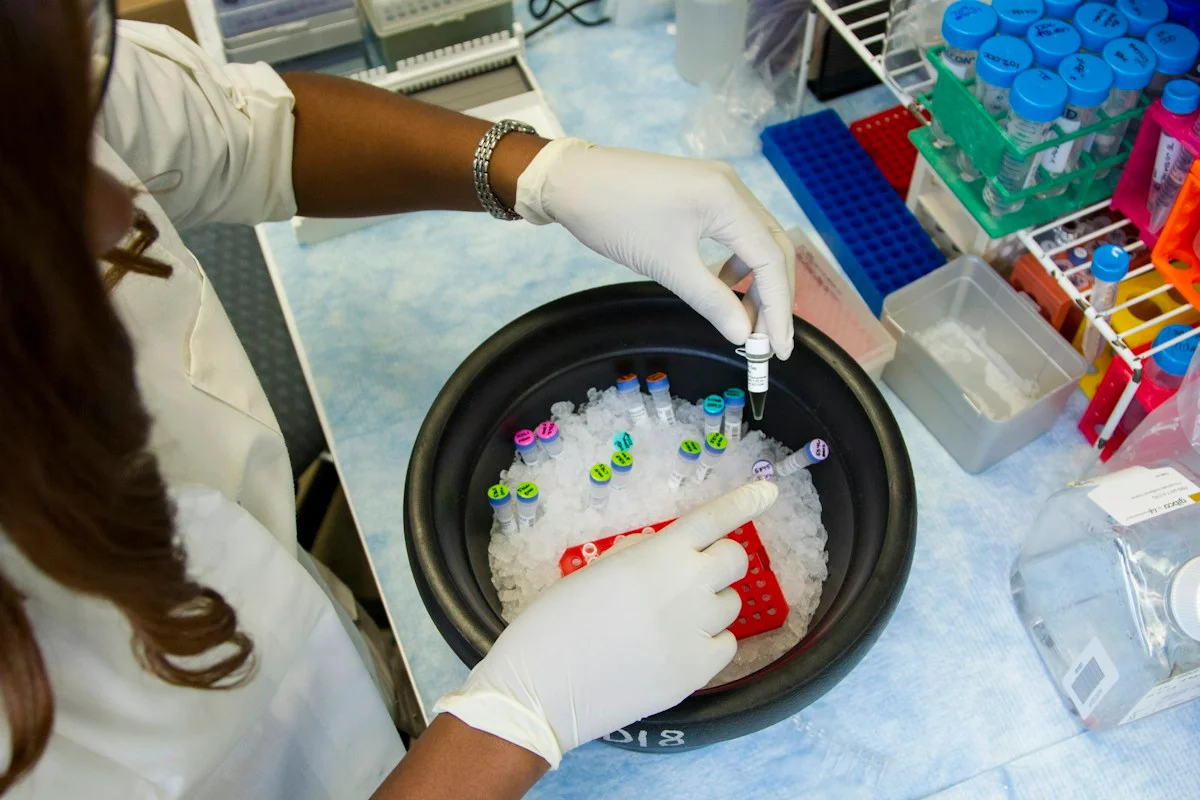
Illustrative photo · not a video frame
The Royal Society · 44 min 28 sec · Background explainer
Is this the AI future we want? | The Royal Society
YouTube loads only when you choose; playback starts when you press play.
A Royal Society discussion with Madhumita Murgia and biomedical engineer Alison Noble on AI’s potential in healthcare, science and culture, recorded at the 30 June 2026 event.
Evidence check: A discussion of opportunities and risks, including future possibilities. It is not evidence that every application described is available or clinically proven.
Published 2026-07-01. Source checked 14 October 2026. Check captions on the publisher’s video page.
Check the healthcare evidencePhoto: Daniel Sone / National Cancer Institute / Unsplash · Licence
Continue the story
Read next
A second perspective on AI in health & life sciences, with its own sources and qualifications.
Can a burn-risk model help before the outcome is known?
A peer-reviewed Iranian study reports very high internal discrimination in 2,266 burn admissions. But the model uses hospital stay, ICU stay and infection information accumulated during care, overpredicted mortality in parts of the test set and has not been validated outside one hospital, so it is not an admission score or a deployable clinical tool.
Read the next reportExplore the full source and evidence record
What this means for people
- People with MS could eventually receive more informative monitoring from scans already collected in care, but this model cannot yet support individual treatment decisions.
Global context
The cohort and research team were US-based. Scanner protocols, disease mix and access to specialist imaging vary internationally.
What the evidence does not yet show
- Single research cohort with no external validation
- Only 111 participants had four-year processing-speed data
- Prediction correlation does not establish calibration or clinical benefit
What to watch next
- External validation across hospitals and scanners
- Prospective calibration
- Comparison with simpler clinical baselines
- Evidence of improved care or trial design
Living evidence record
Impact record IAI-1HWYX2L
Evidence stage
Studied
Confidence
Supported
Reporting basis
Source analysis
Independent or research support
Present
Record status
Monitoring
Last checked
25 October 2026
Source trail
1 direct source across 1 source type.
People impact
Documented in this record.
Uncertainty
Limits and next checks are explicit.
Stages describe the evidence available—not whether a technology is good or bad. See the public method.
Single-source reporting disclosure
This record analyses one direct source. It can establish what Nature Communications published or reported, but it is not independent corroboration of every performance claim or predicted outcome. The confidence label will change only when broader evidence is added.
Evidence trail
Sources used for this report
Links checked 25 October 2026
Research question, topics and regions
Whether connectivity estimates derived from routinely acquired structural MRI can predict later cognitive scores in people with multiple sclerosis
Topics: Multiple sclerosis · Clinical MRI · Cognition · Brain connectivity
Regions: United States
This report is labelled source analysis. We summarise and analyse source material in our own words; company statements remain attributed claims until independently supported. Translated summaries preserve the meaning of the original source and link back to it. Read our editorial standards.
Reader commentary
What does this mean where you are?
Tell us what you have seen at work, in your community or in everyday life. A question is welcome too. No account is needed; we review notes before publishing them.
Explore commentary across the portal →Published reader notes
0No published reader notes yet. You can start the evidence-led discussion above.
Prefer a private correction or response? Contact the newsroom.