A brain-surgery ICU model predicted mortality—but is it ready for another hospital?
A Chinese single-centre study reports strong test discrimination across 7,841 postoperative neurosurgical ICU patients. The model still needs external and prospective validation before it should influence care.
The short version
- What happened
- Researchers retrospectively analysed 7,841 postoperative neurosurgical ICU patients at one Chinese hospital; 6.1% died in hospital.
- Who it affects
- A validated tool might help ICU teams identify some high-risk patients earlier, but false reassurance could delay review for patients whose acute neurological deterioration is not reflected in routine laboratory values.
- What remains unproven
- Retrospective, single-centre design with no external or prospective validation.
Strong internal test results from one ICU
Researchers used records from 7,841 adults admitted after neurosurgery to one neurosurgical intensive-care unit in Jinhua, China. In-hospital mortality was 6.1%. They split the cohort into 5,488 training patients and 2,353 test patients, selected 21 variables with LASSO and compared seven algorithms without class weighting.[1]
Who it affects
A validated tool might help ICU teams identify some high-risk patients earlier, but false reassurance could delay review for patients whose acute neurological deterioration is not reflected in routine laboratory values.[1]
Keep in mind
Retrospective, single-centre design with no external or prospective validation.
A 6.1% mortality rate creates class imbalance; the algorithms were trained without class weighting.
Prediction performance does not show that acting on the score improves survival, treatment or clinician workload.
Source analysis · 1 linked source. Original source date: 20 October 2026.
Keep following the evidence
Join The Impact Brief founding list for selected AI reports, their effect on people and the evidence limits. Read a sample first.
Read the full report · 3 min The evidence, methods, implications and limitations
Strong internal test results from one ICU
Researchers used records from 7,841 adults admitted after neurosurgery to one neurosurgical intensive-care unit in Jinhua, China. In-hospital mortality was 6.1%. They split the cohort into 5,488 training patients and 2,353 test patients, selected 21 variables with LASSO and compared seven algorithms without class weighting.
XGBoost performed best on the held-out test set, with an area under the receiver-operating curve of 0.877 (95% confidence interval 0.849–0.905), a Brier score of 0.0424 and a calibration slope of 1.149. The authors report discrimination comparable with logistic regression, while XGBoost had the lower Brier score. Mean neutrophil count, glucose and albumin were the leading SHAP features.[1]
A risk score is not evidence of better care
For clinicians and families, a well-calibrated score could support earlier review or clearer conversations. But a retrospective model can learn local admission, laboratory and treatment patterns that change across hospitals. The study also found that some false-negative patients had relatively reassuring laboratory markers, suggesting acute neurological events may be missed by a system dominated by routine measurements.
No other hospital tested the model, and no prospective trial measured whether showing the score changes treatment, workload, survival or harmful escalation. Before clinical use, it needs temporal and multi-centre validation, subgroup error reporting, a defined decision threshold and an impact study against usual care. The peer-reviewed paper is useful development evidence, not a deployment licence.[1]
The distinction that matters
What the study establishes
The evidence becomes weaker as the claim moves from internal prediction to clinical benefit.
Measured
7,841 single-centre records
Internal train/test performance
Not tested
Use in another hospital
Transportability remains unknown
Not tested
Show scores to clinicians
Patient benefit remains unknown
Watch the background, then check the evidence
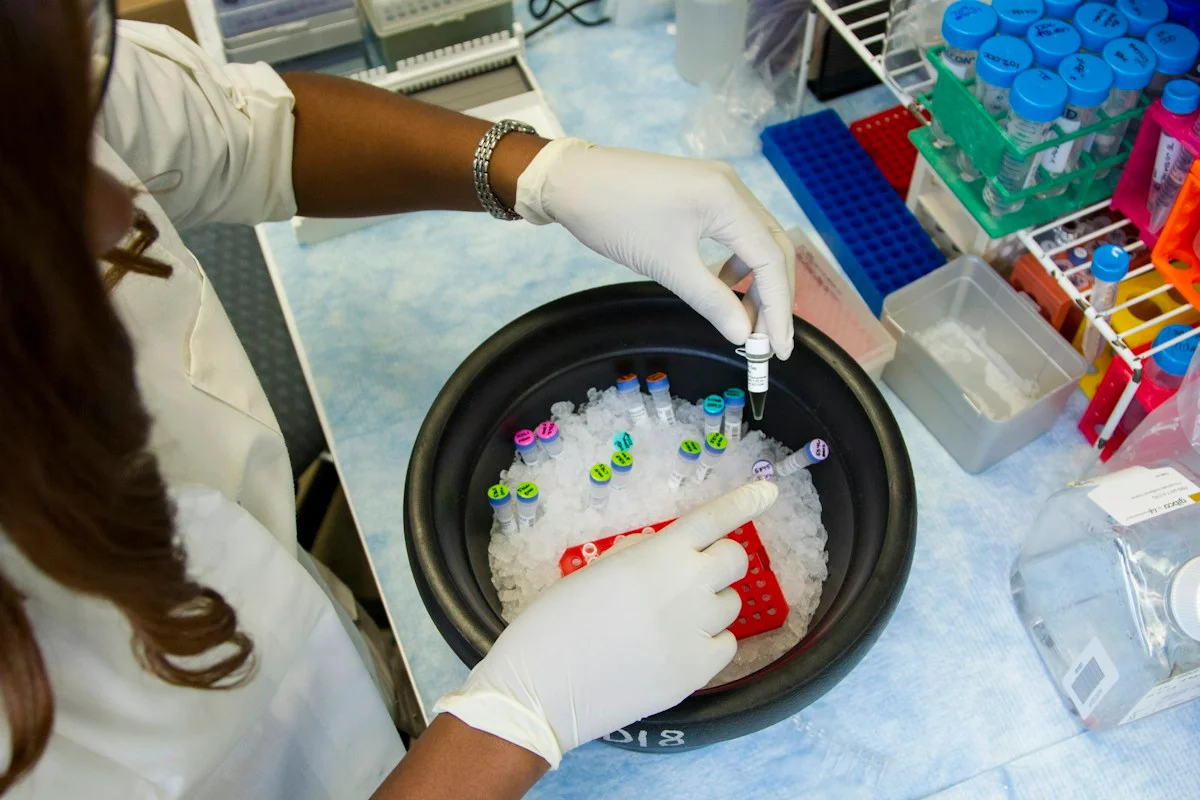
Illustrative photo · not a video frame
The Royal Society · 44 min 28 sec · Background explainer
Is this the AI future we want? | The Royal Society
YouTube loads only when you choose; playback starts when you press play.
A Royal Society discussion with Madhumita Murgia and biomedical engineer Alison Noble on AI’s potential in healthcare, science and culture, recorded at the 30 June 2026 event.
Evidence check: A discussion of opportunities and risks, including future possibilities. It is not evidence that every application described is available or clinically proven.
Published 2026-07-01. Source checked 14 October 2026. Check captions on the publisher’s video page.
Check the healthcare evidencePhoto: Daniel Sone / National Cancer Institute / Unsplash · Licence
Evidence check
Retrospective, single-centre design with no external or prospective validation.
A 6.1% mortality rate creates class imbalance; the algorithms were trained without class weighting.
Prediction performance does not show that acting on the score improves survival, treatment or clinician workload.
Reporting basis: Source analysis. Original source date: 20 October 2026.
Continue the story
Read next
Continue exploring clinical prediction: compare the finding and its evidence limits.
Can AI predict risks before thymic-tumour surgery?
Models trained on 726 Chinese patients estimated complications, longer stays and severe pain before surgery. External AUCs of 0.660–0.776 make this promising risk support—not evidence for automated care decisions.
Read the next reportExplore the full source and evidence record
What this means for people
- A validated tool might help ICU teams identify some high-risk patients earlier, but false reassurance could delay review for patients whose acute neurological deterioration is not reflected in routine laboratory values.
- Families need risk estimates presented as uncertain support for clinical judgement, not an individual prognosis produced by a machine.
Global context
ICU prediction models often lose accuracy when moved between hospitals because patient mix, testing and treatment differ. Transparent multi-centre evaluation is therefore more important than a small internal ranking advantage.
What the evidence does not yet show
- Retrospective, single-centre design with no external or prospective validation.
- A 6.1% mortality rate creates class imbalance; the algorithms were trained without class weighting.
- Prediction performance does not show that acting on the score improves survival, treatment or clinician workload.
What to watch next
- External validation across hospitals, regions and time periods
- Sensitivity and false-negative rates at a clinically chosen threshold, including subgroup results
- A prospective comparison measuring decisions, workload, harms and patient outcomes
Living evidence record
Impact record IAI-1J62ODH
Evidence stage
Studied
Confidence
Supported
Reporting basis
Source analysis
Independent or research support
Present
Record status
Monitoring
Last checked
20 October 2026
Source trail
1 direct source across 1 source type.
People impact
Documented in this record.
Uncertainty
Limits and next checks are explicit.
Stages describe the evidence available—not whether a technology is good or bad. See the public method.
Single-source reporting disclosure
This record analyses one direct source. It can establish what BMC Medical Informatics and Decision Making published or reported, but it is not independent corroboration of every performance claim or predicted outcome. The confidence label will change only when broader evidence is added.
Evidence trail
Sources used for this report
Links checked 20 October 2026
Research question, topics and regions
Whether routinely collected ICU data can predict in-hospital mortality after neurosurgery
Topics: Critical care · Clinical prediction · Neurosurgery · Explainable AI · External validation
Regions: China · East Asia
This report is labelled source analysis. We summarise and analyse source material in our own words; company statements remain attributed claims until independently supported. Translated summaries preserve the meaning of the original source and link back to it. Read our editorial standards.
Reader commentary
What does this mean where you are?
Tell us what you have seen at work, in your community or in everyday life. A question is welcome too. No account is needed; we review notes before publishing them.
Explore commentary across the portal →Published reader notes
0No published reader notes yet. You can start the evidence-led discussion above.
Prefer a private correction or response? Contact the newsroom.