Can a written instruction become a working protein?
A peer-reviewed Nature paper reports that Pinal turned plain-language descriptions into active proteins across four laboratory tasks. The strongest result was a designed H-protein that raised product titre 1.7-fold in one carbon-fixation pathway—but the study is still a small, task-specific proof of concept.
The short version
- What happened
- Pinal is a 16-billion-parameter model trained with 1.7 billion synthetically annotated protein–text pairs and then used to propose proteins from written functional descriptions.
- Who it affects
- For laboratory teams, the near-term value is a simpler way to specify and screen candidates—not a replacement for synthesis, assay design, safety work or expert interpretation.
- What remains unproven
- Four selected tasks and heterogeneous assays do not yield one general success rate.
The model linked text, predicted structure and sequence
Pinal was trained on 1.7 billion synthetic descriptions paired with protein information, then asked for candidates using written functional prompts rather than a supplied sequence or structure template. Computational filters ranked candidates for predicted foldability, match to the requested function and diversity before selected proteins were made and tested in the laboratory. The paper reports 12 active designs in its main validation set, with 30–60% sequence identity to functionally annotated Swiss-Prot proteins.[1]
Who it affects
For laboratory teams, the near-term value is a simpler way to specify and screen candidates—not a replacement for synthesis, assay design, safety work or expert interpretation.[1]
Keep in mind
Four selected tasks and heterogeneous assays do not yield one general success rate.
The main validation reports 12 active designs, but activity and comparators differ by task.
No independent laboratory has yet reproduced the published results.
The work does not demonstrate a deployable therapy, waste-treatment system or carbon-removal technology.
The authors declared no competing interests; the earlier bioRxiv version is the same work, not independent evidence or replication.
Source analysis · 1 linked source. Original source date: 21 October 2026.
Keep following the evidence
Join The Impact Brief founding list for selected AI reports, their effect on people and the evidence limits. Read a sample first.
Read the full report · 3 min The evidence, methods, implications and limitations

The model linked text, predicted structure and sequence
Pinal was trained on 1.7 billion synthetic descriptions paired with protein information, then asked for candidates using written functional prompts rather than a supplied sequence or structure template. Computational filters ranked candidates for predicted foldability, match to the requested function and diversity before selected proteins were made and tested in the laboratory. The paper reports 12 active designs in its main validation set, with 30–60% sequence identity to functionally annotated Swiss-Prot proteins.[1]
Four very different tasks showed the requested activity
The laboratory cases covered fluorescence, a PET-degrading hydrolase, an alcohol dehydrogenase and an H-protein used in metabolism. The intended function appeared in every case, including catalytic activity for both enzymes. In the clearest comparative result, one H-protein increased product titre 1.7-fold against the corresponding native E. coli H-protein in a multi-enzyme carbon-dioxide-fixation pathway without iterative experimental optimisation.[1]
The distinction that matters
From a sentence to a laboratory result
The study inserted experimental selection between language generation and any claim of function.
Prompt
Describe a desired protein function
Pinal proposes structures and sequences
Filter
Rank foldability, fit and diversity
Select candidates to manufacture
Assay
Test the made proteins in the laboratory
Measure whether the requested activity appears
A useful interface is not yet a dependable engineering pipeline
The four tasks used different screens and denominators, so the 12 active proteins should not be read as a universal hit rate. Candidates were computationally filtered, activity was demonstrated in controlled assays, and the authors declared no competing interests; independent replication is still absent. The result makes language a more plausible front end for molecular design, but practical adoption depends on prospective tests, reproducible yields, safety assessment and comparisons with specialist design workflows.[1]
Watch the background, then check the evidence
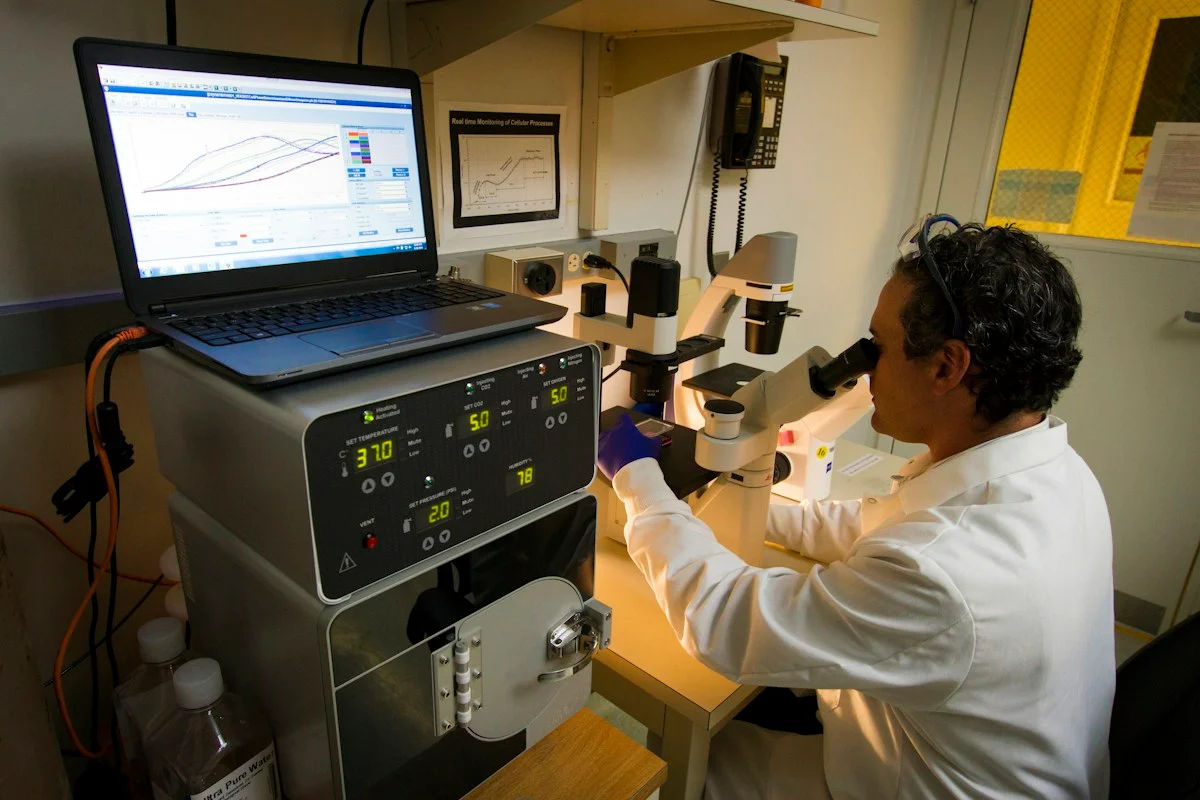
Illustrative photo · not a video frame
Google DeepMind · 1 min 52 sec · Background explainer
Protein folding explained
YouTube loads only when you choose; playback starts when you press play.
A short introduction to why a protein’s shape matters. It provides background for understanding what AI structure prediction contributes to biological research.
Evidence check: This is the developer’s explanation. Predicting a structure does not by itself establish a treatment’s safety or benefit for patients.
Published 2020-11-30. Source checked 14 October 2026. Check captions on the publisher’s video page.
Explore current researchEvidence check
Four selected tasks and heterogeneous assays do not yield one general success rate.
The main validation reports 12 active designs, but activity and comparators differ by task.
No independent laboratory has yet reproduced the published results.
The work does not demonstrate a deployable therapy, waste-treatment system or carbon-removal technology.
The authors declared no competing interests; the earlier bioRxiv version is the same work, not independent evidence or replication.
Reporting basis: Source analysis. Original source date: 21 October 2026.
Continue the story
Read next
Continue exploring protein design: compare the finding and its evidence limits.
Can an AI-designed protein carry a detectable watermark without losing its function?
A peer-reviewed Nature paper reports lab-tested watermarks in designed protein binders and a separate mark in predicted structures. The result is a proof of concept for provenance—not a safety certificate or a universal detector for synthetic biology.
Read the next reportExplore the full source and evidence record
What this means for people
- For laboratory teams, the near-term value is a simpler way to specify and screen candidates—not a replacement for synthesis, assay design, safety work or expert interpretation.
Global context
Protein-design systems are moving from predicting structures toward specifying functions. The practical test is whether independent groups can reproduce useful activity at acceptable cost, safety and yield across more than a few curated tasks.
What the evidence does not yet show
- Four selected tasks and heterogeneous assays do not yield one general success rate.
- The main validation reports 12 active designs, but activity and comparators differ by task.
- No independent laboratory has yet reproduced the published results.
- The work does not demonstrate a deployable therapy, waste-treatment system or carbon-removal technology.
- The authors declared no competing interests; the earlier bioRxiv version is the same work, not independent evidence or replication.
What to watch next
- Independent laboratory replication
- Prospective success rates with declared denominators
- Head-to-head comparisons with specialist design systems
- Safety and manufacturing performance beyond bench assays
Living evidence record
Impact record IAI-1WPEOUO
Evidence stage
Studied
Confidence
Supported
Reporting basis
Source analysis
Independent or research support
Present
Record status
Monitoring
Last checked
21 October 2026
Source trail
1 direct source across 1 source type.
People impact
Documented in this record.
Uncertainty
Limits and next checks are explicit.
Stages describe the evidence available—not whether a technology is good or bad. See the public method.
Single-source reporting disclosure
This record analyses one direct source. It can establish what Nature published or reported, but it is not independent corroboration of every performance claim or predicted outcome. The confidence label will change only when broader evidence is added.
Evidence trail
Sources used for this report
Links checked 21 October 2026
Research question, topics and regions
Whether a protein foundation model can translate natural-language descriptions of function into experimentally active protein designs
Topics: Protein design · Synthetic biology · Foundation models · Laboratory validation · Peer review
Regions: China · Global
This report is labelled source analysis. We summarise and analyse source material in our own words; company statements remain attributed claims until independently supported. Translated summaries preserve the meaning of the original source and link back to it. Read our editorial standards.
Reader commentary
What does this mean where you are?
Tell us what you have seen at work, in your community or in everyday life. A question is welcome too. No account is needed; we review notes before publishing them.
Explore commentary across the portal →Published reader notes
0No published reader notes yet. You can start the evidence-led discussion above.
Prefer a private correction or response? Contact the newsroom.