Stroke-bleeding AI models looked accurate—why is clinical use still premature?
A meta-analysis of 11 cohort studies and 3,541 patients found pooled AUC 0.891 for imaging-based models after thrombectomy. High risk of bias, limited external validation and mixed comparators leave clinical benefit unproven.
The short version
- What happened
- The review included 11 cohort studies with 3,541 patients; ten studies contributed eligible AUC estimates and evaluation cohorts ranged from 18 to 261 people.
- Who it affects
- A reliable risk tool could help stroke teams target monitoring after thrombectomy, but missing a high-risk patient can be consequential and pooled sensitivity was about two-thirds.
- What remains unproven
- Most included studies were retrospective, and only three reported independent external validation.
The pooled models ranked risk well, with uneven sensitivity
Researchers searched eight English- and Chinese-language databases through 2 July 2026 for imaging-based artificial-intelligence models predicting hemorrhagic transformation after mechanical thrombectomy. Eleven cohort studies with 3,541 patients met the review criteria; ten supplied an eligible area-under-the-curve estimate. Evaluation cohorts were small, ranging from 18 to 261 people.[1]
Bias and timing limit what the summary number means
Most studies were retrospective, only three reported independent external validation, and the review judged most studies at high risk of bias—particularly in the analysis domain. Small validation sets, many candidate predictors relative to outcome events and incomplete reporting can make performance look better than it will be in new patients. With only 11 studies, the reviewers did not formally test publication bias.[1]
Who it affects
A reliable risk tool could help stroke teams target monitoring after thrombectomy, but missing a high-risk patient can be consequential and pooled sensitivity was about two-thirds.[1]
Keep in mind
Most included studies were retrospective, and only three reported independent external validation.
The review judged most studies at high risk of bias, especially because of analysis choices, small samples and limited event counts.
Outcome definitions, imaging timing, model workflows and comparators varied across studies.
Post-procedure images may capture early bleeding rather than predict a future event, creating predictor–outcome temporal overlap.
The meta-analysis assessed discrimination, not whether model-guided care improves disability, survival or quality of life.
Source analysis · 1 linked source. Original source date: 20 October 2026.
Keep following the evidence
Join The Impact Brief founding list for selected AI reports, their effect on people and the evidence limits. Read a sample first.
Read the full report · 3 min The evidence, methods, implications and limitations
The pooled models ranked risk well, with uneven sensitivity
Researchers searched eight English- and Chinese-language databases through 2 July 2026 for imaging-based artificial-intelligence models predicting hemorrhagic transformation after mechanical thrombectomy. Eleven cohort studies with 3,541 patients met the review criteria; ten supplied an eligible area-under-the-curve estimate. Evaluation cohorts were small, ranging from 18 to 261 people.
The pooled AUC was 0.891, with a 95% confidence interval of 0.853–0.928 and I² of 29.0%. Pooled sensitivity was 0.666 and specificity was 0.919. In plain language, the reviewed models tended to rank higher-risk patients well and produced fewer false positives than false negatives. But the studies used different imaging, outcome definitions, time points and modelling workflows, and direct comparisons with conventional methods did not establish consistent superiority.[1]
Bias and timing limit what the summary number means
Most studies were retrospective, only three reported independent external validation, and the review judged most studies at high risk of bias—particularly in the analysis domain. Small validation sets, many candidate predictors relative to outcome events and incomplete reporting can make performance look better than it will be in new patients. With only 11 studies, the reviewers did not formally test publication bias.
There is also a clinical-timing problem: some post-procedural images may already contain early signs of bleeding, so a model can partly detect an event that has begun rather than predict a genuinely future complication. No pooled result shows that using a model changes blood-pressure management, antithrombotic treatment, intensive monitoring, disability or survival. Clinicians therefore need prospective, locked-model validation and a trial of model-guided decisions before these scores influence care.[1]
The distinction that matters
What the meta-analysis found—and what it did not
The headline performance is a pooled discrimination result from small observational cohorts, not a clinical-effect estimate.
Evidence base
11 cohorts; 3,541 patients
10 eligible AUC estimates
Performance
AUC 0.891
Sensitivity 0.666; specificity 0.919
Transport
3 externally validated studies
Clinical benefit not tested
Watch the background, then check the evidence
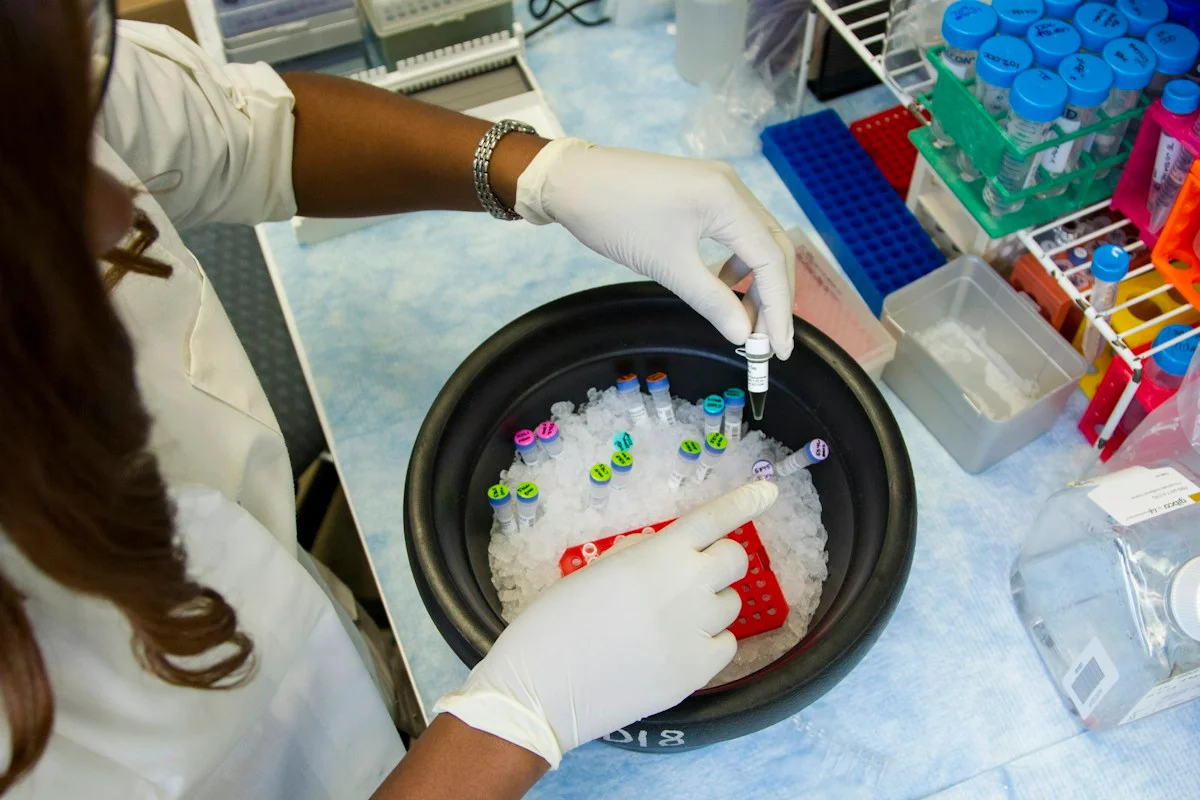
Illustrative photo · not a video frame
The Royal Society · 44 min 28 sec · Background explainer
Is this the AI future we want? | The Royal Society
YouTube loads only when you choose; playback starts when you press play.
A Royal Society discussion with Madhumita Murgia and biomedical engineer Alison Noble on AI’s potential in healthcare, science and culture, recorded at the 30 June 2026 event.
Evidence check: A discussion of opportunities and risks, including future possibilities. It is not evidence that every application described is available or clinically proven.
Published 2026-07-01. Source checked 14 October 2026. Check captions on the publisher’s video page.
Check the healthcare evidencePhoto: Daniel Sone / National Cancer Institute / Unsplash · Licence
Evidence check
Most included studies were retrospective, and only three reported independent external validation.
The review judged most studies at high risk of bias, especially because of analysis choices, small samples and limited event counts.
Outcome definitions, imaging timing, model workflows and comparators varied across studies.
Post-procedure images may capture early bleeding rather than predict a future event, creating predictor–outcome temporal overlap.
The meta-analysis assessed discrimination, not whether model-guided care improves disability, survival or quality of life.
Reporting basis: Source analysis. Original source date: 20 October 2026.
Continue the story
Read next
Continue exploring clinical ai: compare the finding and its evidence limits.
Can five preoperative signals predict kidney injury after hip-fracture surgery?
A single-hospital Chinese study of 616 older patients found moderate internal discrimination from a five-variable model. Only 54 developed acute kidney injury, the result changed with the creatinine definition, and no outside hospital has tested it.
Read the next reportExplore the full source and evidence record
What this means for people
- A reliable risk tool could help stroke teams target monitoring after thrombectomy, but missing a high-risk patient can be consequential and pooled sensitivity was about two-thirds.
- Patients should not have treatment changed solely from these models until prospective studies show added value over clinical and imaging assessment.
Global context
The review drew from studies in several countries and searched Chinese as well as English sources, but local scanners, thrombectomy practice, treatment pathways and patient mix can alter performance. Calibration and utility must be tested in each intended health system.
What the evidence does not yet show
- Most included studies were retrospective, and only three reported independent external validation.
- The review judged most studies at high risk of bias, especially because of analysis choices, small samples and limited event counts.
- Outcome definitions, imaging timing, model workflows and comparators varied across studies.
- Post-procedure images may capture early bleeding rather than predict a future event, creating predictor–outcome temporal overlap.
- The meta-analysis assessed discrimination, not whether model-guided care improves disability, survival or quality of life.
What to watch next
- Prospective multicentre validation with prespecified imaging time points and locked models
- Calibration and performance by bleeding definition, centre, scanner and patient subgroup
- Direct comparison with conventional scores and stroke-team judgement
- Trials measuring whether model-guided monitoring or treatment improves disability and survival without harmful overtreatment
Living evidence record
Impact record IAI-1XDEU0Y
Evidence stage
Studied
Confidence
Supported
Reporting basis
Source analysis
Independent or research support
Present
Record status
Monitoring
Last checked
21 October 2026
Source trail
1 direct source across 1 source type.
People impact
Documented in this record.
Uncertainty
Limits and next checks are explicit.
Stages describe the evidence available—not whether a technology is good or bad. See the public method.
Single-source reporting disclosure
This record analyses one direct source. It can establish what Frontiers in Neurology published or reported, but it is not independent corroboration of every performance claim or predicted outcome. The confidence label will change only when broader evidence is added.
Evidence trail
Sources used for this report
Links checked 21 October 2026
Research question, topics and regions
Imaging-based AI models intended to predict hemorrhagic transformation after mechanical thrombectomy for acute ischemic stroke
Topics: Stroke · Mechanical thrombectomy · Clinical AI · Medical imaging · Risk prediction · Systematic review
Regions: Global · Asia · North America · South America
This report is labelled source analysis. We summarise and analyse source material in our own words; company statements remain attributed claims until independently supported. Translated summaries preserve the meaning of the original source and link back to it. Read our editorial standards.
Reader commentary
What does this mean where you are?
Tell us what you have seen at work, in your community or in everyday life. A question is welcome too. No account is needed; we review notes before publishing them.
Explore commentary across the portal →Published reader notes
0No published reader notes yet. You can start the evidence-led discussion above.
Prefer a private correction or response? Contact the newsroom.