An AI scored 1.1 million rat sleep segments—but how far does 13 animals take us?
A peer-reviewed model retained high sleep-stage accuracy across three serotonergic drug conditions. The subject-held-out design is useful, but all recordings came from 13 male rats in one laboratory.
The short version
3 key points
- What changed
- Researchers trained on more than 1.1 million expert-labelled four-second EEG/EMG windows from 13 adult male rats across saline, psilocybin, MDL100907 and combined conditions.
- Why it matters
- Preclinical researchers could spend less time hand-scoring long recordings if the result reproduces on their own equipment and compounds.
- What to watch
- Independent replication in another laboratory and recording system
Strong internal testing on a small cohort
A peer-reviewed study reports that an automated system could classify wake, non-REM, REM and artefact states in rat recordings while holding out whole animals from training. The dataset contained more than 1.1 million expert-labelled four-second EEG/EMG windows from 13 adult male Long-Evans rats. Each animal underwent saline, psilocybin, the 5-HT2A antagonist MDL100907 and a combined condition in a randomised crossover design.[1]
Who it affects
Preclinical researchers could spend less time hand-scoring long recordings if the result reproduces on their own equipment and compounds.[1]
Keep in mind
Only 13 adult male rats from one supplier and one laboratory were studied.
The cross-treatment test covers serotonergic compounds, not other pharmacological mechanisms.
The study reports classification metrics, not independent-lab reproducibility, staff-time savings or better drug-development decisions.
Source analysis · 1 linked source. Original source date: 20 October 2026.
Read the full report · 3 min The evidence, methods, implications and limitations

Strong internal testing on a small cohort
A peer-reviewed study reports that an automated system could classify wake, non-REM, REM and artefact states in rat recordings while holding out whole animals from training. The dataset contained more than 1.1 million expert-labelled four-second EEG/EMG windows from 13 adult male Long-Evans rats. Each animal underwent saline, psilocybin, the 5-HT2A antagonist MDL100907 and a combined condition in a randomised crossover design.
Across five subject-held-out folds, the full model reached 94.4% accuracy, F1 0.943 and ROC-AUC 0.993. A stricter test trained only on saline recordings and evaluated unseen animals across drug conditions; F1 fell from 0.943 to 0.937. Performance ranged from 0.932 under psilocybin to 0.946 under MDL100907. A size-matched control suggested the small drop was linked more to reduced training volume than to the treatment shift.[1]
Useful for laboratories, not evidence about patients
The practical opportunity is faster, more consistent sleep scoring in preclinical drug experiments. The data-efficiency test reached F1 0.921 with eight hours of labelled training data, compared with 0.943 using roughly 1,000 hours. That could reduce expert annotation, but the study did not measure saved staff time, reproducibility between laboratories or drug-development outcomes.
The apparent scale needs care: windows from the same 13 animals are correlated observations, not a million independent subjects. All animals were male, came from one supplier and were recorded in one Czech laboratory; only serotonergic perturbations were tested. The team has released code and model weights but not yet the full dataset. External replication across laboratories, sexes, species, hardware and different drug mechanisms would materially strengthen the claim. Funding included Czech public grants and private funds through PSYRES; one author disclosed company shares, consulting and psychedelic-trial interests outside this work.[1]
The distinction that matters
What the validation actually tests
The design separates repeated signal windows from the independent animals that produced them.
Training data
Label more than 1.1 million four-second windows
Learn sleep-stage patterns
Held-out unit
Keep whole rats out of each fold
Test 13-animal cross-subject transfer
Next evidence
Repeat across labs and drug mechanisms
Test real external robustness
Watch the background, then check the evidence
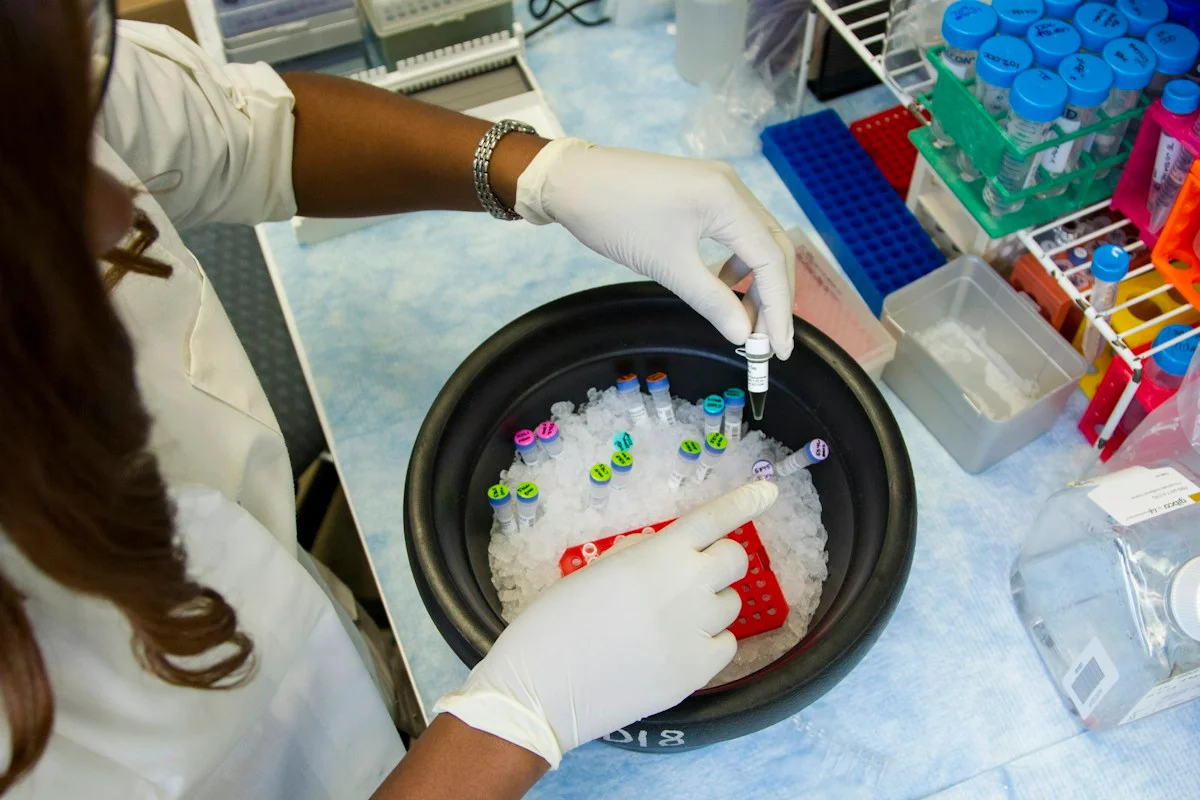
Illustrative photo · not a video frame
The Royal Society · 44 min 28 sec · Background explainer
Is this the AI future we want? | The Royal Society
YouTube loads only when you choose; playback starts when you press play.
A Royal Society discussion with Madhumita Murgia and biomedical engineer Alison Noble on AI’s potential in healthcare, science and culture, recorded at the 30 June 2026 event.
Evidence check: A discussion of opportunities and risks, including future possibilities. It is not evidence that every application described is available or clinically proven.
Published 2026-07-01. Source checked 14 October 2026. Check captions on the publisher’s video page.
Check the healthcare evidencePhoto: Daniel Sone / National Cancer Institute / Unsplash · Licence
Evidence check
Only 13 adult male rats from one supplier and one laboratory were studied.
The cross-treatment test covers serotonergic compounds, not other pharmacological mechanisms.
The study reports classification metrics, not independent-lab reproducibility, staff-time savings or better drug-development decisions.
Reporting basis: Source analysis. Original source date: 20 October 2026.
Continue the story
Read next
Also about drug discovery
Did AI design an antibiotic that worked in mice?
A peer-reviewed model helped select 46 new lipopeptides; 44 inhibited at least one tested pathogen, and one reduced bacteria in two mouse-wound models. It is promising preclinical evidence—not a human treatment.
Read the 5 min reportAlso about drug discovery
Can we trust AI gene-perturbation models yet?
A peer-reviewed benchmark across 14 single-cell datasets and 18 metrics finds that common scores can hide useful gene-perturbation signals. Several deep-learning models beat uninformative baselines after calibration, but the study predicts gene-expression responses—not medicines, safety or patient benefit.
Read the 8 min reportExplore the full source and evidence record
What this means for people
- Preclinical researchers could spend less time hand-scoring long recordings if the result reproduces on their own equipment and compounds.
- Patients should not read the result as a diagnostic advance: the study concerns laboratory rats and drug experiments, not human sleep care.
Global context
Automated staging is already used in preclinical sleep research. This work adds a carefully held-out pharmacological test, but cross-laboratory tools such as SPINDLE have broader cohort evidence in other settings; the new architecture is not yet a universal replacement.
What the evidence does not yet show
- Only 13 adult male rats from one supplier and one laboratory were studied.
- The cross-treatment test covers serotonergic compounds, not other pharmacological mechanisms.
- The study reports classification metrics, not independent-lab reproducibility, staff-time savings or better drug-development decisions.
What to watch next
- Independent replication in another laboratory and recording system
- Performance in female animals and with non-serotonergic compounds
- Release of the complete labelled dataset and prospective workflow studies
Living evidence record
Impact record IAI-0M5I63M
Evidence stage
Studied
Confidence
Supported
Reporting basis
Source analysis
Independent or research support
Present
Record status
Monitoring
Last checked
20 October 2026
Source trail
1 direct source across 1 source type.
People impact
Documented in this record.
Uncertainty
Limits and next checks are explicit.
Stages describe the evidence available—not whether a technology is good or bad. See the public method.
Single-source reporting disclosure
This record analyses one direct source. It can establish what Scientific Reports published or reported, but it is not independent corroboration of every performance claim or predicted outcome. The confidence label will change only when broader evidence is added.
Evidence trail
Sources used for this report
Links checked 20 October 2026
Research question, topics and regions
Whether automated rodent sleep staging generalises to unseen animals and serotonergic drug conditions
Topics: Preclinical research · Sleep · EEG · Drug discovery · Machine learning
Regions: Czech Republic · European Union
This report is labelled source analysis. We summarise and analyse source material in our own words; company statements remain attributed claims until independently supported. Translated summaries preserve the meaning of the original source and link back to it. Read our editorial standards.
The Impact Brief · Free
Keep following the stories that matter to you.
Get our weekday briefing on what changed and why it matters. Choose your topics below.
Reader commentary
What does this mean where you are?
Tell us what you have seen at work, in your community or in everyday life. A question is welcome too. No account is needed; we review notes before publishing them.
Explore commentary across the portal →Published reader notes
0No published reader notes yet. You can start the evidence-led discussion above.
Prefer a private correction or response? Contact the newsroom.