A foot-amputation AI scored 0.83 in another hospital—why isn’t it clinic-ready?
A four-hospital Chinese study predicted 12-month amputation among 1,919 people with diabetes and lower-extremity arterial disease. External validation is useful, but retrospective design, pooled imputation and table inconsistencies block clinical adoption.
The short version
- What happened
- The retrospective study included 1,919 patients at four Chinese hospitals: 967 for training, 414 for internal validation and 538 at another hospital for external validation.
- Who it affects
- People with diabetes and arterial disease need rapid vascular and multidisciplinary foot assessment; a risk score must not delay urgent referral, revascularisation or treatment of infection.
- What remains unproven
- Retrospective records cannot show that model-guided care improves amputation, survival, healing or quality of life.
The model was tested at a geographically separate hospital
Researchers reviewed 1,919 patients with diabetes and lower-extremity arterial disease treated at four hospitals in Sichuan between 2018 and 2024. The outcome was any major or minor amputation within 12 months. Of the full cohort, 269 people—14.0%—had an amputation, 118 died before amputation and 1,532 were censored without either recorded event.[1]
Who it affects
People with diabetes and arterial disease need rapid vascular and multidisciplinary foot assessment; a risk score must not delay urgent referral, revascularisation or treatment of infection.[1]
Keep in mind
Retrospective records cannot show that model-guided care improves amputation, survival, healing or quality of life.
Multiple imputation on the pooled dataset before cohort splitting may leak information across development and validation data.
The cohorts differed at baseline, all came from four Chinese hospitals and 98.1% of participants were recorded as Han.
The published baseline table contains apparent internal count and percentage inconsistencies that should be corrected before independent reuse.
The outcome combined major and minor amputation; performance for clinically different amputation levels was not established in the reported headline metrics.
Source analysis · 1 linked source. Original source date: 20 October 2026.
Keep following the evidence
Join The Impact Brief founding list for selected AI reports, their effect on people and the evidence limits. Read a sample first.
Read the full report · 3 min The evidence, methods, implications and limitations
The model was tested at a geographically separate hospital
Researchers reviewed 1,919 patients with diabetes and lower-extremity arterial disease treated at four hospitals in Sichuan between 2018 and 2024. The outcome was any major or minor amputation within 12 months. Of the full cohort, 269 people—14.0%—had an amputation, 118 died before amputation and 1,532 were censored without either recorded event.
Three hospitals supplied 967 training and 414 internal-validation records; a fourth supplied 538 external-validation records, including 73 amputations. After comparing ten algorithms, the paper selected a gradient-boosting model using 14 variables. Its area under the receiver-operating curve was 0.860 internally and 0.828 externally. A separate Fine–Gray model used the same predictors to account for death before amputation.[1]
Good discrimination is not proof of safer care
The model emphasised Rutherford stage, reported financial burden, age, functional status, wounds, diabetic-foot status, statin use and inflammatory or coagulation markers. Those inputs could help organise risk review, but the study did not compare model-guided care with ordinary multidisciplinary assessment, and it measured no change in revascularisation, healing, amputation, survival or quality of life.
The authors acknowledge that missing values were imputed on the pooled dataset before the train–validation split, creating potential information leakage. Cohorts also differed at baseline, the internal set was relatively small and all participants were Chinese; 98.1% were recorded as Han. The published baseline table contains apparent count and percentage inconsistencies. Prospective external validation, corrected tables, locked code and calibration in other health systems are needed before clinical use.[1]
The distinction that matters
What the study tested
The evidence supports risk-model validation, not a claim that using the calculator improves care.
Development
967 retrospective records
Fit 14-predictor models
Internal check
414 records from the same hospital group
AUC 0.860
External check
538 records from another hospital
AUC 0.828; 73 amputations
Watch the background, then check the evidence
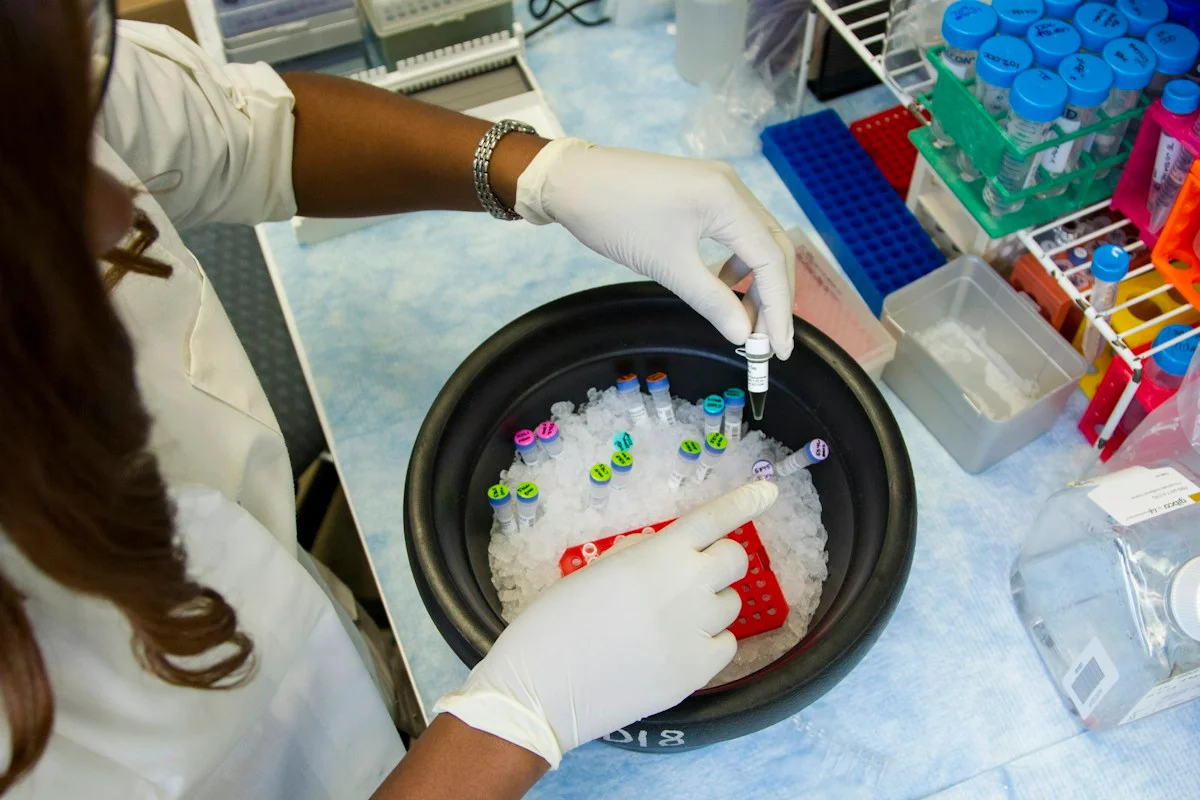
Illustrative photo · not a video frame
The Royal Society · 44 min 28 sec · Background explainer
Is this the AI future we want? | The Royal Society
YouTube loads only when you choose; playback starts when you press play.
A Royal Society discussion with Madhumita Murgia and biomedical engineer Alison Noble on AI’s potential in healthcare, science and culture, recorded at the 30 June 2026 event.
Evidence check: A discussion of opportunities and risks, including future possibilities. It is not evidence that every application described is available or clinically proven.
Published 2026-07-01. Source checked 14 October 2026. Check captions on the publisher’s video page.
Check the healthcare evidencePhoto: Daniel Sone / National Cancer Institute / Unsplash · Licence
Evidence check
Retrospective records cannot show that model-guided care improves amputation, survival, healing or quality of life.
Multiple imputation on the pooled dataset before cohort splitting may leak information across development and validation data.
The cohorts differed at baseline, all came from four Chinese hospitals and 98.1% of participants were recorded as Han.
The published baseline table contains apparent internal count and percentage inconsistencies that should be corrected before independent reuse.
The outcome combined major and minor amputation; performance for clinically different amputation levels was not established in the reported headline metrics.
Reporting basis: Source analysis. Original source date: 20 October 2026.
Continue the story
Read next
Continue exploring clinical prediction: compare the finding and its evidence limits.
A brain-surgery ICU model predicted mortality—but is it ready for another hospital?
A Chinese single-centre study reports strong test discrimination across 7,841 postoperative neurosurgical ICU patients. The model still needs external and prospective validation before it should influence care.
Read the next reportExplore the full source and evidence record
What this means for people
- People with diabetes and arterial disease need rapid vascular and multidisciplinary foot assessment; a risk score must not delay urgent referral, revascularisation or treatment of infection.
- Clinicians could use a validated model to prioritise surveillance, but only after checking calibration, data quality and added value over existing clinical assessment.
Global context
The separate hospital is a meaningful validation step, but transport to NHS diabetic-foot pathways or other regions remains untested. Different referral thresholds, vascular access, coding, treatment and population characteristics can change calibration even when AUC remains similar.
What the evidence does not yet show
- Retrospective records cannot show that model-guided care improves amputation, survival, healing or quality of life.
- Multiple imputation on the pooled dataset before cohort splitting may leak information across development and validation data.
- The cohorts differed at baseline, all came from four Chinese hospitals and 98.1% of participants were recorded as Han.
- The published baseline table contains apparent internal count and percentage inconsistencies that should be corrected before independent reuse.
- The outcome combined major and minor amputation; performance for clinically different amputation levels was not established in the reported headline metrics.
What to watch next
- Prospective validation with locked preprocessing and no cross-cohort imputation
- Calibration, decision-curve analysis and separate major- and minor-amputation performance
- Comparison with multidisciplinary clinical assessment and established vascular risk tools
- A trial measuring referral timing, revascularisation, healing, amputation, survival and patient burden
Living evidence record
Impact record IAI-1XSWB55
Evidence stage
Studied
Confidence
Supported
Reporting basis
Source analysis
Independent or research support
Present
Record status
Monitoring
Last checked
21 October 2026
Source trail
1 direct source across 1 source type.
People impact
Documented in this record.
Uncertainty
Limits and next checks are explicit.
Stages describe the evidence available—not whether a technology is good or bad. See the public method.
Single-source reporting disclosure
This record analyses one direct source. It can establish what Frontiers in Cardiovascular Medicine published or reported, but it is not independent corroboration of every performance claim or predicted outcome. The confidence label will change only when broader evidence is added.
Evidence trail
Sources used for this report
Links checked 21 October 2026
Research question, topics and regions
Prediction of 12-month major or minor amputation in people with diabetes and lower-extremity arterial disease
Topics: Diabetic foot · Amputation · Peripheral arterial disease · Clinical prediction · External validation
Regions: China · Asia
This report is labelled source analysis. We summarise and analyse source material in our own words; company statements remain attributed claims until independently supported. Translated summaries preserve the meaning of the original source and link back to it. Read our editorial standards.
Reader commentary
What does this mean where you are?
Tell us what you have seen at work, in your community or in everyday life. A question is welcome too. No account is needed; we review notes before publishing them.
Explore commentary across the portal →Published reader notes
0No published reader notes yet. You can start the evidence-led discussion above.
Prefer a private correction or response? Contact the newsroom.