A face photo ranked cancer mortality risk—should it guide treatment?
A peer-reviewed model separated higher- and lower-risk patients in two retrospective radiotherapy cohorts, but it has not shown that face-based scores improve clinical decisions or outcomes.
The short version
3 key points
- What changed
- The direct survival model was trained on 34,389 US patient photographs, tested on 3,822 held-out patients and externally validated in 4,892 radiotherapy patients in the Netherlands.
- Why it matters
- Patients should not read a face-based risk score as a diagnosis, life-expectancy estimate or reason to accept or refuse treatment.
- What to watch
- Prospective, consented evaluation against clinician judgement and established frailty tools
The model found a signal in two cancer cohorts
A single facial photograph contained information associated with survival among patients treated in radiotherapy services, according to a peer-reviewed model-development study published on 19 October. The researchers first trained a foundation model on more than 40 million face images. They then built one model to estimate facial age and another—FAHR-FaceSurvival—to rank mortality risk directly.[1][2]
Who it affects
Patients should not read a face-based risk score as a diagnosis, life-expectancy estimate or reason to accept or refuse treatment.[1][2][3]
Keep in mind
All clinical analyses were retrospective and drawn from radiotherapy cohorts rather than a prospective treatment study.
The US test cohort was predominantly White, and transfer to under-represented groups, non-Western settings and non-cancer care remains uncertain.
The study measured discrimination and adjusted associations, not better decisions, fewer complications, improved survival or quality of life.
Residual confounding is possible because facial appearance may encode disease severity, treatment history, lifestyle and socioeconomic factors not fully captured by the adjustment set.
The survival-model weights and patient-level images are not publicly available for unrestricted independent reproduction.
Source analysis · 3 linked sources. Original source date: 19 October 2026.
Read the full report · 4 min The evidence, methods, implications and limitations
The model found a signal in two cancer cohorts
A single facial photograph contained information associated with survival among patients treated in radiotherapy services, according to a peer-reviewed model-development study published on 19 October. The researchers first trained a foundation model on more than 40 million face images. They then built one model to estimate facial age and another—FAHR-FaceSurvival—to rank mortality risk directly.
FAHR-FaceSurvival used 34,389 photographs from a US radiotherapy cohort for training and 3,822 held-out patients for testing. In that test set, its overall concordance index was 0.72, meaning it usually—but far from perfectly—ranked a patient who died sooner above one who survived longer. The highest-risk quartile had more than three times the adjusted mortality hazard of the lowest. The association persisted in a geographically separate cohort of 4,892 patients treated at Maastricht in the Netherlands.[1][2]
Useful risk information is not yet useful care
The study's scale and external cohort make it stronger than a single-centre proof of concept. The facial-age model was also tested on 38,211 US patients. Appearing at least five years older than chronological age was associated with a 21% higher adjusted mortality hazard; appearing at least five years younger was associated with a 17% lower hazard. In the Dutch cohort, both the facial-age deviation and direct survival score retained associations after adjustment for age, sex and cancer site.
Those are prognostic associations, not evidence that a face score improves treatment. Every clinical analysis was retrospective, and all patients came from radiotherapy records. The model was not compared prospectively with clinician judgement, a geriatric assessment, grip strength or a Timed Up and Go test. No study used the score to choose treatment, and no patient outcome, quality-of-life measure, waiting time or inequity measure was improved.[1]
The distinction that matters
What the study established—and what it did not
The evidence moves through three different steps that should not be collapsed into one claim.
Retrospective signal
Analyse stored face photographs and survival records
Mortality-risk ranking in two radiotherapy cohorts
Clinical comparison
Compare with clinicians and established frailty tools
Not prospectively tested
Patient benefit
Use the score in real treatment decisions
No outcome trial reported
Bias, privacy and reproducibility remain live questions
The US test cohort was 87.6% White. Performance varied across demographic and cancer subgroups, and the association for Hispanic patients was not statistically conclusive, with a very wide confidence interval. The authors say common changes in pose, light, expression and makeup did not materially alter facial-age estimates, but cancer-only cohorts from mainly Western centres limit transfer to other diseases, health systems and populations.
The study was funded by the European Research Council, with the funder reported to have no role in the work. Several authors disclosed industry relationships, and Mass General Brigham has filed a provisional US patent covering next-generation facial-health algorithms. Code and the age-model weights are public, but the survival-model weights and patient photographs are not. Before clinical use, independent prospective studies would need consent and privacy safeguards, prespecified comparators, subgroup performance, calibration and evidence that decisions and patient outcomes improve.[1][2][3]
Watch the background, then check the evidence
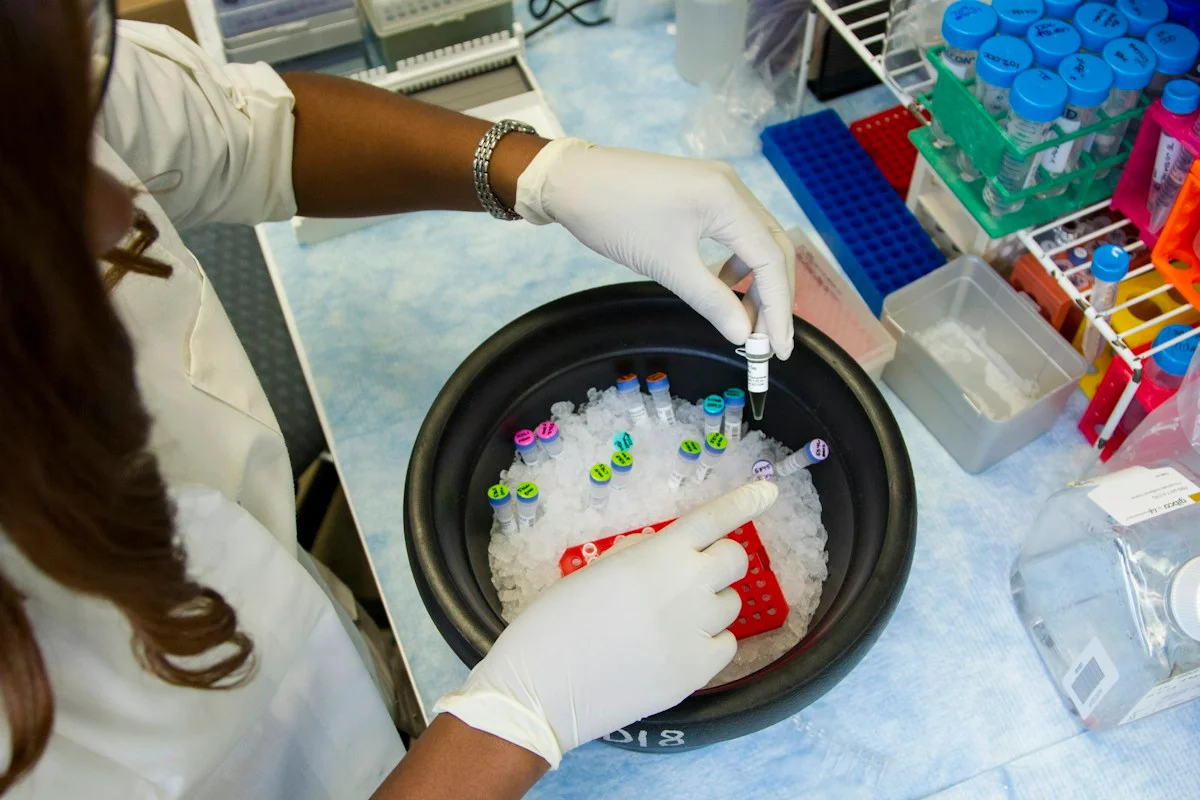
Illustrative photo · not a video frame
The Royal Society · 44 min 28 sec · Background explainer
Is this the AI future we want? | The Royal Society
YouTube loads only when you choose; playback starts when you press play.
A Royal Society discussion with Madhumita Murgia and biomedical engineer Alison Noble on AI’s potential in healthcare, science and culture, recorded at the 30 June 2026 event.
Evidence check: A discussion of opportunities and risks, including future possibilities. It is not evidence that every application described is available or clinically proven.
Published 2026-07-01. Source checked 14 October 2026. Check captions on the publisher’s video page.
Check the healthcare evidencePhoto: Daniel Sone / National Cancer Institute / Unsplash · Licence
Evidence check
All clinical analyses were retrospective and drawn from radiotherapy cohorts rather than a prospective treatment study.
The US test cohort was predominantly White, and transfer to under-represented groups, non-Western settings and non-cancer care remains uncertain.
The study measured discrimination and adjusted associations, not better decisions, fewer complications, improved survival or quality of life.
Residual confounding is possible because facial appearance may encode disease severity, treatment history, lifestyle and socioeconomic factors not fully captured by the adjustment set.
The survival-model weights and patient-level images are not publicly available for unrestricted independent reproduction.
Reporting basis: Source analysis. Original source date: 19 October 2026.
Continue the story
Read next
Also about survival prediction
Can AI predict five-year colorectal cancer survival from pathology slides?
A retrospective preprint reports moderate discrimination across a US trial cohort and an external NHS dataset. The model is not ready to guide treatment, and its selected ensemble did not clearly beat the strongest comparator.
Read the 8 min reportAlso about cancer care
AI scans and liver cancer: a survival signal, not a treatment rule
AI measurements from routine scans were associated with liver-cancer survival. The retrospective study does not establish which treatment a patient should receive.
Read the 3 min reportExplore the full source and evidence record
What this means for people
- Patients should not read a face-based risk score as a diagnosis, life-expectancy estimate or reason to accept or refuse treatment.
- Clinicians need prospective comparison with established frailty and prognostic assessments before using the score in shared decisions.
- Health systems would need explicit biometric-data safeguards, subgroup auditing and a clear route for patients to question or decline facial analysis.
Global context
The study links a large US radiotherapy dataset with external validation from Maastricht in the Netherlands. That geographical separation is useful, but it remains evidence from two Western oncology systems and does not establish performance in primary care, other diseases or regions with different populations and imaging practices.
What the evidence does not yet show
- All clinical analyses were retrospective and drawn from radiotherapy cohorts rather than a prospective treatment study.
- The US test cohort was predominantly White, and transfer to under-represented groups, non-Western settings and non-cancer care remains uncertain.
- The study measured discrimination and adjusted associations, not better decisions, fewer complications, improved survival or quality of life.
- Residual confounding is possible because facial appearance may encode disease severity, treatment history, lifestyle and socioeconomic factors not fully captured by the adjustment set.
- The survival-model weights and patient-level images are not publicly available for unrestricted independent reproduction.
What to watch next
- Prospective, consented evaluation against clinician judgement and established frailty tools
- Calibration and decision-curve analysis in independent health systems and under-represented groups
- Whether use of the score changes treatment decisions, complications, quality of life or survival
- Biometric-data governance, opt-out rights, security and protection against non-clinical reuse
Living evidence record
Impact record IAI-1A0EF0Z
Evidence stage
Studied
Confidence
Corroborated
Reporting basis
Source analysis
Independent or research support
Present
Record status
Monitoring
Last checked
20 October 2026
Source trail
3 direct sources across 3 source types.
People impact
Documented in this record.
Uncertainty
Limits and next checks are explicit.
Stages describe the evidence available—not whether a technology is good or bad. See the public method.
Related-source reporting disclosure
This record analyses 3 linked source records around the same underlying development. The extra records add method, date or context, but they do not by themselves constitute independent replication of every performance claim or predicted outcome.
Evidence trail
Sources used for this report
Links checked 20 October 2026
Research question, topics and regions
Whether AI features extracted from ordinary facial photographs add useful information about survival in patients receiving radiotherapy
Topics: Cancer care · Survival prediction · Facial analysis · Clinical validation · Biometric privacy
Regions: North America · Europe · United States · Netherlands
This report is labelled source analysis. We summarise and analyse source material in our own words; company statements remain attributed claims until independently supported. Translated summaries preserve the meaning of the original source and link back to it. Read our editorial standards.
The Impact Brief · Free
Keep following the stories that matter to you.
Get our weekday briefing on what changed and why it matters. Choose your topics below.
Reader commentary
What does this mean where you are?
Tell us what you have seen at work, in your community or in everyday life. A question is welcome too. No account is needed; we review notes before publishing them.
Explore commentary across the portal →Published reader notes
0No published reader notes yet. You can start the evidence-led discussion above.
Prefer a private correction or response? Contact the newsroom.