Can MRI predict early radiotherapy response before glioma treatment?
GUARD-LGG retained an AUC of 0.882 across seven external institutions and 0.913 in 328 prospectively enrolled patients. That is encouraging validation, not proof that model-guided treatment improves survival.
The short version
- What happened
- GUARD-LGG was trained on 963 patients, tested on 187 patients from seven independent institutions and then tested in 328 prospectively enrolled patients.
- Who it affects
- People with lower-grade glioma face treatment choices with long time horizons and substantial uncertainty. A risk estimate may inform discussion, but it should not replace multidisciplinary review or be presented as a personal guarantee.
- What remains unproven
- No randomised comparison of model-informed treatment with usual care and no evidence of improved survival or quality of life.
The model travelled beyond its development centre
GUARD-LGG combines clinical and pre-treatment imaging features to predict early radiotherapy response in lower-grade glioma. It was trained on 963 patients at a major centre, tested in 187 patients from seven independent institutions and evaluated in 328 patients prospectively enrolled in a registered clinical trial.[1]
Who it affects
People with lower-grade glioma face treatment choices with long time horizons and substantial uncertainty. A risk estimate may inform discussion, but it should not replace multidisciplinary review or be presented as a personal guarantee.[1]
Keep in mind
No randomised comparison of model-informed treatment with usual care and no evidence of improved survival or quality of life.
The accepted early-access record does not expose a clinical decision threshold or a direct usual-care comparator in its public summary.
Performance and calibration still need independent prospective replication across scanners, populations and treatment protocols.
Source analysis · 1 linked source. Original source date: 20 October 2026.
Keep following the evidence
Join The Impact Brief founding list for selected AI reports, their effect on people and the evidence limits. Read a sample first.
Read the full report · 3 min The evidence, methods, implications and limitations
The model travelled beyond its development centre
GUARD-LGG combines clinical and pre-treatment imaging features to predict early radiotherapy response in lower-grade glioma. It was trained on 963 patients at a major centre, tested in 187 patients from seven independent institutions and evaluated in 328 patients prospectively enrolled in a registered clinical trial.
Reported AUCs were 0.946 (95% confidence interval 0.938–0.962) in training, 0.929 (0.894–0.965) in internal validation, 0.882 (0.830–0.934) externally and 0.913 (0.878–0.949) prospectively. Model interpretation highlighted residual tumour, age and MRI texture and contrast features. Predicted unfavourable response was also associated with shorter overall survival, but association does not show that the prediction caused or can prevent that outcome.[1]
Prediction still needs a decision trial
For patients, a credible pre-treatment estimate might support closer monitoring, trial eligibility or a more informed discussion about uncertainty. The important advance is that performance was assessed outside the training centre and in a prospectively enrolled cohort, reducing—but not eliminating—the risk that the model merely memorised one institution's imaging and treatment patterns.
The accessible accepted-paper record does not establish a clinical comparator, a model-guided treatment protocol or improved patient outcomes. It also cannot show whether radiotherapy should be intensified, delayed or replaced for a person labelled unlikely to respond. Before clinical use, investigators need prespecified thresholds, calibration and subgroup errors, independent prospective replication, and a trial comparing model-informed decisions with usual multidisciplinary care.[1]
The distinction that matters
What each validation step answers
Testing in new patients strengthens a prediction claim, but it does not establish treatment benefit.
Training
963 patients
Build the predictor
External
187 patients at seven institutions
Test transportability
Prospective
328 enrolled patients
Test forward in time, not decision impact
Watch the background, then check the evidence
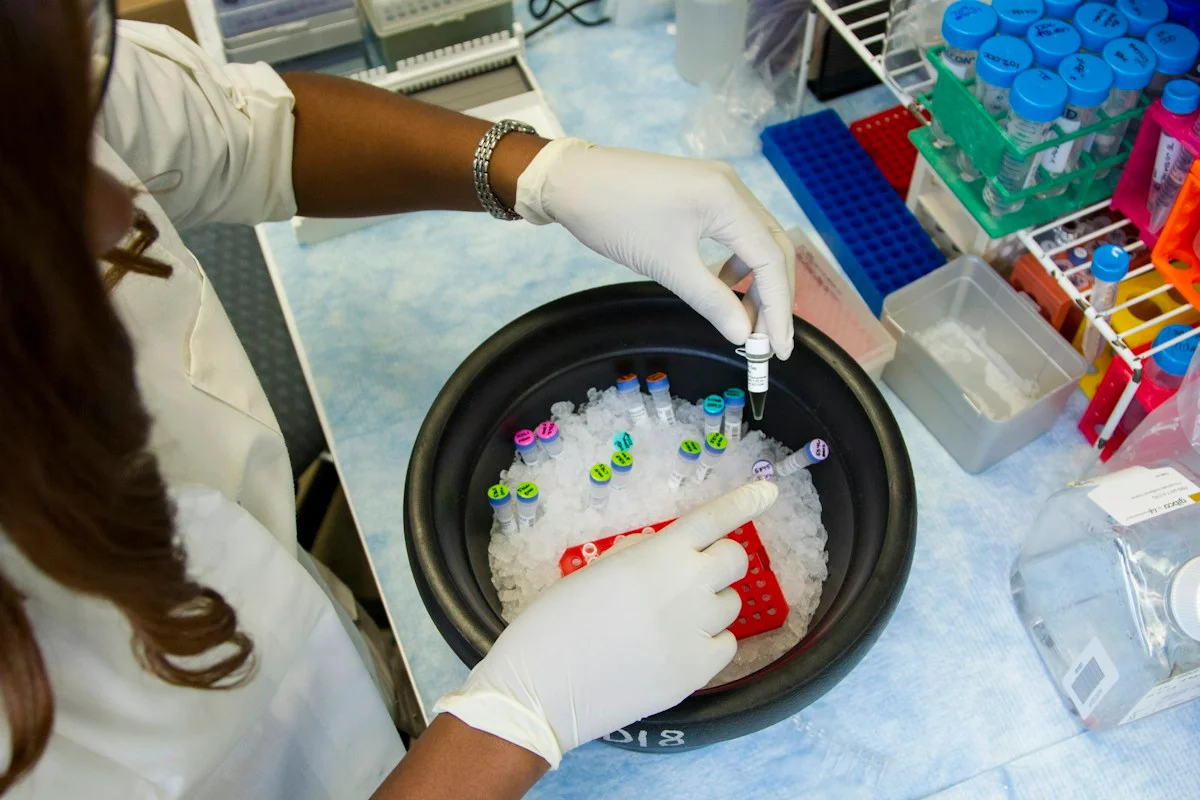
Illustrative photo · not a video frame
The Royal Society · 44 min 28 sec · Background explainer
Is this the AI future we want? | The Royal Society
YouTube loads only when you choose; playback starts when you press play.
A Royal Society discussion with Madhumita Murgia and biomedical engineer Alison Noble on AI’s potential in healthcare, science and culture, recorded at the 30 June 2026 event.
Evidence check: A discussion of opportunities and risks, including future possibilities. It is not evidence that every application described is available or clinically proven.
Published 2026-07-01. Source checked 14 October 2026. Check captions on the publisher’s video page.
Check the healthcare evidencePhoto: Daniel Sone / National Cancer Institute / Unsplash · Licence
Evidence check
No randomised comparison of model-informed treatment with usual care and no evidence of improved survival or quality of life.
The accepted early-access record does not expose a clinical decision threshold or a direct usual-care comparator in its public summary.
Performance and calibration still need independent prospective replication across scanners, populations and treatment protocols.
Reporting basis: Source analysis. Original source date: 20 October 2026.
Continue the story
Read next
Continue exploring clinical prediction: compare the finding and its evidence limits.
A brain-surgery ICU model predicted mortality—but is it ready for another hospital?
A Chinese single-centre study reports strong test discrimination across 7,841 postoperative neurosurgical ICU patients. The model still needs external and prospective validation before it should influence care.
Read the next reportExplore the full source and evidence record
What this means for people
- People with lower-grade glioma face treatment choices with long time horizons and substantial uncertainty. A risk estimate may inform discussion, but it should not replace multidisciplinary review or be presented as a personal guarantee.
- Clinicians need the model's calibration, threshold and false-negative profile before using it to alter radiotherapy, because a mistaken low-response label could redirect effective care.
Global context
Multicentre and prospective testing make GUARD-LGG stronger than a single-centre development study. Translation nevertheless depends on whether the score remains calibrated in other health systems and changes decisions in a way that benefits patients.
What the evidence does not yet show
- No randomised comparison of model-informed treatment with usual care and no evidence of improved survival or quality of life.
- The accepted early-access record does not expose a clinical decision threshold or a direct usual-care comparator in its public summary.
- Performance and calibration still need independent prospective replication across scanners, populations and treatment protocols.
What to watch next
- Independent prospective validation with calibration and subgroup error reporting
- A prespecified decision threshold tied to a clear clinical action
- Randomised evidence on treatment choices, survival, quality of life and avoidable harms
Living evidence record
Impact record IAI-16LGOHN
Evidence stage
Studied
Confidence
Supported
Reporting basis
Source analysis
Independent or research support
Present
Record status
Monitoring
Last checked
20 October 2026
Source trail
1 direct source across 1 source type.
People impact
Documented in this record.
Uncertainty
Limits and next checks are explicit.
Stages describe the evidence available—not whether a technology is good or bad. See the public method.
Single-source reporting disclosure
This record analyses one direct source. It can establish what npj Digital Medicine published or reported, but it is not independent corroboration of every performance claim or predicted outcome. The confidence label will change only when broader evidence is added.
Evidence trail
Sources used for this report
Links checked 20 October 2026
Research question, topics and regions
Whether pre-treatment clinical and MRI features can predict early radiotherapy response in lower-grade glioma
Topics: Glioma · Radiotherapy · MRI · Clinical prediction · Prospective validation
Regions: China · Australia · United States · East Asia
This report is labelled source analysis. We summarise and analyse source material in our own words; company statements remain attributed claims until independently supported. Translated summaries preserve the meaning of the original source and link back to it. Read our editorial standards.
Reader commentary
What does this mean where you are?
Tell us what you have seen at work, in your community or in everyday life. A question is welcome too. No account is needed; we review notes before publishing them.
Explore commentary across the portal →Published reader notes
0No published reader notes yet. You can start the evidence-led discussion above.
Prefer a private correction or response? Contact the newsroom.