Could pathology and RNA improve endometrial-cancer risk estimates? The external test had eight events
A multimodal model outscored a clinicopathological baseline in 63 external patients, but only eight experienced progression events. The retrospective result is promising, not evidence for changing treatment.
The short version
3 key points
- What changed
- PRISM combined digitised tissue slides and RNA-sequencing pathways in 287 TCGA patients, then underwent a locked external test in 63 CPTAC patients.
- Why it matters
- More precise risk estimates could eventually help avoid undertreatment or unnecessary intensive follow-up. This study did not test either benefit, so present decisions should continue to follow validated clinical evidence.
- What to watch
- Larger locked external validations with more progression events
An external test improved credibility—but not certainty
A research model combining digitised pathology slides with RNA sequencing separated progression risk in early-stage endometrioid endometrial cancer, including in an external dataset, a peer-reviewed study reports. The researchers developed PRISM in 287 eligible patients from The Cancer Genome Atlas: 229 for training and 58 for internal validation. After locking the specification, they retrained on all 287 cases and evaluated it once in 63 patients from the separate CPTAC programme, without further tuning.[1]
Who it affects
More precise risk estimates could eventually help avoid undertreatment or unnecessary intensive follow-up. This study did not test either benefit, so present decisions should continue to follow validated clinical evidence.[1]
Keep in mind
The retrospective analysis used selected public cohorts requiring matched slides, RNA, clinical variables and outcome data.
The external cohort contained 63 patients and only eight progression-free-survival events.
The cohorts differed in grade, molecular subtype and radiotherapy use, and endpoints were harmonised from available records.
No prospective workflow, treatment decision, patient outcome, cost or turnaround-time effect was measured.
Source analysis · 1 linked source. Original source date: 19 October 2026.
Read the full report · 4 min The evidence, methods, implications and limitations
An external test improved credibility—but not certainty
A research model combining digitised pathology slides with RNA sequencing separated progression risk in early-stage endometrioid endometrial cancer, including in an external dataset, a peer-reviewed study reports. The researchers developed PRISM in 287 eligible patients from The Cancer Genome Atlas: 229 for training and 58 for internal validation. After locking the specification, they retrained on all 287 cases and evaluated it once in 63 patients from the separate CPTAC programme, without further tuning.
The external concordance index was 0.745. For progression by 36 months, PRISM's time-dependent area under the curve was 0.727, compared with 0.685 for a baseline using clinicopathological features and molecular subtype. Adding PRISM to a clinicopathological model raised a complementary 36-month AUC from 0.609 to 0.719. These are discrimination measures: they describe how well higher scores rank risk, not whether using the score improves a person's outcome.[1]
Eight external events limit the conclusion
The external cohort is the study's most valuable feature and its clearest constraint. Only eight of the 63 CPTAC patients experienced a progression-free-survival event. In the 287-person development cohort, there were 53 events. Small event counts make estimates sensitive to individual cases and leave limited scope to test performance across treatment groups, molecular subtypes or demographic groups. Confidence intervals and calibration matter alongside AUC. The two public cohorts also differed in tumour grade, subtype composition and use of radiotherapy.
PRISM links image regions with RNA-derived pathway programmes, giving researchers a way to inspect associations involving cell-cycle activity, glycolysis, hypoxia and related biology. That interpretability is useful for hypothesis generation, but the highlighted regions are not proof that a pathway caused progression. Requiring both a whole-slide image and matched transcriptomic data may also select an unrepresentative subset and would create cost, tissue and turnaround demands in routine care.[1]
The distinction that matters
How the evidence narrows
The design separates model development from the independent test, while showing why the event denominator matters.
229 patients
Train on slides plus RNA
TCGA development
58 patients
Select and validate internally
Lock model
63 patients
Run once without tuning
CPTAC external test
8 events
Estimate progression discrimination
Promising, uncertain
What patients and tumour boards can take from it
For patients, the study does not change treatment or follow-up recommendations. It did not prospectively enrol people, compare model-guided decisions with usual care or measure recurrence, quality of life or survival after acting on a score. Clinicians should therefore read it as evidence that two data types may contain complementary prognostic information—not as a validated test. The paper did not establish a treatment threshold or show that its categories improve on every current guideline. A useful clinical study would also specify what action follows each risk category and who bears responsibility for uncertain results.
Confidence would rise with larger multi-hospital cohorts, prospectively adjudicated outcomes, locked thresholds and evaluation against current clinical guidelines. Trials should measure calibration, treatment changes, harms and feasibility as well as ranking performance. The authors declared no commercial conflicts; a hospital supported the publication charge. Until those studies are complete, PRISM is a technically credible research direction with a genuine external check, but its eight-event validation cannot support routine adoption.[1]
Watch the background, then check the evidence
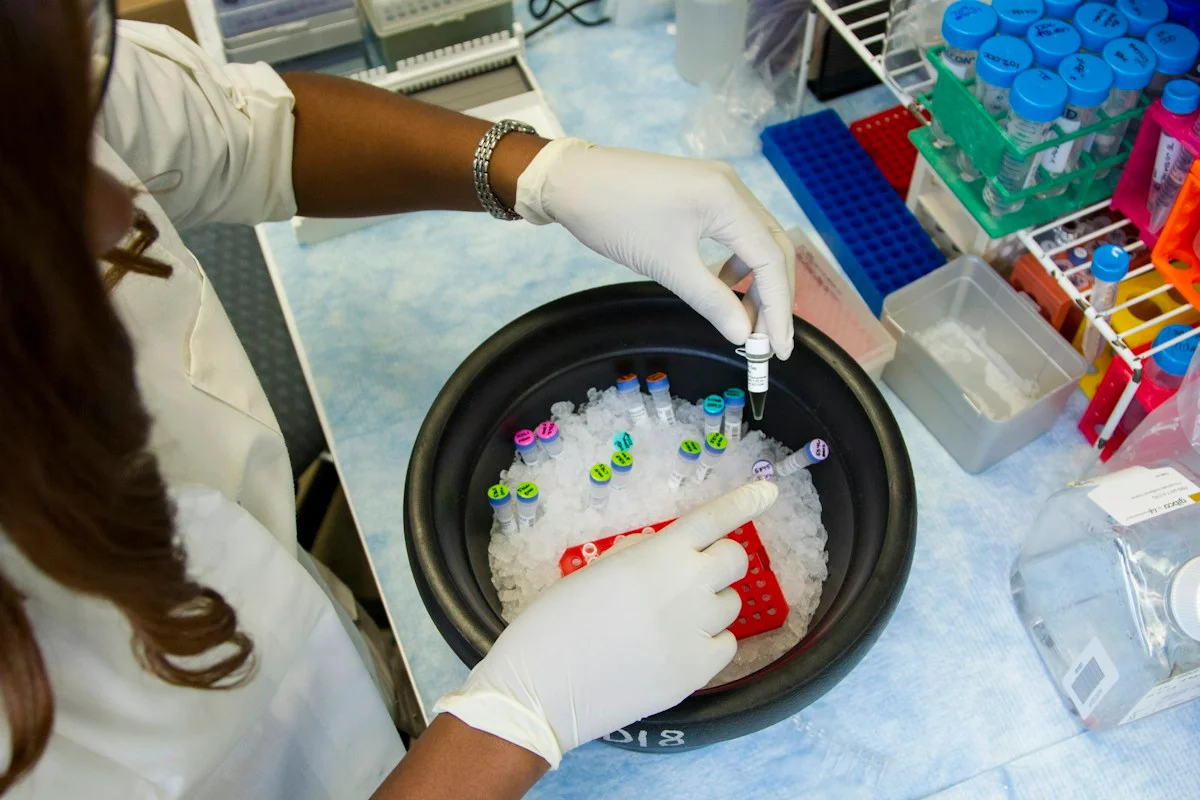
Illustrative photo · not a video frame
The Royal Society · 44 min 28 sec · Background explainer
Is this the AI future we want? | The Royal Society
YouTube loads only when you choose; playback starts when you press play.
A Royal Society discussion with Madhumita Murgia and biomedical engineer Alison Noble on AI’s potential in healthcare, science and culture, recorded at the 30 June 2026 event.
Evidence check: A discussion of opportunities and risks, including future possibilities. It is not evidence that every application described is available or clinically proven.
Published 2026-07-01. Source checked 14 October 2026. Check captions on the publisher’s video page.
Check the healthcare evidencePhoto: Daniel Sone / National Cancer Institute / Unsplash · Licence
Evidence check
The retrospective analysis used selected public cohorts requiring matched slides, RNA, clinical variables and outcome data.
The external cohort contained 63 patients and only eight progression-free-survival events.
The cohorts differed in grade, molecular subtype and radiotherapy use, and endpoints were harmonised from available records.
No prospective workflow, treatment decision, patient outcome, cost or turnaround-time effect was measured.
Reporting basis: Source analysis. Original source date: 19 October 2026.
Continue the story
Read next
Also about external validation
Can prostate-pathology AI generalise to Iraqi patients?
Three research models trained outside Iraq showed strong agreement with pathologists on 339 biopsy slides from 185 patients in Erbil. The result supports local validation, not autonomous diagnosis or immediate clinical deployment.
Read the 7 min reportAlso about external validation
A lung-nodule model travelled better—but its labels were not pathology
A Chinese research team improved discrimination and calibration when moving a CT model from a US dataset to a Portuguese cohort. The test covered 618 external nodules, but remained retrospective and partly relied on radiologist ratings.
Read the 4 min reportExplore the full source and evidence record
What this means for people
- More precise risk estimates could eventually help avoid undertreatment or unnecessary intensive follow-up. This study did not test either benefit, so present decisions should continue to follow validated clinical evidence.
Global context
Both validation datasets were US research programmes, while the investigators were based in China. Hospital scanners, pathology workflows, sequencing access and patient populations vary internationally, so local multi-centre validation is necessary.
What the evidence does not yet show
- The retrospective analysis used selected public cohorts requiring matched slides, RNA, clinical variables and outcome data.
- The external cohort contained 63 patients and only eight progression-free-survival events.
- The cohorts differed in grade, molecular subtype and radiotherapy use, and endpoints were harmonised from available records.
- No prospective workflow, treatment decision, patient outcome, cost or turnaround-time effect was measured.
What to watch next
- Larger locked external validations with more progression events
- Prospective multi-hospital workflow studies
- Calibration and subgroup performance against current guidelines
- Clinical utility, sequencing cost and turnaround time
Living evidence record
Impact record IAI-0J61JY2
Evidence stage
Studied
Confidence
Supported
Reporting basis
Source analysis
Independent or research support
Present
Record status
Monitoring
Last checked
19 October 2026
Source trail
1 direct source across 1 source type.
People impact
Documented in this record.
Uncertainty
Limits and next checks are explicit.
Stages describe the evidence available—not whether a technology is good or bad. See the public method.
Single-source reporting disclosure
This record analyses one direct source. It can establish what Frontiers in Cell and Developmental Biology published or reported, but it is not independent corroboration of every performance claim or predicted outcome. The confidence label will change only when broader evidence is added.
Evidence trail
Sources used for this report
Links checked 19 October 2026
Research question, topics and regions
Whether an interpretable model combining whole-slide pathology and RNA pathway data improves progression-risk discrimination in early-stage endometrioid endometrial carcinoma
Topics: Endometrial cancer · Computational pathology · RNA sequencing · Risk prediction · External validation
Regions: China · United States · Global health
This report is labelled source analysis. We summarise and analyse source material in our own words; company statements remain attributed claims until independently supported. Translated summaries preserve the meaning of the original source and link back to it. Read our editorial standards.
The Impact Brief · Free
Keep following the stories that matter to you.
Get our weekday briefing on what changed and why it matters. Choose your topics below.
Reader commentary
What does this mean where you are?
Tell us what you have seen at work, in your community or in everyday life. A question is welcome too. No account is needed; we review notes before publishing them.
Explore commentary across the portal →Published reader notes
0No published reader notes yet. You can start the evidence-led discussion above.
Prefer a private correction or response? Contact the newsroom.